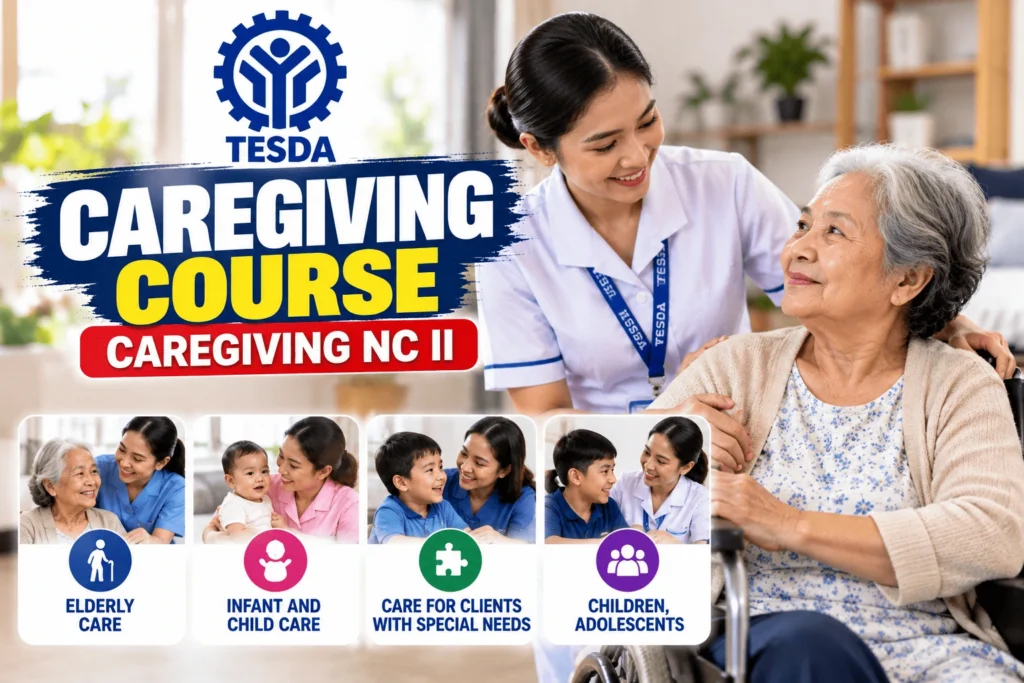
Quick Answer: TESDA Caregiving courses prepare learners to provide care and support for elderly individuals, children, newborns, adolescents, and people with special needs. After completing training and passing the competency assessment, learners may earn a Caregiving NC II certification recognized by TESDA.
Behind every well-run household, senior residence, daycare, and care facility is someone who notices when a person needs help before they ask for it. That person might help an elderly parent bathe and eat safely, keep a toddler fed and secure, or support an adult with special needs in doing everyday tasks with dignity.
Caregiving is one of the most popular TESDA qualifications, partly because it can lead to work in homes, healthcare settings, and community care, and partly because it has long been associated with overseas employment. It is also one of the longer TESDA programs, so it’s worth understanding before you commit.
This guide explains what Caregiving NC II is, the different caregiving qualifications TESDA offers, what you’ll learn, what you need to enroll, how long training takes, how assessment works, and what careers it can lead to in the Philippines and abroad. It also covers the skills a good caregiver needs and how to choose a training center.
Quick Facts
| Item | Details |
|---|---|
| Course | Caregiving |
| Qualification | NC II |
| Industry | Health, wellness, and social services |
| Certification | TESDA National Certificate (after competency assessment) |
| Career Path | Caregiver and related care and support roles |
| Training Type | Technical-vocational, competency-based |
What Is the TESDA Caregiving Course?
The TESDA Caregiving Course trains learners to provide care, support, and assistance to elderly individuals, children, newborns, adolescents, and people with special needs. It is competency-based: you’re trained in the skills, then assessed on whether you can perform them to the required standard.
Course overview
TESDA offers caregiving training under several qualification titles. The general Caregiving NC II covers care for infants and toddlers, children, the elderly, and people with special needs. Other qualifications focus on a particular group, such as elderly clients or clients with special needs. We list them in the next section.
Healthcare support role
Caregiving sits in the support layer of healthcare and social services. Caregivers are not nurses or doctors. They help clients with daily living, monitor and report changes, and help keep the environment safe and clean. They work under the direction of families, employers, or the professionals responsible for the client’s care. Understanding this scope is part of being a safe, reliable caregiver.
Caregiver responsibilities
Depending on the setting and client, a caregiver’s day may include:
- Helping with bathing, grooming, dressing, toileting, and feeding
- Assisting with mobility, transfers, and exercises as instructed
- Preparing meals that suit the client’s needs
- Reminding clients about scheduled medications and following care instructions (within the limits of the caregiver’s role and the care plan)
- Observing and reporting changes in condition
- Keeping the living space clean and safe
- Providing companionship and emotional support
- Responding to emergencies using basic first aid
Demand for caregivers
Demand comes from two directions. At home, families increasingly need help caring for aging relatives, children, and family members with disabilities, and the Philippines has a shortage of healthcare workers more broadly. Abroad, countries with aging populations often look to foreign workers to support elder care. TESDA itself has promoted caregiving among its health-related courses for people who want to work abroad. Demand varies by country, employer, and year, so treat the overseas picture as an opportunity to research carefully, not a guarantee.
What Is Caregiving NC II?
Caregiving NC II = TESDA National Certification for Caregivers.
Caregiving NC II is a TESDA qualification that develops the competencies required for caregiving services in homes, healthcare facilities, and community settings. It represents the standard level of industry skills (NC II) in a caregiving role. Candidates who are assessed as competent may receive a National Certificate.
The general Caregiving NC II covers a broad range of care: infants and toddlers, children, elderly clients, and people with special needs, along with related tasks like home maintenance and meal preparation. That breadth is one reason it has a long training duration.
For a full explanation of how NC levels work, see What Is a TESDA National Certificate (NC)? NC I, NC II, NC III, and NC IV Explained.
Types of TESDA Caregiving Qualifications
TESDA offers more than one caregiving qualification. Which one fits depends on whom you want to care for and where you want to work. Qualification titles and hours can be updated, so confirm what your training center is registered to offer.
Caregiving NC II (general)
This is the traditional, widely offered qualification and the one most people mean when they say “Caregiving NC II.” It covers infants and toddlers, children, elderly clients, and people with special needs.
Caregiving (Elderly) NC II
This qualification focuses on older adults.
- Elderly care. Supporting daily living, comfort, and dignity.
- Aging process. Understanding the physical, mental, and social changes that come with aging.
- Care planning. Following and helping implement plans of care.
- Specialty care procedures. Handling care tasks specific to older clients, within the caregiver’s scope.
It suits people who want to work in senior care, home care for older adults, or elder care facilities.
Caregiving (Clients with Special Needs) NC II
This qualification focuses on clients with disabilities or special needs.
- Care support. Helping implement and monitor care plans.
- Personal assistance. Assisting with personal care and daily activities.
- Specialized caregiving. Understanding conditions, using appropriate terminology, and responding properly to emergencies.
It’s a good fit for people who want to work with children, adults, or elderly clients who have special support needs.
Caregiving (Newborn to Pre-Schooler) NC II
This qualification focuses on early childhood care.
- Infant care. Feeding, bathing, hygiene, and comfort for babies.
- Child development. Understanding early developmental stages and supporting them.
- Health and safety practices. Keeping young children safe and recognizing signs of illness.
It suits those who want to work as nannies, childcare assistants, or in daycare settings.
Caregiving (Grade Schooler to Adolescent) NC II
This qualification focuses on school-age children and teenagers.
- Child care. Everyday care, routines, and supervision.
- Cognitive development. Supporting learning, homework routines, and thinking skills.
- Emotional development. Responding to emotional and social needs.
- Growth support. Supporting healthy habits and age-appropriate independence.
Related healthcare qualifications
If your goal is a broader healthcare support role, also look at Health Care Services NC II, which is a separate qualification. TESDA has promoted both Caregiving NC II and Health Care Services NC II as health-related programs, especially for people aiming to work abroad. Which one fits depends on the roles you’re targeting, so ask your training center and check employer requirements. For a wider view of options, see the TESDA Courses List 2026.
What Will You Learn in the TESDA Caregiving Course?
Like other TESDA qualifications, Caregiving NC II organizes learning into basic, common, and core competencies.
Basic competencies
Workplace skills that apply to any job:
- Participating in workplace communication
- Working in a team environment
- Practicing career professionalism
- Practicing occupational health and safety procedures
Common competencies
Skills shared across caregiving work, such as:
- Infection control
- Working as a first aider
- Providing high-standard, respectful care to clients
Core competencies
The core units are the heart of the qualification and take up most of the training time. For the general Caregiving NC II, they cover:
- Providing care and support to infants and toddlers
- Providing care and support to children
- Providing care and support to the elderly
- Providing care and support to people with special needs
- Maintaining a clean and safe living environment (home maintenance)
- Preparing meals appropriate to clients’ needs
Unit titles vary slightly between qualifications and Training Regulation versions, so ask your center for its current unit list.
Core skills in plain language
- Personal care assistance. Helping with bathing, grooming, dressing, toileting, and feeding while respecting privacy and dignity.
- Health and safety procedures. Preventing falls and infections, handling equipment safely, and following hygiene rules.
- Nutrition support. Planning and preparing simple, suitable meals, and supporting eating and hydration.
- Emergency response. Recognizing emergencies, giving first aid within your training, and getting the right help quickly.
- Communication skills. Listening, speaking respectfully, and communicating with clients who may have hearing, speech, memory, or developmental challenges.
- Care planning. Following care plans, documenting care, and reporting changes to families or supervising professionals.
Practical activities
Good programs have a heavy practical component, such as:
- Assisting daily living activities. Practicing safe transfers, mobility support, bathing, and feeding.
- Monitoring health conditions. Taking and recording basic observations as taught, and noticing signs that something is wrong.
- Maintaining a safe environment. Cleaning, organizing, and removing hazards.
- Supporting physical and emotional needs. Providing companionship, structured activities, and reassurance.
Know the limits of your role
Part of caregiver training is learning what you should not do. Caregivers generally aren’t licensed to diagnose, prescribe, or perform procedures reserved for licensed health professionals. If a client’s condition changes, your job is to observe, support, and report, and to call for emergency help when necessary. Employers and countries differ on what a caregiver may do, especially around medications, so always follow the care plan and the law that applies to your workplace.
TESDA Caregiving Course Requirements
Common requirements
Requirements vary by center, but typically include:
- Valid ID
- Birth certificate (PSA copy is often requested)
- Recent ID photos
- Enrollment form
- Additional training center requirements. These often include a medical certificate or health clearance, proof of education, and barangay or police clearance, depending on the center or scholarship.
Trainee entry requirements
TESDA’s Training Regulations set trainee entry requirements for each qualification. For Caregiving NC II, commonly cited requirements include being physically and mentally fit, being able to communicate verbally and in writing, showing good moral character, and having a general understanding of caring for elderly people, people with special needs, infants, or toddlers, along with a willingness to be trained in handling them.
Because you’ll be working closely with vulnerable people, providers may ask for health and character documents. Ask each center for its complete list before you pay.
Tips on preparing documents
- Make photocopies of everything and keep originals safe.
- Make sure your name is spelled consistently across documents, since mismatches can cause problems later with your certificate and any overseas application.
- If you plan to work abroad, ask about additional documents early, such as a passport, which can take time to process.
See TESDA Requirements: Documents Needed for Enrollment for a full checklist.
How to Enroll in a TESDA Caregiving Course
Step 1: Find a TESDA-accredited training center
Look for a center registered to offer the specific caregiving qualification you want. Public TESDA institutions and private providers both offer caregiving, and some offer blended or online components. See TESDA Accredited Training Centers: How to Find Approved Training Providers.
Step 2: Prepare enrollment requirements
Gather your ID, birth certificate, photos, medical documents, and clearances as required.
Step 3: Submit your application
Fill out the enrollment form and submit your documents. Ask about the schedule, fees, scholarship slots, and whether assessment and practical placement are included.
Step 4: Attend training
Attend regularly and take the practical sessions seriously. Caregiving skills are learned by doing: handling real equipment, practicing safe techniques, and working with mannequins or role-play partners.
Step 5: Complete assessment requirements
After training, you’ll go through a competency assessment with a TESDA-accredited assessor. If you’re found competent, you can receive your National Certificate. Some programs may also require you to complete supervised industry learning before assessment, so ask what applies.
For more detail on the process, read How to Enroll in TESDA Programs: Step-by-Step Guide.
Training Duration
Training hours vary by qualification and training provider, and caregiving is one of the longer TESDA programs.
For the general Caregiving NC II, widely cited sources describe a nominal duration of 786 hours, made up of about 18 hours of basic competencies, 18 hours of common competencies, and 750 hours of core competencies. TESDA has described this as roughly five months of training, while noting that actual duration can be longer depending on the institution. Other qualifications have different hours. Training provider listings report figures such as roughly 549 hours for Grade Schooler to Adolescent, about 561 hours for Elderly, and about 813 hours for Clients with Special Needs. Some providers advertise different totals or schedules, so treat these numbers as a guide and confirm the figure for the exact program you’re considering.
Classroom, practical, and supervised learning
Some Caregiving NC II programs include classroom instruction, practical training, and supervised industry learning. TESDA Training Regulations show programs that combine competency training with supervised learning experiences, such as practical exposure in a care setting. This hands-on component is valuable because it lets you apply skills under supervision before you’re on your own. Ask your center where the supervised learning takes place, how long it lasts, and whether there are extra costs.
Factors that affect your timeline
- Full-time vs. part-time schedules. Full-time can take a few months. Part-time or weekend programs can stretch longer.
- Provider schedules. Some programs only start when enough trainees enroll.
- Practical placement. Waiting for a placement slot can add time.
- Scholarship calendars. Government-funded programs follow fixed schedules.
- Assessment scheduling. Assessment is separate and may not happen right after training.
Note: Nominal hours are TESDA’s published figures for designing the program and do not include the separate competency assessment. Confirm actual hours and schedules with your provider.
TESDA Assessment and Certification
Training and certification are separate steps. Finishing the program does not automatically give you an NC. You earn it by demonstrating competency.
Certification flow
Training
   ↓
Competency Assessment
   ↓
Pass Assessment
   ↓
National Certificate (NC II)
Successful candidates receive a National Certificate after demonstrating competency through assessment.
What to expect
A TESDA-accredited assessor evaluates whether you can perform the units of competency. Caregiving assessments commonly use a mix of:
- Written examination. Testing your knowledge of procedures and concepts.
- Demonstration. Performing tasks, such as assisting with personal care, feeding, or safe transfers.
- Observation. The assessor watches how you work, including how you treat clients and follow safety rules.
- Interview or oral questioning. Explaining your decisions and what you would do in different situations.
You’ll be judged as “competent” or “not yet competent.” If you’re not yet competent, ask for feedback, practice the weak areas, and ask about reassessment procedures and fees.
Tips for assessment day
- Practice each procedure until you can do it calmly and in the right order.
- Always show respect for the client, even if the “client” is a mannequin or role-player. Attitude counts.
- Follow infection control and safety steps every time (hand hygiene, safe positioning, clean workspace).
- Speak clearly and explain what you’re doing as you work.
- If you don’t know something, say so honestly and describe how you’d find out or who you’d report to. Safe practice matters more than bluffing.
After you pass
Keep the original certificate safe, make digital copies, and verify your record in TESDA’s Registry of Certified Workers. For overseas applications, employers and agencies often check certificates, and some ask for authentication. Our TESDA Certificate Verification Guide explains how to verify your certificate, what to do if it can’t be found, how to replace a lost one, and how long NCs stay valid (typically five years).
For more about the meaning of the NC, read What Is a TESDA National Certificate (NC)?
Career Opportunities After Caregiving NC II
Caregiving NC II opens a range of roles in homes, facilities, and community settings.
| Position | Industry |
|---|---|
| Caregiver | Home Care |
| Elderly Caregiver | Senior Care |
| Childcare Assistant | Childcare |
| Healthcare Support Worker | Healthcare |
| Personal Care Assistant | Community Care |
| Residential Care Worker | Assisted Living |
What these roles involve
Caregiver (home care). Provides care in a client’s home, often live-in or scheduled shifts. Duties may include personal care, meals, light housekeeping, companionship, and following the care plan.
Elderly caregiver (senior care). Supports older adults at home, in senior residences, or in care facilities. Often involves mobility support, memory-related challenges, and coordinating with families and health professionals.
Childcare assistant. Supports the care of infants and children in homes, daycares, or schools, including feeding, hygiene, play, routines, and safety.
Healthcare support worker. Assists nursing or clinical staff in hospitals, clinics, or care homes with non-clinical tasks, under supervision.
Personal care assistant (community care). Provides one-on-one support to people with disabilities or chronic conditions in community settings.
Residential care worker (assisted living). Works in group living facilities, helping residents with daily activities and a safe, comfortable environment.
Where caregivers work
- Private homes
- Hospitals and clinics (support roles)
- Nursing homes, assisted living, and senior residences
- Daycare centers and early childhood programs
- Special education and disability support organizations
- Community and home care agencies
Building your caregiving career
- Start with solid experience. Local experience in a home or facility builds confidence and references.
- Add training. Consider first aid, CPR, dementia care, or other short courses that employers value.
- Consider related qualifications. Specializing (elderly, special needs, early childhood) or pursuing Health Care Services NC II can broaden your options.
- Think about further study. Some caregivers use their experience to pursue nursing or other healthcare studies. That requires separate education and licensing.
- Keep your records in order. Certificates, references, and a verified TESDA record all help when you apply.
For a broader comparison with other TESDA options, see Best TESDA Courses for High-Paying Jobs in the Philippines.
Caregiver Jobs Abroad
Caregiving is one of the occupations most associated with Filipino overseas workers. The destinations below are commonly mentioned, but the rules differ a lot from country to country and change over time.
Popular destinations
- Japan. Has had programs for foreign workers in nursing care, usually with Japanese language and skills requirements.
- Canada. Has had caregiver immigration pathways, which have been revised several times. They typically involve language testing, education or credential checks, and employer or program rules.
- Australia. Has aged care and disability care workforce needs, with its own qualification, registration, and visa requirements.
- Middle East. Has long hired Filipino caregivers and household workers, often under contract with agency involvement.
- Europe. Some countries recruit care workers, with national language, qualification, and immigration rules.
International demand
Many countries with aging populations face care worker shortages, which is why recruiters look for caregivers abroad. But demand is not the same as an open door. Quotas, visa rules, and recognition of foreign qualifications vary, and programs can open or close with changes in policy.
Additional employer requirements
Expect requirements beyond the TESDA certificate. Depending on the country and job, you may need:
- Language ability (for example, English tests, or Japanese language and care-skills tests)
- Medical examinations and vaccination records
- Police or background clearances
- Passport and visa documentation
- Evidence of experience or references
- In some countries, additional licenses, registrations, or recognized local qualifications
- A trade or practical test by the employer or agency
Experience considerations
Many overseas employers prefer caregivers with real work experience, and some require a minimum number of years or hours. Local caregiving experience, especially in a facility, can strengthen your application. Fresh graduates may need time to build a record.
Protect yourself
Overseas caregiving jobs attract scammers. Follow these rules:
- Use only licensed recruitment agencies, and verify the agency and job order with the Department of Migrant Workers (DMW).
- Never buy a certificate. A real NC requires training and a competency assessment. A fake can end your application and cause legal trouble.
- Be wary of “guaranteed visa” promises, unusually high salary claims, or large upfront fees.
- Read your contract carefully and keep copies. Understand salary, hours, living arrangements, deductions, and what happens if you leave the job.
- Make sure your TESDA certificate can be verified. See the TESDA Certificate Verification Guide.
A balanced view
Working abroad can improve a family’s finances, but it also involves separation from family, emotional strain, and sometimes difficult working conditions. Research your destination, speak to people who’ve worked there, and make a plan before you commit.
Skills Needed to Become a Successful Caregiver
Technical skills can be taught. Personal qualities make the difference between an adequate caregiver and an excellent one.
Compassion
Clients may be in pain, frightened, lonely, or frustrated. Genuine care shows in how you speak, how you touch, and how you respect their dignity.
Patience
Older clients may move slowly or repeat questions. Children test limits. Clients with special needs may need extra time. Patience prevents frustration and mistakes.
Communication
You’ll talk with clients, families, supervisors, and healthcare professionals. Clear, respectful communication, including listening, helps you understand needs and report accurately.
Observation Skills
Noticing small changes, such as appetite, mood, skin, breathing, or sleep, can alert you to problems early. Good caregivers note and report what they see.
Problem Solving
Care work rarely follows a script. You’ll adapt to different clients, sudden problems, and limited resources, and make safe decisions.
Time Management
Meals, medications, appointments, hygiene, and household tasks all have times. Organizing your day keeps clients safe and comfortable.
Attention to Detail
Correct measurements, clean technique, and careful documentation matter. Small slips can have real consequences.
Physical and emotional stamina
Not on the standard list, but essential. Lifting, standing, and long shifts are physically demanding, and caring for people through illness and decline can be emotionally heavy. Looking after your own health and setting boundaries are part of staying in this field for the long term.
Why Choose the TESDA Caregiving Course?
- ✔ Industry-recognized certification. An NC gives employers and agencies a standard way to understand your skills.
- ✔ Practical healthcare skills. You learn hands-on techniques useful in your own family as well as in work.
- ✔ Local employment opportunities. Home care, senior care, childcare, and facility roles exist in many communities.
- ✔ Overseas career potential. Caregiving is among the occupations most associated with international employment.
- ✔ Foundation for healthcare careers. The experience can lead to further healthcare training.
Honest challenges
- It’s a longer course. Compared with many NC II programs, the hours are substantial, so plan your time and budget.
- The work is demanding. Physical effort, long hours, and emotionally tough situations are part of the job.
- Local pay can be modest. Many learners are drawn to caregiving because of overseas opportunities, but those have their own requirements, costs, and risks.
- Overseas rules change. What worked for someone five years ago may not apply today.
If you’re drawn to caring for people and you’re prepared for the demands, it can be rewarding. Some people prefer a different path. For comparison, see our guides on the TESDA Welding Course and the TESDA Bookkeeping Course.
How to Choose a TESDA Caregiving Training Center
Because caregiving training is long and practical, the quality of your center matters a great deal.
- ✔ TESDA Accredited. Confirm the center’s accreditation or registration.
- ✔ Registered Caregiving Program. Make sure the exact caregiving qualification you want is registered, not just the school in general.
- ✔ Qualified Trainers. Ask about trainers’ credentials and healthcare or care-work experience.
- ✔ Practical Training Facilities. Look for a skills lab with beds, mannequins, mobility aids, and enough equipment for hands-on practice.
- ✔ Assessment Support. Ask whether the center is an assessment center or helps you schedule assessment.
Questions to ask before paying
- Is this exact program registered with TESDA, and under which qualification title?
- How many hours is the program, and what’s the weekly schedule?
- Does it include supervised industry learning, where, and for how long?
- What are the total fees, and what do they include (uniforms, materials, medical exams, assessment)?
- Is the assessment fee included?
- How many trainees share each practice station?
- Can I speak with past graduates, and where are they working?
- Do you offer scholarship slots?
Red flags
- Promises of “guaranteed NC” or “guaranteed overseas job”
- No visible TESDA registration for the program
- Very large class sizes with few practice materials
- Vague fees or pressure to pay large amounts without receipts
- Claims that the center can place you abroad without being a licensed recruitment agency
See TESDA Accredited Training Centers: How to Find Approved Training Providers for more tips.
Scholarships and Costs
Costs for caregiving programs vary widely because of the long hours and practical requirements. Some centers include uniforms, supplies, and assessment fees in their rates, while others charge them separately.
Caregiving is among the TESDA qualifications that scholarship programs have commonly covered, though slots and eligibility depend on the program, region, and funding. Ask your nearest TESDA office or accredited center, and read the TESDA Scholarships Guide: How to Apply for Free Training Programs.
TESDA also offers online learning for some caregiving topics. Online lessons can help you understand the theory, but caregiving relies on supervised hands-on practice and a competency assessment, so online study may not replace accredited training. See Free TESDA Online Courses with Certificates for what’s available.
Frequently Asked Questions
What is Caregiving NC II?
It’s a TESDA qualification that certifies competence in providing care and support to clients such as infants, children, the elderly, and people with special needs. You earn the National Certificate by completing training and passing a competency assessment. TESDA also offers qualifications focused on particular groups, such as Caregiving (Elderly) NC II.
How long is the TESDA Caregiving Course?
The general Caregiving NC II is widely reported at 786 nominal hours, which TESDA has described as roughly five months, though actual time depends on the provider and schedule. Other caregiving qualifications have different hours. Confirm the figure with your center.
Can I work abroad after certification?
Many Filipino caregivers work abroad, and a TESDA certificate can support your application. However, certification alone doesn’t guarantee a job. Employers and countries have their own requirements, such as language ability, experience, medical exams, and visas. Use licensed recruitment agencies and verify offers with the DMW.
Is caregiving a good career?
It can be, if you enjoy helping people and can handle the demands. Demand is strong in many places, and the work can be meaningful. It can also be physically and emotionally tiring, and pay varies widely by location and employer. Think about your goals, family situation, and resilience before deciding.
Do I need healthcare experience?
Usually no. TESDA training starts from the fundamentals, though entry requirements depend on the qualification and provider. A general understanding of caring for people and willingness to learn are commonly expected, along with being physically and mentally fit. Prior experience can help in job applications.
What jobs can I get after NC II?
Common roles include caregiver, elderly caregiver, childcare assistant, healthcare support worker, personal care assistant, and residential care worker. The right fit depends on your qualification, experience, and where you live or plan to work.
Are scholarships available?
Yes, scholarships have been available for caregiving, depending on the program, region, and funding. Eligibility and slots vary. Read the TESDA Scholarships Guide and check with your local TESDA office.
How do I verify my certificate?
Use TESDA’s Registry of Certified Workers, choose the registry that matches your certificate’s issuance year, and search by name or certificate number. Our TESDA Certificate Verification Guide explains each step and what to do if your record can’t be found.
Related TESDA Guides
- TESDA Courses List 2026: Complete Guide to Training Programs and Certifications
- Best TESDA Courses for High-Paying Jobs in the Philippines
- TESDA Welding Course: Complete Guide to SMAW NC II Certification
- TESDA Bookkeeping Course: Complete Guide to Bookkeeping NC III Certification
- TESDA Scholarships Guide: How to Apply for Free Training Programs
- How to Enroll in TESDA Programs: Step-by-Step Guide
- TESDA Requirements: Documents Needed for Enrollment
- TESDA Accredited Training Centers: How to Find Approved Training Providers
- TESDA Certificate Verification Guide: How to Check TESDA Certificates Online
- What Is a TESDA National Certificate (NC)? NC I, NC II, NC III, and NC IV Explained
- Free TESDA Online Courses with Certificates
Final Thoughts
Caregiving NC II is one of TESDA’s most recognized healthcare-related qualifications, and it asks a lot of the people who take it: time, practice, patience, and heart.
- It’s one of TESDA’s most recognized healthcare-related qualifications. Employers, agencies, and families understand what it represents.
- The course develops practical caregiving and support skills. You learn to help people safely and with dignity.
- Certification can help you pursue careers in home care, elderly care, childcare, and healthcare support. Different qualifications let you focus on the clients you want to serve.
- It may also support overseas employment and career growth in the healthcare sector. Remember that overseas jobs involve extra requirements, and rules change.
Your next steps: review the TESDA Courses List, check scholarship options, prepare your enrollment requirements, and choose an accredited training center. After certification, verify your record and keep building your skills and experience.
Training hours, requirements, fees, and qualification titles can change when TESDA updates its Training Regulations. Overseas employment rules also change often. Always confirm current information with TESDA, your accredited training center, the DMW, and the destination country’s official sources before making decisions or paying any fees.