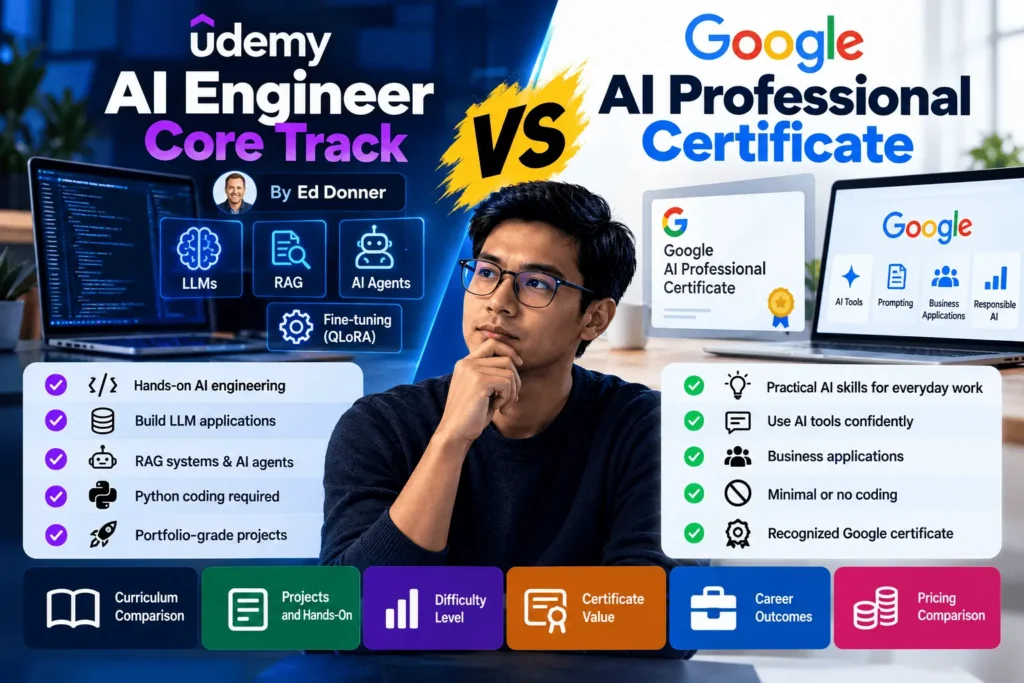
Direct answer: Both programs teach AI-related skills, but they target different learners. The AI Engineer Core Track focuses on hands-on AI engineering: coding, RAG systems, AI agents, and LLM development. The Google AI Professional Certificate emphasizes broader AI knowledge, everyday business applications, and a recognized credential. If you write code and want to build AI systems, choose the AI Engineer Core Track. If you’re a non-technical professional who wants to use AI tools confidently at work, choose the Google AI Professional Certificate.
The “Udemy or Google?” question comes up constantly, and it’s a fair one to ask before spending money. On the surface both sit in the same search results under “AI course,” but they aren’t really competing for the same student. One teaches you to build with AI. The other teaches you to work with AI. This comparison breaks down the curriculum, projects, difficulty, certificate value, career outcomes, and pricing side by side, so you can pick the one that matches where you actually are right now.
AI Engineer Core Track at a glance:
| Item | Details |
|---|---|
| Platform | Udemy |
| Instructor | Ed Donner |
| Rating | 4.7/5 |
| Students | 171,000+ |
| Duration | 8 Weeks |
| Certificate | Yes |
| Skill Level | Intermediate |
Quick Comparison Table
| Feature | AI Engineer Core Track | Google AI Professional Certificate |
|---|---|---|
| Platform | Udemy | Coursera (also on Google Skills and Udemy) |
| Instructor | Ed Donner | |
| Coding Required | Yes (Python) | Minimal to none |
| Duration | About 8 weeks | About 8 hours of core content |
| Projects | Extensive, portfolio-grade builds | Moderate, 20+ guided activities |
| AI Agents | Yes, built from scratch | Limited |
| RAG | Yes, full pipeline | Limited (used as a tool, not built) |
| Certificate | Udemy certificate of completion | Google certificate plus Credly badge |
| Difficulty | Intermediate | Beginner |
| Pricing Model | One-time Udemy purchase (frequent sales) | Monthly subscription ($49/month in the US and Canada) |
| Best For | Developers and technical learners | General professionals and non-coders |
The one-line summary: the Core Track produces AI engineers; the Google certificate produces AI-fluent professionals. Everything else in this article is detail that supports that distinction.
Want the full breakdown of either program? Read our AI Engineer Core Track Review or our Google AI Professional Certificate Review.
Overview of AI Engineer Core Track
Course Goals
The AI Engineer Core Track, taught by Ed Donner on Udemy, is built to turn developers into LLM engineers over an eight-week arc. The goal isn’t awareness of AI; it’s the ability to design, build, and ship AI-powered applications. The course has drawn more than 170,000 students with a 4.7-star average across more than 22,000 ratings, which makes it one of the most widely taken technical AI courses on the platform.
Skills Learned
- Prompt engineering and structured LLM interaction
- Retrieval-Augmented Generation (RAG): chunking, embeddings, vector databases, and retrieval logic
- AI agent design: tool use, function calling, and multi-step workflows
- Fine-tuning with QLoRA, a parameter-efficient method for customizing models
- LangChain and general LLM application development
- Python-based AI development across more than 20 models, both frontier and open-source
Target Audience
Developers, Python programmers, data analysts with some coding background, machine learning enthusiasts, IT professionals, and career changers who already have a technical foundation. It is not built for someone who has never written a line of code.
Overview of Google AI Professional Certificate
Course Goals
The Google AI Professional Certificate launched in February 2026 and is designed to take someone from “I know what Gemini and ChatGPT are” to “I can apply generative AI across my daily work.” Rather than teaching how models are built, it teaches how to direct them: writing structured prompts, evaluating outputs for accuracy and bias, and chaining AI-assisted tasks into faster workflows. Google built it around job-market demand and employer input, and it has drawn well over a million learners on Coursera with a rating around 4.8 out of 5.
Skills Learned
- Structured prompting using a repeatable framework
- Responsible and critical AI use, including checking output for errors and bias
- Applying AI to six work areas: brainstorming and planning, research, writing and communication, content creation, data analysis, and app building
- “Vibe coding,” meaning building a simple working app by describing it in plain language
- Workflow chaining across multiple AI-assisted tasks
Target Audience
Non-technical professionals, students, teachers, freelancers, small business owners, and career changers who want practical AI fluency without learning to code. No prior AI or programming experience is required.
Curriculum Comparison
AI Engineer Core Track
The Core Track moves through a deliberate technical progression:
- LLMs: how large language models work, their failure modes, and how to choose between frontier models and open-source alternatives
- RAG: architecting a system that connects a model to your own data so answers are grounded rather than invented
- Agents: designing systems that plan, call tools, and complete multi-step tasks with limited supervision
- QLoRA: fine-tuning an existing model efficiently instead of training from scratch
- Production concepts: an introduction to moving a prototype toward a real deployment
Each stage is taught by building. You don’t just hear about RAG; you build a knowledge-worker application that answers questions from real documents.
Google AI Professional Certificate
The Google certificate is organized around workplace tasks rather than technical concepts:
- AI concepts: the foundations of generative AI, covered in the first course
- Responsible AI: evaluating output for accuracy and bias, and understanding where the technology creates risk
- Prompting: a structured framework for getting reliable, relevant output
- Business use cases: planning, research, writing, content creation, and data analysis applied to realistic work scenarios
It works primarily inside Gemini, NotebookLM, Gemini in Google Workspace, and Google AI Studio, though Google states that other browser-based AI tools can be used to complete the labs.
The core difference in one sentence: the Core Track asks “how is this system built?” and the Google certificate asks “how do I get more done with this system?” Neither question is better; they belong to different jobs.
Projects and Hands-On Learning
Both programs are practical rather than lecture-heavy, but the kind of practice is very different.
AI Engineer Core Track: you build working software. Examples include a brochure generator that navigates and summarizes a company website, a multi-modal airline support agent with function calling, a meeting-minutes tool that mixes open- and closed-source models, a Python-to-C++ code converter, and a RAG-powered knowledge worker over company documents. These are real applications with code you can push to GitHub and demonstrate in an interview.
Google AI Professional Certificate: you produce work artifacts. Across more than 20 hands-on activities you create things like a workback plan from a vague brief, a source-grounded research report, a meeting summary with action items, audience-specific versions of one message, a cleaned dataset with a visualization, and a small web app built through natural-language instructions.
Which offers more practical projects? In sheer technical depth and portfolio value for engineering roles, the Core Track wins clearly. In immediate, transferable usefulness for everyday office work, the Google certificate’s activities are arguably more directly applicable. A software developer will get little from planning-and-communication exercises; a marketing manager will get little from a Python-to-C++ converter. Match the project type to the job you actually have or want.
Difficulty Level
Who will find each course easier?
The Google AI Professional Certificate is deliberately beginner-friendly. There are no prerequisites, no coding, and each course is short, often about an hour. Most learners can finish the whole certificate in a weekend or a few weeks of casual evenings.
The AI Engineer Core Track is intermediate. It assumes you can already read and write Python and are comfortable working in a code editor. The pace is quick once you move past the foundations, and the eight-week structure rewards consistent, hands-on practice. Learners without programming experience commonly struggle because they end up learning Python and AI concepts at the same time.
| Learner Profile | Easier Option |
|---|---|
| No coding background | Google AI Professional Certificate |
| Comfortable with Python | AI Engineer Core Track (manageable) or Google (very easy) |
| Non-technical, wants quick results | Google AI Professional Certificate |
| Developer wanting depth | AI Engineer Core Track |
“Easier” doesn’t mean “better.” A developer breezing through the Google certificate will have completed something very easy that adds little new capability. Difficulty should match your starting point, not be minimized.
Certificate Value
Employer Recognition
The Google certificate carries a recognized brand. Google’s Career Certificates have built employer familiarity over several years, and this program was developed with input from a coalition of large employers. For general hiring signals like “this candidate takes AI literacy seriously,” the Google name does real work.
The Udemy certificate from the Core Track is a certificate of completion. It shows you finished the program, but it isn’t a formal industry credential, and most employers won’t recognize it by name. What they will recognize is a portfolio of working AI applications.
Resume Value
Listing the Google AI Professional Certificate under Certifications adds a credible, easily understood line, especially for non-technical roles where AI fluency is becoming a baseline expectation. Listing the Core Track is worth doing mainly as context for the projects underneath it. On a technical resume, “built a RAG application with agent tooling” outweighs any certificate title.
LinkedIn Value
The Google certificate comes with a verifiable Credly badge that adds to LinkedIn’s Licenses & Certifications section with one-click verification. The Core Track’s Udemy certificate can also be added, and pairing it with a short write-up or GitHub link of a project you built tends to drive more recruiter interest than the certificate alone.
The honest takeaway: for credential recognition, Google wins. For proof of technical ability, the Core Track’s projects win. Neither certificate by itself gets you hired. Employers hire on skills, portfolio, and demonstrated problem-solving.
👉 See the AI Engineer Core Track on Udemy
Career Outcomes
AI Engineer Core Track
The skills map directly to technical roles:
- AI Engineer: building and deploying AI-powered applications and pipelines
- LLM Engineer: RAG systems, prompt optimization, and fine-tuning
- AI Application Developer: the product layer on top of AI capabilities
- Also: Automation Specialist and AI Consultant, including freelance work building chatbots, RAG systems, and automation workflows
The course alone won’t guarantee a job, but the portfolio it produces is exactly what hiring managers ask about. For a deeper look, see our AI Engineer Core Track Jobs guide.
Google AI Professional Certificate
The certificate’s value lies in strengthening non-engineering profiles rather than opening engineering doors. It supports roles and career moves such as:
- AI-fluent professionals in existing roles: marketing, operations, communications, project management, customer success, and business analysis, where employers increasingly expect AI skills as a baseline
- AI Specialist or AI Coordinator-style roles: business-side positions focused on adopting and applying AI tools across a team
- Business AI roles: helping teams use AI for research, content, reporting, and workflow improvements
To be clear, these titles vary widely between companies and aren’t guaranteed outcomes. Google does not promise a salary or job title after completion, and it’s not designed to prepare you for AI or machine learning engineering. Its strength is making a good candidate more credible, not replacing experience. See our Google AI Professional Certificate Jobs guide for more detail.
Which helps you become an AI Engineer? The AI Engineer Core Track, without question. The Google certificate teaches you to use AI tools, not to build AI systems.
Pricing Comparison
The two programs use completely different pricing models, and that matters more than the sticker numbers.
Udemy Sales Pricing (AI Engineer Core Track)
Udemy courses are typically bought once and owned for life. List prices are rarely what people pay, because Udemy runs frequent, deep promotional sales. Check the current price on the course page before buying instead of assuming the listed price is final. With a one-time purchase you get lifetime access, mobile access, and future course updates.
Coursera Subscription Model (Google AI Professional Certificate)
In the United States and Canada, the certificate is $49 per month through Coursera, with pricing that may vary in other countries. Because the core content is only about 8 hours, many learners finish within one billing cycle, making the effective cost a single $49 payment. Slower learners pay for extra months. Coursera Plus subscribers get it included. Extras include a 3-month trial of Google AI Pro for eligible learners, financial aid options on Coursera (which forfeit the AI Pro trial), and a free small-business access program in the US.
Which Costs More?
Neither is expensive. The Google certificate is cheap and short, so total spending is low and predictable if you move quickly. The Core Track is a bigger time commitment, but a discounted one-time Udemy purchase gives you far more hands-on hours per dollar. Since both prices change regularly, verify current pricing on each platform before you decide.
Which Course Is Better for Beginners?
For true beginners, meaning people new to both AI and programming, the Google AI Professional Certificate is the better starting point. It assumes nothing, moves in short units, and gives you immediate, usable skills in tools you can start applying tomorrow.
The Core Track can be a good second step for a beginner who then decides to learn Python and go technical, but starting there with no coding experience usually leads to frustration and stalled progress. If you’re a beginner who does have basic Python, the Core Track becomes viable, since the AI concepts themselves are explained clearly.
Which Course Is Better for Developers?
For developers, the AI Engineer Core Track is the clear choice. You already have the prerequisite skill, so nearly all your time goes to the material that’s actually new: RAG, agents, fine-tuning, and production concepts. The Google certificate would cover ground you’ve likely already covered informally and won’t add engineering capability.
The one scenario where a developer might still glance at the Google certificate is if they work alongside non-technical teammates and want to understand how those teammates use AI day to day. That’s a nice-to-have, not a career move.
Which Course Is Better for Career Changers?
This depends on the direction of the change.
Moving into a technical AI role (AI Engineer, LLM Engineer): the Core Track is the right vehicle, provided you have or are willing to build Python fundamentals first. The Google certificate won’t get you there on its own.
Moving into a business-side role where AI fluency is an asset (operations, marketing, project management, analytics): the Google certificate is the more efficient and better-matched choice. It’s fast, recognized, and directly applicable to those functions.
Not sure yet: start with the Google certificate. It’s inexpensive, quick, and will show you whether AI work appeals to you before you commit eight weeks to a technical program.
Atlas Decision Matrix™
If you prefer a quick scorecard, here’s how the two programs compare across the factors that usually decide the choice. Ratings are qualitative judgments based on the course structures described above, not measured data.
| Factor | AI Engineer Core Track | Google AI Professional Certificate |
|---|---|---|
| Technical Depth | Excellent | Low |
| Beginner Friendliness | Moderate | Excellent |
| Portfolio Value (technical) | Excellent | Limited |
| Time to Complete | Long (about 8 weeks) | Very short (about a weekend to a few weeks) |
| Credential Recognition | Moderate (project-driven) | Strong (Google brand plus Credly badge) |
| Coding Required | Yes | No |
| Everyday Workplace Usefulness | Moderate | Excellent |
| Path to AI Engineering Roles | Direct | Indirect |
| Cost Predictability | Variable (Udemy sales) | Predictable (monthly subscription) |
Read the table by column rather than counting wins. If your priorities are the left-hand strengths, technical depth, portfolio, and a direct route to engineering roles, the Core Track fits. If your priorities are beginner friendliness, recognition, speed, and everyday usefulness, the Google certificate fits.
Can You Take Both? A Practical Learning Path
Because the two programs teach different layers of the same field, they stack well. A sensible sequence for a learner starting from zero looks like this:
Beginner → Google AI Professional Certificate → Python basics → AI Engineer Core Track → Portfolio → AI role
Here’s why that order works:
- Start with the Google certificate. It takes a weekend to a few weeks, costs little, and gives you working fluency with prompting, research, and evaluating AI output. You also find out quickly whether AI work interests you.
- Build Python fundamentals. This is the gate between the two programs. Give yourself real time here, because it’s the step most people skip and then regret.
- Take the AI Engineer Core Track. With Python in hand, the eight weeks become productive instead of overwhelming, and your earlier prompting experience makes the LLM material easier to absorb.
- Turn the projects into a portfolio. Publish them, write short case studies, and share them on LinkedIn.
Learners who already code can skip straight to step 3. Non-technical professionals who don’t want an engineering career can stop after step 1 and still come out well ahead.
Common Mistakes When Choosing Between the Two
Choosing by brand instead of goal. The Google name is reassuring, but a well-known credential that doesn’t teach what you need is still the wrong purchase. Start from the role you want.
Assuming a certificate equals a job. Neither program guarantees employment. Both work best as part of a bigger picture: real skills, visible work, and consistent effort in the job search.
Underestimating the Python gate. The most common Core Track frustration comes from starting without programming basics. If that’s you, the Google certificate or a Python course should come first.
Overestimating the Google certificate for technical roles. It teaches you to use AI tools, not to build them. It’s excellent at that, but it won’t stand in for engineering skills on a developer resume.
Ignoring your current job. If your day-to-day work is spreadsheets, reports, and communication, immediate productivity gains from the Google certificate may outweigh a technical course you’d never apply.
AI Engineer Core Track: Pros and Cons
Pros
- Portfolio-ready projects you can show to employers or clients
- Covers RAG and AI agents, two of the most in-demand LLM skills
- Updated regularly to keep pace with the field
- Practical, build-first approach instead of passive lectures
Cons
- Requires Python knowledge before you start
- Fast pace once you pass the foundations
- Not ideal for complete beginners
Final Verdict
Choose AI Engineer Core Track If:
- You want technical AI engineering skills
- You enjoy coding and already know basic Python
- You want portfolio projects you can show employers or clients
- You’re aiming for AI Engineer, LLM Engineer, AI Application Developer, or freelance AI development work
Choose Google AI Professional Certificate If:
- You’re new to AI and want a structured learning path
- You’re a non-technical professional who wants to use AI at work
- You prefer a recognized Google credential with a verifiable badge
- You want fast results at a low, predictable cost
The Bottom Line
There’s no universal winner, because these courses answer different questions. The AI Engineer Core Track is the stronger option for anyone building a technical AI career, and the Google AI Professional Certificate is the stronger option for anyone applying AI in a non-technical one. Choosing the wrong one isn’t a disaster, but it’s a waste of time: a beginner will stall in the Core Track, and a developer will be bored by the Google certificate.
Decide based on what you want to do after finishing, not on which brand or platform sounds more impressive.
👉 Check the latest price for the AI Engineer Core Track on Udemy
Frequently Asked Questions
Is AI Engineer Core Track better than Google AI Professional Certificate? Neither is universally better. The Core Track is better for building AI systems and preparing for engineering roles. The Google certificate is better for non-technical professionals who want practical AI fluency and a recognized credential.
Which certificate is more recognized? The Google AI Professional Certificate has stronger brand recognition and comes with a verifiable Credly badge. The Core Track’s Udemy certificate is a completion certificate, so its value comes mainly from the projects you build rather than the certificate itself.
Which course helps you become an AI Engineer? The AI Engineer Core Track. It teaches RAG, agents, and fine-tuning through real projects. The Google certificate teaches how to use AI tools and doesn’t prepare you for AI or machine learning engineering.
Which course is better for beginners? The Google AI Professional Certificate. It requires no coding or prior AI experience. The Core Track assumes you already know basic Python.
Can I take both? Yes, and many learners reasonably do. A common path is the Google certificate first for AI fundamentals and workplace fluency, then the Core Track to go technical once you’ve built Python skills. They complement each other more than they overlap.