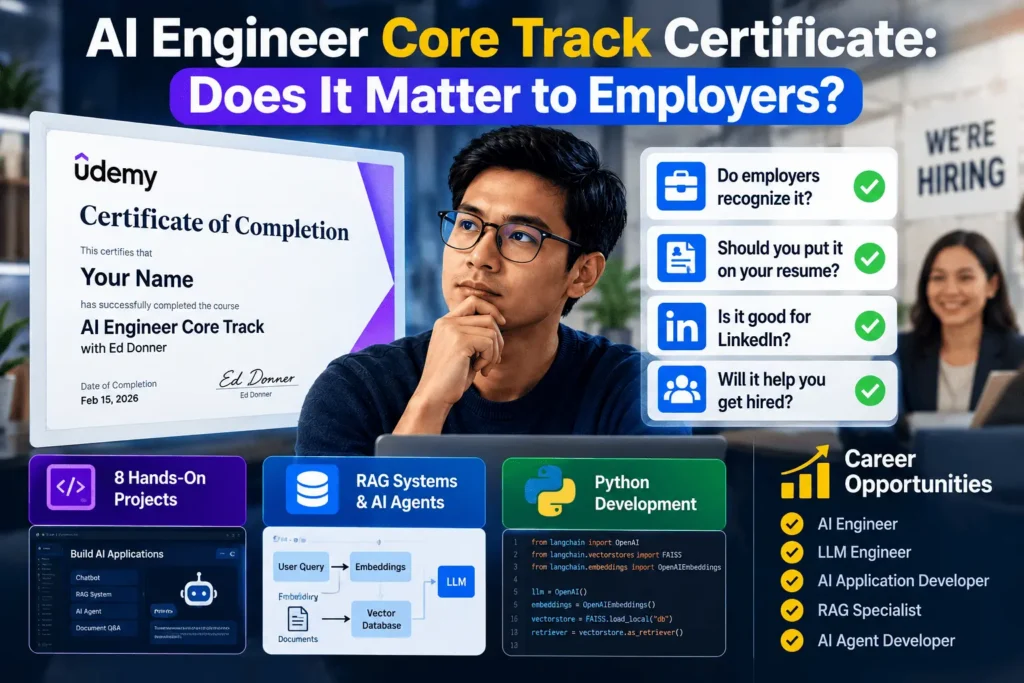
Direct answer: The AI Engineer Core Track certificate demonstrates that you completed a structured AI engineering program covering LLMs, RAG systems, AI agents, fine-tuning, and AI application development. However, most employers place greater value on the projects and practical skills you gain from the course than on the certificate itself.
If you’re weighing whether to enroll, or you’ve already finished and you’re wondering what that PDF actually buys you, this is the question worth answering honestly rather than optimistically. A certificate is easy to earn and easy to overrate. Understanding what employers actually look for — and where a completion certificate fits into that picture — can help you decide whether it’s worth pursuing, and more importantly, how to use it once you have it.
New here? Start with our full AI Engineer Core Track Review for the curriculum and instructor background, or jump to AI Engineer Core Track Jobs for the career paths the skills map to.
Quick facts:
| Item | Details |
|---|---|
| Platform | Udemy |
| Type | Certificate of Completion |
| Instructor | Ed Donner |
| Duration | 8 Weeks |
| Projects | 8 Applications |
| Coding Required | Yes |
| Best For | Developers & Career Changers |
At a glance:
- Certificate Value: Moderate
- Portfolio Value: High
- Employer Recognition: Moderate
- Career Impact: High (with projects)
What Is the AI Engineer Core Track Certificate?
The certificate is awarded automatically once you complete the course on Udemy. There’s no separate exam, proctored test, or skills assessment gating it — finishing the lecture and project content is what triggers it.
What it looks like in practice:
- Udemy-issued certificate — it carries Udemy’s branding and verification, not a third-party certifying body
- Certificate of completion — it confirms you finished the material, not that you passed an independent evaluation of your ability
- Digital format — downloadable as a PDF and shareable via a Udemy verification link, which you can add to LinkedIn or a resume
- Lifetime access to course materials — separate from the certificate itself, but worth noting: your purchase includes ongoing access to updated lectures, so the certificate isn’t the only thing you keep after finishing
This is a fundamentally different kind of credential than something like an AWS certification exam or a university degree, and understanding that difference is the key to using it correctly.
It also helps to be clear about what the certificate is competing against for an employer’s attention. In a technical hiring process, a resume with a certificate line item is one signal among many — years of experience, prior job titles, a portfolio link, a GitHub profile, referrals, and interview performance all carry weight too, often far more than a single course credential. The certificate doesn’t need to be the strongest signal on your resume to be worth having; it just needs to be an honest, accurately-framed one that doesn’t overpromise what it represents.
What Does the Certificate Actually Prove?
Course Completion
At minimum, it proves commitment. Finishing an eight-week, hands-on technical course is not nothing — a meaningful share of people who start online courses don’t finish them, and simply completing this one signals follow-through and self-discipline. That’s a real, if modest, signal to an employer, especially for a career changer with no other AI-related credentials yet.
Exposure to AI Engineering Concepts
The certificate implies you’ve been through material covering large language models, prompt engineering, retrieval-augmented generation, AI agents, LangChain, and QLoRA fine-tuning. It doesn’t prove mastery of any single one of these — it proves exposure and guided practice. That distinction matters in an interview: you can reasonably say you’ve worked with RAG and agents, but claiming deep expertise off the certificate alone would oversell what it represents.
Hands-On Project Experience
This is where the certificate’s implicit value is strongest. Because the course is project-based rather than lecture-only, completing it means you built eight working applications — not just watched videos about how they’re built. The certificate itself doesn’t show this, but it’s the reason the certificate is worth more than a typical “watch and complete” course certificate would be. The projects, not the PDF, are the actual proof.
Do Employers Recognize AI Engineer Core Track Certificates?
Most employers recognize Udemy as a learning platform but generally do not treat Udemy certificates as formal industry certifications. There’s no equivalent to the recognition an AWS, Google Cloud, or Microsoft certification carries, because Udemy certificates aren’t backed by a standardized exam or a certifying body — anyone who finishes the course content receives one.
That doesn’t mean the certificate is worthless. It means its weight depends heavily on who’s looking at it.
Startup Employers
Startups, especially small and early-stage ones, tend to focus on skills, portfolio, and GitHub activity over credentials. A founder or technical lead reviewing candidates is usually looking for evidence you can ship, not evidence you completed a specific course. If your GitHub shows a working RAG application and a functioning agent-based tool, the certificate becomes a minor supporting detail rather than the headline.
Enterprise Employers
Larger organizations often layer more process into hiring — recruiter screens, structured technical interviews, sometimes take-home assignments. Here, the certificate might get a passing mention from a recruiter doing an initial resume scan, but it won’t carry you through a technical interview. Enterprise hiring managers weigh experience, prior portfolio work, and how you perform in live technical interviews far more heavily than any single course credential.
Freelance Clients
Freelance and consulting clients usually care least about credentials and most about outcomes. A small business owner hiring someone to build a customer support chatbot wants to see a similar project you’ve already built, hear how you’d approach their specific problem, and get a sense of your communication and turnaround time. Case studies and demos close freelance deals; certificates rarely do.
The Common Thread Across All Three
Notice that none of these three employer types — startup, enterprise, or freelance client — lead with “show me your certificate.” Each one leads with a different form of the same underlying question: can you actually do this? Startups ask it through your GitHub and portfolio, enterprises ask it through structured interviews and past experience, and freelance clients ask it through case studies and demos. The certificate never disappears from the picture entirely, but it consistently plays a supporting role rather than the leading one, regardless of who’s evaluating you.
What Employers Value More Than Certificates
Real Projects
Working software beats a credential every time, because it’s directly verifiable. An employer can open a repository, read the code, and run the application — there’s no need to trust a third party’s word for what you can do.
GitHub Repositories
A public GitHub profile with clean commit history, readable code, and clear documentation turns your course projects from claims into evidence. It’s the single most requested artifact in technical hiring, and it’s something a certificate simply can’t substitute for.
Technical Skills
The ability to explain why you built something a certain way — why you chose a particular chunking strategy for RAG, why you structured an agent’s tool-calling loop a certain way — is what separates someone who followed a tutorial from someone who understands the underlying engineering. This shows up in interviews, not on certificates.
Problem-Solving Ability
Employers are often less interested in whether you know a specific framework and more interested in how you approach an unfamiliar problem. Course projects that required you to debug, adapt, or extend beyond what was taught are the ones worth highlighting — they demonstrate problem-solving, not just following along.
Portfolio Quality
Quantity matters less than polish. A handful of well-documented, thoughtfully explained projects outperforms a long list of half-finished ones. This is true whether you’re pursuing a full-time role or freelance work.
Example: Candidate A vs. Candidate B
Picture two people applying for the same junior AI Engineer role, both having completed the AI Engineer Core Track.
Candidate A lists the certificate on their resume. Nothing else.
Candidate B lists the certificate too, but also links a GitHub repository containing a working RAG application, an AI chatbot with a short demo video, and a brief write-up explaining the design decisions behind each project.
Both candidates technically hold the same credential. But Candidate B has converted that credential into something a hiring manager can actually evaluate — code they can read, a demo they can watch, and reasoning they can question in an interview. Candidate A is asking the employer to take the course’s value on faith; Candidate B is showing it. In almost every hiring scenario, Candidate B gets the callback.
The gap between these two candidates isn’t talent — they took the exact same course. It’s entirely a matter of what happened after the course ended. Candidate A stopped at the certificate. Candidate B spent a few extra hours turning finished projects into something presentable and public. That’s a small, repeatable habit, not a difference in ability, which is exactly why it’s worth building deliberately rather than leaving to chance.
How the AI Engineer Core Track Helps Build Credibility
Credibility in AI hiring right now comes less from where you learned and more from what you can demonstrably do. Here’s how each part of the course contributes to that:
RAG Projects
Retrieval-augmented generation is one of the most requested skills in current AI Engineer and LLM Engineer postings, precisely because it’s the mechanism most companies use to make AI outputs trustworthy and specific to their own data. A working RAG project on your portfolio directly answers one of the most common technical interview questions in this space: “how would you make an LLM answer accurately from our internal documents?”
AI Agents
Agent-based systems — tools that plan and execute multi-step tasks — are increasingly what companies mean when they say they want to “automate with AI.” Having a built agent project gives you a concrete answer when an interviewer asks how you’d approach workflow automation, rather than a theoretical one.
LLM Applications
Beyond RAG and agents specifically, having built full applications (a chatbot, a multi-modal support tool) shows you can assemble a complete, user-facing product — not just isolated pieces of AI functionality. This end-to-end capability is exactly what “AI Application Developer” roles are screening for.
Fine-Tuning Experience
QLoRA fine-tuning experience is less commonly held than prompting or RAG skills, simply because fewer courses and fewer self-taught learners go that deep. Having it on your portfolio — even a modest fine-tuning project — sets you apart from the much larger pool of candidates whose AI experience stops at calling an API.
Portfolio Development
Taken together, these projects don’t just teach individual skills — they form the raw material for a portfolio that does the talking for you. This is, functionally, the entire value proposition of the course: not the certificate at the end, but the body of work it forces you to build along the way.
👉 Explore the full AI Engineer Core Track curriculum
Should You Put the AI Engineer Core Track on Your Resume?
When You Should
- Students building an initial technical resume with limited prior experience — the certificate plus projects gives you something concrete to list where you might otherwise have gaps
- Career changers moving from a non-technical background, where the certificate signals a deliberate, structured effort to build the relevant skills
- Junior developers who are already coding but new to AI specifically, where listing it shows targeted upskilling in a fast-growing area
When It Matters Less
- Experienced AI professionals who already have production AI work on their resume — for them, the certificate adds little next to actual job history and shipped systems
- Senior engineers whose portfolio and track record already speak for themselves; listing a beginner-to-intermediate course certificate can, at that level, read as padding rather than as a genuine credential
Example Resume Entry
A clean, honest way to list it:
AI Engineer Core Track — Udemy (Instructor: Ed Donner) Completed an 8-week, project-based AI engineering program covering RAG systems, AI agents, and QLoRA fine-tuning. Built 8 applications including a RAG-powered knowledge assistant and a multi-modal customer support agent. [GitHub: link]
Notice what’s doing the actual work in that entry: not the course name, but the specific projects and the GitHub link attached to it. That’s the format worth copying — course name for context, projects for proof.
Should You Add the Certificate to LinkedIn?
Yes, generally — it’s low-cost and low-risk to add, and it can genuinely help with discoverability.
Benefits:
- Visibility — certificates and skills you add to LinkedIn feed into the platform’s search and recommendation systems, making you more discoverable for related roles
- Recruiter discovery — recruiters sourcing candidates for AI-related roles frequently search LinkedIn by skill and keyword; having RAG, AI agents, and LLM-related terms associated with your profile increases the chance you show up
- Skill validation — while not a formal validation, it does signal to anyone viewing your profile that you’ve made a deliberate, recent investment in this specific skill area
Best practice: don’t add the certificate in isolation. Pair it with links to your GitHub projects and a portfolio (even a simple one-page site or a pinned post walking through your best project). The certificate alone on a LinkedIn profile reads as a checkbox; the certificate alongside visible, verifiable work reads as evidence.
A practical way to structure this on LinkedIn: add the certificate under Licenses & Certifications as usual, then use the Featured section on your profile to pin your two or three strongest project links or a short demo video. Recruiters sourcing AI talent frequently skim Featured content before reading a full profile, so this is often the first thing that actually gets seen — and it does more to differentiate you than the certificate listing alone ever will.
AI Engineer Core Track Certificate vs. Google AI Professional Certificate
| Factor | AI Engineer Core Track | Google AI Professional Certificate |
|---|---|---|
| Platform | Udemy | Google / Coursera |
| Recognition | Moderate | Strong |
| Portfolio Value | High | Moderate |
| Coding Skills Demonstrated | High | Low |
| Resume Value | Project-based | Brand-based |
Key difference: Google wins on recognition — it carries a well-known brand and a verifiable Credly badge that recruiters and applicant systems more readily recognize. The AI Engineer Core Track wins on technical proof — the projects behind it demonstrate coding ability and hands-on AI engineering skill that the Google certificate, by design, doesn’t require or produce.
Which matters more depends on the role. For a technical AI Engineer or LLM Engineer position, the Core Track’s project-based proof outweighs Google’s brand recognition. For a general business role where AI fluency is a nice-to-have rather than the core requirement, Google’s recognized name carries more weight with less effort required to prove it. For the full side-by-side breakdown, see our AI Engineer Core Track vs. Google AI Professional Certificate comparison.
Does the Certificate Help Freelancers?
There’s a modest but real benefit here. Potential upsides include:
- Client trust — for a client unfamiliar with evaluating technical skill directly, seeing a relevant certificate provides a small amount of reassurance before they’ve reviewed your actual work
- Portfolio enhancement — listing it alongside your project portfolio on a freelance profile (Upwork, Fiverr, a personal site) rounds out your credibility narrative
- Proposal credibility — mentioning specific, relevant training in a project proposal can nudge a client toward shortlisting you, particularly for AI-related gigs where many freelancers claim experience without much to show for it
Important note: clients usually care more about results. A client hiring for a RAG-powered internal chatbot wants to see a similar project you’ve built and hear a clear, specific plan for their use case — not a certificate. Treat the certificate as a supporting detail in a proposal, never the centerpiece.
Can the Certificate Help You Get an AI Job?
Direct answer: the certificate alone is unlikely to secure employment. No single course credential, from any provider, reliably does that on its own — hiring is a multi-factor decision, and a completion certificate is one of the weaker factors in that mix.
However, combined with the following, it can meaningfully strengthen your profile:
- Projects — the working applications you built during the course, ideally extended or polished afterward
- Portfolio — a clean, organized presentation of that work, whether on GitHub, a personal site, or both
- Interview preparation — the ability to explain your technical decisions clearly and think through unfamiliar problems live
- GitHub — public, well-documented code that lets an employer verify your claims directly
Think of the certificate as one input among several rather than the deciding factor. Candidates who treat it as the finish line tend to be disappointed by their job search results; candidates who treat it as the starting point for a portfolio-building effort tend to see much better outcomes.
It’s worth being specific about what “combined with the above” actually looks like in a real job search, because the phrase is easy to nod along to and easy to under-execute. It means your resume lists specific projects with links, not just a course name. It means your LinkedIn Featured section shows work, not just a badge. It means when an interviewer asks “walk me through something you built,” you have a ready, detailed answer rather than a general description of the course. Each of these is a small, concrete task — and each one does more for your job search than the certificate alone ever will.
Common Mistakes People Make
Mistake #1: Thinking the certificate guarantees a job. It doesn’t, and no course credential from any provider does. Treating it as a guarantee sets you up for frustration when applications don’t convert as expected.
Mistake #2: Ignoring project work. The certificate is a byproduct of the course; the projects are the actual deliverable. Students who rush through the projects to get to the certificate are optimizing for the wrong output.
Mistake #3: Not publishing projects. Finishing a project and never putting it anywhere public (GitHub, a portfolio site, LinkedIn) means the work you did essentially doesn’t exist to anyone evaluating you. Publishing takes minimal extra effort and multiplies the value of the work you already did.
Mistake #4: Listing certificates without proof of skills. A resume line that says “AI Engineer Core Track — Udemy” with nothing backing it up invites skepticism rather than confidence. Always attach the evidence — a link, a demo, a brief description of what you built — right next to the credential.
Is the AI Engineer Core Track Certificate Worth It?
For Developers
Yes, though the certificate itself isn’t really the point for this group — the specialization and portfolio expansion are. A developer already has credibility as a coder; this course adds a specific, in-demand AI specialization on top of that foundation.
For Students
Strong value, particularly when the certificate is paired with published projects. For students without much else on their resume yet, it fills a real gap and gives interviewers something concrete to ask about.
For Career Changers
Conditionally valuable — the certificate helps signal serious intent to a hiring manager skeptical of a non-technical background, but only if it’s backed by the projects. Without that backing, it risks looking like a single, isolated attempt rather than a genuine transition.
For IT Professionals
Worthwhile as a specialization marker, especially when paired with any AI-adjacent work you can point to at your current job, even informally. It signals a deliberate move toward a growing specialty rather than a lateral credential with no direction behind it.
Certificate Value: Pros and Cons
Pros
- Signals commitment and follow-through on a structured 8-week program
- Adds a discoverable AI-related credential to LinkedIn and resumes
- Easy to pair with GitHub links and a portfolio for added weight
- Low cost and low effort to add once you’ve already completed the course
Cons
- Not a formally recognized industry certification
- Carries little weight on its own without projects behind it
- Less useful for experienced AI professionals with existing track records
- Easily overrated by candidates who stop at the certificate instead of building a portfolio
Final Verdict
The Bottom Line
The AI Engineer Core Track certificate has some value as evidence of course completion, but its greatest strength comes from the practical projects and AI engineering skills developed during the program. For most employers, portfolios, GitHub repositories, and demonstrable technical ability matter more than the certificate itself.
Don’t let that framing discourage you from taking the course — it’s a reason to take it seriously rather than a reason to skip it. The certificate was never going to be the thing that gets you hired. The eight working applications sitting behind it are. Treat the certificate as a small, useful add-on to a resume or LinkedIn profile, and treat the projects as the actual asset you’re building. Get that priority right, and the question of whether the certificate “matters” mostly answers itself.
👉 Start building AI projects with the AI Engineer Core Track
Frequently Asked Questions
Is AI Engineer Core Track a recognized certification? Not in the formal, industry-standardized sense — there’s no certifying body or exam behind it. It’s a Udemy certificate of completion, which shows you finished a structured program but isn’t equivalent to a credential like an AWS or Google Cloud certification.
Do employers accept Udemy certificates? Most employers acknowledge Udemy as a legitimate learning platform, but they generally don’t treat its certificates as formal qualifications on their own. They’re far more likely to be persuaded by the projects and skills the certificate represents than by the certificate document itself.
Should I put AI Engineer Core Track on my resume? Yes, especially if you’re a student, career changer, or junior developer — but always pair it with links to the projects you built. Listing it alone, without evidence, is far less effective than listing it alongside a GitHub repository or portfolio link.
Is AI Engineer Core Track better than Google AI Professional Certificate? They’re not directly comparable, because they measure different things. The Core Track certificate is backed by more technical, portfolio-grade proof of coding and AI engineering ability; the Google certificate carries stronger name recognition and a verifiable badge. Which one “matters more” depends on whether the role you’re targeting is technical or general-business.
Does the certificate help freelancers? Somewhat — it can add a small amount of trust in a proposal, particularly with clients unfamiliar with evaluating technical work directly. But freelance clients still care most about results, demonstrations, and case studies, not the certificate itself.
Can the certificate help me become an AI Engineer? It can contribute to that goal, but only as part of a bigger picture that includes real projects, a public portfolio, and interview preparation. On its own, the certificate is unlikely to be the deciding factor in any hiring decision.
Is the certificate worth it for beginners? Yes, conditionally — provided “beginner” means new to AI specifically rather than new to programming entirely. Complete coding beginners should build basic Python skills first; once you have that foundation, the certificate (and, more importantly, the projects behind it) is a solid credibility marker to build on early in a technical career.
How is this different from asking whether the course itself is worth it? It’s a narrower question on purpose. Our full AI Engineer Core Track Review covers whether the course as a whole — curriculum, instructor, projects, pricing — is a good investment. This article focuses specifically on the piece of paper at the end: what it proves, who actually looks at it, and how to use it well once you have it. You can find the course worth taking for its skills and projects while also being realistic that the certificate itself is a minor part of that value — the two judgments aren’t in conflict.