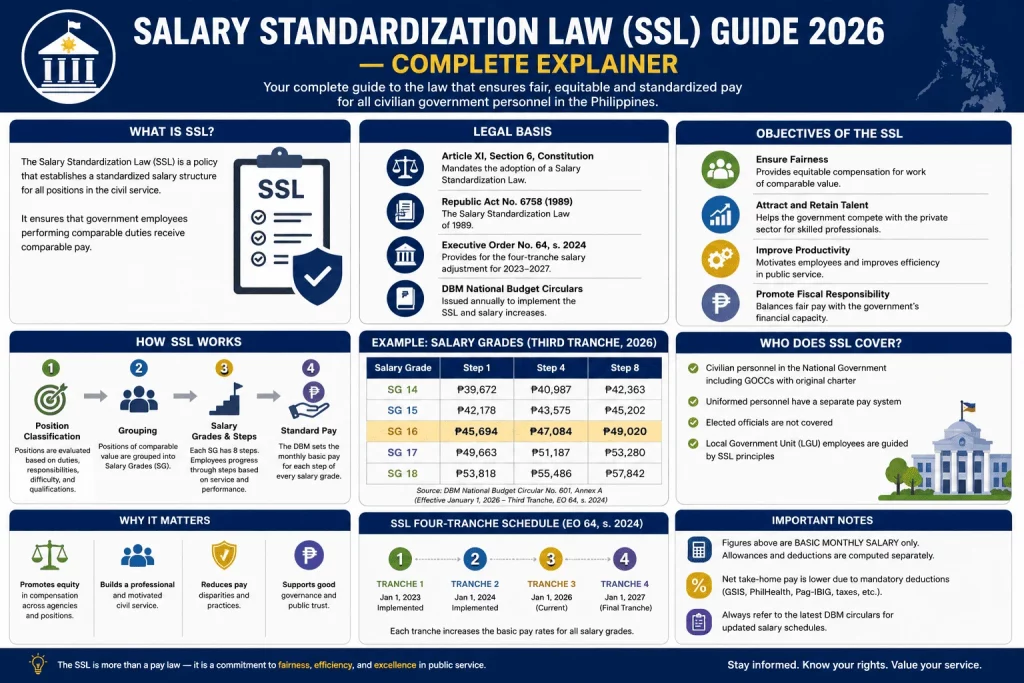
The Salary Standardization Law (SSL) is the legal framework that governs the compensation of civilian government employees in the Philippines. It establishes a unified salary structure by assigning government positions to specific salary grades and salary steps, ensuring that employees performing comparable work receive equitable compensation across agencies — from the Department of Budget and Management (DBM) down to the smallest local government unit.
Since its introduction in 1989 under Republic Act No. 6758, the Salary Standardization Law has undergone several reforms — administered alongside the Civil Service Commission (CSC), the Governance Commission for GOCCs (GCG), and the Commission on Audit (COA) — to improve government compensation, address salary disparities, and maintain the competitiveness of public sector pay. Today, it serves as the foundation of the Philippine government’s compensation and position classification system, affecting millions of government workers nationwide.
Whether you are a government employee, an aspiring civil servant, a human resource practitioner, or simply researching how government salaries work, understanding the Salary Standardization Law is essential. This guide explains the law’s purpose, legal basis, salary grade system, compensation framework, latest salary schedule, decision-support tools, and other important concepts using clear, practical language.
Definition Box — Salary Standardization Law (SSL): A series of Philippine laws (RA 6758, RA 8975, RA 9858, EO 201, RA 11466) that establish a unified Compensation and Position Classification System (CPCS) for civilian government employees, assigning every covered position a Salary Grade (1–33) and Salary Step (1–8) that together determine monthly basic salary.
Quick Answer
The Salary Standardization Law (SSL) is a Philippine law that standardizes the salaries of civilian government employees by implementing a unified Compensation and Position Classification System (CPCS). Under the law, each government position is assigned a Salary Grade (SG) and corresponding Salary Steps, which determine an employee’s monthly basic salary based on the position’s duties, responsibilities, qualifications, and years of service. The system is implemented primarily by the Department of Budget and Management (DBM) through official salary schedules published via National Budget Circulars and the Official Gazette, while position classification standards are administered in coordination with the Civil Service Commission (CSC).
Quick Facts ⭐
| Item | Details |
|---|---|
| Official Name | Salary Standardization Law (SSL) |
| Country | Philippines |
| Primary Purpose | Standardize government employee compensation |
| Coverage | Civilian government employees in the Executive, Legislative, and Judicial branches, Constitutional Commissions, State Universities and Colleges, and GOCCs (subject to applicable laws) |
| Implementing Agency | Department of Budget and Management (DBM) |
| Position Classification | Compensation and Position Classification System (CPCS) |
| Salary Grades | SG 1 to SG 33 |
| Salary Steps | Step 1 to Step 8 |
| Current Framework | Implemented through RA 11466 (SSL V) and corresponding DBM National Budget Circulars |
| Main Objective | Promote equal pay for substantially equal work in government |
Key Takeaways
- The Salary Standardization Law establishes a uniform salary structure for civilian government employees.
- Government positions are classified into 33 Salary Grades, each containing eight Salary Steps.
- Salary Grades reflect the complexity, responsibility, and qualification requirements of a position, while Salary Steps generally recognize length of service and satisfactory performance.
- The Department of Budget and Management issues the official salary schedules and implementing guidelines.
- The law has evolved through multiple Salary Standardization programs (SSL I to SSL V) to improve government compensation over time.
- The Salary Standardization Law applies primarily to civilian government personnel and does not automatically cover every government-related worker or entity under identical compensation rules.
- Total compensation includes more than the basic salary — PERA, mid-year bonus, year-end bonus, CNA incentive, and mandatory contributions to GSIS, PhilHealth, and Pag-IBIG Fund are governed by separate issuances.
TL;DR
The Salary Standardization Law (SSL) provides the standardized salary framework used by the Philippine government for civilian employees. It assigns every eligible plantilla position to a Salary Grade and Salary Step, ensuring a consistent compensation system across agencies. Beyond determining monthly basic salaries, the SSL also supports career progression, position classification, budget planning, and equitable compensation throughout the public sector. Understanding how Salary Grades, Salary Steps, and official salary schedules work helps employees interpret their compensation and career advancement opportunities more accurately.
Salary Standardization Law at a Glance ⭐
| Category | Summary |
|---|---|
| What it is | A law establishing a standardized compensation system for civilian government employees |
| Who implements it | Department of Budget and Management |
| Who helps administer position standards | Civil Service Commission |
| Salary Structure | Salary Grade (SG) + Salary Step |
| Number of Salary Grades | 33 |
| Number of Salary Steps | 8 per grade |
| Basis for Salary Grade | Duties, responsibilities, complexity of work, qualifications, and organizational level |
| Basis for Salary Step | Generally based on length of service and satisfactory performance, subject to applicable rules |
| Main Goal | Ensure fair, rational, and equitable compensation throughout the government |
| Why it matters | Provides transparency, consistency, and fairness in government compensation while supporting employee career progression and responsible fiscal management |
Editorial Note (Transparency & E-E-A-T): This guide is based on the latest applicable Salary Standardization laws, executive issuances, and official compensation guidelines available at the time of writing, including Republic Act No. 6758, Republic Act No. 11466, and related DBM National Budget Circulars. Salary schedules and implementation policies may change through future legislation or official DBM issuances. Readers should verify current information using official government publications — the Official Gazette, the DBM website, or the Civil Service Commission — before making employment or compensation decisions.
What Is the Salary Standardization Law?
The Salary Standardization Law (SSL) is a series of Philippine laws that establish a unified compensation and position classification system for civilian government employees. Its primary objective is to ensure that employees performing substantially similar duties and responsibilities receive equitable compensation, regardless of the government agency where they work.
Instead of allowing each agency to develop its own salary structure, the SSL provides a standardized framework — the Compensation and Position Classification System (CPCS) — that classifies every eligible plantilla position into a specific Salary Grade (SG) and Salary Step. These classifications determine an employee’s monthly basic salary and create a transparent compensation system throughout the public sector.
The law also serves as the government’s primary mechanism for adjusting salaries over time. Through successive Salary Standardization programs, compensation has been periodically updated by the DBM through National Budget Circulars to improve competitiveness, address wage disparities, and support the recruitment and retention of qualified public servants.
Key Point: Salary standardization is a system, not a single one-time law — it is a continuing legal and administrative framework that DBM, CSC, and Congress jointly maintain.
Purpose
The Salary Standardization Law was enacted to create a fair, rational, and sustainable compensation system across the Philippine government. Before the introduction of salary standardization, different agencies often followed varying compensation practices, resulting in inconsistencies for employees performing comparable work.
Its primary objectives include:
- Standardizing salaries across government agencies.
- Promoting the principle of equal pay for substantially equal work.
- Establishing a uniform Compensation and Position Classification System (CPCS).
- Providing a transparent basis for promotions and salary progression.
- Supporting effective government budgeting and fiscal planning by the DBM.
- Enhancing the government’s ability to attract and retain competent public servants.
Beyond determining monthly salaries, the SSL also strengthens accountability by ensuring that compensation decisions are based on objective factors such as job complexity, responsibility, qualifications, and organizational level rather than individual agency policies — with the Commission on Audit (COA) reviewing compliance during regular audits.
Who Is Covered
The Salary Standardization Law generally applies to civilian government personnel whose compensation is governed by the national government’s Compensation and Position Classification System.
Covered employees typically include those working in:
- National Government Agencies (NGAs)
- Departments and executive offices
- Constitutional Commissions
- The Legislative Branch
- The Judicial Branch
- State Universities and Colleges (SUCs)
- Government-owned or controlled corporations (GOCCs) that follow the national compensation framework or are otherwise covered by applicable compensation laws
- Local government units (LGUs), subject to applicable laws, budgetary limitations, and implementing rules
Coverage depends on the employee’s appointment, position classification, and the governing compensation laws applicable to the agency.
Who Is NOT Covered ⭐
Not all individuals working in or with the government are automatically covered by the Salary Standardization Law. Several categories of workers are governed by separate compensation systems or contractual arrangements.
Examples include:
- Uniformed personnel of the Armed Forces of the Philippines (AFP)
- Members of the Philippine National Police (PNP)
- Personnel of the Bureau of Fire Protection (BFP)
- Personnel of the Bureau of Jail Management and Penology (BJMP)
- Individuals hired under Job Order (JO) arrangements
- Contract of Service (COS) workers
- Consultants engaged under professional service contracts
- Certain GOCC personnel whose compensation is governed by separate laws or by the Governance Commission for GOCCs (GCG)
These groups are generally subject to different compensation policies, salary structures, or governing statutes rather than the civilian Salary Standardization framework.
Important: Being employed by a government office does not automatically mean an individual is covered by the Salary Standardization Law. The applicable compensation system depends on the employee’s employment status, appointment, and the specific law governing the agency.
Legal Basis
The current Salary Standardization framework is founded on a series of laws and implementing issuances that have progressively reformed government compensation.
The principal legal authorities include:
- Republic Act No. 6758 – Salary Standardization Law (SSL I), also known as the Compensation and Position Classification Act of 1989, which established the CPCS for civilian government personnel.
- Republic Act No. 11466 – Salary Standardization Law of 2019 (SSL V), which authorized the latest multi-year salary adjustments for civilian government employees.
- Implementing rules and official salary schedules issued by the Department of Budget and Management, published through DBM National Budget Circulars and the Official Gazette.
- Relevant executive issuances, including Executive Order No. 201 (2016), implementing salary adjustments.
- Position classification standards and qualification standards issued in coordination with the Civil Service Commission (CSC).
Together, these laws and issuances provide the legal framework for determining salary grades, salary steps, position classifications, and the implementation of compensation adjustments across the Philippine civil service.
Evolution of the Salary Standardization Law
The Salary Standardization Law has evolved through five major legislative phases, commonly referred to as SSL I through SSL V. Each phase was introduced to modernize the government’s compensation system, improve salary competitiveness, and maintain a fair and sustainable pay structure for civilian government employees.
SSL I — Republic Act No. 6758 (1989)
The first Salary Standardization Law, officially known as the Compensation and Position Classification Act of 1989, established the government’s unified Compensation and Position Classification System (CPCS) for civilian personnel. Its major contributions: establishing the CPCS, creating the Salary Grade system, introducing standardized Salary Steps, and classifying positions by duties, responsibilities, qualifications, and complexity.
SSL II — Republic Act No. 8975 (2000)
Provided nationwide salary increases, updated salary schedules, and improved salary progression while maintaining the CPCS established under SSL I.
SSL III — Republic Act No. 9858 (2009)
Introduced another series of phased salary increases to improve recruitment, retention, and fiscal sustainability.
SSL IV — Executive Order No. 201 (2016)
Implemented through an executive issuance rather than legislation, SSL IV introduced a four-year salary adjustment program (2016–2019) aimed at modernizing compensation and addressing salary compression.
SSL V — Republic Act No. 11466 (2019)
The current legislative framework, authorizing a four-year implementation period (2020–2023) through official DBM salary schedules and National Budget Circulars.
SSL I–V Comparison Table
| Version | Year | Legal Basis | Major Improvement |
|---|---|---|---|
| SSL I | 1989 | RA 6758 | Established the CPCS and Salary Grade framework |
| SSL II | 2000 | RA 8975 | First major nationwide salary adjustment under the standardized system |
| SSL III | 2009 | RA 9858 | Updated salary schedules and strengthened compensation |
| SSL IV | 2016 | EO 201 | Four-year increase program (2016–2019) |
| SSL V | 2019 | RA 11466 | Latest four-tranche adjustment (2020–2023) |
Current Salary Standardization Framework (2024–2027)
- Executive Order No. 64 (2024)
- First Tranche (2024)
- Second Tranche (2025)
- Third Tranche (2026)
- Fourth Tranche (2027)
Timeline
| Year | Program | Legal Basis |
|---|---|---|
| 1989 | SSL I | RA 6758 |
| 2000 | SSL II | RA 8975 |
| 2009 | SSL III | RA 9858 |
| 2016 | SSL IV | EO 201 |
| 2019 | SSL V | RA 11466 |
| 2024 | Current Salary Schedule | EO 64 |
Key Point Summary: The Salary Standardization Law has continuously evolved for more than three decades to ensure that government compensation remains fair, transparent, and responsive to economic conditions, while retaining the same core objective: equal pay for substantially equal work.
How the Salary Standardization Law Works
The Salary Standardization Law operates through the Compensation and Position Classification System (CPCS), which provides a uniform method for classifying government positions and determining compensation. An employee’s monthly basic salary is determined by three key factors: the position held, the assigned Salary Grade, and the applicable Salary Step.
Position Classification
Position classification is the process of evaluating and organizing government positions according to the nature of the work performed, level of responsibility, complexity of duties, required education, training, experience, and supervisory functions. The classification process evaluates the position, not the employee.
Key Point: The Salary Grade is assigned to the position, not to the employee occupying it.
Salary Grade
A Salary Grade (SG) represents the relative value of a government position within the compensation system, ranging from SG 1 to SG 33.
Salary Step
Each Salary Grade is divided into eight Salary Steps (Step 1–8). Step 1 is generally the entry salary for newly appointed employees; progression to higher steps may occur based on length of service, satisfactory performance, and applicable civil service and compensation rules.
Quick Tip: When checking your pay, always look up both your Salary Grade and Salary Step together — one number without the other is incomplete.
Salary Grade vs. Salary Step — Comparison Table
| Factor | Salary Grade | Salary Step |
|---|---|---|
| What it reflects | Position classification / relative value of the job | Salary level within the assigned grade |
| Basis | Job evaluation (duties, complexity, qualifications) | Length of service, performance, applicable rules |
| Range | SG 1 to SG 33 | Step 1 to Step 8 |
| Change trigger | Promotion or reclassification | Step increment over time |
| Stability | Tied to the position, permanent unless reclassified | May increase periodically under applicable rules |
Compensation Structure
| Component | Purpose |
|---|---|
| Position Classification | Determines the proper classification of a government position |
| Salary Grade | Indicates the relative value and level of the position |
| Salary Step | Determines the employee’s salary within the assigned Salary Grade |
| Monthly Basic Salary | The official salary corresponding to the Salary Grade and Step |
| Other Compensation | May include PERA, mid-year bonus, year-end bonus, CNA Incentive, and mandatory GSIS, PhilHealth, and Pag-IBIG contributions authorized under separate laws and regulations |
It is important to distinguish between an employee’s basic salary and their total compensation. The SSL primarily governs the basic monthly salary, while allowances and benefits are subject to separate laws, budgetary provisions, and implementing issuances.
Salary Computation Framework ⭐
Government Position
        │
        ▼
Position Classification
        │
        ▼
Assigned Salary Grade (SG)
        │
        ▼
Applicable Salary Step
        │
        ▼
Official Salary Schedule (DBM)
        │
        ▼
Monthly Basic Salary
Key Point Summary: Every covered position is first classified, then assigned a Salary Grade, while each employee’s salary is determined by the corresponding Salary Step shown in the official salary schedule. This system promotes fairness, transparency, and consistency throughout the Philippine civil service.
How to Find Your Salary Grade
- Check your appointment paper or Notice of Salary Adjustment (NOSA) — the official Salary Grade is stated on your appointment documents issued by your agency’s HRMO.
- Match your position title against the CSC-approved Position Classification for your agency, since generic job titles (e.g., “Administrative Officer”) can map to different SGs depending on level (Administrative Officer II vs. III).
- Confirm with your Human Resource Management Office (HRMO), which maintains the official plantilla and position allocation list.
- Cross-check against the latest DBM salary schedule to see the SG’s corresponding monthly basic salary range.
Did You Know? Two employees with the exact same job title in different agencies can have different Salary Grades if their approved plantilla items were classified differently.
How to Read an Official Salary Table
Official DBM salary tables are organized as a grid: Salary Grade (rows) × Salary Step (columns), with each cell showing the monthly basic salary.
- Locate your Salary Grade along the left-most column.
- Move across to the column matching your current Salary Step.
- The intersecting cell is your monthly basic salary under that schedule.
- Check the effective date printed on the table header — salary schedules are tranche-based and superseded by newer DBM issuances.
- Confirm the legal basis cited on the table (e.g., RA 11466, Fourth Tranche) to ensure it’s the current version.
How to Determine Your Salary Step
Your Salary Step is normally determined by:
- The step assigned upon initial appointment (usually Step 1, unless a higher step is authorized by qualification or prior service credit).
- Step increments earned through satisfactory performance and continuous service, per applicable CSC and DBM rules.
- Any step adjustments resulting from promotion, which typically resets or re-anchors the step within the new Salary Grade.
Your HRMO’s personnel records (Service Record and Notice of Step Increment) are the authoritative source for your current step.
Common Salary Computation Scenarios
| Scenario | How It’s Computed |
|---|---|
| Newly hired employee | SG of the position × Step 1 (default), unless higher step is authorized |
| Employee due for step increment | Same SG, next Step, based on service/performance rules |
| Employee promoted to a new position | New SG of the higher position × applicable step under promotion rules |
| Employee transferring to another agency (same position level) | Generally retains SG if the receiving position is classified the same |
| Employee reclassified due to job re-evaluation | New SG based on updated position classification, subject to CSC/DBM approval |
Salary Grade Decision Flowchart
Are you a civilian government employee under an
approved plantilla position?
        │
   ┌────┴────┐
  YES        NO → You may be covered by a separate
   │               compensation system (uniformed
   │               personnel, JO, COS, some GOCCs)
   ▼
Check your appointment paper / HRMO records
   │
   ▼
Identify your assigned Salary Grade (SG 1–33)
   │
   ▼
Identify your current Salary Step (1–8)
   │
   ▼
Look up SG + Step in the latest DBM salary schedule
   │
   ▼
That figure = your Monthly Basic Salary
Salary Grade vs. Position Title Matrix
| Salary Grade Range | General Classification | Illustrative Titles* |
|---|---|---|
| SG 1–10 | Entry-level / administrative support | Utility Worker, Driver, Administrative Aide |
| SG 11–18 | Technical and professional | Teacher I, Nurse I, Engineer I, Accountant I |
| SG 19–24 | Supervisory / middle management | Division Chief, Senior Specialist |
| SG 25–30 | Executive / senior leadership | Director, Regional Director, Assistant Secretary |
| SG 31–33 | Top government officials | Undersecretary, Secretary, Constitutional Officials |
*Illustrative only — actual Salary Grade always depends on the agency’s CSC-approved and DBM-confirmed position classification, not the title alone.
Salary Grade vs. Take-Home Pay
A higher Salary Grade means a higher monthly basic salary, but take-home pay is not the same figure. Take-home pay is what remains after mandatory deductions and may be offset by additional allowances:
| Adds to take-home pay | Deducts from take-home pay |
|---|---|
| PERA | GSIS premium (employee share) |
| Mid-Year Bonus / Year-End Bonus (paid separately) | PhilHealth premium |
| CNA Incentive (if applicable) | Pag-IBIG Fund contribution |
| Other agency-specific allowances | Withholding tax |
Key Point: Comparing job offers using basic salary (SG-based) alone can be misleading — always factor in mandatory deductions and recurring allowances to estimate actual take-home pay.
SSL vs. Salary Increase
These terms are often used interchangeably but mean different things:
| Term | Meaning |
|---|---|
| Salary Standardization Law (SSL) | The overarching legal framework and classification system (CPCS) that assigns positions to Salary Grades and Steps |
| Salary Increase | A specific adjustment to the peso amounts in the salary schedule, usually authorized under a particular SSL tranche or DBM issuance |
In other words, a “salary increase” happens within the SSL framework — it updates the numbers in the table, not the classification system itself.
Salary Grade System Explained
The Salary Grade (SG) System is the backbone of the Salary Standardization Law. It provides a uniform method for determining compensation by assigning every plantilla position to one of 33 Salary Grades based on the position’s value to the organization — evaluating the position, not the employee.
Grade Levels
| Salary Grade | General Classification | Typical Positions* |
|---|---|---|
| SG 1–10 | Entry-Level and Administrative Support | Administrative Aides, Utility Workers, Clerks, Drivers |
| SG 11–18 | Technical and Professional | Teachers, Nurses, Engineers, Accountants, Administrative Officers |
| SG 19–24 | Supervisory and Middle Management | Division Chiefs, Senior Specialists, Department Managers |
| SG 25–30 | Executive and Senior Leadership | Directors, Assistant Secretaries, Regional Directors |
| SG 31–33 | Top Government Officials | Undersecretaries, Secretaries, Constitutional Officials |
*Examples are illustrative only. Actual Salary Grades depend on the officially approved position classification.
Understanding Salary Grades
Each increase in Salary Grade generally reflects higher qualification requirements, greater technical expertise, increased supervisory responsibilities, more complex duties, higher organizational impact, and greater accountability. Salary Grade should not be interpreted solely as a measure of seniority.
Salary Progression
1. Step Progression — moving from one Salary Step to another within the same Salary Grade when applicable service and performance rules are met. This increases basic salary without changing the position.
2. Promotion to a Higher Salary Grade — appointment to a different position carrying a higher SG, usually involving greater duties, higher qualifications, and increased responsibility.
Promotion Rules
Promotion is not automatic. Employees must generally satisfy qualification standards relating to educational attainment, civil service eligibility, relevant training, work experience, performance, competency requirements, and availability of a vacant plantilla position, subject to agency selection and appointment procedures under CSC rules.
Real Example ⭐
Maria is newly appointed as an Administrative Officer II (SG 11, Step 1). Her monthly basic salary is found by locating SG 11, Step 1 in the DBM salary schedule. After several years of satisfactory service, she advances to Step 4 within the same SG. Later, she is promoted to Administrative Officer III (SG 14), and her compensation is recomputed using SG 14 and the applicable step.
This illustrates the two ways compensation may increase: horizontal progression (higher Steps within the same SG) and vertical progression (promotion to a higher SG).
SSL Career Progression Framework™
A simplified model for visualizing how a civil servant’s compensation evolves over a career:
STAGE 1: Entry            STAGE 2: Growth           STAGE 3: Leadership
Appointment at Step 1  →  Step increments within  →  Promotion to higher SG
(lowest step of the       the same SG (horizontal    (vertical movement) +
assigned SG)              progression)                new step anchoring
Each stage is governed by distinct rules: Stage 1 by appointment classification, Stage 2 by service/performance-based step rules, and Stage 3 by CSC qualification standards and agency selection processes.
Key Point Summary: The Salary Grade System provides a transparent and standardized framework for government compensation, combining position-based Salary Grades with service-based Salary Steps to support fairness and career development.
Official Salary Schedule
The Official Salary Schedule is the government’s authorized table specifying the monthly basic salary for every Salary Grade and Salary Step under the SSL, issued by the DBM through National Budget Circulars.
Latest Salary Tables
The latest salary schedules stem from Republic Act No. 11466 (SSL V), implemented in four tranches:
| Tranche | Effective Date |
|---|---|
| First Tranche | January 1, 2020 |
| Second Tranche | January 1, 2021 |
| Third Tranche | January 1, 2022 |
| Fourth Tranche | January 1, 2023 |
The Fourth Tranche, effective January 1, 2023, remains the latest nationwide salary schedule issued under RA 11466 unless superseded by a new law or official issuance.
Note: This guide explains how the SSL works. Detailed Salary Grade peso tables are best presented in a dedicated Salary Grade Guide (see Related Guides) so they remain easy to update whenever new DBM schedules are issued.
Step Increments
| Salary Grade | Available Steps |
|---|---|
| SG 15 (example) | Step 1 → Step 2 → Step 3 → Step 4 → Step 5 → Step 6 → Step 7 → Step 8 |
Step Increments increase basic monthly salary, do not change the Salary Grade, generally do not require promotion, and are governed by applicable CSC and DBM rules.
Effective Dates
| Salary Standardization Program | Effective Implementation |
|---|---|
| SSL I | 1989 |
| SSL II | 2000 |
| SSL III | 2009 |
| SSL IV | 2016–2019 |
| SSL V | 2020–2023 |
As of this guide, the most recent nationwide salary schedule is the Fourth Tranche of SSL V (January 1, 2023). If Congress enacts a new SSL or authorizes another adjustment program, DBM will issue updated schedules and implementing guidelines.
Key Point Summary: The Official Salary Schedule is the government’s authoritative reference for basic salaries. Since it may change through future legislation or DBM issuances, employees should always verify against the latest official publication.
Benefits
- Promotes Equal Pay for Equal Work — uniform compensation standards, reduced salary inequities, transparent determination.
- Standardizes Government Compensation — a single CPCS across all covered agencies, simplifying payroll administration and inter-agency movement.
- Encourages Career Growth — structured salary progression via step increments and promotions.
- Improves Recruitment and Retention — periodic schedule updates help attract and retain professionals in engineering, healthcare, IT, finance, and education.
- Supports Transparent Budget Planning — standardized rates improve DBM’s fiscal forecasting and personnel services budgeting.
- Strengthens Position Classification — links compensation to the objective value of the position rather than the individual.
Benefits at a Glance
| Benefit | Why It Matters |
|---|---|
| Equal Pay | Ensures fairness for comparable government positions |
| Standardized Salaries | Creates consistency across government agencies |
| Career Progression | Supports salary growth through steps and promotions |
| Better Recruitment | Helps attract and retain qualified professionals |
| Budget Efficiency | Improves personnel budgeting and fiscal management |
| Transparent Classification | Links salaries to objective job evaluation standards |
Limitations
- Budget Constraints — salary increases depend on national budget availability and are often phased.
- Salary Compression — a narrowing gap between lower and higher SGs can reduce promotion incentives.
- Periodic Salary Adjustments — increases require new legislation, executive authority, or DBM issuances; schedules can remain static for years.
- Coverage Limitations — uniformed personnel, JO, COS, and some GOCC staff are excluded from the civilian SSL framework.
- Administrative Complexity — requires continuous coordination among DBM, CSC, COA, and individual agencies.
Limitations at a Glance
| Limitation | Impact |
|---|---|
| Budget Constraints | May delay or phase salary increases |
| Salary Compression | Can reduce promotion incentives |
| Legislative Dependence | Salary adjustments require official authorization |
| Limited Coverage | Not all government personnel are covered |
| Administrative Complexity | Requires ongoing coordination and compliance |
Common Misconceptions
- “The SSL covers everyone working in government.” Reality: JO, COS, uniformed personnel, and some GOCCs follow separate systems.
- “Salary Grade is the same as Salary Step.” Reality: SG reflects position level; Step reflects salary level within that grade.
- “Promotion automatically happens after several years.” Reality: promotion requires a vacant plantilla item, qualification standards, and merit-based selection.
- “Every salary increase comes from a new Salary Grade.” Reality: increases can come from step advancement or SG promotion — separate mechanisms.
- “Agencies can set their own salary rates.” Reality: agencies must follow the DBM’s official salary schedules.
- “The SSL determines all government benefits.” Reality: SSL governs basic salary; allowances, bonuses, and incentives are governed by separate issuances.
Common Mistakes ⭐
- Confusing Salary Grade with actual salary (always check both SG and Step).
- Assuming every government employee is covered by the SSL.
- Expecting automatic promotion based on tenure alone.
- Using outdated salary tables instead of the latest DBM schedule.
- Ignoring qualification standards when planning for promotion.
Common Mistakes Checklist
- ✅ Verify both Salary Grade and Salary Step.
- ✅ Check the latest official salary schedule.
- ✅ Understand your employment status and coverage.
- ✅ Review qualification standards before seeking promotion.
- ✅ Rely on official government issuances instead of unofficial salary lists.
Checklist Before Accepting a Government Position
- [ ] Confirm the exact Salary Grade and Step stated in the appointment paper (not just the position title).
- [ ] Ask HRMO whether the position is plantilla, JO, or COS — this determines whether SSL coverage applies at all.
- [ ] Check whether the offer cites the current DBM salary schedule (Fourth Tranche, RA 11466) or an outdated one.
- [ ] Clarify what allowances (PERA, bonuses, CNA incentive) are included on top of basic salary.
- [ ] Confirm mandatory deductions (GSIS, PhilHealth, Pag-IBIG, tax) to estimate real take-home pay.
- [ ] Ask about the agency’s promotion and step-increment track record for the position.
- [ ] Verify civil service eligibility requirements tied to the position’s Salary Grade.
Government Salary Decision Matrix
| If you are deciding to… | Prioritize checking… |
|---|---|
| Accept a new government job offer | SG, Step, plantilla status, and coverage under SSL |
| Compare two government job offers | Basic salary (SG+Step) and allowances/deductions, not title alone |
| Plan for promotion | CSC qualification standards for the next-higher SG |
| Estimate future earnings | Historical step-increment pace and past SSL tranche patterns |
| Verify a payslip discrepancy | Latest DBM schedule and your HRMO’s personnel records |
Salary Verification Workflow
1. Locate your appointment paper / NOSA
        │
2. Confirm SG and Step with HRMO
        │
3. Cross-check against the latest DBM salary schedule
        │
4. If discrepancy found → file a query with HRMO/Payroll
        │
5. If unresolved → escalate to DBM or CSC regional office
Related Laws ⭐
| Law / Issuance | Purpose |
|---|---|
| Republic Act No. 6758 | Established the CPCS (SSL I) |
| Republic Act No. 8975 | Second Salary Standardization program (SSL II) |
| Republic Act No. 9858 | Third Salary Standardization program (SSL III) |
| Executive Order No. 201 (2016) | Fourth round of salary adjustments (SSL IV) |
| Republic Act No. 11466 | Salary Standardization Law of 2019 (SSL V) |
| National Budget Circulars | Official salary schedules and implementation guidelines from DBM |
| Civil Service Laws and Rules | Govern appointments, promotions, and qualification standards |
Best Practices
- Verify your salary using official DBM sources, not unofficial tables or social media posts.
- Understand your position classification — title, SG, Step, qualification standards, and progression path.
- Keep your qualifications updated (education, eligibility, licenses, training).
- Monitor new government issuances (legislation, executive orders, National Budget Circulars).
- Consult your agency’s HRMO for position-specific questions.
Best Practices Checklist
- ✅ Verify salary information using official DBM issuances.
- ✅ Keep records of appointments and personnel documents.
- ✅ Invest in continuing education and training.
- ✅ Stay informed about new compensation policies.
- ✅ Seek clarification from your HR office when needed.
Beginner Tips
Learn three basic terms first: Position Classification, Salary Grade, and Salary Step. Read official documents carefully — check definitions, effective dates, and applicability to your agency. Plan your career early by identifying training, education, and eligibility requirements tied to your target Salary Grade.
Expert Insights
- Position value drives compensation — the system compensates the position, not the individual, promoting objectivity.
- Salary Grades support workforce planning — agencies use the SG structure for staffing forecasts, budget planning, and succession planning.
- Future reforms will likely build on the existing framework rather than replace it, based on the historical pattern of SSL I–V.
Government Compensation Lifecycle
Position Creation → Position Classification (CSC) → Salary Grade Assignment (DBM)
   → Appointment & Step Assignment → Step Progression → Promotion/Reclassification
   → Retirement/Separation (GSIS benefits)
Position Classification Lifecycle
Job created by agency → Submitted to DBM/CSC for evaluation → Duties &
qualifications assessed → Salary Grade assigned → Published in plantilla →
Periodic reclassification review
Salary Grade Roadmap
A visual way to think about long-term progression: Entry SG → mid-career SG (via promotion) → senior/executive SG, with each jump requiring the qualification standards, eligibility, and vacancy conditions discussed in the Promotion Rules section above.
Related Guides ⭐
- Salary Grade Guide (Complete Guide to Salary Grades in the Philippines)
- Salary Step Guide (Salary Step Explained)
- Salary Grade Tables (SG 1–33)
- Plantilla Position Guide
- Government Benefits Guide (PERA, bonuses, GSIS, PhilHealth, Pag-IBIG)
- Position Classification Guide (Compensation and Position Classification System)
- DBM National Budget Circular Guide
- Civil Service Promotion Guide
- Civil Service Eligibility Guide
- Government Hiring Process Explained
This cluster structure allows each supporting article to go deep on one entity (e.g., Salary Grade tables, PERA, promotion rules) while this pillar page provides the comprehensive overview and internal links connecting all of them.
Frequently Asked Questions
What is the Salary Standardization Law?
A series of Philippine laws establishing a standardized compensation and position classification system for civilian government employees, assigning positions to Salary Grades and Salary Steps.
Who implements the Salary Standardization Law?
The Department of Budget and Management issues official salary schedules and implementing guidelines; the Civil Service Commission administers qualification standards.
How many Salary Grades are there?
33 Salary Grades, from SG 1 to SG 33, each with 8 Salary Steps.
What is the difference between a Salary Grade and a Salary Step?
Salary Grade reflects the position’s classification and relative value; Salary Step indicates the employee’s salary level within that grade.
Does every government employee follow the Salary Standardization Law?
No — uniformed personnel, JO workers, COS personnel, and certain GOCC employees may follow separate compensation systems.
How can I verify my official salary?
Refer to the latest DBM salary schedules and implementing issuances, or consult your agency’s HRMO.
How do I know my Salary Grade?
Check your appointment paper, Notice of Salary Adjustment, or ask your HRMO for your CSC-approved position classification.
Who should I contact if my Salary Grade seems incorrect?
Start with your agency’s HRMO; unresolved discrepancies can be escalated to DBM or the CSC regional office.
Can my Salary Grade be changed?
Yes, through position reclassification (subject to CSC/DBM evaluation) or promotion to a different, higher-SG position.
Can Job Order employees receive Salary Grades?
No — JO and COS personnel are engaged under service contracts, not plantilla appointments, so SSL Salary Grades do not apply to them.
Can a promotion skip Salary Grades?
Yes, a promotion can move an employee to any higher SG for which they qualify — it is not required to move one grade at a time — provided a vacant, appropriately classified position exists and qualification standards are met.
Final Verdict
The Salary Standardization Law remains the cornerstone of the Philippine government’s civilian compensation system. By establishing a uniform framework based on Position Classification, Salary Grades, and Salary Steps, it promotes fairness, transparency, and consistency across government agencies.
Although the law has evolved through multiple Salary Standardization programs, its fundamental objective has remained unchanged: to provide equitable compensation for substantially equal work while supporting an effective and professional civil service.
For government employees, job applicants, HR practitioners, and researchers, understanding how the Salary Standardization Law works is essential for interpreting salary schedules, planning career progression, and navigating the public sector compensation system. Because compensation policies may change through new legislation or official issuances, readers should always verify the latest information using official government sources.
Related Topics
To learn more about navigating your career in the Philippine government, explore our deep-dive guides:
- Salary Grade 6 Philippines: Salary, Steps, Positions, and Career Guide
- Salary Grade 7 Philippines: Salary, Benefits & Positions
- Salary Grade 8 Philippines: Salary, Steps, Positions, Benefits, and Career Guide
- Salary Grade 10 Philippines: Salary, Positions, Benefits, and Career Guide
- Salary Grade 11 Philippines 2026: Complete Guide
- Salary Grade 12 Philippines 2026: Salary, Positions & Benefits
- Salary Grade 13 Philippines 2026: Complete Salary & Positions Guide
- Salary Grade 14 Philippines 2026: Complete Salary & Positions Guide
- Salary Grade 15 Philippines: Salary, Positions, Qualifications, and Career Guide
- Salary Grade 19 Philippines 2026: How Much Do SG 19 Employees Earn?
- Salary Grade 24 Philippines 2026: Salary & Benefits
- Salary Grade 25 Philippines: Salary, Positions, Benefits, and Career Guide
- Government Jobs in the Philippines 2026: Complete Job Search Guide
- How to Apply for Government Jobs in the Philippines: Step-by-Step Guide
- Government Salary Grade 2026: Complete Guide to the Philippine Salary Schedule
References
- Department of Budget and Management (DBM). National Budget Circular No. 601 – Implementation of the Third Tranche Compensation Adjustment for Civilian Government Personnel pursuant to Executive Order No. 64, s. 2024.
- Executive Order No. 64, s. 2024. Modifying the Salary Schedule for Civilian Government Personnel and Authorizing the Grant of Additional Benefits.
- Civil Service Commission (CSC). Position Qualification Standards and Civil Service eligibility policies.
- Official Gazette of the Republic of the Philippines. Executive Orders, laws, and official government issuances relating to the Salary Standardization Law.