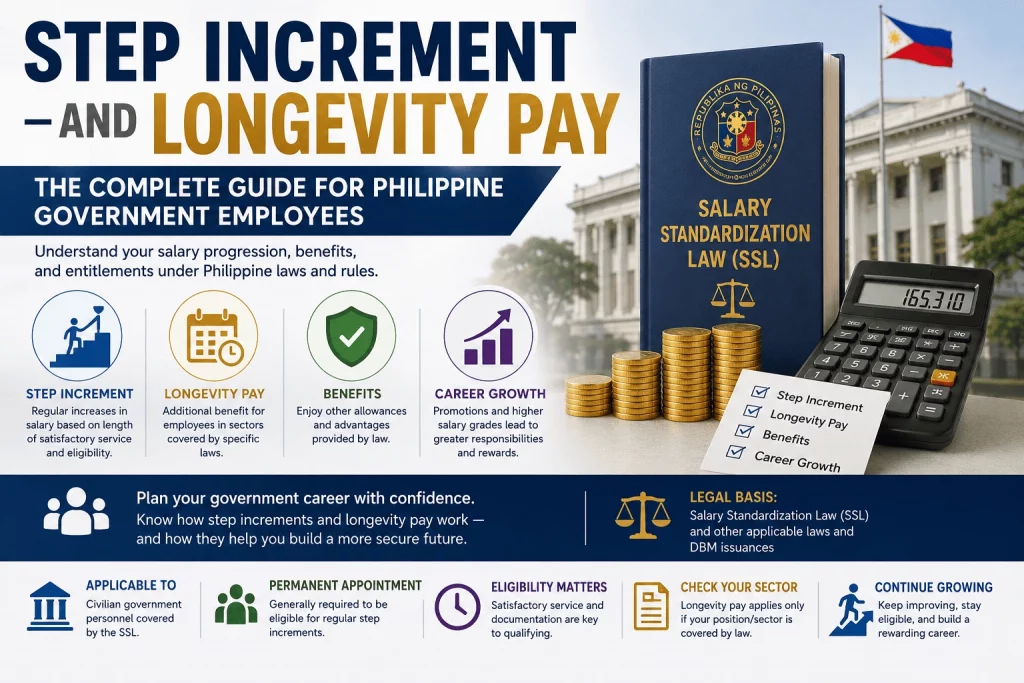
Government employees in the Philippines receive compensation based on the Salary Standardization Law (SSL), which sets out a structured salary schedule and career progression system. Two components of that system — step increments and longevity pay — often get confused with each other, and sometimes with promotion. Although all three can increase an employee’s pay, they follow different rules, different eligibility standards, and different legal foundations.
Understanding the distinction matters for employees, supervisors, HR practitioners, payroll officers, and anyone planning a career in public service. Confusing the two can lead to unrealistic salary expectations or incorrect personnel actions.
This guide explains what step increments and longevity pay are, who qualifies for each, their legal basis, how they’re computed, and where the two benefits overlap — or don’t.
Quick Answer: A step increment increases an employee’s salary within the same Salary Grade after meeting conditions such as satisfactory performance or a required period of service. Longevity pay is additional compensation granted only to specific groups of government personnel under special laws or issuances, in recognition of long and continuous service. They are separate benefits with different eligibility rules, legal bases, and computation methods — and an employee may qualify for both if the requirements for each are independently met.
Key Takeaways
- Step increments move an employee to a higher salary step within the same Salary Grade — never a new grade.
- Longevity pay is not a universal benefit; it applies only to sectors covered by a specific law (e.g., judiciary, prosecutors, uniformed personnel).
- Step increments are generally tied to length of service, performance, or merit, as authorized by DBM and CSC policy.
- An employee can receive both benefits simultaneously if each set of requirements is independently satisfied.
- None of these mechanisms are the same as a promotion.
The Atlas Compensation Decision Guide™
Before diving into definitions and legal citations, most readers just want to know one thing: which path actually gets me a higher salary, given my situation? This is the fastest way to answer that.
| If your goal is… | Best Path | Why |
| Higher salary without changing your position | Step Increment | Rewards service/performance within your current Salary Grade — no need to apply or compete for a new role |
| A higher Salary Grade altogether | Promotion | The only mechanism that moves you into a new, higher-graded position |
| Recognition for long, continuous service in a covered sector | Longevity Pay | Applies only if a specific law names your position (e.g., judiciary, prosecution, uniformed service) |
| The fastest realistic salary growth over time | Promotion + Step Increment | A promotion raises your base immediately; step increments then continue to grow from the new, higher grade |
| Confirming you’re not missing a benefit you’re entitled to | Check all three independently | Step increment, promotion, and longevity pay are evaluated under separate rules — being denied one doesn’t rule out the others |
Note: This guide is a starting orientation, not a substitute for confirming your specific position’s coverage with your HRMO.
Atlas Benefit Comparison Matrix™
A one-glance view of how the three mechanisms compare across the questions employees actually ask.
| Benefit | Universal (all SSL employees) | Raises Salary Grade | Raises Salary | Requires Promotion |
| Step Increment | ✔ | ✘ | ✔ | ✘ |
| Longevity Pay | ✘ | ✘ | ✔ | ✘ |
| Promotion | ✔ | ✔ | ✔ | ✔ |
“Universal” here means the mechanism is generally available to employees under the standardized salary schedule, subject to individually meeting the eligibility requirements — not that every employee automatically receives it.
What Are Step Increment and Longevity Pay?
A step increment rewards continued service or meritorious performance by moving an employee to a higher salary step within their current Salary Grade. The position stays the same; only the step — and the corresponding monthly basic salary — changes.
Longevity pay recognizes extended years of service and is granted only to employees covered by a specific law or government issuance. It exists outside the standard step-progression system entirely; it’s a separate monetary benefit layered on top of regular compensation, with its own eligibility rules depending on sector.
| Feature | Step Increment | Longevity Pay |
| Rewards | Progression within the salary schedule | Extended years of government service |
| Applies to | Employees within a Salary Grade | Only sectors named in a specific law |
| Function | Supports career progression | Encourages long-term retention in covered services |
| Basis | Service length and/or performance | Primarily years of qualifying service |
Key Differences at a Glance
| Feature | Step Increment | Longevity Pay |
| Purpose | Rewards continued service or performance through salary progression | Rewards long, continuous government service |
| Nature | Increase in monthly basic salary within the same Salary Grade | Separate monetary benefit added on top of salary |
| Coverage | Employees under the standardized salary schedule | Only personnel covered by special laws or issuances |
| Legal Basis | SSL and DBM/CSC issuances | Special laws, executive issuances, or agency-specific rules |
| Computation | Movement from one salary step to the next | Formula set by the applicable law |
| Changes Salary Grade? | No | No |
| Requires Promotion? | No | No |
| Universal? | Subject to standard compensation rules | No — only for covered sectors |
A step increment permanently raises an employee’s monthly basic salary, since future adjustments are calculated from the new step. Longevity pay doesn’t touch the Salary Grade or step at all — it’s paid separately, according to whatever formula the governing law specifies.
Example: Step Increment
Maria, an administrative officer at Salary Grade 15, Step 3, meets the service and performance requirements and advances to SG 15, Step 4. Her position and Salary Grade are unchanged; only her monthly basic salary increases.
Example: Longevity Pay
Juan works in a government service where a special law grants longevity pay after a set number of years of continuous, satisfactory service. His Salary Grade and step stay the same — he simply receives an additional longevity benefit, computed under that law, on top of his regular pay.
Can Both Benefits Be Received?
Yes — but only if each is independently earned. An employee in a sector covered by a longevity pay law may also qualify for step increments if they separately meet those requirements. Receiving one does not automatically trigger the other; eligibility for each is evaluated under its own governing rules.
| Scenario | Step Increment | Longevity Pay |
| Maria meets both sets of requirements | ✅ Granted | ✅ Granted |
| Carlos works in an agency with no longevity pay law | ✅ Granted | ❌ Not applicable |
| Angela is covered by a longevity law but hasn’t hit the service threshold for a step increment | ⏳ Not yet | ✅ Granted |
Common Misconceptions
- “A step increment is the same as a promotion.” No — a step increment stays within the same Salary Grade; a promotion typically means a higher position and Salary Grade.
- “All government employees receive longevity pay.” Incorrect — it’s limited to sectors covered by specific laws.
- “Longevity pay raises my Salary Grade.” No — it’s an add-on benefit that doesn’t touch grade or step.
- “A step increment guarantees longevity pay.” No — each has separate, independently evaluated requirements.
Legal Basis
Step increments are grounded primarily in the Salary Standardization Law (SSL), which establishes the Salary Grade structure and the steps within each grade, alongside implementing issuances from the Department of Budget and Management (DBM) — covering how increments are granted, funding requirements, and documentation. The Civil Service Commission (CSC) shapes the process further through rules on performance management, merit and fitness, and service records, which agencies must follow before approving related personnel actions.
Longevity pay does not flow from the SSL. It exists only where a specific law or issuance authorizes it for a defined group — commonly cited examples include uniformed personnel, members of the judiciary, prosecutors, public attorneys, and certain constitutional offices. Each governing law sets its own eligibility years, computation formula, and payment ceiling, which is why there’s no single nationwide longevity pay formula.
| Benefit | General Legal Authority |
| Step Increment | SSL + DBM/CSC implementing issuances |
| Longevity Pay | Sector-specific laws, executive issuances, or agency statutes |
Note: Employees should confirm the exact Republic Act, Executive Order, or DBM/CSC circular number that governs their position, since these are periodically amended. Your agency’s HRMO or the Official Gazette are the authoritative sources.
Who Qualifies for a Step Increment?
Step increments are generally available to civilian employees compensated under the SSL and covered by the government’s Position Classification and Compensation System — including staff in National Government Agencies, State Universities and Colleges, SSL-covered GOCCs, and other entities using the standardized salary schedule.
Typical requirements:
- Completion of the required period of continuous, satisfactory service in the current step
- A qualifying performance rating under the agency’s Performance Management System
- No unresolved administrative penalties affecting eligibility
- Compliance with documentary and agency-specific requirements
Merit Step Increment (MSI): A separate track for employees whose performance is exceptional or outstanding beyond normal expectations. MSIs are limited, budget-dependent, and require approval — a satisfactory rating alone doesn’t qualify someone.
What can affect eligibility: promotion, agency transfer, extended leave without pay, separation from service, or pending administrative cases can all delay or disqualify a step increment, depending on the specific circumstances and governing rules.
Meeting the minimum service period is necessary but not sufficient — agencies must also confirm legal, budgetary, and documentary compliance before approving the movement.
Atlas Step Increment Eligibility Checklist™
Use this quick self-check before raising the topic with your HRMO. It doesn’t guarantee approval — final decisions depend on agency policy and budget — but it flags whether you’re even in a position to ask.
- ☐ Holding a permanent appointment under the standardized salary schedule
- ☐ Completed the required period of continuous service in your current step
- ☐ Received a satisfactory (or higher) performance rating for the covered period
- ☐ No pending or unresolved administrative case that would affect eligibility
- ☐ Service Record and Personal Data Sheet (PDS) are up to date and error-free
- ☐ No recent promotion, transfer, or leave without pay that resets or interrupts your service count
- ☐ Confirmed with your HRMO that budgetary and documentary requirements are in order
If you checked every box, you’re in a reasonable position to formally inquire about your step increment. If one or two boxes are unchecked, that’s usually the specific gap to resolve first — not a sign the benefit doesn’t apply to you.
Who Qualifies for Longevity Pay?
Longevity pay applies only to personnel expressly named in a governing law — it is not earned simply by accumulating years of service. Common examples include uniformed personnel, judges and justices, prosecutors, and public attorneys, though coverage always depends on the specific statute.
Not automatically covered, regardless of tenure:
- Employees with many years of service in a position with no longevity pay law
- Permanent appointees
- Employees who regularly receive step increments
- Employees at a high Salary Grade
None of these create entitlement on their own — the deciding factor is always whether a specific law names that position.
Common eligibility factors across longevity pay laws:
| Requirement | Typical Consideration |
| Covered Position | Must be named in a governing law |
| Length of Service | Minimum qualifying years, set by that law |
| Continuous Service | May need to be uninterrupted |
| Performance | Faithful, satisfactory service may be required |
| Legal Authority | Must be expressly authorized — agencies can’t grant it independently |
How Step Increments Work
Every plantilla position carries a Salary Grade, and each grade contains several steps, each corresponding to a higher monthly salary. As an employee advances from one step to the next, the salary rises while the Salary Grade and position title stay fixed.
Typical process for a regular step increment:
- Employee completes the required period of satisfactory service.
- Agency evaluates eligibility.
- HRMO verifies service records and performance ratings.
- Agency prepares the personnel action.
- Authorized official approves the step movement.
- Payroll is updated to reflect the new step.
Exact timelines and documentation depend on current DBM and CSC issuances and internal agency policy — always confirm specifics with your HRMO rather than assuming a fixed schedule applies government-wide.
How Longevity Pay Is Computed
There is no single formula for longevity pay across government. Computation depends entirely on the law governing the employee’s specific sector — which sets the qualifying years, the rate or fixed amount, payment frequency, and any cap.
Illustrative example only (not an official formula):
| Item | Sample Value |
| Basic Monthly Salary | ₱50,000 |
| Longevity Rate (hypothetical) | 5% |
| Sample Longevity Pay | ₱2,500 |
This simply demonstrates how a percentage-based formula might work if a law prescribed one — actual computation varies by governing legislation, and employees should never apply one sector’s formula to another’s.
Documentation typically required to establish eligibility includes a service record, appointment papers, certification of continuous government service, and payroll records, though specific requirements vary by implementing agency.
Step Increment vs. Promotion
These are frequently confused but are distinct personnel actions.
| Feature | Step Increment | Promotion |
| Position | Unchanged | Changes to a higher position |
| Salary Grade | Unchanged | Usually increases |
| Responsibilities | Generally unchanged | Increase significantly |
| Qualification standards | Existing ones apply | Must meet standards for the new position |
| Selection process | Not competitive | Usually a formal promotion process |
Example: Ramon, an Administrative Officer II at SG 11 Step 3, advances to SG 11 Step 4 through a step increment — same position, higher salary. Later, he’s promoted to Administrative Officer III: a new position, a higher Salary Grade, and expanded duties. After the promotion, his future step increments are calculated from the new Salary Grade, not the old one.
Neither action is objectively “better” — a step increment rewards sustained performance in a current role, while a promotion recognizes readiness for greater responsibility. Many employees experience both over the course of a career.
Atlas Career Compensation Timeline™
A simplified view of how these mechanisms typically stack over the course of a government career. Not every employee follows this exact sequence — longevity pay only enters the picture if your sector has a governing law — but it illustrates how the pieces relate.
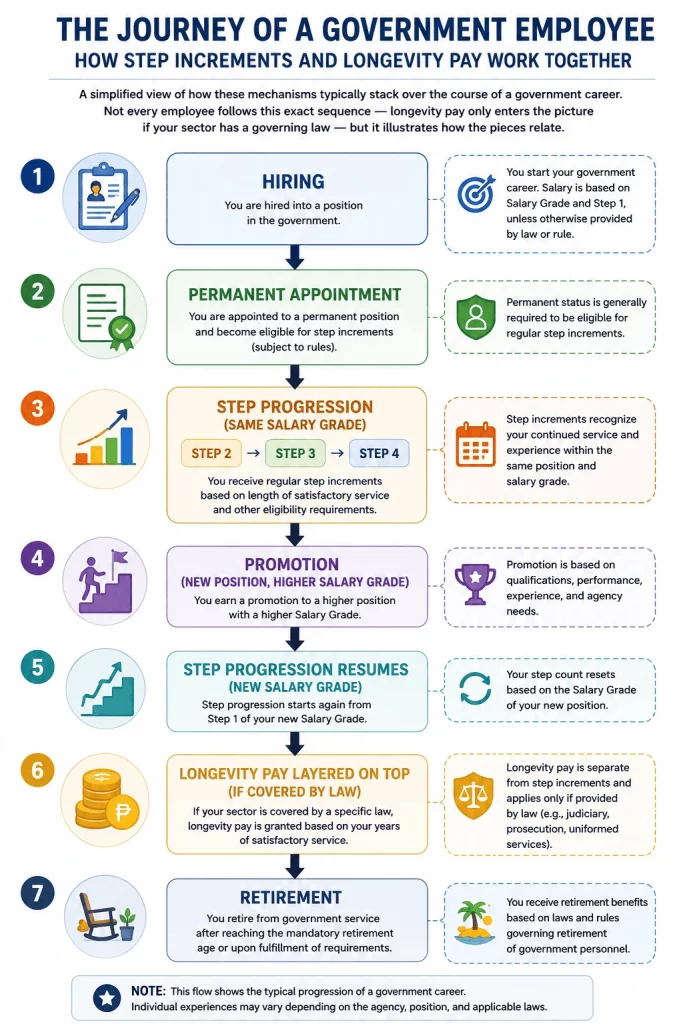
Read it as a general shape, not a guaranteed path — some employees stay at one Salary Grade for their whole career and never seek promotion, and longevity pay never enters the picture at all unless a specific law covers their sector.
Atlas Compensation Decision Tree™: Which Benefit Applies to Me?
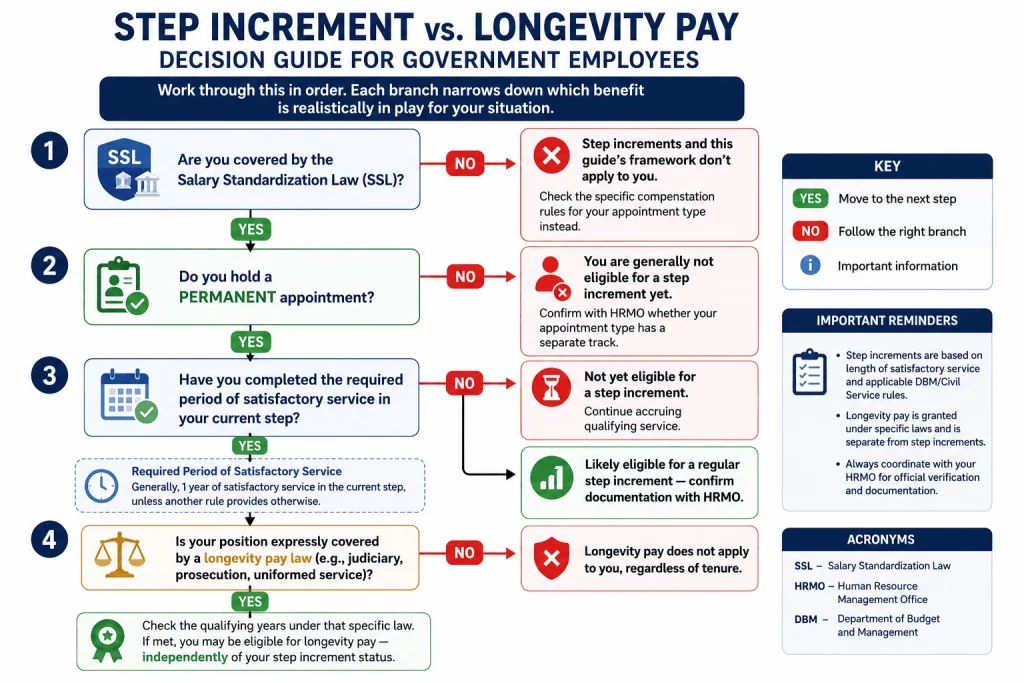
Key reminder: the step increment branch and the longevity pay branch are evaluated separately. A “no” on one branch never automatically means “no” on the other.
Common Scenarios: Am I Eligible?
Real situations tend to answer these questions faster than definitions alone. Here’s how the framework applies to a few common cases.
Scenario 1: Permanent employee, 3 years in current step Eligible ba? Likely eligible for a step increment, provided the required service period in the current step has been completed, the performance rating is satisfactory or higher, and there’s no pending administrative case. Longevity pay does not apply unless the specific position is named in a governing law.
Scenario 2: Job Order (JO) personnel, 10 years of service Eligible ba? Generally not eligible for a step increment, regardless of tenure — JO and Contract of Service personnel are typically compensated under separate arrangements outside the standard Position Classification and Compensation System, unless a specific policy states otherwise. Longevity pay also does not apply, since JO personnel are not covered by the sector-specific laws that grant it.
Scenario 3: Promoted last year Eligible ba? Yes, for future step increments — but they’re now computed from the new, higher Salary Grade the promotion moved them into, not the old one. The service clock for the next step increment generally restarts from the effectivity of the promotion, subject to agency policy. Longevity pay eligibility is unaffected by the promotion itself and still depends entirely on whether the position is covered by a specific law.
Scenario 4: Judge with 20 years of service Step increment? Judicial positions may be covered by their own compensation framework rather than the standard step system — this depends on the specific law governing judicial compensation, so confirm through the relevant judicial administrative office rather than assuming the general SSL step rules apply as-is. Longevity pay? Likely eligible, since the judiciary is one of the sectors commonly named in longevity pay laws, subject to meeting that law’s specific qualifying years and continuous-service requirements. Promotion? Would require moving to a different judicial position or level (e.g., through appointment to a higher court) — service length alone does not trigger this.
These scenarios illustrate general patterns only. Actual eligibility always depends on the specific law, appointment type, and agency policy governing the position — confirm with HRMO or the relevant administrative office before relying on any of these as a final answer.
Common Mistakes to Avoid
- Assuming a step increment equals a promotion. They affect different things — salary step vs. position and grade.
- Assuming every long-serving employee gets longevity pay. It requires a specific covering law, not just tenure.
- Treating step increments as automatic. Service length alone isn’t enough — performance ratings, documentation, and agency approval all matter.
- Confusing Salary Grade with salary step. Grade reflects job classification; step reflects salary progression within that classification.
- Expecting long service alone to raise pay. Salary increases come from several distinct mechanisms — step increments, promotions, SSL-wide adjustments, and statutory benefits — each governed separately.
- Neglecting personnel records. Inaccurate service records, appointment history, or performance ratings can delay any compensation action.
- Relying on informal sources. Social media, forums, and workplace rumors are not reliable for compensation rules — verify with your HRMO, DBM, CSC, or the Official Gazette.
Frequently Asked Questions
Is a step increment automatic for all government employees?
No. Employees must meet eligibility requirements — service length, performance rating, documentation, and agency approval — before a step increment is granted.
How often can an employee receive a step increment?
This depends on current DBM guidelines and agency policy. Check with your HRMO for the timeline that applies to your position.
Does a step increment change my Salary Grade?
No. Only the salary step changes (e.g., SG 15 Step 2 to SG 15 Step 3); the Salary Grade and position title stay the same.
Is a promotion the same as a step increment?
No. A promotion moves an employee to a new, usually higher-graded position with expanded duties. A step increment raises pay within the current position and grade.
Who is entitled to longevity pay?
Only employees in positions specifically named in a governing law or issuance — long service alone doesn’t create entitlement.
Do all employees get longevity pay after 10 or 15 years?
No. There’s no universal rule; each governing law sets its own required years and terms, and most civilian positions aren’t covered at all.
Can I receive both a step increment and longevity pay?
Yes, if you independently qualify for each — they’re evaluated under separate rules and one doesn’t guarantee the other.
Does longevity pay increase my Salary Grade?
No. It’s a separate benefit that doesn’t alter position, grade, or step.
How can I check my current salary step?
Review your appointment papers, Notice of Salary Adjustment, payroll records, or Service Record, or ask your HRMO directly.
Can contractual or Job Order personnel receive step increments?
Generally no. Step increments apply to positions under the government’s standard Position Classification and Compensation System; contractual, JO, and Contract of Service personnel are typically compensated under separate arrangements unless a specific policy states otherwise.
Where can I verify current rules?
Your agency’s HRMO, the DBM, the CSC, the Official Gazette, and the specific laws or circulars governing your position are the most reliable sources.
Practical Tips for Government Employees
Whether you’re aiming for a step increment, checking longevity pay eligibility, or planning toward a promotion, a few habits make the process smoother:
- Keep your Service Record and Personal Data Sheet (PDS) current. Gaps or errors in these documents are one of the most common reasons compensation actions get delayed.
- Track your performance ratings over time, not just at evaluation season — this makes it easier to spot whether you’re on pace for a regular or merit step increment.
- Ask your HRMO directly which law, if any, governs longevity pay for your specific position, rather than assuming coverage based on what a colleague in another agency receives.
- Request written confirmation of your current Salary Grade and step whenever you’re unsure — this becomes useful if a discrepancy appears in payroll later.
- Watch for DBM and CSC circulars relevant to your sector; implementing rules are updated periodically and can shift service-period requirements or documentation standards.
- Don’t assume promotion resets everything to your disadvantage — while future step increments are calculated from your new Salary Grade after a promotion, the promotion itself typically comes with a salary increase that reflects the higher-level role.
None of these steps guarantee a particular outcome, since final approval always depends on budget availability, agency policy, and compliance with the governing law. But they reduce the chances of an eligible benefit being delayed simply due to missing paperwork or unclear records.
Why the Distinction Matters for Career Planning
Employees who understand the difference between these mechanisms are better positioned to set realistic expectations. A step increment offers steady, incremental salary growth for employees who stay in the same role and perform consistently — useful for anyone not actively pursuing promotion in the near term. Longevity pay, where it applies, rewards loyalty to a specific line of service, which matters most for employees in sectors like the judiciary, prosecution service, or uniformed ranks where such laws exist. Promotion, meanwhile, remains the primary path to a materially higher Salary Grade and expanded responsibilities.
Conflating these three creates two common problems in practice: employees who expect a benefit they’re not legally entitled to, and HR offices that face avoidable disputes because expectations weren’t calibrated to the correct legal framework from the start. Clarity here benefits both sides — employees get accurate expectations, and agencies spend less time correcting misunderstandings after the fact.
Final Verdict
Step increments and longevity pay both increase government compensation, but they’re built for different purposes. A step increment is part of the structured salary progression system, letting employees advance within their current Salary Grade based on service and performance. Longevity pay is a sector-specific benefit that recognizes extended, faithful service — but only where a specific law authorizes it.
Because eligibility for each depends on distinct legal frameworks, the safest approach is to confirm your position’s specific coverage with your HRMO rather than assume either benefit applies universally. Compensation rules change through new legislation and administrative issuances, so checking official sources — DBM, CSC, and the Official Gazette — before making salary assumptions is always worthwhile
Related Topics
- Government Salary Grade 2026: Complete Guide to the Philippine Salary Schedule
- Salary Standardization Law (SSL) Guide 2026 — Complete Explainer
- PERA, RATA, and Hazard Pay Guide
- How to Get a Plantilla Position in the Philippine Government (2026 Guide)
- How to Apply for Government Jobs in the Philippines: Step-by-Step Guide
- CSC Eligibility Requirements: Complete Guide for Government Job Applicants
References
- Department of Budget and Management (DBM). National Budget Circular No. 601 – Implementation of the Third Tranche Compensation Adjustment for Civilian Government Personnel pursuant to Executive Order No. 64, s. 2024.
- Civil Service Commission (CSC). Position Qualification Standards and Civil Service eligibility policies.
- Official Gazette of the Republic of the Philippines. Executive Orders, laws, and official government issuances relating to the Salary Standardization Law