Last Updated: July 3, 2026
Effective Salary Schedule: January 1, 2026 (Third Tranche)
Verified Against: Executive Order No. 64, s. 2024; DBM National Budget Circular No. 601; Civil Service Commission (CSC); Official Gazette
Reviewed On: July 3, 2026
Next Review Schedule: Upon the release of a new DBM salary schedule or by January 2027, whichever comes first.
Understanding Salary Grade (SG) 9 is important if you’re applying for a government job or planning a career in the Philippine public sector. Under the government’s Salary Standardization framework, each position is assigned a salary grade that determines its basic monthly salary. Salary Grade 9 generally covers entry-level to junior technical and administrative positions that require specific qualifications and skills.
Quick Answer
Salary Grade 9 (SG 9) is a government pay classification in the Philippines that provides a fixed monthly basic salary based on an employee’s salary step. Employees under SG 9 receive progressively higher salaries as they advance through the salary steps while remaining in the same salary grade. SG 9 positions are commonly found in national government agencies, state universities and colleges, government-owned and controlled corporations, and local government units.
💡 Applying for an entry-level government job? Most SG 9 positions require Civil Service eligibility. Practice for free with our CSE Reviewer — mock exams and drills for all subjects. Start practicing free →
Key Takeaways
- Salary Grade 9 is part of the Philippine government’s standardized compensation system.
- Monthly salary depends on the employee’s assigned salary step.
- SG 9 commonly includes junior technical, administrative, and supervisory support positions.
- Employees receive government benefits in addition to their basic salary.
- Career advancement usually involves promotion to higher salary grades based on qualifications and performance.
TL;DR
If you’re applying for an SG 9 government position, your compensation consists of a basic monthly salary determined by your salary step, plus statutory and government benefits such as PERA, GSIS, PhilHealth, Pag-IBIG, leave benefits, bonuses, and other incentives authorized by law. Promotion opportunities are available through merit, experience, and meeting qualification standards.
What Is Salary Grade 9?
Salary Grade 9 is a compensation level under the Philippine government’s Salary Standardization system. It determines the basic monthly pay for qualifying government employees, with actual earnings varying according to the employee’s salary step within the grade.
The Philippine government uses a standardized salary grading system to ensure fair and consistent compensation across agencies. Every plantilla position is assigned a salary grade ranging from the lowest to the highest levels. Within each salary grade are multiple salary steps that recognize longevity and performance.
Salary Grade 9 typically covers positions requiring specialized administrative, clerical, or technical competencies. While agencies may assign different job titles, the salary grade ensures that employees occupying equivalent positions receive comparable basic pay.
Common Positions Under Salary Grade 9
Examples of positions that may be classified under SG 9 include:
- Administrative support personnel
- Technical assistants
- Office support specialists
- Records management personnel
- Accounting support staff
- Engineering or laboratory assistants
- Other agency-specific plantilla positions
The exact job title and qualification standards depend on the hiring agency and the applicable qualification standards issued by the Civil Service Commission.
Key Point Summary
Salary Grade 9 represents a standardized government compensation level designed to provide equitable pay for positions with similar levels of responsibility and qualification requirements.
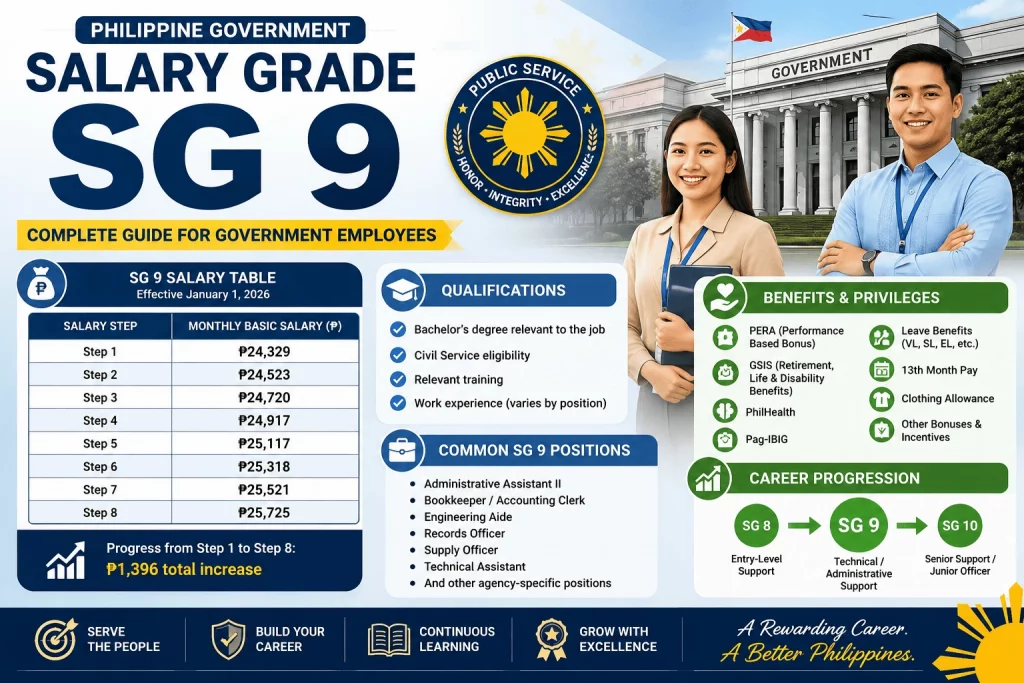
Official Salary Grade 9 (SG 9) Salary Table
Effective January 1, 2026
| Salary Step | Monthly Basic Salary (₱) |
| Step 1 | 24,329 |
| Step 2 | 24,523 |
| Step 3 | 24,720 |
| Step 4 | 24,917 |
| Step 5 | 25,117 |
| Step 6 | 25,318 |
| Step 7 | 25,521 |
| Step 8 | 25,725 |
Salary Progression
An employee appointed to Salary Grade 9 typically starts at Step 1 (₱24,329), unless authorized to start at a higher step under applicable compensation rules. As the employee earns step increments based on government regulations, the monthly basic salary increases until reaching Step 8 (₱25,725).
| Progression | Increase |
| Step 1 → Step 8 | ₱1,396 total increase |
Key Point Summary
Although all SG 9 employees belong to the same salary grade, their basic monthly salary depends on their assigned salary step. Step increments reward continued satisfactory service while the employee remains in the same position or salary grade.
Common Salary Grade 9 Positions in the Philippine Government
Salary Grade 9 is commonly assigned to entry-level and junior technical positions that require specialized skills, administrative experience, or professional support functions. The exact position title, duties, and qualification standards vary by government agency, but all SG 9 positions receive the same basic salary corresponding to their assigned salary step.
Examples of SG 9 Positions
Below are examples of government positions that may be classified under Salary Grade 9, depending on the approved plantilla and agency staffing pattern.
| Position | Typical Function |
| Administrative Assistant II | Provides administrative and clerical support |
| Administrative Aide VI (where applicable) | Performs specialized administrative functions |
| Bookkeeper | Maintains accounting records and financial transactions |
| Accounting Clerk | Assists in accounting and bookkeeping operations |
| Engineering Aide | Supports engineering projects and field activities |
| Laboratory Technician | Conducts laboratory tests and maintains equipment |
| Records Officer | Manages official records and document control |
| Supply Officer | Oversees inventory, procurement, and property management |
| Computer Operator | Operates and monitors government computer systems |
| Technical Assistant | Provides technical and administrative assistance to offices |
Important: The salary grade is attached to the plantilla position, not merely the job title. The same job title may have a different salary grade in another agency depending on its approved staffing pattern and classification.
Typical Qualification Requirements
While qualifications vary by agency, SG 9 positions commonly require one or more of the following:
- Bachelor’s degree relevant to the position
- Appropriate Civil Service Eligibility
- Relevant training programs
- Related work experience (for certain positions)
- Technical competencies specific to the agency
Always refer to the hiring agency’s Qualification Standards and vacancy announcement for the exact requirements.
Where SG 9 Positions Are Found
Salary Grade 9 positions are available in many government institutions, including:
- National Government Agencies (NGAs)
- State Universities and Colleges (SUCs)
- Local Government Units (LGUs)
- Government-Owned and Controlled Corporations (GOCCs)
- Constitutional Commissions
- Legislative and Judicial offices
Career Opportunities
An SG 9 employee may later qualify for promotion to higher salary grades through:
- Outstanding performance
- Additional education
- Specialized training
- Relevant work experience
- Compliance with Civil Service qualification standards
- Availability of higher plantilla positions
Key Point Summary
Salary Grade 9 serves as an important entry point for many government careers. It offers competitive compensation, comprehensive government benefits, and opportunities for advancement through merit, qualifications, and experience.
Qualifications and Eligibility for Salary Grade 9 Positions
There is no single set of qualifications for all Salary Grade 9 (SG 9) positions. Each government agency establishes qualification standards based on the position, in accordance with the Civil Service Commission (CSC) policies. Applicants generally need the required education, experience, training, and Civil Service eligibility specified in the vacancy announcement.
Qualification Standards
Government positions are evaluated using four primary qualification standards:
| Qualification | Description |
| Education | Completion of the required educational program, typically a bachelor’s degree or other qualification relevant to the position. |
| Experience | Relevant work experience, if required by the position. Some SG 9 positions accept applicants with little or no prior experience. |
| Training | Completion of job-related training or seminars, when required. |
| Eligibility | Appropriate Civil Service Eligibility or another eligibility recognized by law for the position. |
The exact requirements vary depending on the agency and the nature of the job.
Civil Service Eligibility
Many SG 9 positions require one of the following eligibilities:
- Career Service Professional Eligibility
- Career Service Subprofessional Eligibility (for positions where applicable)
- Bar or Board Eligibility (for licensed professions)
- Other eligibilities recognized under special laws
Some positions may be exempt from Civil Service eligibility requirements if authorized by law or if they fall under non-career service appointments.
💡 Applying for an entry-level government job? Most SG 9 positions require Civil Service eligibility. Practice for free with our CSE Reviewer — mock exams and drills for all subjects. Start practicing free →
Skills Employers Look For
In addition to the minimum qualifications, government agencies often seek applicants with competencies such as:
- Effective written and oral communication
- Computer proficiency (e.g., Microsoft Office applications)
- Records and document management
- Analytical and problem-solving skills
- Customer service orientation
- Teamwork and interpersonal skills
- Time management and organizational abilities
Technical positions may require specialized knowledge related to accounting, engineering, information technology, agriculture, healthcare, or other professional fields.
Required Documents
Applicants are commonly asked to submit the following:
- Application letter
- Personal Data Sheet (PDS)
- Updated résumé or curriculum vitae
- Transcript of Records (TOR)
- Diploma
- Civil Service Eligibility or Professional License (if applicable)
- Certificates of training
- Certificates of employment (if applicable)
- Performance rating (for current government employees)
- Other documents required by the hiring agency
Tips for Applicants
To improve your chances of being hired for an SG 9 position:
- Carefully review the vacancy announcement before applying.
- Ensure all documentary requirements are complete and up to date.
- Highlight experience and training relevant to the position.
- Verify that your Civil Service eligibility matches the position’s requirements.
- Submit your application before the deadline and follow the agency’s instructions.
📋 Getting your documents ready? Don’t forget your CSE eligibility. Take our free practice exam →
Key Point Summary
Salary Grade 9 positions do not have a universal qualification standard. The hiring agency determines the specific education, experience, training, and eligibility requirements based on the approved plantilla position. Reading the official job posting carefully is the best way to ensure you meet all qualifications.
Benefits of Salary Grade 9 Employees
Direct Answer: Employees holding Salary Grade 9 (SG 9) positions are entitled not only to their monthly basic salary but also to a comprehensive package of government-mandated benefits. These benefits may include allowances, insurance coverage, retirement benefits, leave privileges, bonuses, and other incentives, subject to existing laws and government regulations.
1. Personnel Economic Relief Allowance (PERA)
The Personnel Economic Relief Allowance (PERA) is a monthly allowance granted to qualified government employees to help offset daily living expenses.
Key Features
- Fixed monthly allowance
- Granted to qualified civilian government employees
- Separate from the basic salary
- Non-integrated into the basic pay
2. GSIS Benefits
Permanent government employees are generally covered by the Government Service Insurance System (GSIS).
GSIS benefits may include:
- Retirement benefits
- Life insurance
- Disability benefits
- Separation benefits
- Survivorship benefits
- Emergency and policy loans
- Multi-purpose loans
Employees and employers both contribute to the GSIS in accordance with existing laws.
3. PhilHealth Coverage
SG 9 employees are covered by PhilHealth, which provides health insurance benefits.
Coverage may include:
- Inpatient hospitalization
- Selected outpatient services
- Emergency medical care
- Case rate benefits
- Other health insurance benefits provided under PhilHealth policies
Monthly contributions are shared by both the employee and the government employer.
4. Pag-IBIG Fund Benefits
Government employees also contribute to the Home Development Mutual Fund (Pag-IBIG Fund).
Benefits include:
- Housing loans
- Multi-purpose loans
- Calamity loans
- Provident savings
- Dividend earnings on savings
5. Leave Privileges
Most permanent SG 9 employees earn paid leave credits.
Common leave benefits include:
| Leave Benefit | Description |
| Vacation Leave | Paid leave for personal time off |
| Sick Leave | Paid leave during illness or medical treatment |
| Maternity Leave | Granted under applicable laws |
| Paternity Leave | Available to qualified male employees |
| Parental Leave | Subject to eligibility requirements |
| Special Leave Benefits | As provided under special laws and CSC rules |
Unused leave credits may be accumulated or monetized, subject to applicable regulations.
6. Mid-Year and Year-End Bonuses
Qualified government employees may receive:
- Mid-Year Bonus
- Year-End Bonus
- Cash Gift
- Performance-Based Bonus (PBB), subject to agency eligibility and performance requirements
- Other incentives authorized by the national government
The availability and amount of these benefits depend on current laws, budget issuances, and agency compliance with performance guidelines.
7. Clothing or Uniform Allowance
Qualified government personnel may receive a Clothing or Uniform Allowance, subject to annual budget guidelines issued by the Department of Budget and Management (DBM).
8. Other Possible Benefits
Depending on the agency and applicable regulations, SG 9 employees may also receive:
- Loyalty incentives
- Step increments
- Longevity pay (where authorized)
- Hazard pay (for eligible positions)
- Subsistence allowance (for qualified personnel)
- Laundry allowance (for eligible occupations)
- Magna Carta benefits (for covered professions)
- Overtime compensation or compensatory time off, when authorized
Benefits Summary
| Benefit | Available to SG 9 Employees |
| Basic Monthly Salary | ✔ |
| PERA | ✔ |
| GSIS Membership | ✔ |
| PhilHealth Coverage | ✔ |
| Pag-IBIG Membership | ✔ |
| Paid Leave Credits | ✔ |
| Mid-Year Bonus | ✔ |
| Year-End Bonus | ✔ |
| Cash Gift | ✔ |
| Performance-Based Bonus (subject to eligibility) | ✔ |
| Clothing/Uniform Allowance | ✔ |
Key Point Summary
A Salary Grade 9 position offers more than just a monthly salary. Qualified employees enjoy a comprehensive government compensation package that includes social insurance, healthcare, retirement benefits, paid leave, bonuses, and various allowances. These benefits significantly enhance the overall value of government employment and contribute to long-term financial security.
Career Progression for Salary Grade 9 Employees
Direct Answer: A Salary Grade 9 (SG 9) position can serve as a solid foundation for a long-term career in the Philippine government. Employees who consistently perform well, meet qualification standards, and complete the required education, training, and experience may become eligible for promotion to higher salary grades as vacancies arise.
How Career Progression Works
Promotion in the government is generally based on the principles of merit, fitness, and competence. Agencies follow the qualification standards prescribed by the Civil Service Commission (CSC) and their respective Merit Promotion Plans.
A promotion is not automatic. Employees typically need to:
- Meet the minimum qualification standards for the higher position.
- Demonstrate satisfactory or outstanding performance.
- Complete the required education and training.
- Acquire the necessary work experience.
- Compete for an available plantilla position.
Typical Career Path
While career progression varies by agency and occupation, an SG 9 employee may advance through positions similar to the following:
| Career Stage | Typical Salary Grade |
| Entry-Level Position | SG 9 |
| Senior Assistant / Technical Staff | SG 10–11 |
| Administrative or Technical Officer | SG 11–15 |
| Supervisory Position | SG 18–22 |
| Division Chief / Manager | SG 24–26 |
| Director-Level Position | SG 27–28 |
| Executive Position | SG 29–33 |
Actual salary grades depend on the agency’s approved organizational structure and plantilla positions.
Ways to Improve Promotion Opportunities
Employees can strengthen their chances for promotion by:
- Pursuing higher educational qualifications.
- Completing CSC-accredited or job-related training.
- Consistently earning high performance ratings.
- Developing leadership and technical competencies.
- Gaining specialized work experience.
- Applying for vacant higher-level plantilla positions.
- Obtaining professional licenses or certifications relevant to their field.
Salary Grade 9 Compared with Adjacent Grades
| Salary Grade | Step 1 Monthly Salary (₱) | Typical Career Level |
| SG 8 | 22,423 | Entry-level support |
| SG 9 | 24,329 | Technical or administrative support |
| SG 10 | 26,917 | Senior support or junior officer |
Difference from SG 8 to SG 9: ₱1,906 increase at Step 1.
Difference from SG 9 to SG 10: ₱2,588 increase at Step 1.
These figures are based on the effective January 1, 2026 salary schedule.
Long-Term Career Benefits
Remaining in government service can provide several long-term advantages, including:
- Regular salary step increments
- Promotion to higher salary grades
- Increased retirement benefits through GSIS
- Expanded leadership opportunities
- Access to advanced government training programs
- Greater job stability compared with many private-sector positions
Career Planning Tips
To maximize your career growth:
- Create an Individual Development Plan (IDP).
- Attend learning and development programs regularly.
- Keep your Personal Data Sheet (PDS) updated.
- Maintain complete employment and training records.
- Monitor vacancy announcements on the CSC Job Portal and agency websites.
- Build expertise in your chosen field instead of relying solely on years of service.
Key Point Summary
Salary Grade 9 is more than an entry-level government salary—it can be the starting point of a rewarding public service career. By meeting qualification standards, consistently performing well, and continuously developing your skills, you can progress to higher salary grades with increased responsibilities, compensation, and leadership opportunities.
Salary Grade 9 vs. Salary Grades 8 and 10
Direct Answer: Salary Grade 9 (SG 9) sits between Salary Grade 8 (SG 8) and Salary Grade 10 (SG 10) in the Philippine government’s compensation structure. Compared to SG 8, SG 9 offers a higher basic salary and is generally assigned to positions with greater technical knowledge, responsibility, or administrative complexity. SG 10 provides another increase in compensation and often involves more advanced duties or supervisory functions.
Salary Comparison (Effective January 1, 2026)
| Salary Grade | Step 1 | Step 8 | Difference from SG 9 (Step 1) |
| SG 8 | ₱22,423 | ₱23,709 | −₱1,906 |
| SG 9 | ₱24,329 | ₱25,725 | — |
| SG 10 | ₱26,917 | ₱28,465 | +₱2,588 |
SG 8 vs. SG 9
| Category | SG 8 | SG 9 |
| Basic Salary | Lower | Higher |
| Job Complexity | Routine support functions | Technical or specialized administrative functions |
| Qualification Requirements | May require fewer specialized qualifications | Often requires more specialized education or skills |
| Career Level | Entry-level support | Junior technical or administrative level |
Key Difference: Employees promoted from SG 8 to SG 9 receive an increase in basic salary and are often entrusted with more specialized responsibilities.
SG 9 vs. SG 10
| Category | SG 9 | SG 10 |
| Basic Salary | Lower | Higher |
| Level of Responsibility | Technical or administrative support | Senior support or junior officer responsibilities |
| Decision-Making | Limited to moderate | Greater responsibility and accountability |
| Career Advancement | Foundation level | Next step toward supervisory roles |
Key Difference: Promotion from SG 9 to SG 10 generally reflects increased responsibility, broader scope of work, and higher compensation.
Should You Aim for SG 9?
An SG 9 position is a good choice if you:
- Are starting or building a career in government service.
- Want stable employment with comprehensive benefits.
- Meet the qualification standards for technical or administrative positions.
- Plan to pursue promotions to higher salary grades.
For many employees, SG 9 serves as an important stepping stone toward officer-level and supervisory positions.
Decision Matrix
| Your Goal | Recommended Grade |
| Enter government service | SG 8 or SG 9 |
| Gain technical or administrative experience | SG 9 |
| Seek higher responsibilities and faster career progression | SG 10 and above |
| Prepare for supervisory positions | SG 10–18 |
Key Point Summary
Salary Grade 9 strikes a balance between entry-level and higher technical positions. It offers a meaningful salary increase over SG 8 while providing valuable experience and opportunities for advancement to SG 10 and beyond. For many government employees, SG 9 is a strategic point for building a long-term career in public service.
Common Mistakes
Avoiding these common mistakes can help applicants and employees better understand how the Philippine government’s compensation system works.
1. Confusing Salary Grade with Salary Step
A Salary Grade identifies the compensation level of a government position, while a Salary Step determines the employee’s exact monthly basic salary within that salary grade.
For example, two employees may both occupy SG 9 positions, but one may receive a higher salary because they are assigned to Step 5 instead of Step 1.
2. Assuming All SG 9 Positions Have the Same Duties
Although positions under Salary Grade 9 share the same compensation level, their responsibilities differ significantly among government agencies.
An SG 9 employee in an accounting office may perform financial functions, while another in an engineering office may provide technical field support.
3. Believing Promotion Is Automatic
Promotion is based on:
- Qualification standards
- Merit and fitness
- Performance evaluation
- Availability of a vacant plantilla position
Years of service alone do not guarantee promotion.
4. Ignoring Qualification Standards
Before applying, always verify the vacancy announcement to ensure you satisfy the required:
- Education
- Experience
- Training
- Civil Service Eligibility
Missing even one requirement may disqualify an application.
5. Looking Only at Basic Salary
Government compensation extends beyond the monthly basic salary. Employees may also receive:
- PERA
- GSIS benefits
- PhilHealth coverage
- Pag-IBIG benefits
- Leave credits
- Mid-Year Bonus
- Year-End Bonus
- Cash Gift
- Other authorized allowances and incentives
Best Practices
If you’re pursuing an SG 9 position, consider these recommendations:
- Review the latest DBM salary schedule before applying.
- Read the vacancy announcement carefully.
- Keep your Personal Data Sheet (PDS) updated.
- Prepare certified copies of required documents in advance.
- Attend relevant training programs to improve your qualifications.
- Maintain a strong performance record if you are already employed in government service.
- Monitor vacancies through the Civil Service Commission and official government agency websites.
- Develop technical and leadership skills to prepare for future promotions.
Frequently Asked Questions (FAQ)
What is the starting salary for Salary Grade 9?
As of January 1, 2026, the Step 1 monthly basic salary for Salary Grade 9 is ₱24,329.
Can a newly hired employee start above Step 1?
Yes. While most new employees begin at Step 1, a higher salary step may be granted if authorized under applicable government compensation rules.
Does Salary Grade 9 include bonuses?
Yes. Qualified employees may receive bonuses and incentives such as the Mid-Year Bonus, Year-End Bonus, Cash Gift, and Performance-Based Bonus (subject to applicable laws and eligibility requirements).
Is Civil Service Eligibility required?
Many SG 9 positions require the appropriate Civil Service Eligibility or another eligibility recognized by law. However, requirements vary depending on the position and hiring agency.
Are SG 9 employees entitled to GSIS and PhilHealth benefits?
Yes. Permanent government employees are generally covered by GSIS, PhilHealth, and the Pag-IBIG Fund, in accordance with applicable laws and regulations.
Can SG 9 employees be promoted?
Yes. Employees may qualify for promotion to higher salary grades if they meet the qualification standards, demonstrate satisfactory performance, and successfully compete for vacant positions.
Do all agencies use the same Salary Grade 9 pay?
Yes. The basic salary schedule is standardized across the national government. However, some agencies may provide additional benefits or incentives when authorized by law or special issuances.
🎯 Ready to start your government career? Get exam-ready with our free 170-item full mock exam and subject-by-subject drills. Start your free CSE Reviewer →
Final Verdict
Salary Grade 9 is an excellent entry point for professionals seeking a stable and rewarding career in the Philippine government. With a monthly basic salary ranging from ₱24,329 to ₱25,725 (effective January 1, 2026), comprehensive government benefits, and opportunities for career advancement, SG 9 positions offer both financial security and professional growth.
Whether you are a first-time applicant or an existing government employee planning your next career move, understanding the salary schedule, qualification standards, benefits, and promotion pathways will help you make informed career decisions and prepare for long-term success in public service.
Related Topics
To learn more about navigating your career in the Philippine government, explore our deep-dive guides:
- Salary Grade 6 Philippines: Salary, Steps, Positions, and Career Guide
- Salary Grade 7 Philippines: Salary, Benefits & Positions
- Salary Grade 8 Philippines: Salary, Steps, Positions, Benefits, and Career Guide
- Salary Grade 10 Philippines: Salary, Positions, Benefits, and Career Guide
- Salary Grade 11 Philippines 2026: Complete Guide
- Salary Grade 12 Philippines 2026: Salary, Positions & Benefits
- Salary Grade 13 Philippines 2026: Complete Salary & Positions Guide
- Salary Grade 14 Philippines 2026: Complete Salary & Positions Guide
- Salary Grade 15 Philippines: Salary, Positions, Qualifications, and Career Guide
- Salary Grade 19 Philippines 2026: How Much Do SG 19 Employees Earn?
- Salary Grade 24 Philippines 2026: Salary & Benefits
- Salary Grade 25 Philippines: Salary, Positions, Benefits, and Career Guide
- Government Jobs in the Philippines 2026: Complete Job Search Guide
- How to Apply for Government Jobs in the Philippines: Step-by-Step Guide
- Government Salary Grade 2026: Complete Guide to the Philippine Salary Schedule
References
The information in this guide should be verified against the latest official government issuances. Primary references include:
- Department of Budget and Management (DBM). National Budget Circular No. 601 – Implementation of the Third Tranche Compensation Adjustment for Civilian Government Personnel pursuant to Executive Order No. 64, s. 2024.
- Executive Order No. 64, s. 2024. Modifying the Salary Schedule for Civilian Government Personnel and Authorizing the Grant of Additional Benefits.
- Civil Service Commission (CSC). Position Qualification Standards and Civil Service eligibility policies.
- Official Gazette of the Republic of the Philippines. Executive Orders, laws, and official government issuances relating to the Salary Standardization Law.
- Government Service Insurance System (GSIS). Official information on retirement, insurance, and employee benefits.
- PhilHealth. Official guidelines on the National Health Insurance Program for government employees.
- Home Development Mutual Fund (Pag-IBIG Fund). Official membership, savings, and housing benefit information
Disclaimer
This guide is intended for informational purposes only and is based on official government issuances available at the time of writing. While every effort has been made to ensure accuracy, salary schedules, qualification standards, benefits, and implementing rules may change through subsequent laws, executive orders, DBM circulars, CSC issuances, or other government regulations.
Readers should always consult the latest official publications of the Department of Budget and Management (DBM), Civil Service Commission (CSC), and the Official Gazette for the most current and authoritative information.