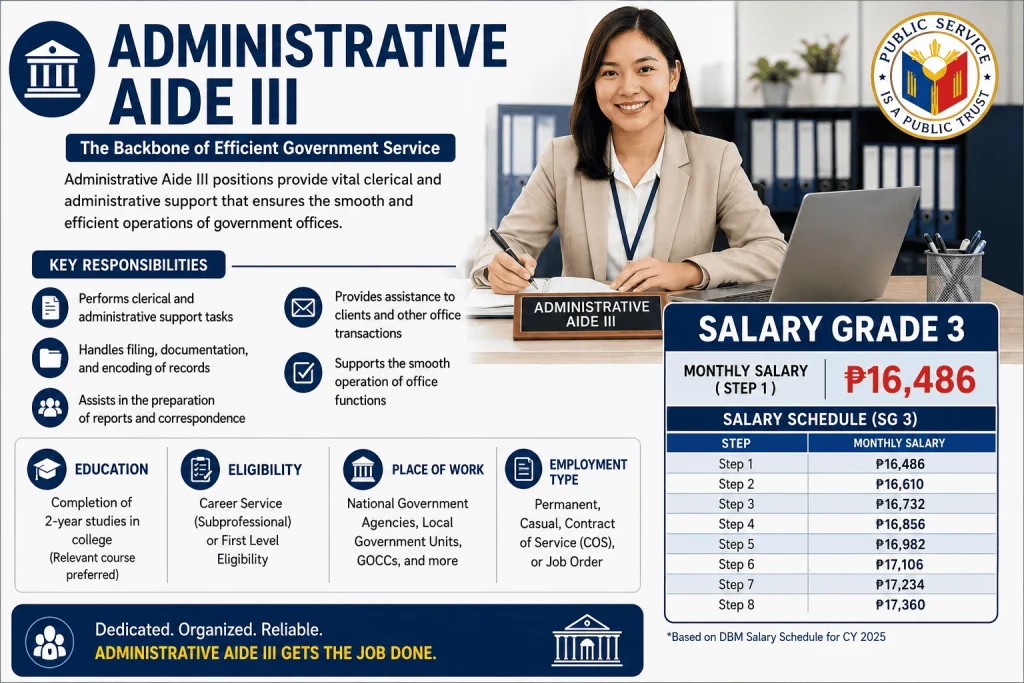
Quick Answer:
Administrative Aide III (also called Clerk I) is a Salary Grade 3 (SG 3) position in the Philippine civil service, shifting focus from general utility work toward basic clerical duties. It typically requires a high school diploma, no prior work experience, and no college degree. Under the 2026 salary schedule, the monthly basic pay ranges from ₱16,486 at Step 1 to ₱17,360 at Step 8, plus standard government benefits (GSIS, PhilHealth, Pag-IBIG, PERA, and leave credits). The role involves filing, records handling, correspondence routing, and other entry-level clerical support.
Administrative Aide III Quick Facts
| Item | Details |
|---|---|
| Salary Grade | SG 3 |
| Monthly Salary | ₱16,486–₱17,360 |
| Position Equivalent | Clerk I |
| Education | High School Graduate |
| Experience | None Required |
| Training | None Required |
| Eligibility | CSC Sub-Professional |
Key Takeaways
- Administrative Aide III is classified under Salary Grade 3 (SG 3).
- Monthly salary ranges from ₱16,486 to ₱17,360 in 2026.
- High school graduate qualification is typically sufficient.
- No work experience is usually required.
- CSC Sub-Professional Eligibility is needed for permanent appointment.
- Clerk I is the common equivalent position title.
- Duties shift toward basic clerical and records work, unlike the utility focus of Aide I and II.
Administrative Aide III Position Summary
| Item | Details |
|---|---|
| Position Title | Administrative Aide III |
| Equivalent Title | Clerk I |
| Salary Grade | SG 3 |
| Salary Range | ₱16,486–₱17,360 |
| Education | High School Graduate |
| Experience | None Required |
| Training | None Required |
| Eligibility | CSC Sub-Professional |
| Government Level | First-Level Position |
Administrative Aide III Salary, Qualifications, and Duties at a Glance
Administrative Aide III is a Salary Grade 3 government position commonly known as Clerk I. It typically requires a high school diploma, no work experience, no training, and CSC Sub-Professional Eligibility for permanent appointment. Duties include filing documents, routing correspondence, basic records maintenance, and general clerical support in a government office.
Administrative Aide III Salary Table (2026)
| Step | Monthly Basic Salary |
|---|---|
| Step 1 | ₱16,486 |
| Step 2 | ₱16,610 |
| Step 3 | ₱16,732 |
| Step 4 | ₱16,856 |
| Step 5 | ₱16,982 |
| Step 6 | ₱17,106 |
| Step 7 | ₱17,234 |
| Step 8 | ₱17,360 |
Source: Executive Order No. 64, s. 2024, Third Tranche salary schedule (DBM National Budget Circular No. 601), effective January 1, 2026.
Salary Grade 3 Compared to Minimum Wage
As of 2026, Administrative Aide III employees receive a monthly basic salary ranging from ₱16,486 to ₱17,360 under Salary Grade 3. Unlike many private-sector jobs that are paid on a daily wage basis, government positions also include PERA, GSIS, leave credits, bonuses, and security of tenure — making total compensation significantly higher than the basic salary alone once these are factored in.
This distinction matters when comparing Administrative Aide III pay against private-sector minimum wage jobs, which are typically computed per day worked and rarely include equivalent government-mandated benefits such as GSIS retirement coverage, cumulative and cash-convertible leave credits, or guaranteed mid-year and year-end bonuses.
Administrative Aide III Qualification Standards (Official Format)
| Qualification | Requirement |
|---|---|
| Education | High School Graduate |
| Training | None Required |
| Experience | None Required |
| Eligibility | Career Service Sub-Professional |
A full breakdown, including agency-specific variations, is covered in Section 3 below.
What Is Administrative Aide III?
Administrative Aide III is a Salary Grade 3 clerical support position, commonly known as Clerk I, that handles filing, records, and correspondence in a government office.
Administrative Aide III is a rank-and-file position in the Philippine government’s Position Classification System, jointly maintained by the Civil Service Commission (CSC) and the Department of Budget and Management (DBM). Its formal equivalent title in most plantilla structures is Clerk I, and it is assigned Salary Grade 3 (SG 3) — the point in the Administrative Aide series where the role’s focus shifts from general utility work toward basic clerical functions.
While Administrative Aide I and II are centered on cleaning, hauling, and equipment- or transport-related tasks, Administrative Aide III marks the first clearly clerical position in the Aide ladder. It involves filing, records handling, correspondence routing, and other entry-level administrative support — making it a natural next step for utility staff who want to transition into office-based work, and a common starting point for high school graduates specifically seeking clerical experience.
Because it remains classified within the Aide series (SG 1–6), Administrative Aide III retains the accessible Qualification Standards typical of this tier: no college degree, no specialized training, and no prior work experience are required for most plantilla items. This makes it one of the more frequently posted vacancies across national agencies and local government units alike, particularly in offices with high document-processing volume.
Administrative Aide III Definition
Administrative Aide III is a first-level government position under Salary Grade 3 commonly known as Clerk I. The role focuses on clerical support, records management, document filing, and correspondence handling within government agencies.
Salary Grade 3: Full Pay Breakdown
Administrative Aide III earns a monthly basic salary of ₱16,486 to ₱17,360 under Salary Grade 3 in 2026.
Under the Third Tranche of Executive Order No. 64, series of 2024, which took effect January 1, 2026, Salary Grade 3 positions — including Administrative Aide III — earn a monthly basic salary ranging from ₱16,486 (Step 1) to ₱17,360 (Step 8).
Each salary grade contains eight incremental steps. Employees typically move up one step approximately every three years of continuous, satisfactory service, under Joint CSC-DBM Circular No. 1, s. 1990, subject to agency budget allocation. A separate rule under Joint CSC-DBM Circular No. 1, s. 2012 also allows one or two step increments for employees with the highest performance ratings, though this is granted more selectively and depends on available agency funding.
Beyond Basic Pay: Standard Allowances and Bonuses
While the basic salary at SG 3 is modest, Administrative Aide III employees — once appointed permanently — are entitled to additional compensation that meaningfully increases total annual take-home pay:
- Personnel Economic Relief Allowance (PERA) — ₱2,000 per month, standard across the civil service
- Uniform/Clothing Allowance — up to ₱7,000 per year under the FY 2026 General Appropriations Act
- 13th Month Pay — mandatory for all government employees
- Mid-Year Bonus — equivalent to one month’s basic salary, typically released from mid-May
- Year-End Bonus and Cash Gift — one month’s basic salary plus ₱5,000, typically released in November
- Productivity Enhancement Incentive (PEI) — an annual incentive granted subject to availability of funds
Estimated Total Monthly Compensation
| Benefit | Estimated Amount |
|---|---|
| Basic Salary (Step 1) | ₱16,486 |
| PERA | ₱2,000 |
| Estimated Total Monthly Compensation | ₱18,486 |
This estimate covers basic salary plus PERA only. It excludes annual-only benefits such as the uniform/clothing allowance, 13th month pay, mid-year bonus, year-end bonus, cash gift, and PEI, which are received on a yearly (not monthly) basis and would further raise total annual take-home pay.
A Note on the 2027 Adjustment
The salary figures above reflect the Third Tranche of a four-tranche compensation adjustment program running from 2024 to 2027. A fourth and final tranche is scheduled to take effect in 2027, which will further raise SG 3 pay. Applicants and current employees should watch for updated DBM circulars closer to that date.
Qualification Standards for Administrative Aide III
Administrative Aide III typically requires a high school diploma, no work experience, no training, and CSC Sub-Professional Eligibility for permanent appointment.
The CSC’s Qualification Standards (QS) framework evaluates every position using four criteria, commonly abbreviated as ETEE: Education, Training, Experience, and Eligibility. For Administrative Aide III, these remain close to the minimum level found across the civil service, matching Administrative Aide II’s education bar while shifting the expected skill set toward clerical work.
Administrative Aide III Qualification Standards
| Qualification Factor | Typical Requirement |
|---|---|
| Education | High School Graduate |
| Training | None Required |
| Experience | None Required |
| Eligibility | Career Service Sub-Professional (for permanent appointment) |
Note: The qualification standards discussed in this guide are based on commonly published Administrative Aide III vacancies and CSC qualification standards. Always refer to the specific vacancy announcement, as agencies may adopt position-specific requirements — particularly for items that involve specialized filing systems, records management software, or basic computer encoding.
Education
- High school graduate is the standard minimum for most Administrative Aide III plantilla items
- No college units or vocational certificate are generally required
- Agencies retain discretion to prefer applicants with additional computer literacy or clerical coursework, even though it is not a formal requirement
Training
- None required for most items, though some agencies prefer or provide short in-house training on filing systems, records classification, or basic office software
Experience
- None required. Fresh applicants with no prior work history are generally eligible to apply, though prior clerical, administrative, or customer-service experience is often viewed favorably during screening
Eligibility
- CSC Sub-Professional Eligibility (Career Service Sub-Professional, First Level) is the standard requirement for permanent appointment
- Applicants without eligibility can still be considered for casual, job order (JO), or contract-of-service (COS) engagements rather than permanent plantilla appointment
Job Description and Daily Duties
Administrative Aide III handles filing, correspondence routing, records retrieval, and basic data recording in a government office.
The core function of an Administrative Aide III (Clerk I) is basic clerical support, marking a clear shift from the utility-focused duties of Administrative Aide I and II. Typical duties include:
- Filing and organizing documents — physical and, increasingly, digital records
- Routing correspondence — receiving, sorting, and forwarding memos, letters, and official communications
- Records retrieval — locating and providing requested documents for staff or clients
- Basic data recording — logging incoming and outgoing documents, maintaining simple tracking sheets or logbooks
- Front-desk or reception support, in offices where Clerk I staff assist walk-in clients or direct visitors
- Photocopying, scanning, and document preparation for meetings, reports, or client transactions
- Messengerial duties, delivering documents between offices or departments when needed
- Simple inventory of office supplies and forms, particularly those used for public transactions
Unlike Administrative Aide I and II, which emphasize physical utility work, Administrative Aide III duties revolve around accuracy, organization, and attention to detail in handling documents and records. Supervisors typically look for candidates who can maintain consistent, error-free filing systems, since misplaced or mishandled records can disrupt an entire office’s operations.
In smaller offices with limited staffing, an Administrative Aide III may also be asked to assist with basic utility tasks when needed, reflecting the same cross-functional flexibility seen across the lower Aide levels.
Why Government Agencies Hire Administrative Aide III
Agencies hire Administrative Aide III staff to keep records organized, manage document flow, and support the clerical backbone of daily operations.
Government agencies hire Administrative Aide III personnel to organize records, manage document flow, support front-line client transactions, and maintain the clerical backbone necessary for efficient public service delivery.
Every government office — regardless of size — handles a constant stream of documents: applications, memos, requests, permits, and internal correspondence. Without dedicated clerical staff to file, route, and retrieve these documents accurately, higher-grade professional and technical employees would be forced to divert time away from their specialized responsibilities to manage basic paperwork.
By maintaining Administrative Aide III positions in their plantilla, agencies and LGUs can:
- Keep records organized and retrievable, reducing delays in processing public transactions
- Maintain accurate document tracking, which supports transparency and accountability in government operations
- Free up higher-grade employees to focus on specialized clerical, technical, or professional work rather than basic filing and correspondence handling
- Provide a natural next step for Administrative Aide I and II employees seeking to transition into office-based, clerical career tracks
- Support front-line public service, since Clerk I staff often serve as the first point of contact for documents entering or leaving an office
Where Administrative Aide III Positions Are Posted
Administrative Aide III vacancies are most commonly posted by local government units, followed by national agencies, SUCs, and hospitals.
Administrative Aide III vacancies are posted across nearly every level and branch of Philippine government, including:
- National government agencies — regional and field offices with high document-processing volume, such as DepEd, DOH, DSWD, and DA
- Local government units — provincial, city, municipal, and barangay offices, where Clerk I roles are especially common in offices handling permits, records, and public transactions
- State universities and colleges (SUCs) — for registrar, administrative, and records offices
- Government hospitals and rural health units, particularly for medical records support
- Government-owned and controlled corporations (GOCCs)
As with the rest of the Aide series, LGUs post this position most frequently. Jobseekers who are open to municipal, provincial, or barangay-level postings — rather than only national head offices — typically find more openings.
Civil Service Eligibility for Administrative Aide III
Administrative Aide III requires Career Service Sub-Professional Eligibility for permanent appointment.
The relevant eligibility exam for Administrative Aide III is the:
Career Service Sub-Professional Examination (CSE Sub-Professional)
This CSC-administered exam is the standard eligibility requirement for Salary Grade 1 to 9 positions, which fully covers Administrative Aide III. Key details:
- Coverage: verbal ability, numerical ability, analytical ability, and general information (Philippine Constitution, code of conduct for public officials, current events, and basic government processes)
- Format: offered as a Paper-and-Pencil Test (PPT) or Computerized Examination (COMEX) through CSC regional and field offices
- Passing score: 80%
- Validity: the resulting Career Service Sub-Professional Eligibility is valid for life and immediately qualifies the holder for permanent appointment to any SG 1–9 position nationwide, including Administrative Aide I through VI
Without eligibility, an applicant may still be accepted for an Administrative Aide III item, but generally only under a casual, job order, or contract-of-service arrangement, which does not carry the same security of tenure or full benefits as a permanent appointment.
🎯 Planning to Apply for an Administrative Aide III Position?
Most Administrative Aide III (Clerk I) plantilla positions require Career Service Sub-Professional Eligibility for permanent appointment.
Prepare with our free Civil Service Reviewer.
Free Practice Includes
✅ 170-Item Mock Exam
✅ Civil Service Sub-Professional Reviewer
✅ Practice Questions with Explanations
✅ Instant Results
How to Apply for Administrative Aide III
Applying involves monitoring vacancy announcements, submitting a complete Personal Data Sheet to the HRMO, and passing screening and interview.
Step 1: Monitor Vacancy Announcements
Regularly check:
- CSC Government Manpower Information System (GMIS) at csc.gov.ph
- The HRMO bulletin board and official website/Facebook page of your target LGU or agency
- PhilGEPS for some job order or contractual postings
Step 2: Prepare Application Documents
Standard requirements typically include:
- Fully accomplished Personal Data Sheet (CS Form No. 212), available on the CSC website
- Photocopy of Civil Service Eligibility certificate, if available
- High school diploma (or Form 137/138, if diploma is unavailable)
- Barangay clearance, NBI clearance, or other local requirements as specified by the hiring office
- Recent 2×2 ID photo
Step 3: Submit to the HRMO
Applications are usually submitted directly to the Human Resource Management Office (HRMO) of the hiring agency, either in person or through the specific channel listed in the vacancy posting.
Step 4: Screening
The agency’s Human Resource Merit Promotion and Selection Board (HRMPSB) reviews applications against the position’s Qualification Standards and shortlists candidates for further evaluation.
Step 5: Interview and Practical Assessment
Shortlisted applicants are typically invited for a basic panel interview. Many agencies also administer a short filing or basic clerical skills assessment — such as organizing sample documents or answering simple office-scenario questions — to verify fit for the role.
Step 6: Appointment
Successful applicants for permanent items receive a Notice of Appointment, submitted to the CSC for approval. Once approved, the appointee is enrolled in GSIS, PhilHealth, and Pag-IBIG, and formally begins service.
🚀 Get Ready Before You Apply
A complete application is important—but for permanent positions, Civil Service Eligibility is often just as important.
Practice before taking the exam.
✔ 170-Item Mock Exam
✔ Timed Practice Tests
✔ Instant Explanations
Administrative Aide III vs. Other Aide Levels
Administrative Aide III is the first level in the Aide series where duties shift from utility work to clerical work.
It helps to see how Administrative Aide III compares against the rest of the Aide series to understand where it sits and what the next step up looks like.
| Position | Salary Grade | Typical Role | Education Requirement |
|---|---|---|---|
| Administrative Aide I | SG 1 | Utility Worker I | Elementary/High school graduate |
| Administrative Aide II | SG 2 | Utility Worker II | High school graduate |
| Administrative Aide III | SG 3 | Clerk I | High school graduate |
| Administrative Aide IV | SG 4 | Data Encoder | 2-year vocational course (typical) |
| Administrative Aide V | SG 5 | Clerk II | 2-year vocational course (typical) |
| Administrative Aide VI | SG 6 | Clerk III | 2-year vocational course (typical) |
Administrative Aide III marks the transition point in the Aide series: it is the first level where duties are primarily clerical rather than utility-based, even though its education requirement remains the same as Administrative Aide II. From here, Administrative Aide IV and above generally expect a two-year vocational background, reflecting increasingly specialized clerical and encoding responsibilities.
Career Progression From Administrative Aide III
Administrative Aide III employees typically progress to Administrative Aide IV, pursue eligibility exams, or complete a college degree for higher roles.
Administrative Aide III often serves as the entry point into a clerical career track within government service, with several realistic paths forward:
- Promotion within the Aide series — moving up to Administrative Aide IV and beyond as higher-grade items become vacant and the employee applies and qualifies
- Specializing in records management or data encoding, which can strengthen candidacy for Administrative Aide IV (Data Entry Machine Operator I)
- Pursuing the CSE Sub-Professional exam while employed, which opens up eligibility for a wider range of SG 1–9 positions across agencies
- Completing a college degree part-time, a common path for Aide-level employees who use the stability of a government job to fund and complete further education, eventually qualifying for Administrative Assistant (SG 7–8) or Administrative Officer (SG 9+) roles
- Cross-agency or cross-LGU transfers, especially once eligibility is secured, allowing movement to larger offices with more advancement opportunities
Because Administrative Aide III already involves clerical work, many employees at this level use it as a direct springboard into higher clerical and administrative positions, rather than needing to first transition out of a purely utility-based role.
Skills That Help You Get Hired
Organizational skills, attention to detail, and basic computer literacy give applicants an edge for Administrative Aide III positions.
While the formal Qualification Standards for Administrative Aide III require no training or experience for most items, applicants who stand out during the interview and selection process typically demonstrate:
- Strong organizational skills — the ability to maintain accurate, easy-to-navigate filing systems
- Attention to detail, since misfiled or lost documents can cause significant operational delays
- Basic computer literacy, including familiarity with word processing and simple spreadsheet tools, even if not formally required
- Reliability and punctuality — a consistently valued trait across all Aide-level positions
- Clear written and verbal communication, useful for routing correspondence and assisting walk-in clients
- A cooperative, service-oriented attitude, since Clerk I staff often interact directly with both colleagues and the public
- Basic familiarity with government document types (memos, routing slips, transmittal letters), which can be a helpful advantage during screening
Common Application Mistakes to Avoid
An incomplete Personal Data Sheet and applying to only one office are the most common reasons applicants miss out.
- Submitting an incomplete Personal Data Sheet — a leading cause of automatic disqualification during HRMPSB screening
- Assuming eligibility is mandatory for every posting — many offices hire Administrative Aide III staff under casual or job order status first, especially for first-time applicants without eligibility yet
- Applying to only one office — applying across multiple LGUs and agencies significantly improves your chances given how competitive clerical-level postings can be
- Overlooking barangay and municipal-level postings — smaller offices post this position frequently, especially those handling high volumes of permits, certificates, and public records
- Underestimating the practical assessment — some agencies test basic filing or organizational skills during screening, so it helps to review common office filing systems beforehand
- Missing the application deadline — government hiring timelines are strictly enforced, and late submissions are typically not accepted
Benefits of the Position
Permanent Administrative Aide III employees receive GSIS, PhilHealth, Pag-IBIG, leave credits, bonuses, and security of tenure.
Once appointed to a permanent Administrative Aide III item, employees receive the full standard package of Philippine government benefits:
- GSIS membership — covering retirement, disability, and life insurance
- PhilHealth — national health insurance coverage
- Pag-IBIG Fund — access to housing loans and a mandatory savings program
- Leave credits — 15 days vacation leave and 15 days sick leave annually, both cumulative and convertible to cash upon separation or retirement
- Mandatory bonuses — 13th month pay, mid-year bonus, year-end bonus, and cash gift
- Security of tenure — removal from a permanent position requires just cause and due process under civil service law
- Retirement benefits under RA 8291 (GSIS Act), including lump sum or monthly pension options depending on years of service
For many applicants, these benefits — job security in particular — outweigh the relatively modest basic salary, making Administrative Aide III an attractive option compared to informal or contractual private sector clerical work at a similar pay level.
Related Government Positions
Related positions include Administrative Aide II, Administrative Aide IV, Administrative Aide V, and Administrative Assistant I.
Administrative Aide III is part of a much larger family of entry-level and clerical positions in the Philippine civil service. Jobseekers researching this role often also look into:
- Administrative Aide II (Utility Worker II) — the position immediately below, SG 2
- Administrative Aide IV (Data Entry Machine Operator I) — the next step up, with a stronger encoding focus, SG 4
- Administrative Aide V (Clerk II) — a more advanced clerical role, SG 5
- Administrative Assistant I — higher clerical/administrative coordination role, SG 7
- Administrative Officer I — supervisory/professional-track role, SG 9 and above
Understanding where Administrative Aide III fits within this broader structure makes it easier to plan a realistic promotion path once you’re already inside the system.
People Also Ask
Is Administrative Aide III a permanent government position?
Yes. Administrative Aide III can be a permanent plantilla position if the employee meets the qualification standards and possesses the required civil service eligibility.
Can I apply for Administrative Aide III without civil service eligibility?
Yes. Some agencies hire applicants under Job Order, Casual, or Contract of Service arrangements even without eligibility.
What is the equivalent position of Administrative Aide III?
Administrative Aide III is commonly equivalent to Clerk I in government plantilla structures.
Frequently Asked Questions
What is the salary of Administrative Aide III in 2026?
Administrative Aide III is classified at Salary Grade 3 (SG 3), with a monthly basic salary ranging from ₱16,486 at Step 1 to ₱17,360 at Step 8 under the 2026 salary schedule, exclusive of allowances and bonuses.
What education is required for Administrative Aide III?
Most Administrative Aide III positions require a high school diploma. No college degree or vocational course is generally required.
Do I need work experience to apply?
No. Administrative Aide III generally has no minimum experience requirement, making it accessible to first-time jobseekers, though prior clerical experience is often viewed favorably.
Is Civil Service Eligibility required?
Eligibility (specifically the Career Service Sub-Professional Eligibility) is required for permanent appointment. Applicants without eligibility can still be hired under casual, job order, or contract-of-service arrangements.
What does an Administrative Aide III do on a daily basis?
The role primarily involves basic clerical work — filing documents, routing correspondence, records retrieval, and simple data recording.
Is Administrative Aide III the same as Clerk I?
Yes. “Clerk I” is the formal position title most commonly used in plantilla structures for Administrative Aide III, Salary Grade 3.
Can a college graduate apply for Administrative Aide III?
Yes. The position has a minimum qualification requirement only. Applicants with higher educational attainment may still apply.
Can Administrative Aide III become permanent?
Yes, provided the employee meets the qualification standards and possesses the required civil service eligibility.
Is Administrative Aide III a plantilla position?
Yes. Many Administrative Aide III vacancies are plantilla items, although some agencies also hire under casual or job order arrangements.
What is the difference between Administrative Aide II and Administrative Aide III?
Administrative Aide II (SG 2) is primarily a utility role, sometimes involving equipment operation or driving duties, while Administrative Aide III (SG 3) shifts the focus to basic clerical work such as filing and correspondence handling.
Where can I find Administrative Aide III job openings?
Check the CSC Government Manpower Information System (GMIS), individual LGU and agency websites, and HRMO bulletin boards, with local government units typically posting this position most frequently.
Is Administrative Aide III a permanent government job? It can be
Is Administrative Aide III a permanent government job?
It can be, once formally appointed to a plantilla item with CSC approval. Some Administrative Aide III roles are filled instead under casual or job order status, which does not carry the same tenure or full benefits.
Final Thoughts
Administrative Aide III offers an accessible entry point into clerical government work — requiring only a high school diploma in most cases, while introducing the filing, records, and correspondence skills that form the foundation of most office-based public sector careers. While the basic salary at Salary Grade 3 remains modest, the position offers genuine job security, a full government benefits package, and a realistic path toward higher-paying clerical and administrative roles over time.
For jobseekers considering this path, the most effective approach is to: (1) take the Career Service Sub-Professional Examination as early as possible to unlock permanent appointment eligibility, (2) build basic computer literacy and organizational skills that make filing and records work easier, and (3) apply broadly across LGUs and agencies rather than a single office to maximize the chances of a successful appointment.
📚 Build Your Government Career
Passing the Civil Service Exam can help you qualify for permanent government positions, including Administrative Aide III and higher clerical roles.
Start practicing today with our free Civil Service Reviewer.
Related Topics
To learn more about navigating your career in the Philippine government, explore our deep-dive guides:
- Salary Grade 1 in the Philippines (2026): Complete Guide to Pay, Steps, and Eligibility
- Salary Grade 2 in the Philippines (2026): Complete Guide to Pay, Steps, and Eligibility
- Salary Grade 3 in the Philippines (2026): Complete Guide to Pay, Steps, and Eligibility
- Salary Grade 6 Philippines: Salary, Steps, Positions, and Career Guide
- Salary Grade 7 Philippines: Salary, Benefits & Positions
- Salary Grade 8 Philippines: Salary, Steps, Positions, Benefits, and Career Guide
- Job Order vs. COS vs. Permanent: What Is a Plantilla Position?
- CSC Eligibility Requirements: Complete Guide for Government Job Applicants
- PERA, RATA, and Hazard Pay Guide
- Government Jobs in the Philippines 2026: Complete Job Search Guide
- How to Apply for Government Jobs in the Philippines: Step-by-Step Guide
- Government Salary Grade 2026: Complete Guide to the Philippine Salary Schedule
- Administrative Aide Salary Grade, Duties, Qualifications, and Career Guide
- Administrative Aide I Salary Grade and Qualifications (2026)
- Administrative Aide II Salary Grade, Qualifications, and Job Description (2026)
References
- Department of Budget and Management (DBM). National Budget Circular No. 601 – Implementation of the Third Tranche Compensation Adjustment for Civilian Government Personnel pursuant to Executive Order No. 64, s. 2024.
- Civil Service Commission (CSC). Position Qualification Standards and Civil Service eligibility policies.
- Official Gazette of the Republic of the Philippines. Executive Orders, laws, and official government issuances relating to the Salary Standardization Law