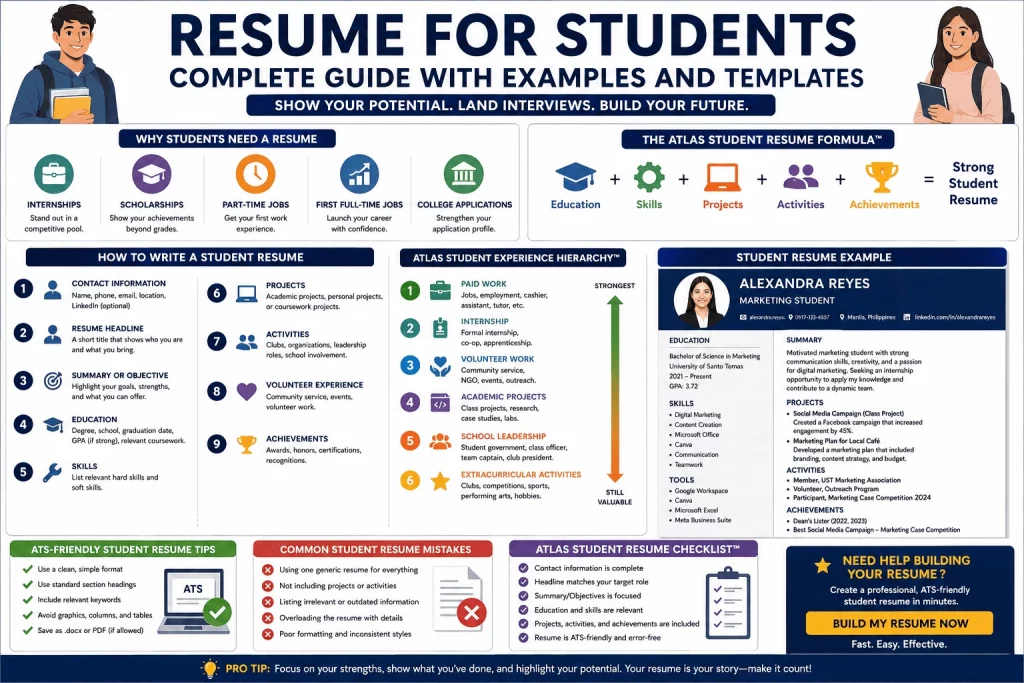
If you’re a student staring at a blank document trying to write your first resume, you’ve probably hit the same wall almost every student hits: “I don’t have any real experience — what do I even put on this?”
Here’s the truth: you have more to work with than you think, and a resume for students isn’t judged by the same standard as a resume for a ten-year industry veteran. Employers, scholarship committees, and internship coordinators reviewing student applications already expect a thinner work history. What they’re actually evaluating is potential — how you think, what you’ve built, how you’ve contributed, and whether you show initiative even without a long employment record behind you.
A well-built student resume matters for more situations than most students realize:
- Internships — Most internship applications require a resume as the first screening document, and for many students, this is the very first resume they’ll ever submit.
- Scholarships — Many scholarship committees request a resume alongside an application essay, using it to evaluate a candidate’s activities, leadership, and achievements beyond grades alone.
- Part-time jobs — Retail, food service, tutoring, and campus jobs almost always ask for a resume, even for entry-level, hourly positions.
- First full-time jobs — For graduating students, the resume built during school often becomes the foundation of the resume used to launch an actual career.
- College applications — Some college and university application processes, particularly for competitive programs, transfer applications, or honors tracks, request a resume to supplement the primary application materials.
In every one of these situations, the resume is doing the same job: translating your education, activities, and potential into a document that a stranger — a recruiter, a scholarship reviewer, an admissions officer — can quickly understand and trust. What makes this challenging for students specifically is that most resume advice online is written for professionals who already have years of work history to draw from. That advice doesn’t translate well to a seventeen-year-old applying for their first part-time job, or a sophomore applying for a summer internship with nothing but coursework and a couple of club memberships to show for it.
That gap is exactly what this guide is built to close. Rather than treating “no experience” as a problem to apologize for, this guide treats it as a starting point — one where education, projects, activities, and academic achievement become legitimate, resume-worthy content in their own right, not a placeholder until “real” experience comes along. Every recruiter, scholarship committee, and internship coordinator reading a student’s resume already understands that a student resume looks different from a twenty-year professional’s resume. The goal isn’t to disguise that difference — it’s to present it as confidently and clearly as possible.
This guide walks through exactly how to build that document from scratch, with proven frameworks, real examples, and a checklist to confirm you haven’t missed anything before you hit submit. Whether you’re a high schooler writing your very first resume, a college student preparing for internship season, or a graduating senior transitioning into the professional job market, the structure and principles below apply directly to your situation — with specific guidance for each stage along the way.
What Is a Student Resume?
A student resume is a resume designed to highlight education, skills, projects, volunteer work, extracurricular activities, and achievements when professional work experience is limited. Instead of leading with a long employment history — the way a traditional professional resume would — a student resume leads with the strongest, most relevant proof of ability a student actually has access to: academic performance, coursework, campus involvement, and any hands-on projects or part-time roles completed so far.
The goal isn’t to pretend you have experience you don’t have. It’s to present the experience you do have — academic, extracurricular, and informal — in a structured, professional format that a recruiter or reviewer can evaluate seriously.
The Atlas Student Resume Formula™
Every strong student resume can be broken down into five essential building blocks. Think of this as the core equation behind every effective student resume, regardless of your stage or target opportunity.
Student Resume =
Education + Skills + Projects + Activities + Achievements = Strong Student Resume
Each component plays a distinct role. Education establishes your academic foundation and credibility. Skills demonstrate practical, applicable ability. Projects prove you can actually execute — not just learn theory. Activities show initiative, leadership, and time-management outside the classroom. And achievements — awards, honors, recognitions — provide third-party validation that you stand out. Miss any one of these five components, and your resume starts to feel thin. Include all five, thoughtfully, and even a student with zero formal work experience can produce a resume that reads as genuinely compelling.
It’s worth noting that these five components don’t need to appear as five separate, equally weighted sections on every resume. A high school student might combine activities and achievements into a single section, while a college student nearing graduation might expand projects into its own detailed, multi-entry section while condensing activities into a brief list. The formula isn’t a rigid template — it’s a checklist of substance. As long as all five categories are represented somewhere in the document, the specific section structure can flex to fit your particular mix of experience.
The Atlas Student Resume Anatomy™
While the formula above defines what goes into a strong student resume, the order those pieces appear in on the page matters just as much. Here’s the recommended top-to-bottom structure:
Name
        ↓
Headline
        ↓
Summary
        ↓
Education
        ↓
Skills
        ↓
Projects
        ↓
Activities
        ↓
Achievements
This order isn’t arbitrary — it follows the same logic recruiters and reviewers naturally use when scanning a resume. Your name and headline establish who you are and what you’re pursuing in the first few seconds. Your summary gives context before any details are read. Education comes next because, for most students, it’s the strongest and most immediately credible section. From there, skills, projects, and activities build outward from credentials into demonstrated ability and initiative, before achievements close the document with third-party validation. Following this anatomy consistently also makes your resume easier to scan quickly — which matters both for a recruiter skimming applications by hand and for an ATS parser mapping your content into structured fields, since both benefit from a predictable, linear flow rather than sections placed in an unconventional order.
Ready to put this formula into action? Build a resume that combines all five elements automatically using our Free Resume Builder — designed specifically for students and first-time job seekers.
Why Students Need a Resume
A resume isn’t just a formality — it’s the single document that opens (or closes) the door to nearly every early opportunity a student pursues. Here’s where it matters most:
Applying for Internships Internship programs, especially competitive ones, use the resume as the first filter before any interview is scheduled. A clear, well-organized resume signals to the internship coordinator that you take the opportunity seriously, and it’s often the only piece of information they have about you before deciding whether to move forward — which makes getting it right disproportionately important relative to the effort it takes to build.
Part-Time Jobs Even hourly, entry-level positions in retail, food service, or tutoring frequently request a resume as part of the hiring process, particularly at larger companies with more formal HR procedures. In a competitive local job market, a well-organized resume can distinguish you from other applicants who submitted something rushed or incomplete.
Campus Positions Many colleges and universities hire students for on-campus roles — research assistantships, library positions, student ambassador programs, and administrative support roles — nearly all of which require a resume as part of the application. These positions are often a valuable first source of resume-worthy experience in their own right, creating a positive cycle where an early campus job strengthens the resume used for the next opportunity.
Scholarships Merit-based and activity-based scholarships often ask for a resume to evaluate a candidate holistically, beyond grades and test scores alone, especially when a scholarship rewards leadership or community involvement. A resume gives scholarship committees a fast, scannable way to see the full picture of a candidate’s involvement, which can be harder to convey within the word limits of an essay alone.
Entry-Level Jobs For students approaching graduation, the resume becomes the primary tool for transitioning from student life into the professional workforce, and it typically evolves directly from the resume built during school. Rather than starting over, most graduates simply refine and expand the same document — swapping in internship or capstone experience where activities once stood, and gradually shifting the balance toward professional achievement as real work history accumulates.
The Atlas Student Resume Roadmap™
Not every student needs to emphasize the same things. Your resume’s focus should shift depending on where you are in your academic journey.
| Student Stage | Resume Goal |
|---|---|
| High School | Activities + Skills |
| College Student | Projects + Internships |
| Fresh Graduate | Education + Experience |
| Job Seeker | Professional Positioning |
High school students typically have the least formal experience to draw from, so the resume should lean heavily on extracurricular activities, part-time or informal work, and demonstrable skills — communication, teamwork, technical tools, or language proficiency. At this stage, even small commitments — a regular babysitting client, a summer reading program, a school committee — can be framed as legitimate, structured experience.
College students are usually building toward internships, so the resume shifts focus toward specific class projects, capstone work, and any internship or co-op experience already completed, alongside continued activity involvement. This is typically the stage where the “Projects” section starts to carry real weight, since college-level coursework tends to produce more substantial, portfolio-worthy output than earlier academic work.
Fresh graduates are approaching the professional job market directly, so the resume should balance academic credentials with any experience gained — internships, part-time roles, or research work — while starting to frame that experience in terms of professional impact rather than academic completion. This is often the point where GPA and coursework detail begin to shrink, making room for accomplishment-driven bullet points instead.
Job seekers actively applying for entry-level professional roles need a resume that reads less like a student’s résumé and more like a professional’s, with achievements and outcomes positioned front and center, even if the underlying experience came from school-related work. At this stage, the resume should increasingly mirror the structure and tone of a standard professional resume, even if the individual entries are still rooted in academic or early-career experience.
Use this roadmap to decide where to put your emphasis before you even start writing — it will save you from spending equal time on sections that don’t carry equal weight for your specific stage, and it gives you a clear reference point to revisit as you move from one stage to the next over the course of your academic journey.
How to Write a Resume for Students
Follow these eight steps in order to build a complete, well-structured student resume from the ground up.
Step 1: Contact Information
Start with the basics: full name, phone number, professional email address, city and state (or province), and — if relevant to your field — a LinkedIn profile or portfolio link. Keep this section clean and free of unnecessary detail like a full mailing address or a photo, both of which are unnecessary on a modern resume and can even create formatting risk when the document is processed by hiring software. If your current email address is informal or outdated — something created years earlier for a school project, for example — it’s worth creating a simple, professional-looking address using some combination of your first and last name specifically for job applications.
Step 2: Resume Headline
A resume headline is a short, one-line phrase placed near the top of your resume that immediately communicates who you are and what you’re pursuing — for example, “Marketing Student Seeking Summer Internship” or “Computer Science Major with a Focus on Web Development.” It gives a recruiter instant context before they even read your summary, and it’s particularly valuable for students, since it clarifies your field and stage right away, before your relatively short resume gives the reader much else to go on.
→ For detailed examples, see our guide to Resume Headline Examples.
Step 3: Resume Summary or Objective
Directly beneath your headline, include a two-to-three sentence summary or objective statement. A summary works well if you already have some relevant experience to highlight concisely — for example, a completed internship or a strong project directly related to your target role. An objective statement — which focuses more on your goals and what you’re seeking — tends to work better for students with very limited experience, since it frames your intent clearly without needing much prior accomplishment to draw from. Either way, this section should be tailored specifically to the opportunity you’re applying for, rather than written once and reused unchanged across every application.
→ See our full breakdown of Resume Summary Examples and Resume Objective Examples for wording you can adapt.
Step 4: Education
For most students, education is the strongest, most credible section on the resume — so it deserves a prominent, early placement (typically right after your summary or objective).
Example structure:
- Degree (or expected degree, with anticipated graduation date)
- School name
- Graduation date (or expected graduation date)
- GPA (optional — include only if it strengthens your application, generally 3.0 or higher on a 4.0 scale, or the equivalent in your grading system)
- Relevant coursework (particularly useful for students with limited work experience, since it demonstrates applied academic knowledge directly relevant to the target role)
As you gain more experience — internships, part-time jobs, substantial projects — this section naturally becomes shorter and moves further down the page, making room for experience-based sections to take the lead instead.
Step 5: Skills Section
List both hard skills (technical, teachable abilities like specific software, tools, or languages) and soft skills (communication, teamwork, adaptability) that are directly relevant to the opportunity you’re applying for. Avoid vague, generic entries — be as specific as possible. Instead of listing “computer skills,” name the actual software or platforms you’re proficient in. Instead of listing “good communicator,” consider demonstrating that skill through a bullet point in your projects or activities section instead, since specific, demonstrated skills consistently carry more weight than generic self-descriptions.
→ For a complete list of student-relevant hard and soft skills, see our Skills for Resume guide.
Step 6: Projects
This is one of the most underused sections on student resumes, and one of the most valuable. Include:
- Student projects — significant assignments or group projects that demonstrate applied skill
- Capstone projects — final-year or major academic projects that showcase depth of knowledge
- Personal projects — self-initiated work, such as a personal website, an app, a research initiative, or a creative portfolio piece, completed outside of formal coursework
Projects are powerful because they give a recruiter concrete, specific proof of what you can actually do — something a list of classes or a GPA alone can’t fully demonstrate. When describing a project, briefly note the goal, your specific role or contribution (especially in group work), the tools or methods used, and — if possible — a measurable or observable outcome.
Step 7: Activities
Include organizations, leadership positions, and school clubs that show initiative and involvement beyond the classroom:
- Student government or club leadership positions
- Athletic teams or performance groups
- Academic or professional student organizations
- Event planning or organizing committees
Leadership roles — even informal ones, like organizing a club event or leading a group project — are worth highlighting explicitly, since leadership signals are heavily weighted by many recruiters evaluating entry-level candidates. Where possible, describe not just the title you held, but what you actually did in that role and what came out of it.
Step 8: Volunteer Experience
Community work, school event support, and NGO involvement all belong here. Volunteer experience demonstrates initiative, reliability, and — depending on the role — relevant transferable skills, and it’s often one of the easiest sections for students to build out even with a limited formal work history. Treat volunteer entries with the same structure and specificity as a paid role: what organization, what you did, and what impact or outcome resulted from it.
The Atlas Student Experience Hierarchy™
Students often think: “I have no experience.”
This is almost never actually true — it’s usually a framing problem, not a content problem. The Atlas Student Experience Hierarchy™ reframes what counts as legitimate resume content, starting from the most traditionally weighted experience down to often-overlooked categories that still carry real value:
- Paid Work
- Internship
- Volunteer Work
- Academic Projects
- School Leadership
- Extracurricular Activities
Notice that paid work and internships sit at the top — they’re the most immediately recognizable to a recruiter, since they carry the clearest signal of real-world, professional-context experience. But the hierarchy doesn’t stop there, and it shouldn’t. Volunteer work, academic projects, school leadership, and extracurricular activities are all legitimate resume content, and for many students — especially high schoolers and early college students — these lower tiers make up the majority of what actually goes on the resume. The key insight is that a resume built entirely from tiers three through six can still be a genuinely strong resume, as long as it’s presented with the same structure, specificity, and professionalism as a resume built from tiers one and two.
In practice, this means treating a volunteer shift, a class project, or a club leadership role with the same bullet-point structure you’d use for a paying job: what you did, how you did it, and what resulted from it. A club treasurer who managed a budget and organized fundraising events has genuinely relevant, transferable experience — even though no paycheck was involved — and describing it with the same clarity and specificity as a paid role makes that experience land with the same credibility on the page.
Student Resume Examples
Different situations call for different emphasis. Here’s a breakdown of the most common student resume types and what makes each one work.
High School Student Resume Example
A high school resume typically leads with activities and skills rather than formal work experience. Extracurricular involvement — clubs, sports, volunteer work — often takes center stage, alongside any part-time or informal work like babysitting, tutoring, or freelance tasks. Coursework relevant to the target opportunity (advanced classes, honors programs) can also strengthen this version. Because high school students are typically the earliest in their academic journey, this version leans hardest on framing everyday involvement — a part-time job, a club role, a volunteer shift — with the same structure and clarity a professional resume would use for paid work.
College Student Resume Example
A college resume shifts toward projects and internships as the primary proof points, supported by continued activity involvement and campus leadership. This version often introduces a dedicated “Projects” section for the first time, since college coursework tends to produce more substantial, resume-worthy work than earlier academic stages. By this point, many students are also holding down part-time campus jobs or off-campus roles, which start to carry more weight alongside the academic content.
University Student Resume Example
Similar to the college student version, but often includes more advanced coursework, research involvement, or teaching assistant roles, particularly for students in their junior or senior years who are building toward a specific career path. Students at this stage are also more likely to have completed at least one internship, which typically becomes the anchor of the entire resume once it’s added.
Student Resume for Internship
This version is tailored specifically to a target internship posting, with the professional summary, skills section, and any relevant coursework or projects adjusted to closely mirror the internship’s specific requirements and keywords. Because internship postings are often reviewed by the same recruiting teams — and sometimes the same ATS platforms — used for full-time hiring, applying the same ATS-friendly formatting principles covered earlier in this guide matters just as much here as it does for a professional applicant.
Student Resume for Part-Time Job
A more compact, straightforward version focused on availability, reliability, relevant soft skills (customer service, communication, teamwork), and any prior part-time or informal work experience — since part-time employers are typically evaluating for dependability and basic competency rather than specialized technical skill. This version can often be slightly shorter and less detailed than an internship-focused resume, since part-time hiring managers are usually reviewing a higher volume of applications and reading each one quickly.
Student Resume Templates
Overview only — a full breakdown of downloadable and builder-based Resume Templates for Students is covered in a dedicated companion guide. In general, students have two main options: downloading a pre-formatted template and filling it in manually, or using a guided resume builder that handles formatting automatically. Both approaches can work well, but the right choice often comes down to how comfortable you are maintaining consistent formatting on your own — something covered in more depth later in this guide.
ATS-Friendly Student Resume
Regardless of which template style a student chooses, it should follow ATS-friendly formatting principles to ensure it’s parsed correctly by hiring software:
- Simple format — single-column layout, no graphics, tables, or text boxes
- Standard headings — Education, Skills, Experience, Projects, Activities, rather than creative section titles
- ATS keywords — terminology pulled directly from the internship or job posting, integrated naturally throughout the resume content
This matters just as much for students as it does for experienced professionals. Many students assume ATS screening only applies to corporate job applications, but a growing number of internship programs — particularly at larger companies — route applications through the same automated screening systems used for full-time hiring. A student resume built with decorative graphics or a multi-column layout runs the same parsing risk as any other resume, which means the ATS-friendly formatting principles covered throughout this site apply directly to student applicants as well, not just seasoned job seekers.
→ For a complete breakdown of ATS formatting rules and template tiers, see our full guide to ATS-Friendly Resume Templates.
The Atlas Student Resume Score™
Use this simple scoring framework to evaluate how complete and well-rounded your student resume is before submitting it.
| Area | Points |
|---|---|
| Education | 20 |
| Skills | 20 |
| Projects | 20 |
| Activities | 20 |
| Formatting | 20 |
A resume that scores well across all five areas reflects the full Atlas Student Resume Formula™ in action — strong academic credentials, clearly listed skills, demonstrated project work, visible activity involvement, and clean, ATS-friendly formatting. If any single area is scoring low, that’s a direct signal of where to focus your revisions before your next application.
Common Student Resume Mistakes
Even motivated students make avoidable mistakes that weaken an otherwise solid resume. Watch for these five common issues.
Using One Generic Resume
Submitting the exact same resume to every opportunity — regardless of whether it’s an internship, a scholarship, or a part-time job — significantly weakens your relevance to each individual application. Even small adjustments to your summary, skills, and highlighted projects can meaningfully improve how well your resume matches what each specific opportunity is looking for. It doesn’t require rebuilding the resume from scratch each time — often, adjusting just the top third of the document (headline, summary, and top skills) is enough to noticeably improve relevance for a specific posting.
Ignoring Projects
Many students underestimate how valuable their coursework and personal projects actually are, leaving this section thin or omitting it entirely. This is a missed opportunity, since projects are often the most concrete, specific proof of ability a student can offer in place of formal work experience. A group project that resulted in a working prototype, a research paper, or a completed campaign is genuinely resume-worthy content — don’t leave it out simply because it wasn’t a paid assignment.
Listing Irrelevant Information
Including outdated, unrelated, or overly personal details — like unrelated hobbies with no connection to the target opportunity, or information from many years earlier that no longer reflects your current skill level — dilutes the resume’s focus and takes up space that could be used for more relevant content. As a general rule, if a piece of information doesn’t support the specific opportunity you’re applying for, it’s worth cutting, even if it feels like a meaningful personal detail to include.
Poor Formatting
Overly designed templates, inconsistent fonts, or cluttered layouts can make a resume harder to read for both human reviewers and, in some cases, ATS software used to screen larger applicant pools. Clean, consistent formatting should always take priority over decorative styling. This is especially important for students, who may be tempted to reach for visually elaborate templates to compensate for a shorter resume — when in reality, a clean, well-organized one-pager reads as more professional than a busy, over-designed document.
Missing Keywords
Failing to mirror the specific language used in the internship, scholarship, or job posting — the exact skills, tools, or qualifications mentioned — makes it harder for both automated systems and human reviewers to quickly recognize your fit for the opportunity. Before submitting, it’s worth reading the posting one more time and checking whether the specific terms it uses actually appear somewhere in your resume, in a natural, accurate way.
The Atlas Student Resume Checklist™
Before submitting your resume, confirm every item on this list:
- ✓ Contact information
- ✓ Resume headline
- ✓ Summary/objective
- ✓ Education
- ✓ Skills
- ✓ Projects
- ✓ Activities
- ✓ ATS-friendly format
If you can check off every item, your resume covers the full range of content a strong student application needs — and it’s structured in a way that both a human reviewer and an ATS parsing system can process cleanly.
Want a resume that checks every one of these boxes automatically? Build yours in minutes with our Free Resume Builder — pre-formatted, ATS-tested, and designed with students in mind.
Student Resume vs Professional Resume
While both document types share the same fundamental goal — presenting your qualifications clearly and persuasively — the emphasis and structure differ in a few important ways.
| Element | Student Resume | Professional Resume |
|---|---|---|
| Primary Focus | Education, projects, activities | Work history, achievements |
| Section Order | Education often listed first | Work experience often listed first |
| Experience Type | Academic, volunteer, informal work | Paid, professional roles |
| Length | Typically one page | One to two pages, depending on experience |
| Keywords | Coursework, skills, campus involvement | Job titles, industry-specific achievements |
| Formatting Priority | Clarity and ATS compatibility | Clarity, ATS compatibility, and achievement metrics |
As a student gains more formal work experience over time, their resume gradually shifts from the student model toward the professional model — work experience moves earlier in the document, achievements become more metric-driven, and academic details (like coursework and GPA) typically get trimmed down or removed entirely once several years of professional experience have been established.
There’s no fixed rule for exactly when this transition happens — it depends more on the strength and relevance of the experience accumulated than on a specific number of years since graduation. A fresh graduate with a strong, directly relevant internship might shift toward a more professional structure almost immediately, while another graduate in a less linear career path might continue leaning on academic and activity-based content for a while longer. The safest approach is to let the strength of your actual content guide the structure: once your work experience section is substantial enough to stand on its own, it’s usually time to let it lead the resume.
Why Use a Resume Builder?
Building a resume from scratch — especially for a first-time job seeker unfamiliar with formatting conventions — can be time-consuming and easy to get wrong. A dedicated resume builder removes much of that friction. Here’s what a good resume builder offers:
Faster Creation Instead of manually formatting a document from a blank page, a builder provides a pre-structured layout, letting you focus purely on the content rather than spacing, margins, and section order. For a student juggling coursework, activities, and applications, this time savings can be the difference between submitting a polished resume before a deadline or scrambling to piece one together at the last minute.
ATS Optimization A well-designed resume builder is already structured to pass through Applicant Tracking Systems cleanly, removing the guesswork around fonts, columns, and formatting choices covered earlier in this guide. This matters more than most students expect — even internship postings at larger companies are increasingly screened through the same ATS platforms used for full-time hiring.
Professional Formatting Even students with no design experience can produce a clean, polished, recruiter-ready document, since the visual structure is already handled by the tool. This levels the playing field somewhat between students who happen to have design skills or access to premium templates, and those who don’t.
Beginner-Friendly For students building their very first resume, a guided builder experience — with prompts, examples, and section-by-section guidance — significantly lowers the barrier to producing a genuinely strong first draft. Rather than staring at a blank page wondering what belongs in a “Skills” section or how to phrase a bullet point about a school project, a good builder walks you through each decision with concrete examples to draw from.
Beyond these core benefits, a resume builder also makes it far easier to maintain multiple tailored versions of your resume — one for internship applications, another for part-time work, another for scholarship submissions — without having to manually rebuild the formatting each time. As your experience grows and your resume evolves from a student-focused document into a more professional one, a builder-based resume is also easier to update incrementally, rather than requiring a full redesign every time you add a new role or achievement.
Building your very first resume? Skip the blank page entirely and start with a guided, ATS-friendly structure using our Free Resume Builder — built specifically for students with limited experience.
Frequently Asked Questions
Can students create a resume without work experience?
Yes. A student resume is specifically designed to work even when formal, paid work experience is limited or nonexistent. By leading with education, skills, projects, activities, and achievements — the five components of the Atlas Student Resume Formula™ — students can build a genuinely strong, credible resume using academic and extracurricular experience alone.
What should students put on a resume?
At minimum, a student resume should include contact information, a resume headline, a summary or objective statement, education, skills, and at least one additional section — projects, activities, or volunteer experience — that demonstrates practical ability or initiative beyond the classroom. Students with some work history, even informal or part-time, should include that as well.
How long should a student resume be?
One page is the standard length for most student resumes, particularly for high school students, college students, and fresh graduates with limited experience. A one-page format forces clarity and prioritization, which tends to produce a stronger, more focused document than trying to stretch content across additional pages.
Should students include GPA?
Including GPA is optional and depends on the number. If your GPA is strong — generally 3.0 or higher on a 4.0 scale, or the equivalent under your school’s grading system — including it can strengthen your application, particularly for academically competitive opportunities. If your GPA doesn’t clearly support your candidacy, it’s usually better to leave it off and let your skills, projects, and activities carry the resume instead.
What skills should students put on a resume?
Students should include a mix of hard skills — specific tools, software, technical abilities, or language proficiency relevant to the target opportunity — and soft skills, such as communication, teamwork, time management, and adaptability. The strongest approach is to review the specific internship, job, or scholarship requirements and prioritize the skills that most directly match what’s being requested.
Is a resume builder good for students?
Yes, particularly for students building their first resume. A resume builder removes much of the formatting guesswork, ensures ATS-friendly structure from the start, and often provides guided prompts or examples that help students figure out what to include — even when they’re unsure how to translate their academic and extracurricular experience into resume-ready content.
Do I need a different resume for every application?
Not an entirely different document, but you should tailor the content each time. Keeping one well-built base resume and adjusting the headline, summary, skills, and highlighted projects to match each specific internship, job, or scholarship description is far more effective than either reusing one unchanged version everywhere or rebuilding the whole document from scratch for every application. Small, targeted adjustments — especially to the top third of the page — are usually enough to noticeably improve relevance.
Conclusion
A strong student resume doesn’t require years of professional experience — it requires the right structure and the right framing. By combining education, skills, projects, activities, and achievements using the Atlas Student Resume Formula™, and by presenting that content in a clean, ATS-friendly format, students at every stage — from high school through fresh graduate — can build a resume that genuinely competes for internships, scholarships, part-time jobs, and first full-time roles.
Use the Atlas Student Resume Roadmap™ to focus your effort on what matters most for your specific stage, run through the Atlas Student Resume Checklist™ before every submission, and remember the Atlas Student Experience Hierarchy™ the next time you catch yourself thinking you have “no experience” to offer — because in almost every case, that simply isn’t true.
Your first resume doesn’t need to be perfect, and it doesn’t need to compete with a decade of professional experience it was never meant to have. It needs to accurately, clearly, and confidently represent what you’ve actually done — in the classroom, in your community, in your projects, and in the small leadership moments that add up to something worth putting on paper. Get that foundation right now, and every resume you build afterward — through college, through your first job, and beyond — will be easier for it.
Ready to build your resume? Put everything in this guide into practice with our Free Resume Builder — a guided, ATS-friendly resume tool designed specifically for students.
Related Guides
- ATS-Friendly Resume Templates: Best Templates That Pass ATS
- Resume Templates: Best Resume Templates for Every Career
- Resume Headline Examples: 300+ Professional Resume Headlines for Every Job
- Resume Action Verbs: 500+ Powerful Resume Verbs for Every Profession
- Resume Achievements Examples: 300+ Achievement Statements for Every Profession
- Resume Format Examples: Best Resume Formats for Every Career
- Work Experience Examples for Resume: 200+ Examples by Profession
- Skills for Resume: 300+ Skills Examples for Every Profession
- Resume Summary Examples: 150 Professional Summary Examples for Every Job
- Resume Builder: Complete Guide to Creating a Professional Resume
- Resume Objective Examples: 150+ Examples for Every Job
- Application Letter for Fresh Graduates: Sample and Writing Guide
- Free Application Letter Generator for Government Jobs and Private Companies
- Application Letter for Administrative Assistant I: Complete Sample and Writing Guide
- Application Letter for Teacher I: Sample, Format, and Writing Guide
- Application Letter for Nurse I: Sample and Writing Guide