Last Updated: July 5, 2026
Effective Salary Schedule: January 1, 2026 (Third Tranche)
Verified Against: Executive Order No. 64, s. 2024; DBM National Budget Circular No. 601; Civil Service Commission (CSC); Official Gazette
Salary Grade (SG) 17 is one of the compensation levels under the Philippine government’s Compensation and Position Classification System. It applies to a range of professional, technical, supervisory, and specialist positions across national government agencies, state universities and colleges, and other government institutions.
If you’re applying for a government position, planning your career, or comparing compensation levels, understanding Salary Grade 17 helps you determine the expected monthly salary, career progression opportunities, qualification requirements, and government benefits associated with the position.
Because government salary schedules are periodically updated through legislation and official issuances, always refer to the latest salary schedule published by the Department of Budget and Management and other official government sources.
Quick Answer
Salary Grade 17 is a government compensation level under the Philippine Salary Standardization system. Employees assigned to SG 17 receive a monthly basic salary based on their salary step, with Step 1 representing the entry rate and higher steps reflecting salary progression through longevity or advancement. In addition to the basic salary, eligible employees may receive statutory government benefits and authorized allowances, subject to applicable laws and regulations.
💡 Working toward an SG 17 position? Most SG 17 roles require Civil Service eligibility. Practice for free with our CSE Reviewer — mock exams and drills for all subjects. Start practicing free →
Key Takeaways
- Salary Grade 17 is intended for mid- to senior-level professional and supervisory government positions.
- Monthly pay depends on the employee’s assigned salary step.
- Salary progression occurs through the salary step system established by government compensation rules.
- Employees may receive additional benefits such as GSIS, PhilHealth, Pag-IBIG, leave benefits, and authorized allowances.
- Official salary rates should always be verified using the latest issuances from the Department of Budget and Management.
TL;DR
If you’re considering a government career, Salary Grade 17 represents a competitive compensation level for experienced professionals and supervisors. Beyond the monthly basic salary, employees generally enjoy comprehensive government benefits, structured career advancement, and stable employment. However, the exact salary depends on the officially approved salary schedule and the employee’s salary step.
What Is Salary Grade 17?
Salary Grade 17 (SG 17) is a compensation level under the Philippine government’s Compensation and Position Classification System. It is assigned to qualified professional, technical, and supervisory positions whose duties require greater responsibility, specialized expertise, and decision-making authority than lower salary grades. The actual monthly basic salary depends on the employee’s assigned salary step under the current government salary schedule.
Definition
The Philippine government uses a standardized salary grading system to ensure fair and consistent compensation across agencies. Each plantilla position is assigned a specific salary grade based on factors such as:
- Complexity of duties
- Scope of responsibility
- Required education
- Work experience
- Training
- Supervisory functions
- Accountability
Salary Grade 17 falls within the middle-to-upper range of the government’s 33-grade salary structure. Employees at this level typically possess substantial professional experience and may supervise teams, manage programs, or perform highly technical work.
Where It Fits in the Government Salary System
The government compensation system consists of 33 salary grades, with higher grades corresponding to positions involving greater responsibility and more complex functions.
| Salary Grade | General Level |
| SG 1–10 | Entry-level and support positions |
| SG 11–16 | Professional and technical positions (see SG 16 guide) |
| SG 17 | Experienced professionals and supervisors |
| SG 18–24 | Managers, division chiefs, and senior specialists (see SG 18 guide) |
| SG 25–33 | Executive and top management positions |
While Salary Grade 17 is not an executive level, it is considered an important career milestone for many government employees because it often represents the transition from purely technical work to supervisory or higher-level professional responsibilities.
Typical Characteristics of Salary Grade 17 Positions
Although job titles differ among government agencies, positions under Salary Grade 17 generally share several characteristics:
- Require specialized professional knowledge
- May involve supervising personnel or projects
- Demand independent judgment and decision-making
- Require compliance with government standards and regulations
- Contribute to policy implementation, technical operations, or public service delivery
Depending on the agency, employees may work in areas such as administration, finance and accounting, engineering, information technology, health services, education, legal services, planning and development, human resource management, and research and statistics.
Why Salary Grade 17 Matters
For many civil servants, SG 17 represents a significant point in career progression. Reaching this salary grade often reflects increased expertise, leadership responsibilities, and opportunities for advancement into higher supervisory or managerial positions. It can also lead to higher monthly compensation, increased retirement contributions, higher GSIS benefits, greater promotion opportunities, and expanded leadership responsibilities.
In summary: Salary Grade 17 is designed for experienced government professionals and supervisors who perform specialized or leadership functions. It offers structured compensation, career growth opportunities, and access to the standard benefits available to eligible government employees.
Salary Grade 17 Salary Table
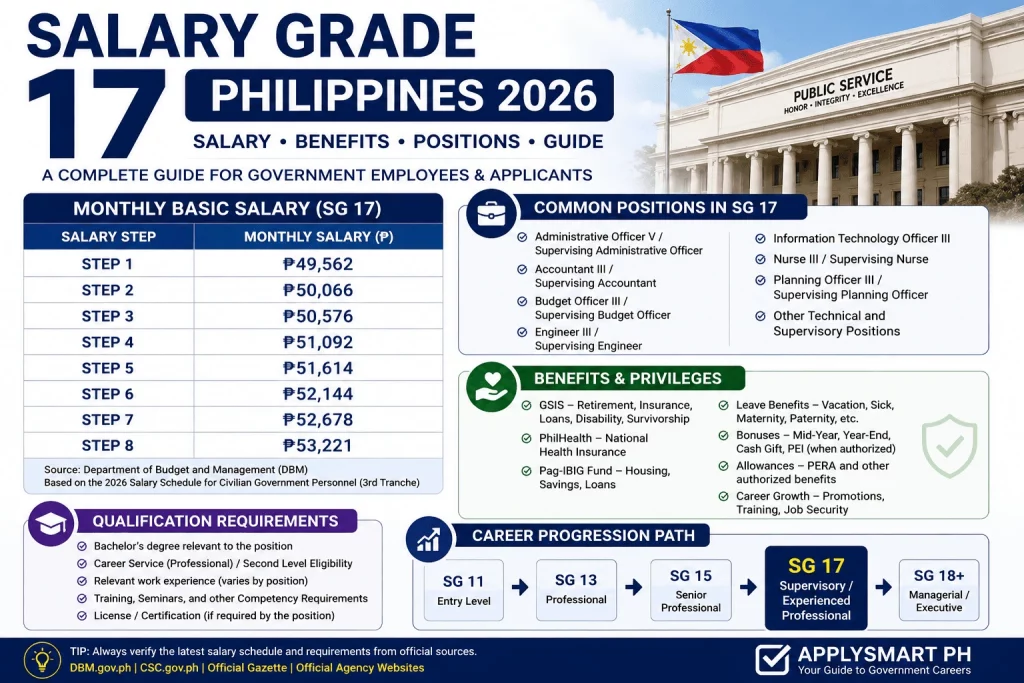
Under the current government salary schedule’s third tranche, effective January 1, 2026, employees under Salary Grade 17 receive a monthly basic salary ranging from ₱49,562 (Step 1) to ₱53,221 (Step 8). The exact amount depends on the employee’s salary step, which reflects length of service and salary progression.
⚠️ Verification note: These figures should be cross-checked against Annex A of DBM National Budget Circular No. 601 before publishing, since exact per-step amounts should always come from the official issuance rather than a secondary source.
Official Monthly Salary by Step
| Salary Step | Monthly Basic Salary |
| Step 1 | ₱49,562 |
| Step 2 | ₱50,066 |
| Step 3 | ₱50,576 |
| Step 4 | ₱51,092 |
| Step 5 | ₱51,614 |
| Step 6 | ₱52,144 |
| Step 7 | ₱52,678 |
| Step 8 | ₱53,221 |
These figures represent basic monthly salary only and do not include authorized allowances, bonuses, incentives, or other employee benefits that may be available under existing laws and government policies.
Effective Date
The salary rates above took effect on January 1, 2026 as part of the third tranche of the updated salary schedule for civilian government personnel. Government agencies are required to implement these rates in accordance with the implementing guidelines issued by the Department of Budget and Management.
Legal Basis
The Salary Grade 17 salary schedule is implemented pursuant to:
- Executive Order No. 64, s. 2024, which updated the salary schedule for civilian government personnel.
- DBM National Budget Circular No. 601 (dated January 22, 2026), which provides the guidelines for implementing the third tranche effective January 1, 2026.
How Salary Steps Affect Pay
Although employees share the same salary grade, their monthly salary may differ because of the salary step system. Step 1 is the hiring or entry rate; higher steps are earned through authorized salary step increments based on applicable government rules. Moving to a higher step increases basic pay while remaining within the same salary grade.
For Salary Grade 17, the difference between Step 1 and Step 8 is ₱3,659 per month, reflecting the structured progression within the grade.
Common Positions Under Salary Grade 17
Salary Grade 17 is commonly assigned to experienced professional, technical, and supervisory positions in the Philippine government. While the salary grade remains the same, the specific job title, duties, and qualification requirements vary depending on the agency and its approved staffing pattern.
Typical Government Positions
Salary Grade 17 may be assigned to positions in national government agencies, constitutional offices, state universities and colleges, government-owned and controlled corporations (subject to applicable compensation rules), and local government units that follow the national compensation framework.
| Position (Examples) | Functional Area |
| Administrative Officer V | Administration |
| Budget Officer II | Budget and Finance |
| Accountant III | Accounting |
| Engineer II | Engineering |
| Planning Officer III | Planning and Development |
| Information Systems Analyst II | Information Technology |
| Human Resource Management Officer III | Human Resources |
| Legal Officer II | Legal Services |
| Statistician III | Statistics and Research |
| Agriculturist III | Agriculture |
| Social Welfare Officer III | Social Services |
| Science Research Specialist III | Research and Development |
Note: Position titles and salary grades may differ among agencies depending on the approved staffing pattern, classification standards, and applicable laws. Always verify the official plantilla or vacancy announcement.
Nature of the Work
Employees occupying Salary Grade 17 positions typically supervise personnel or technical teams, manage programs or specialized functions, prepare technical reports and recommendations, ensure compliance with government laws and regulations, coordinate with multiple offices and stakeholders, analyze policies and operational issues, and provide expert advice within their area of specialization.
Compared with lower salary grades, SG 17 positions usually require greater independence in decision-making and accountability for organizational outcomes.
Qualification Requirements
The qualifications for Salary Grade 17 positions are determined using the qualification standards prescribed by the Civil Service Commission and the specific agency’s approved position description.
| Requirement | Typical Expectation |
| Education | Bachelor’s degree relevant to the position |
| Experience | Several years of relevant work experience |
| Training | Relevant professional or technical training |
| Eligibility | Appropriate Civil Service eligibility or professional license, when required |
Some positions—such as engineers, accountants, nurses, architects, or lawyers—also require a valid professional license in addition to Civil Service requirements.
Career Progression
Salary Grade 17 is often reached after gaining experience in positions classified under Salary Grades 15 or 16. It can also serve as a stepping stone toward higher supervisory and managerial positions, including Salary Grades 18, 19, and above.
| Career Stage | Example Salary Grade |
| Entry-Level Professional | SG 11–13 |
| Experienced Professional | SG 14–16 |
| Senior Professional / Supervisor | SG 17 |
| Division-Level Supervisor or Manager | SG 18–24 |
| Executive Positions | SG 25–33 |
Promotion depends on available plantilla positions, merit, performance, qualifications, and compliance with applicable Civil Service and agency rules.
How Salary Steps Work
Salary steps determine the exact monthly basic salary an employee receives within the same salary grade. For Salary Grade 17, there are eight salary steps, with Step 1 serving as the entry rate and Step 8 representing the highest basic salary within the grade. Employees progress through these steps based on the rules prescribed by the Philippine government.
What Are Salary Steps?
The Philippine government’s compensation system uses salary steps to recognize an employee’s length of service and continued satisfactory performance while remaining in the same position or salary grade. Instead of receiving the same salary throughout their tenure, an employee may advance from one salary step to the next, resulting in gradual increases in monthly basic pay.
| Salary Step | Purpose |
| Step 1 | Entry salary for newly appointed employees |
| Steps 2–7 | Intermediate salary progression |
| Step 8 | Highest salary within Salary Grade 17 |
How Employees Move to a Higher Step
Movement from one salary step to another is not automatic every year. It is governed by applicable compensation laws, Civil Service rules, and DBM guidelines. Factors that may affect salary step progression include continuous government service, satisfactory or higher performance ratings, compliance with applicable DBM and agency policies, and availability of funding when required by law or issuance.
An employee who advances from Step 1 to Step 8 receives an increase of ₱3,659 in monthly basic salary within the same salary grade.
Salary Step vs. Promotion
Many employees confuse a salary step increase with a promotion, but they are different.
| Salary Step Increase | Promotion |
| Employee remains in the same position and salary grade | Employee moves to a higher position |
| Basic salary increases within the same grade | Salary grade usually increases |
| Based on authorized step progression | Based on appointment to a higher position |
| Responsibilities generally remain the same | Responsibilities typically increase |
A promotion may result in both a higher salary grade and a higher salary step, depending on the appointment and applicable government rules.
Practical Example
Consider two employees occupying the same SG 17 position: Employee A is newly appointed and starts at Step 1, while Employee B has several years of satisfactory service and has progressed to Step 6. Although both hold the same position and salary grade, Employee B receives a higher monthly basic salary because of the higher salary step.
Benefits of Salary Grade 17 Employees
Employees holding Salary Grade 17 positions are generally entitled to the standard compensation and benefits provided to eligible civilian government personnel. In addition to their monthly basic salary, they may receive government-mandated social insurance coverage, paid leave, bonuses, and authorized allowances, subject to existing laws, budget regulations, and agency policies.
GSIS Benefits
Most permanent government employees are covered by the Government Service Insurance System (GSIS), which provides social insurance and financial protection throughout an employee’s career and retirement, including retirement benefits, life insurance, disability benefits, survivorship benefits, separation benefits, and emergency and policy loan programs. The amount of benefits depends on factors such as length of government service, salary, and contributions.
PhilHealth Coverage
Eligible employees are enrolled in the Philippine Health Insurance Corporation (PhilHealth), the country’s national health insurance program, which helps reduce medical expenses through benefits for hospital confinement, outpatient services, selected medical procedures, maternity care, and various health packages.
Pag-IBIG Fund Membership
Government employees are generally members of the Home Development Mutual Fund (Pag-IBIG Fund), which provides access to housing loans, multi-purpose loans, calamity loans, and savings with annual dividends.
Leave Benefits
Salary Grade 17 employees are typically entitled to paid leave credits under Civil Service rules, including Vacation Leave, Sick Leave, Maternity Leave, Paternity Leave, Solo Parent Leave (when applicable), Special Leave Benefits provided by law, Rehabilitation Leave (for qualified cases), and Study Leave (subject to agency approval). Unused leave credits may also be converted to terminal leave benefits upon separation or retirement, subject to applicable laws and regulations.
PERA and Other Allowances
Aside from their monthly basic salary, eligible employees may receive authorized allowances and incentives, including the Personnel Economic Relief Allowance (PERA), Mid-Year Bonus, Year-End Bonus, Cash Gift, Clothing or Uniform Allowance, and Productivity Enhancement Incentive (PEI), when authorized. Not every allowance is guaranteed for every employee — eligibility depends on the employee’s appointment status, agency policies, available appropriations, and applicable government regulations.
Other Employee Benefits
Depending on the position and employing agency, Salary Grade 17 personnel may also enjoy stable government employment, defined promotion pathways, professional development and training opportunities, scholarship and capacity-building programs, security of tenure for qualified permanent employees, and retirement benefits under applicable laws.
Benefits Summary
| Benefit | Typical Coverage |
| GSIS | Retirement, insurance, loans, disability, survivorship |
| PhilHealth | National health insurance |
| Pag-IBIG Fund | Housing, savings, and loan programs |
| Leave Benefits | Vacation, sick, maternity, paternity, and other statutory leaves |
| Bonuses | Mid-Year Bonus, Year-End Bonus, Cash Gift, PEI (when authorized) |
| Allowances | PERA and other authorized benefits |
| Career Benefits | Promotion opportunities, training, and job security |
Salary Grade 17 employees receive more than just a competitive monthly salary — eligible personnel also benefit from comprehensive government-sponsored insurance, healthcare, housing assistance, paid leave, bonuses, and structured career development, making government service an attractive long-term career option.
Salary Grade 17 vs. Salary Grades 16 and 18
Salary Grade 17 sits between Salary Grades 16 and 18 in the Philippine government’s compensation structure. Employees in SG 17 generally earn higher basic salaries and assume greater responsibilities than those in SG 16, while SG 18 positions typically involve broader supervisory, managerial, or highly specialized functions with correspondingly higher compensation.
Salary Comparison
| Salary Grade | Step 1 | Step 8 | Typical Level |
| SG 16 | ₱45,637 | ₱49,003 | Experienced Professional |
| SG 17 | ₱49,562 | ₱53,221 | Senior Professional / Supervisor |
| SG 18 | ₱53,873 | ₱57,855 | Supervisory / Technical Specialist |
(Figures as officially published under the third tranche effective January 1, 2026 — verify against DBM NBC 601, Annex A.)
Responsibilities Compared
| Salary Grade | Typical Responsibilities |
| SG 16 | Performs advanced technical or professional work with limited supervisory functions |
| SG 17 | Leads projects, supervises personnel, and exercises greater independent judgment |
| SG 18 | Manages larger teams, oversees major programs, or performs highly specialized leadership functions |
As employees move from SG 16 to SG 18, they are generally expected to handle more complex assignments, larger budgets or programs, greater accountability, increased supervisory responsibilities, and higher-level policy implementation.
When Should You Aim for SG 17?
Salary Grade 17 may be an appropriate career goal if you have several years of relevant government or professional experience, meet the education, experience, training, and eligibility requirements, are prepared to supervise staff or lead projects, and want greater responsibility and higher compensation without yet entering senior management.
| Your Goal | Recommended Target |
| Gain professional experience | SG 16 |
| Move into supervisory responsibilities | SG 17 |
| Manage divisions or major programs | SG 18 or higher |
How to Qualify for Salary Grade 17 Positions
Qualifying for a Salary Grade 17 (SG 17) position requires meeting the qualification standards established by the Civil Service Commission and the hiring agency — typically the appropriate education, relevant work experience, required training, and the necessary civil service eligibility or professional license.
Educational Requirements
Most Salary Grade 17 positions require at least a bachelor’s degree relevant to the duties of the position:
| Position Field | Typical Degree |
| Accounting | Bachelor of Science in Accountancy |
| Engineering | Bachelor of Science in Engineering |
| Information Technology | BS Information Technology, Computer Science, or related field |
| Human Resources | BS Psychology, Human Resource Management, or related field |
| Planning | Economics, Public Administration, Statistics, or related discipline |
| Agriculture | BS Agriculture |
| Social Welfare | Bachelor of Science in Social Work |
| Legal Services | Bachelor of Laws or Juris Doctor (for lawyer positions) |
Work Experience
SG 17 positions are generally intended for experienced professionals rather than entry-level applicants. Agencies commonly require several years of progressively responsible experience directly related to the functions of the position, demonstrated technical or supervisory competence, and experience managing projects, programs, or personnel. The exact experience requirement is specified in the agency’s approved qualification standards and vacancy announcement.
Training Requirements
Many SG 17 positions also require completion of relevant training programs, such as leadership and supervisory training, technical skills development, government procurement training, financial management courses, project management seminars, human resource development programs, or information systems training.
Civil Service Eligibility
Most permanent government positions require the appropriate eligibility prescribed by the Civil Service Commission, including Career Service Professional Eligibility, Bar Eligibility, a Board or Professional License (for regulated professions), or special eligibilities granted under applicable laws.
✅ Need Career Service Professional Eligibility? Prepare for the CSE now →
Competencies Expected
Beyond the minimum qualification standards, successful SG 17 applicants are often expected to demonstrate leadership, strategic thinking, problem-solving, decision-making, communication skills, technical expertise, planning and organization, team management, and public service orientation.
Application Tips
To improve your chances of qualifying for a Salary Grade 17 position: ensure your educational credentials match the position requirements, maintain an updated Personal Data Sheet (PDS), obtain the required Civil Service eligibility or professional license, complete relevant training and seminars, build substantial work experience, review the qualification standards in the vacancy announcement, and submit complete documentary requirements within the application period.
Applicant Checklist
- Relevant bachelor’s degree (or higher, if required)
- Required Civil Service eligibility or professional license
- Sufficient work experience
- Required training hours
- Updated Personal Data Sheet (PDS)
- Transcript of Records and diploma
- Certificates of employment
- Training certificates
- Performance ratings (if required)
- Other documents specified in the job posting
📋 Checking off “Civil Service eligibility” on your list? Take our free practice exam →
Common Reasons Applicants Are Found Ineligible
Applicants may fail to qualify because they do not meet the required years of experience, lack the prescribed Civil Service eligibility or professional license, have insufficient or unrelated training, submit incomplete application documents, apply for positions outside their educational specialization, or fail to satisfy competency-based assessments conducted by the hiring agency.
Common Mistakes
Many applicants and even current government employees misunderstand how Salary Grade 17 works. Understanding these distinctions can help you make informed career decisions and avoid unnecessary disappointment during the application process.
1. Confusing Salary Grade with Salary Step
| Salary Grade | Salary Step |
| Determines the position’s compensation level | Determines the employee’s salary within that grade |
| Assigned to the position | Assigned to the employee |
| Changes through promotion or reclassification | Changes through authorized salary step progression |
2. Assuming Every SG 17 Position Has the Same Duties — The salary grade reflects the position’s level of responsibility rather than its specific job function. An Engineer II may oversee infrastructure projects, while an Accountant III may supervise financial reporting and compliance.
3. Believing Promotion Is Automatic — Promotions generally require a vacant plantilla position, compliance with qualification standards, merit-based selection, agency approval, and applicable budget and staffing authorization. Length of service may strengthen an application but does not automatically result in promotion.
4. Ignoring Qualification Standards — Some applicants focus primarily on salary while overlooking the minimum qualifications in education, experience, training, eligibility, and competencies.
5. Overlooking Total Compensation — Comparing only the monthly basic salary misses the full picture, which also includes GSIS, PhilHealth, Pag-IBIG, paid leave, bonuses, PERA, and other authorized incentives.
6. Relying on Outdated Salary Tables — Government salary schedules are periodically updated. Always verify salary information using the latest publications from the Department of Budget and Management instead of relying on outdated online articles or social media posts.
Quick Checklist to Avoid Mistakes
- Am I looking at the latest official salary schedule?
- Do I understand the difference between salary grade and salary step?
- Do I meet all qualification standards?
- Am I considering the complete benefits package?
- Have I reviewed the agency’s official vacancy announcement?
Best Practices
To maximize your chances of obtaining and succeeding in a Salary Grade 17 position, focus on building the qualifications, experience, and competencies required by the position, and stay informed about official government policies.
- Verify official salary information through the Department of Budget and Management, the Civil Service Commission, and the Official Gazette.
- Invest in professional development — certifications, government-accredited seminars, graduate studies, and leadership programs.
- Build relevant experience — leading projects, supervising teams, solving complex problems, and managing budgets or programs.
- Maintain excellent performance — integrity, accountability, professionalism, efficiency, and public service commitment.
- Prepare complete application documents — PDS, resume, transcript of records, diploma, certificates of employment and training, eligibility/license, and performance ratings.
- Understand the entire compensation package, not just the basic salary.
Career Success Checklist
| Recommendation | Status |
| Meet education requirements | ✓ |
| Obtain the required eligibility or license | ✓ |
| Gain relevant work experience | ✓ |
| Complete required training | ✓ |
| Develop leadership skills | ✓ |
| Maintain strong performance ratings | ✓ |
| Keep employment records updated | ✓ |
| Monitor official vacancy announcements | ✓ |
| Verify information using official government sources | ✓ |
Expert Tip: Don’t treat Salary Grade 17 as your final career goal. View it as a foundation for advancement into higher supervisory and managerial positions.
Beginner Tips
If you’re aiming for a Salary Grade 17 position, start by understanding the government’s qualification standards and building your credentials gradually. Most employees reach SG 17 after gaining relevant education, experience, training, and professional competence through lower-level government or related private-sector positions.
Key concepts to understand: Salary Grade (SG) — the compensation level assigned to a position; Salary Step — the employee’s pay level within a salary grade; Plantilla Position — a permanent position approved and funded by the government; Qualification Standards — the minimum education, experience, training, and eligibility required for a position.
Don’t be discouraged if you don’t immediately qualify for SG 17 — many professionals build up through SG 11–16 first. Focus on developing communication skills, leadership abilities, project management, report writing, data analysis, problem-solving, computer proficiency, and time management. Keep your PDS, eligibility documents, transcript, diploma, employment and training certificates, and performance evaluations organized and updated.
Monitor official government vacancies through agency websites, the Civil Service Commission Job Portal, official government bulletin boards, and agency HR offices — avoid relying solely on unofficial social media posts.
Beginner Checklist
- Do I understand how salary grades and salary steps work?
- Do I meet the educational requirements?
- Do I possess the required Civil Service eligibility or professional license?
- Have I gained sufficient relevant work experience?
- Have I completed the required training?
- Are my application documents complete and updated?
- Am I monitoring official government job announcements?
Expert Tips
Advancing beyond Salary Grade 17 requires more than meeting the minimum qualifications. Employees who consistently demonstrate leadership, technical expertise, strategic thinking, and strong performance are generally better positioned for promotion to higher supervisory and managerial positions.
Strengthen competencies such as strategic planning, decision-making, team leadership, conflict resolution, coaching and mentoring, performance management, and stakeholder engagement. Build specialized expertise through advanced certifications, graduate studies, technical publications, and participation in inter-agency technical working groups.
Promotions in government are generally based on the Merit Selection Plan (MSP) and applicable Civil Service rules — maintain high performance ratings, complete competency-based training, document accomplishments, demonstrate innovation, and build a strong record of ethical conduct.
| Career Goal | Recommended Focus |
| SG 18 | Strengthen supervisory and technical leadership skills |
| SG 19–22 | Gain management experience and lead major programs |
| SG 23–24 | Develop policy formulation, strategic planning, and organizational leadership competencies |
| SG 25 and above | Build executive leadership, governance, and public administration expertise |
Expert Checklist
- Demonstrated leadership experience
- Strong technical expertise
- Consistently high performance ratings
- Relevant advanced training or certifications
- Updated professional portfolio
- Knowledge of current government policies
- Active participation in professional development
- Clear long-term career plan
Final Verdict
Salary Grade 17 is a strong mid-to-senior career milestone in Philippine government service — it pays competitively (₱49,562–₱53,221/month under the 2026 third tranche), comes with the full standard government benefits package, and typically marks the shift from individual-contributor work to supervisory responsibility. It’s not an endpoint: treat it as the launchpad toward SG 18 and beyond by building leadership experience, staying credentialed, and tracking official DBM and CSC updates rather than secondhand salary tables. If your goal right now is simply gaining more experience, SG 16 is the more realistic near-term target; if you’re ready to supervise and lead, SG 17 is where to aim.
People Also Ask (PAA)
Is Salary Grade 17 considered a high salary in the Philippine government?
Yes. Salary Grade 17 is generally considered a competitive compensation level for experienced professionals and supervisors, higher than many entry- and mid-level professional salary grades, and often reflects increased responsibility, technical expertise, or supervisory duties.
What positions are classified under Salary Grade 17?
Examples include Administrative Officer V, Accountant III, Budget Officer II, Engineer II, Human Resource Management Officer III, Information Systems Analyst II, Legal Officer II, Planning Officer III, Social Welfare Officer III, and Statistician III. Always confirm the exact salary grade through the official vacancy announcement or approved plantilla.
Can a newly hired employee start at Salary Grade 17?
Yes, but only if appointed to a position classified as SG 17 and meeting all prescribed qualification standards. New hires generally begin at Step 1 unless a higher step is authorized under applicable rules.
Is Salary Grade 17 the same in every government agency?
The salary rates are standardized for civilian personnel under the national compensation system, but specific duties, job titles, and qualification standards may vary among agencies. Some GOCCs may follow a different compensation framework.
How do employees move from Salary Grade 17 to Salary Grade 18?
Through promotion to a higher-classified position — dependent on a vacant plantilla position, compliance with qualification standards, merit-based selection, satisfactory performance, and approval by the appointing authority. There’s no automatic promotion based on years of service alone.
Does Salary Grade 17 include bonuses and allowances?
No — the published rates are basic monthly salary only. Eligible employees may separately receive PERA, Mid-Year Bonus, Year-End Bonus, Cash Gift, PEI (when authorized), Clothing/Uniform Allowance, and GSIS/PhilHealth/Pag-IBIG benefits.
Are Salary Grade 17 employees permanent government employees?
Not necessarily — salary grade refers only to the position’s compensation level. Appointment status (permanent, temporary, casual, contractual, coterminous, or substitute) determines benefits and security of tenure.
Can private-sector experience qualify someone for an SG 17 position?
Yes, if it satisfies the experience requirements in the agency’s qualification standards and is directly related to the duties of the position.
Do Salary Grade 17 employees receive annual salary increases?
Not automatically. Increases may come from authorized salary step increments, government-wide adjustments approved by law or executive issuance, or promotion to a higher salary grade.
Is Salary Grade 17 a good long-term career level?
Yes — it combines competitive compensation with opportunities for leadership, specialization, and advancement, and is commonly used as a stepping stone toward higher supervisory and managerial positions.
Frequently Asked Questions (FAQ)
What is the monthly salary for Salary Grade 17?
Under the 2026 government salary schedule (third tranche), it ranges from ₱49,562 (Step 1) to ₱53,221 (Step 8), excluding bonuses, allowances, and other benefits.
How many salary steps are there in Salary Grade 17?
Eight (8) salary steps. Employees typically begin at Step 1 unless otherwise authorized, and may progress to higher steps under applicable government rules.
What qualifications are usually required for SG 17 positions?
Generally: a relevant bachelor’s degree, relevant work experience, required training hours, appropriate Civil Service eligibility or professional license (when required), and the competencies specified in the agency’s qualification standards. Always refer to the official vacancy announcement.
Does Salary Grade 17 include allowances?
The published schedule reflects basic monthly salary only. Eligible employees may separately receive PERA, Mid-Year and Year-End Bonuses, Cash Gift, Clothing/Uniform Allowance, PEI (when authorized), and other incentives, depending on appointment status and agency policy.
Can an employee stay at Salary Grade 17 for many years?
Yes — if no higher plantilla position is available, the employee doesn’t seek promotion, or promotion requirements haven’t been met. Authorized salary step increments may still apply during this period
Does every government agency have Salary Grade 17 positions?
Not necessarily — this depends on each agency’s approved organizational structure and staffing pattern.
Is Salary Grade 17 covered by the Salary Standardization Law?
Yes — it’s part of the government’s standardized compensation system implemented through applicable laws, executive issuances, and DBM guidelines.
Can private-sector professionals apply for SG 17 government positions?
Yes, if they satisfy the required education, experience, training, and eligibility, with relevant private-sector experience credited when directly related to the position’s duties.
How is Salary Grade 17 different from Salary Grade 18?
SG 18 generally offers a higher basic salary, greater supervisory or managerial responsibilities, broader organizational accountability, and more complex technical or administrative functions. Moving from SG 17 to SG 18 requires appointment to a higher-classified position through the applicable selection process.
Where can I verify the latest Salary Grade 17 salary schedule?
Consult official sources: Department of Budget and Management, Civil Service Commission, and the Official Gazette of the Republic of the Philippines.
🎯 Ready to move toward SG 17 and beyond? Get exam-ready with our free 170-item full mock exam and subject-by-subject drills. Start your free CSE Reviewer →
Conclusion
Salary Grade 17 represents an important milestone in the Philippine government’s career progression system. With a monthly basic salary ranging from ₱49,562 to ₱53,221 under the 2026 salary schedule, it offers competitive compensation for experienced professionals who are ready to take on greater technical, supervisory, and leadership responsibilities.
Beyond the salary, SG 17 positions provide access to comprehensive government benefits, including GSIS, PhilHealth, Pag-IBIG Fund membership, paid leave, bonuses, and structured opportunities for career advancement. However, securing an SG 17 position requires more than meeting the minimum qualifications—it also demands relevant experience, the appropriate civil service eligibility or professional license, continuous professional development, and a strong record of performance.
If you’re planning a long-term career in government service, Salary Grade 17 can serve as a solid stepping stone toward higher supervisory and managerial positions. Before applying, always verify the latest salary schedule, qualification standards, and vacancy requirements through official sources such as the Department of Budget and Management (DBM), the Civil Service Commission (CSC), and the hiring agency. By preparing strategically and building the necessary credentials, you’ll be better positioned to compete for SG 17 opportunities and continue advancing your government career.
Related Topics
To learn more about navigating your career in the Philippine government, explore our deep-dive guides:
- Salary Grade 6 Philippines: Salary, Steps, Positions, and Career Guide
- Salary Grade 7 Philippines: Salary, Benefits & Positions
- Salary Grade 8 Philippines: Salary, Steps, Positions, Benefits, and Career Guide
- Salary Grade 10 Philippines: Salary, Positions, Benefits, and Career Guide
- Salary Grade 11 Philippines 2026: Complete Guide
- Salary Grade 12 Philippines 2026: Salary, Positions & Benefits
- Salary Grade 13 Philippines 2026: Complete Salary & Positions Guide
- Salary Grade 14 Philippines 2026: Complete Salary & Positions Guide
- Salary Grade 15 Philippines: Salary, Positions, Qualifications, and Career Guide
- Salary Grade 19 Philippines 2026: How Much Do SG 19 Employees Earn?
- Salary Grade 24 Philippines 2026: Salary & Benefits
- Salary Grade 25 Philippines: Salary, Positions, Benefits, and Career Guide
- Government Jobs in the Philippines 2026: Complete Job Search Guide
- How to Apply for Government Jobs in the Philippines: Step-by-Step Guide
- Government Salary Grade 2026: Complete Guide to the Philippine Salary Schedule
Official References
- Department of Budget and Management (DBM). National Budget Circular No. 601 – Implementation of the Third Tranche Compensation Adjustment for Civilian Government Personnel pursuant to Executive Order No. 64, s. 2024.
- Executive Order No. 64, s. 2024. Modifying the Salary Schedule for Civilian Government Personnel and Authorizing the Grant of Additional Benefits.
- Civil Service Commission (CSC). Position Qualification Standards and Civil Service eligibility policies.
- Official Gazette of the Republic of the Philippines. Executive Orders, laws, and official government issuances relating to the Salary Standardization Law.
- Government Service Insurance System (GSIS). Official information on retirement, insurance, and employee benefits.
- PhilHealth. Official guidelines on the National Health Insurance Program for government employees.
- Home Development Mutual Fund (Pag-IBIG Fund). Official membership, savings, and housing benefit information.
Disclaimer
This guide is intended for informational purposes only and is based on official government issuances available at the time of writing. While every effort has been made to ensure accuracy, salary schedules, qualification standards, benefits, and implementing rules may change through subsequent laws, executive orders, DBM circulars, CSC issuances, or other government regulations.
Readers should always consult the latest official publications of the Department of Budget and Management (DBM), Civil Service Commission (CSC), and the Official Gazette for the most current and authoritative information.