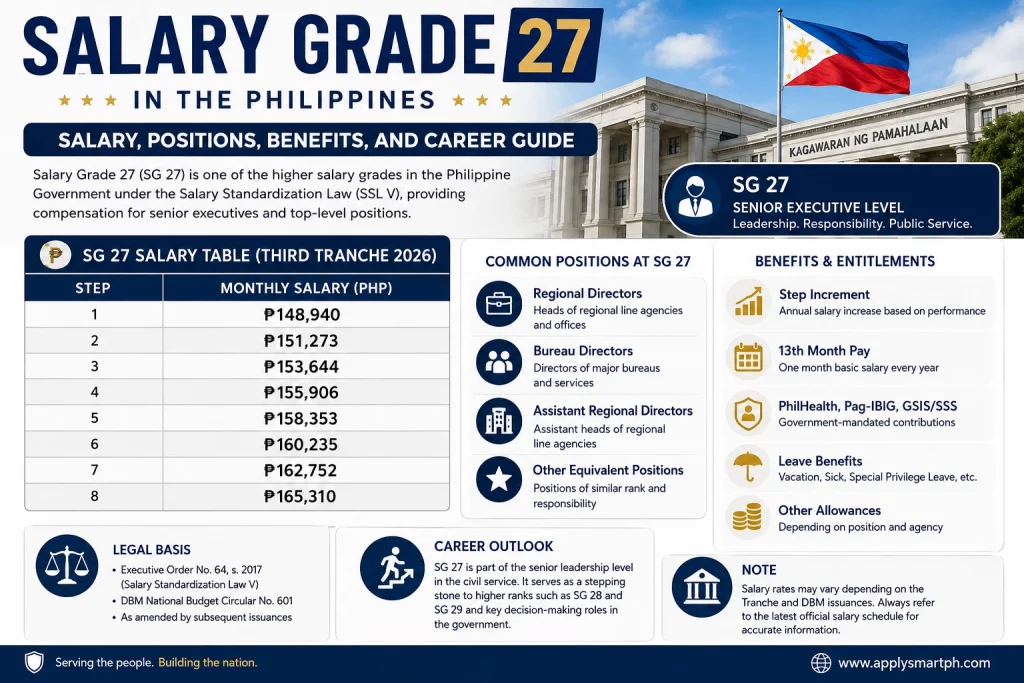
Salary Grade 27 (SG 27) is one of the highest compensation levels in the Philippine government’s Compensation and Position Classification System (CPCS). It is generally assigned to senior executives, directors, and officials with significant leadership responsibilities across national government agencies.
Under the Third Tranche of the Updated Salary Schedule implemented through National Budget Circular No. 601, which carries out Executive Order No. 64, s. 2024, Salary Grade 27 received updated monthly salary rates effective January 1, 2026.
This guide explains the official Salary Grade 27 salary table, how salary steps work, the types of positions commonly classified under SG 27, career progression, benefits, and important considerations for government employees.
Quick Answer
Salary Grade 27 ranges from ₱148,940 to ₱165,310 per month under the Third Tranche Salary Schedule effective January 1, 2026. The exact monthly salary depends on the employee’s salary step (Step 1 to Step 8), which is determined by factors such as length of service and approved step increments under applicable civil service and DBM rules.
Key Takeaways
- Salary Grade 27 is part of the Philippine government’s updated salary schedule.
- Monthly salaries range from ₱148,940 to ₱165,310.
- Eight salary steps determine the exact monthly basic salary.
- The salary schedule took effect on January 1, 2026.
- The legal basis is Executive Order No. 64, s. 2024, implemented through National Budget Circular No. 601.
TL;DR
If your position is classified under Salary Grade 27, your monthly basic salary falls between ₱148,940 and ₱165,310, depending on your assigned salary step. The current salary schedule forms part of the third tranche of the government’s updated compensation system and applies to covered civilian government personnel beginning January 1, 2026.
What Is Salary Grade 27?
Salary Grade 27 is a senior-level compensation classification under the Philippine government’s Compensation and Position Classification System. It is intended for high-ranking officials and executives whose positions involve substantial managerial, administrative, technical, or policy-making responsibilities. The corresponding monthly basic salary depends on the employee’s assigned salary step within the grade.
Salary grades standardize compensation across government agencies by assigning each plantilla position to a salary grade and step. Employees generally begin at Step 1 unless a different step is authorized under applicable rules, while step increases may be granted based on length of service or meritorious performance in accordance with existing regulations.
Key Point: Salary Grade 27 identifies the compensation level of a position; the actual monthly salary is determined by the employee’s salary step.
Salary Grade 27 Salary Table
As of the Third Tranche Salary Schedule effective January 1, 2026, employees assigned to Salary Grade 27 (SG 27) receive a monthly basic salary ranging from ₱148,940 to ₱165,310, depending on their salary step. Higher steps correspond to greater experience, approved step increments, or other personnel actions authorized under existing rules.
Official Salary Grade 27 Monthly Salary Schedule
| Salary Step | Monthly Basic Salary |
| Step 1 | ₱148,940 |
| Step 2 | ₱151,273 |
| Step 3 | ₱153,644 |
| Step 4 | ₱155,906 |
| Step 5 | ₱158,353 |
| Step 6 | ₱160,235 |
| Step 7 | ₱162,752 |
| Step 8 | ₱165,310 |
Understanding Salary Steps
A salary grade establishes the compensation level of a government position, while the salary step determines the exact monthly basic salary within that grade. Under National Budget Circular No. 601:
- Incumbent personnel are generally adjusted to the corresponding step of their position as of December 31, 2025.
- New hires are generally appointed at Step 1, unless another rule or authority applies.
- Casual and contractual personnel are likewise adjusted to Step 1 of the salary grade assigned to their positions.
- Employees may receive higher salary steps through authorized step increments or other personnel actions in accordance with applicable civil service and DBM rules.
Salary Progression Within SG 27
The difference between Step 1 and Step 8 is:
- Starting salary (Step 1): ₱148,940
- Maximum salary (Step 8): ₱165,310
- Total increase across all steps: ₱16,370
This step-based progression rewards continued service and recognizes approved salary advancements while employees remain within the same salary grade.
Comparison with Adjacent Salary Grades
| Salary Grade | Step 1 | Step 8 |
| SG 26 | ₱131,807 | ₱146,983 |
| SG 27 | ₱148,940 | ₱165,310 |
| SG 28 | ₱167,129 | ₱185,537 |
This comparison shows that Salary Grade 27 occupies the upper tier of the civilian government compensation structure, positioned between SG 26 and SG 28.
Key Point Summary
Salary Grade 27 provides an official monthly basic salary of ₱148,940 to ₱165,310 under the Third Tranche Salary Schedule effective January 1, 2026. The applicable salary depends on the employee’s assigned salary step under the government’s Compensation and Position Classification System.
Typical Government Positions Under Salary Grade 27
Salary Grade 27 is typically assigned to senior executive and highly specialized positions within the Philippine government. These positions involve significant leadership, policy development, program management, and administrative responsibility. While the exact salary grade assigned to a position depends on the approved staffing pattern and classification of the agency, SG 27 generally covers high-level managerial roles within the civilian government.
Common Positions That May Be Classified Under Salary Grade 27
The following are examples of positions that are commonly associated with Salary Grade 27, subject to the approved plantilla and position classification of the employing agency:
| Position Category | Typical Role |
| Assistant Secretary (in certain agencies) | Assists in directing departmental operations and policy implementation |
| Bureau or Service Director | Leads a bureau, service, or major organizational unit |
| Executive Director | Oversees programs, projects, and organizational administration |
| Regional Director (selected agencies) | Manages regional operations and supervises field offices |
| Highly Specialized Technical Executive | Provides expert leadership in technical or regulatory functions |
Note: The salary grade of a specific position is determined by the approved Position Classification System and agency plantilla. A position title alone does not guarantee assignment to Salary Grade 27.
Primary Responsibilities
Officials occupying SG 27 positions commonly perform responsibilities such as:
- Leading major offices, bureaus, or regional operations.
- Developing and implementing policies aligned with agency mandates.
- Supervising senior managers and technical personnel.
- Managing substantial government programs and budgets.
- Advising department leadership on strategic and operational matters.
- Ensuring compliance with applicable laws, rules, and government policies.
Because these positions influence organizational direction and public service delivery, they require extensive managerial experience, technical expertise, and leadership capability.
Qualifications
Although requirements vary by agency and position, SG 27 roles generally require:
- A bachelor’s degree relevant to the position.
- Advanced education or professional eligibility where required.
- Significant supervisory or managerial experience.
- Demonstrated leadership and decision-making skills.
- Compliance with Civil Service Commission qualification standards applicable to the position.
Individual qualification requirements are prescribed in each agency’s approved Qualification Standards and plantilla, rather than by the salary grade alone.
Career Progression
Many employees reach Salary Grade 27 after progressing through senior management positions, such as:
- SG 24–25: Division-level management
- SG 26: Senior executive or assistant executive roles
- SG 27: Executive leadership with broader organizational responsibility
- SG 28 and above: Higher executive and department-level leadership positions
Career advancement depends on vacancy availability, qualifications, performance, merit, and compliance with Civil Service Commission and agency promotion policies.
Key Point Summary
Salary Grade 27 is generally reserved for senior government executives entrusted with major leadership, management, and policy-making responsibilities. While several executive positions are commonly classified under SG 27, the official salary grade of any position is determined by its approved classification and plantilla within the employing agency.
Legal Basis
The current Salary Grade 27 salary rates are based on the Third Tranche of the Updated Salary Schedule for civilian government personnel. This salary schedule is authorized under Executive Order (EO) No. 64, s. 2024 and implemented through Department of Budget and Management (DBM) National Budget Circular (NBC) No. 601, which took effect on January 1, 2026.
Executive Order No. 64, s. 2024
Executive Order No. 64, s. 2024 updated the Salary Schedule for civilian government personnel to strengthen the government’s Compensation and Position Classification System (CPCS). Its objectives include maintaining a competitive, effective, and sustainable compensation system that attracts, retains, and motivates high-performing public servants.
The Executive Order provides that the updated salary schedule will be implemented in four (4) tranches covering Fiscal Years 2024 to 2027, with the third tranche beginning on January 1, 2026.
National Budget Circular No. 601
To implement the third tranche, the Department of Budget and Management issued National Budget Circular No. 601, dated January 22, 2026. The circular prescribes the implementing rules, official salary schedule (Annex A), and procedural guidelines for salary adjustments of covered civilian government personnel.
The circular specifically states that:
- The new salary rates take effect January 1, 2026.
- The official salary schedule is contained in Annex A.
- Salary adjustments are based on the employee’s assigned salary grade and salary step as of December 31, 2025, subject to the rules provided in the circular.
Coverage
National Budget Circular No. 601 applies to civilian government personnel in the:
- Executive Branch
- Legislative Branch
- Judicial Branch
- Constitutional Commissions
- Other Constitutional Offices
- State Universities and Colleges (SUCs)
- Covered Government-Owned or Controlled Corporations (GOCCs)
The circular also identifies entities and personnel who are excluded from its coverage, including military and uniformed personnel, certain GOCCs governed by separate compensation systems, consultants, and individuals engaged through job orders or contracts of service.
Salary Adjustment Rules
For the third tranche implementation, NBC No. 601 establishes several key rules:
- Incumbent employees are generally adjusted to the salary rate corresponding to their designated salary step.
- New hires receive the Step 1 rate of the assigned salary grade unless otherwise authorized.
- Casual and contractual personnel are likewise adjusted to Step 1 of their salary grade.
- Employees whose salaries already exceed Step 8 of their salary grade are generally not entitled to an additional salary increase under the circular.
Key Point Summary
Salary Grade 27 is governed by the updated Compensation and Position Classification System established under Executive Order No. 64, s. 2024 and implemented through DBM National Budget Circular No. 601. The current salary schedule became effective on January 1, 2026, and applies to covered civilian government personnel following the implementing rules prescribed by the DBM.
Salary Grade 27 Benefits
Employees holding positions under Salary Grade 27 are entitled to the compensation and benefits authorized for covered civilian government personnel under applicable laws, executive issuances, DBM circulars, and Civil Service Commission (CSC) regulations. In addition to their monthly basic salary, they may receive statutory allowances, government contributions, leave benefits, and other incentives, subject to eligibility requirements and agency-specific rules.
Monthly Basic Salary
The primary compensation for an SG 27 position is the monthly basic salary based on the employee’s assigned salary step.
| Salary Step | Monthly Basic Salary |
| Step 1 | ₱148,940 |
| Step 2 | ₱151,273 |
| Step 3 | ₱153,644 |
| Step 4 | ₱155,906 |
| Step 5 | ₱158,353 |
| Step 6 | ₱160,235 |
| Step 7 | ₱162,752 |
| Step 8 | ₱165,310 |
Government Contributions
Covered SG 27 employees continue to receive government-paid or government-shared contributions required by law, including:
- Government Service Insurance System (GSIS)
- PhilHealth
- Pag-IBIG Fund
- Retirement and Life Insurance Premiums (RLIP), where applicable
- Employees’ Compensation Insurance
National Budget Circular No. 601 specifically recognizes that implementing the updated salary schedule also affects related government contributions such as RLIP, Pag-IBIG, PhilHealth, and Employees’ Compensation Insurance premiums.
Standard Government Allowances
Depending on the employee’s eligibility and existing government regulations, SG 27 personnel may also receive benefits such as:
- Personnel Economic Relief Allowance (PERA)
- Mid-Year Bonus
- Year-End Bonus
- Cash Gift
- Productivity Enhancement Incentive (PEI)
- Clothing or Uniform Allowance
- Other benefits authorized by law or DBM issuances
The availability and amount of these benefits depend on current laws, appropriations, and applicable government policies.
Leave Benefits
SG 27 employees are generally entitled to the leave privileges provided under Civil Service Commission rules, including:
- Vacation Leave
- Sick Leave
- Maternity Leave
- Paternity Leave
- Solo Parent Leave (when applicable)
- Special leave benefits authorized by law
Unused leave credits may also be convertible to terminal leave benefits upon retirement, resignation, or separation from government service, subject to existing regulations.
Retirement Benefits
Employees covered by GSIS may qualify for retirement benefits under applicable retirement laws and GSIS rules after satisfying the required age and service requirements.
National Budget Circular No. 601 also notes that retirement benefits, including Terminal Leave Benefits, are computed based on the employee’s monthly basic salary immediately before the effective date of retirement, in accordance with existing laws, rules, and regulations.
Professional Development Opportunities
Many SG 27 positions also provide opportunities for:
- Executive leadership training
- Specialized technical and management courses
- Local and international seminars
- Capacity-building programs
- Career advancement into higher executive positions
Participation depends on agency policies, available funding, and organizational requirements.
Key Point Summary
Beyond the official monthly salary, Salary Grade 27 employees may receive a comprehensive package of government benefits, including statutory contributions, leave privileges, bonuses, retirement benefits, and professional development opportunities. While these benefits are broadly available to eligible civilian government personnel, specific entitlements depend on applicable laws, DBM and CSC issuances, agency policies, and individual eligibility.
Career Progression
Career progression beyond Salary Grade 27 depends on a combination of qualifications, performance, leadership capability, available plantilla positions, and compliance with Civil Service Commission (CSC) and agency promotion policies. Employees who consistently demonstrate competence and meet the qualification standards may become eligible for appointment to higher executive positions when vacancies arise.
Where Salary Grade 27 Fits in the Career Ladder
Salary Grade 27 belongs to the upper tier of the Philippine government’s Compensation and Position Classification System (CPCS). It is generally occupied by senior executives responsible for managing major offices, directing programs, and providing strategic leadership.
A typical executive career path may resemble the following:
| Career Stage | Typical Salary Grade | General Level of Responsibility |
| Division Leadership | SG 24–25 | Supervises divisions and specialized units |
| Senior Executive | SG 26 | Manages large programs or organizational units |
| Executive Leadership | SG 27 | Leads major bureaus, services, or regional organizations |
| Higher Executive Leadership | SG 28–30 | Oversees multiple offices or agency-wide operations |
| Top Executive Positions | SG 31–33 | Heads constitutional bodies, departments, or equivalent executive offices |
The exact progression varies by agency because organizational structures and approved plantilla positions differ across government offices.
Factors That Influence Promotion
Promotion to higher salary grades is not based solely on years of service. Government agencies generally consider several factors, including:
- Educational qualifications required for the position
- Relevant training and professional development
- Civil Service eligibility or other mandatory qualifications
- Performance evaluation results
- Leadership and management competencies
- Availability of vacant plantilla positions
- Compliance with agency-specific qualification standards
Meeting these requirements increases an employee’s competitiveness when applying for higher-level positions.
Salary Step Progression Within SG 27
Employees may also experience salary growth while remaining in Salary Grade 27 through movement across the salary steps.
For example:
- Step 1: ₱148,940
- Step 8: ₱165,310
This represents an increase of ₱16,370 within the same salary grade through authorized step progression.
Professional Development
Employees aspiring to progress beyond SG 27 can strengthen their qualifications by:
- Completing graduate or postgraduate studies relevant to their field.
- Participating in executive leadership and management programs.
- Attending government-sponsored training and competency development courses.
- Building expertise in strategic planning, financial management, and public administration.
- Demonstrating consistent, high-quality performance and ethical leadership.
Professional development not only supports promotion opportunities but also prepares employees for broader organizational responsibilities.
Information Gain: Career Planning Checklist
Employees targeting higher executive positions should consider the following checklist:
- ✓ Maintain consistently strong performance ratings.
- ✓ Complete mandatory and specialized training programs.
- ✓ Pursue advanced education where beneficial.
- ✓ Develop leadership, communication, and decision-making skills.
- ✓ Monitor vacancies and promotion opportunities within the agency.
- ✓ Ensure compliance with all qualification standards before applying for promotion.
Following these practices can improve readiness for executive-level appointments while supporting long-term career growth in government service.
Key Point Summary
Salary Grade 27 represents a significant executive milestone within the Philippine government. Advancement beyond this level depends on merit, qualifications, organizational needs, and available positions rather than tenure alone. Continuous professional development, leadership experience, and strong performance are essential for employees seeking higher executive appointments.
Salary Grade 27 vs Salary Grade 26
Salary Grade 27 offers a higher compensation level and is generally associated with greater executive responsibility than Salary Grade 26. Based on the official Third Tranche Salary Schedule effective January 1, 2026, SG 27 salaries range from ₱148,940 to ₱165,310, while SG 26 salaries range from ₱131,807 to ₱146,983. The difference reflects the broader leadership, policy-making, and organizational responsibilities typically assigned to SG 27 positions.
Salary Comparison
| Salary Step | SG 26 | SG 27 | Difference |
| Step 1 | ₱131,807 | ₱148,940 | ₱17,133 |
| Step 2 | ₱133,870 | ₱151,273 | ₱17,403 |
| Step 3 | ₱135,968 | ₱153,644 | ₱17,676 |
| Step 4 | ₱138,100 | ₱155,906 | ₱17,806 |
| Step 5 | ₱140,268 | ₱158,353 | ₱18,085 |
| Step 6 | ₱142,469 | ₱160,235 | ₱17,766 |
| Step 7 | ₱144,707 | ₱162,752 | ₱18,045 |
| Step 8 | ₱146,983 | ₱165,310 | ₱18,327 |
Responsibility Comparison
Although duties vary by agency, the two salary grades generally differ in scope and level of responsibility.
| Area | Salary Grade 26 | Salary Grade 27 |
| Leadership Scope | Senior management | Executive leadership |
| Organizational Impact | Major division or program | Bureau, service, or regional office leadership |
| Policy Role | Implements and manages programs | Develops strategic direction and organizational policies |
| Decision-Making | Operational and managerial | Strategic and executive-level decisions |
Actual duties are determined by the position’s approved job description, plantilla, and agency mandate rather than by the salary grade alone.
Career Progression
For many government employees, promotion from SG 26 to SG 27 represents a significant career milestone because it often marks the transition from senior management to executive leadership.
Promotion typically depends on:
- Availability of a vacant SG 27 plantilla position.
- Compliance with qualification standards.
- Demonstrated leadership and managerial competence.
- Strong performance evaluations.
- Agency selection and appointment procedures.
Information Gain: Is Promotion to SG 27 Worth It?
A promotion from SG 26 to SG 27 may provide several advantages beyond the increase in monthly salary:
- Higher executive authority and organizational influence.
- Broader leadership and policy-making responsibilities.
- Greater opportunities to shape agency programs and initiatives.
- Improved long-term retirement benefits because retirement computations are generally based on an employee’s basic salary under applicable laws and regulations.
However, these advantages are accompanied by increased accountability, more complex decision-making responsibilities, and greater expectations for organizational leadership.
Key Point Summary
Salary Grade 27 provides a higher salary and a broader executive role than Salary Grade 26. The official monthly salary difference ranges from ₱17,133 to ₱18,327, depending on the salary step, reflecting the expanded responsibilities expected of SG 27 positions.
Salary Grade 27 vs Salary Grade 28
Salary Grade 28 is the next compensation level above Salary Grade 27 in the Philippine government’s Compensation and Position Classification System (CPCS). Under the Third Tranche Salary Schedule effective January 1, 2026, SG 28 salaries range from ₱167,129 to ₱185,537, while SG 27 salaries range from ₱148,940 to ₱165,310. The higher salary reflects the increased executive responsibility, broader organizational authority, and greater strategic leadership typically associated with SG 28 positions.
Official Salary Comparison
| Salary Step | SG 27 | SG 28 | Difference |
| Step 1 | ₱148,940 | ₱167,129 | ₱18,189 |
| Step 2 | ₱151,273 | ₱169,752 | ₱18,479 |
| Step 3 | ₱153,644 | ₱172,418 | ₱18,774 |
| Step 4 | ₱155,906 | ₱174,797 | ₱18,891 |
| Step 5 | ₱158,353 | ₱177,545 | ₱19,192 |
| Step 6 | ₱160,235 | ₱180,339 | ₱20,104 |
| Step 7 | ₱162,752 | ₱182,660 | ₱19,908 |
| Step 8 | ₱165,310 | ₱185,537 | ₱20,227 |
Leadership Comparison
Although the exact duties depend on the agency and approved plantilla, SG 28 positions generally carry a broader executive mandate than SG 27 positions.
| Area | Salary Grade 27 | Salary Grade 28 |
| Leadership Level | Senior executive | Higher executive leadership |
| Organizational Scope | Bureau, service, or regional office | Multiple bureaus, major sectors, or equivalent executive offices |
| Strategic Role | Implements organizational strategy | Establishes strategic direction across larger organizational units |
| Decision Authority | Executive-level operational decisions | Agency-wide or multi-office executive decisions |
The salary grade reflects the classification of the position, while the actual duties and authority are determined by the approved organizational structure and position description.
Career Advancement from SG 27 to SG 28
Promotion from SG 27 to SG 28 generally requires:
- Appointment to an approved SG 28 plantilla position.
- Compliance with the qualification standards for the higher position.
- Demonstrated executive leadership and management capability.
- Strong performance and professional reputation.
- Completion of the agency’s promotion and selection process.
Because SG 28 positions are fewer in number and carry greater organizational responsibility, competition for these appointments is typically more rigorous.
Information Gain: SG 27 or SG 28?
For employees planning a long-term government career, the transition from SG 27 to SG 28 represents more than a salary increase.
Salary Grade 27 may be appropriate for those who:
- Lead a major office or bureau.
- Prefer executive management with focused organizational responsibilities.
- Are building experience for higher executive appointments.
Salary Grade 28 may be appropriate for those who:
- Oversee multiple organizational units or sectors.
- Participate in agency-wide strategic planning and policy formulation.
- Hold broader executive authority and accountability.
This distinction can help employees understand how salary grades align with increasing leadership expectations rather than compensation alone.
Key Point Summary
Salary Grade 28 is the next executive level above Salary Grade 27, offering an official monthly salary of ₱167,129 to ₱185,537, compared with ₱148,940 to ₱165,310 for SG 27. Depending on the salary step, the monthly difference ranges from ₱18,189 to ₱20,227, reflecting the greater executive responsibilities assigned to SG 28 positions.
Common Mistakes
Many misunderstandings about Salary Grade 27 arise from confusing salary grades with job titles, assuming all employees receive the highest salary step, or overlooking how government compensation is determined. Understanding how the Compensation and Position Classification System (CPCS) works can help employees make informed career and compensation decisions.
1. Assuming Every SG 27 Employee Receives ₱165,310
One of the most common misconceptions is that every employee under Salary Grade 27 automatically earns the maximum monthly salary.
In reality, the monthly basic salary depends on the employee’s assigned salary step.
- Step 1: ₱148,940
- Step 8: ₱165,310
Newly appointed employees generally start at Step 1, unless another step is authorized under applicable laws or regulations. Existing employees are adjusted according to the rules prescribed in National Budget Circular No. 601.
2. Believing Salary Grade Determines the Position Title
Salary Grade 27 does not identify a specific government position.
Instead, it represents the compensation level assigned to an approved plantilla position.
Different government agencies may classify different executive positions under Salary Grade 27 depending on:
- Position classification
- Organizational structure
- Approved staffing pattern
- Agency mandate
Always verify the official plantilla position rather than relying solely on the salary grade.
3. Ignoring Qualification Standards
Some applicants assume that meeting the salary grade alone qualifies them for appointment.
Government appointments require compliance with qualification standards, which may include:
- Educational requirements
- Relevant work experience
- Training
- Civil Service eligibility
- Specialized competencies
Meeting these standards is essential before appointment or promotion.
4. Assuming Promotion Is Automatic
Promotion from SG 26 to SG 27—or from SG 27 to higher salary grades—is not automatic.
Promotion depends on several factors, including:
- Availability of a vacant plantilla position
- Agency selection process
- Merit and fitness
- Performance evaluation
- Qualification standards
- Budgetary authority
Years of service alone do not guarantee promotion.
5. Confusing Basic Salary with Total Compensation
The salary schedule published by the DBM represents the monthly basic salary only.
An employee’s overall compensation may also include:
- Personnel Economic Relief Allowance (PERA)
- Mid-Year Bonus
- Year-End Bonus
- Cash Gift
- Productivity Enhancement Incentive (PEI)
- Clothing or Uniform Allowance
- Government contributions (GSIS, PhilHealth, Pag-IBIG, RLIP, and Employees’ Compensation Insurance), where applicable
These benefits are governed by separate laws, DBM issuances, and agency policies.
6. Using Unofficial Salary Tables
Another common mistake is relying on outdated or unofficial salary schedules found on blogs, social media posts, or third-party websites.
For accurate information, consult official government sources such as:
- Department of Budget and Management (DBM)
- Official Gazette
- National Budget Circulars
- Executive Orders
Using official references helps ensure that salary figures, implementation dates, and eligibility rules are current and accurate.
Information Gain: Quick Self-Check
Before relying on Salary Grade 27 information, ask yourself:
- ✓ Am I looking at the latest DBM salary schedule?
- ✓ Am I checking the correct salary step?
- ✓ Does the position actually carry Salary Grade 27?
- ✓ Am I referring to the monthly basic salary, not total compensation?
- ✓ Am I using official government sources?
Answering these questions can help avoid common misunderstandings about government compensation.
Key Point Summary
Most misconceptions about Salary Grade 27 stem from misunderstanding how the CPCS operates. Salary grades determine the compensation level of a position, while the actual monthly salary depends on the employee’s assigned salary step. Promotions, appointments, and benefits are governed by applicable laws, DBM issuances, Civil Service Commission rules, and agency policies—not by salary grade alone.
Frequently Asked Questions (FAQ)
What is the monthly salary for Salary Grade 27?
Under the Third Tranche Monthly Salary Schedule effective January 1, 2026, the monthly basic salary for Salary Grade 27 ranges from ₱148,940 (Step 1) to ₱165,310 (Step 8). The exact amount depends on the employee’s assigned salary step.
What determines my salary step?
An employee’s salary step is determined by applicable government rules, including the position’s designated salary step, approved step increments due to length of service or meritorious performance, and other authorized personnel actions. For new hires, the salary is generally set at Step 1 unless another rule applies.
Which law or issuance governs Salary Grade 27?
The current Salary Grade 27 salary schedule is based on Executive Order No. 64, s. 2024, as implemented through Department of Budget and Management National Budget Circular No. 601, which took effect on January 1, 2026.
4. Does Salary Grade 27 apply to all government employees?
No. National Budget Circular No. 601 applies to covered civilian government personnel in the Executive, Legislative, and Judicial branches, Constitutional Commissions, other Constitutional Offices, State Universities and Colleges (SUCs), and covered Government-Owned or Controlled Corporations (GOCCs). Certain groups—such as military and uniformed personnel, specific GOCCs governed by separate compensation systems, consultants, and individuals engaged through job orders or contracts of service—are excluded.
Does Salary Grade 27 guarantee a specific job title?
No. A salary grade identifies the compensation level assigned to a position, not the position title itself. The salary grade of a specific position depends on the approved Position Classification System and the agency’s authorized plantilla.
Can I be promoted automatically from Salary Grade 27 to Salary Grade 28?
No. Promotion is not automatic. Advancement depends on:
Availability of an approved vacant position.
Compliance with qualification standards.
Merit and fitness.
Performance evaluation.
Agency promotion policies and selection procedures.
Years of service alone do not guarantee promotion.
Are bonuses and allowances included in the Salary Grade 27 salary?
No. The official Salary Grade 27 figures represent the monthly basic salary only. Eligible employees may also receive bonuses, allowances, and statutory benefits in accordance with existing laws, DBM issuances, and agency policies.
8. Where can I verify the latest Salary Grade 27 salary schedule?
The most reliable sources are:
Department of Budget and Management (DBM)
Official Gazette
Executive Orders
National Budget Circulars
Official government publications should always be used instead of unofficial salary tables found on third-party websites
Final Verdict
Salary Grade 27 represents a senior executive compensation level within the Philippine government’s Compensation and Position Classification System. Effective January 1, 2026, the official monthly basic salary ranges from ₱148,940 to ₱165,310, depending on the employee’s salary step, as provided under the Third Tranche Salary Schedule implementing Executive Order No. 64, s. 2024 through DBM National Budget Circular No. 601.
Beyond salary, SG 27 positions carry significant executive responsibilities, including organizational leadership, policy implementation, and strategic decision-making. Career advancement depends on qualifications, merit, performance, and the availability of higher-level positions rather than tenure alone.
Understanding the salary schedule, legal basis, benefits, career progression, and official implementation rules enables government employees and applicants to make informed career and compensation decisions.
Related Topics
To learn more about navigating your career in the Philippine government, explore our deep-dive guides:
- Salary Grade 6 Philippines: Salary, Steps, Positions, and Career Guide
- Salary Grade 7 Philippines: Salary, Benefits & Positions
- Salary Grade 8 Philippines: Salary, Steps, Positions, Benefits, and Career Guide
- Salary Grade 10 Philippines: Salary, Positions, Benefits, and Career Guide
- Salary Grade 11 Philippines 2026: Complete Guide
- Salary Grade 12 Philippines 2026: Salary, Positions & Benefits
- Salary Grade 13 Philippines 2026: Complete Salary & Positions Guide
- Salary Grade 14 Philippines 2026: Complete Salary & Positions Guide
- Salary Grade 15 Philippines: Salary, Positions, Qualifications, and Career Guide
- Salary Grade 19 Philippines 2026: How Much Do SG 19 Employees Earn?
- Salary Grade 24 Philippines 2026: Salary & Benefits
- Salary Grade 25 Philippines: Salary, Positions, Benefits, and Career Guide
- Government Jobs in the Philippines 2026: Complete Job Search Guide
- How to Apply for Government Jobs in the Philippines: Step-by-Step Guide
- Government Salary Grade 2026: Complete Guide to the Philippine Salary Schedule
References
- Department of Budget and Management (DBM). National Budget Circular No. 601 – Implementation of the Third Tranche Compensation Adjustment for Civilian Government Personnel pursuant to Executive Order No. 64, s. 2024.
- Civil Service Commission (CSC). Position Qualification Standards and Civil Service eligibility policies.
- Official Gazette of the Republic of the Philippines. Executive Orders, laws, and official government issuances relating to the Salary Standardization Law
Disclaimer
This guide is intended for informational purposes only and is based on official government issuances available at the time of writing. While every effort has been made to ensure accuracy, salary schedules, qualification standards, benefits, and implementing rules may change through subsequent laws, executive orders, DBM circulars, CSC issuances, or other government regulations.
Readers should always consult the latest official publications of the Department of Budget and Management (DBM), Civil Service Commission (CSC), and the Official Gazette for the most current and authoritative information.