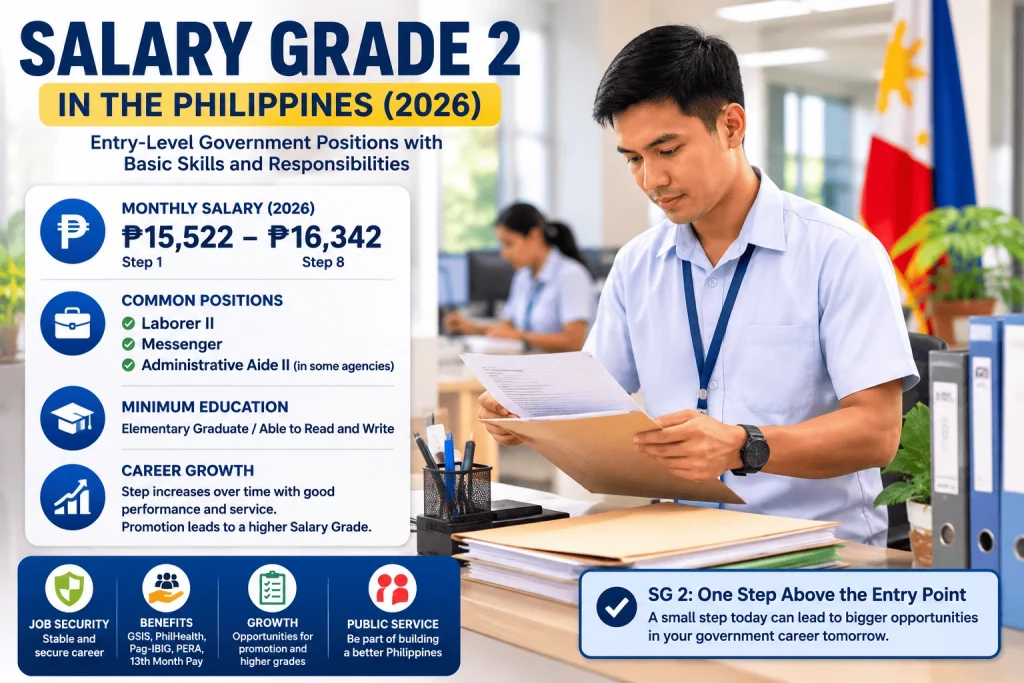
Salary Grade 2 (SG 2) sits just above the lowest tier of the Philippine government’s Compensation and Position Classification System (CPCS). It applies to entry-level positions that require basic manual or clerical-support skills, such as laborers, messengers, and similar general-service roles in national and local government offices.
Understanding how SG 2 works matters for job applicants comparing entry-level government openings, current SG 2 employees checking their pay bracket, and HR personnel processing appointments. This guide explains the current SG 2 salary schedule, the law behind it, who qualifies for it, and how employees can move to a higher salary grade.
Quick Answer
As of January 1, 2026, Salary Grade 2, Step 1 pays ₱15,522 per month under the third tranche of the Salary Standardization Law VI (SSL VI), rising to ₱16,342 at Step 8. SG 2 is assigned to basic support positions such as Laborer II and Messenger, and generally requires only elementary-level literacy plus, in some cases, First Level Civil Service eligibility.
Key Takeaways
- SG 2 is the second-lowest of the 33 salary grades in the Philippine government pay scale.
- It covers 8 salary steps, from ₱15,522 (Step 1) to ₱16,342 (Step 8), effective 2026.
- The rates come from Executive Order No. 64, s. 2024, implementing the 2024–2027 salary schedule authorized under Republic Act No. 11466 (SSL of 2019, as updated).
- Typical SG 2 positions include Laborer II and Messenger.
- Step increases depend on length of service and performance, not automatic promotion.
- Moving to a higher salary grade requires applying for and being appointed to a higher-graded position.
TL;DR
SG 2 sits one step above the government pay floor. In 2026, it pays between ₱15,522 and ₱16,342 a month depending on step. It applies mainly to Laborer II, Messenger, and comparable roles. Employees advance through step increments over time and can move to a higher salary grade only through promotion or appointment to a higher-graded position.
Eligibility or Scope
This guide covers civilian government personnel under the national CPCS. It applies to:
- National government agencies (NGAs)
- Government-owned or controlled corporations (GOCCs) not covered by a separate compensation system under Republic Act No. 10149
- Local government units (LGUs) that have adopted the national salary schedule, subject to local budget capacity
It does not apply to uniformed personnel (military and police), who follow the Base Pay Schedule under a separate law, or to job order (JO) and contract of service (COS) workers, who are not part of the regular plantilla and are not covered by the Salary Standardization Law.
How SG 2 Fits Into the Broader Salary Grade System
The Compensation and Position Classification System (CPCS) groups every government position into 33 salary grades, each with 8 salary steps except Salary Grade 33. This structure, and the roles of the Civil Service Commission (CSC) and the Department of Budget and Management (DBM) in setting it, are the same across every salary grade — SG 2 does not have its own separate framework.
What differs at SG 2 specifically is covered in the sections below: the exact pay table, the positions assigned to it, and the naming pattern DBM uses for this tier of the pay scale.
What Is Salary Grade 2?
Salary Grade 2 is the second tier in the 33-grade Philippine government salary structure, one step above Salary Grade 1. Each grade groups government positions of comparable difficulty, responsibility, and required qualifications, and each grade is paid according to a fixed schedule of eight salary steps.
SG 2 positions typically involve basic manual, custodial, or messenger-type tasks that require minimal formal training but slightly more responsibility than SG 1 roles, such as handling documents, running errands for an office, or performing semi-skilled labor. The CSC and DBM jointly define the qualification standards and pay levels for these positions.
Key Point Summary
- SG 2 is one grade above the lowest rung of the national salary structure.
- It is defined jointly by the CSC (qualifications) and DBM (compensation).
- It applies to low-complexity support and messenger-type government work.
Legal Basis of the Current SG 2 Salary Schedule
The SG 2 figures in this guide come from the same legal framework that governs every salary grade under the current cycle: Republic Act No. 11466 (the base authority for the CPCS), Executive Order No. 64, s. 2024 (which authorizes the 2024–2027 tranche schedule), and the annual DBM National Budget Circulars that publish the exact step-by-step tables. The figures here reflect the third tranche, effective January 1, 2026.
The current SG 2 pay scale is authorized under Executive Order No. 64, s. 2024, in relation to Republic Act No. 11466, and implemented through DBM National Budget Circulars covering the 2024–2027 salary adjustment period.
Salary Grade 2 Table for 2026 (Third Tranche)
The table below shows the full step structure for SG 2, effective January 1, 2026. Figures are stated in Philippine pesos (₱) and represent monthly basic salary before deductions, allowances, or bonuses.
| Salary Step | Monthly Basic Salary (₱) |
|---|---|
| Step 1 | ₱15,522 |
| Step 2 | ₱15,636 |
| Step 3 | ₱15,752 |
| Step 4 | ₱15,869 |
| Step 5 | ₱15,986 |
| Step 6 | ₱16,103 |
| Step 7 | ₱16,223 |
| Step 8 | ₱16,342 |
The difference between Step 1 and Step 8 at SG 2 is ₱820 per month, close to the ₱822 gap seen at SG 1. Step increments stay relatively narrow at the lowest salary grades and widen progressively at higher grades, where positions carry greater responsibility.
How SG 2 Pay Has Changed Across Tranches
SSL VI is being rolled out in four annual tranches, with the first taking effect in 2024 and the last scheduled for 2027. The confirmed rate for SG 2, Step 1 under the third tranche, effective January 1, 2026, is ₱15,522 per month. Earlier tranche amounts for 2024 and 2025 were lower and are published in the corresponding DBM National Budget Circulars for those years; readers who need the exact historical figures for payroll reconciliation should pull them directly from those circulars rather than a third-party estimate.
Based on the pattern observed at SG 1, where Step 1 pay rose by roughly 4 percent in each of the first three tranches, SG 2 likely followed a similar year-on-year percentage increase, though the DBM’s official circular remains the authoritative source for the exact peso amount in any given year.
The Working Title Behind SG 2: Why ‘Laborer II’ Often Isn’t the Official DBM Title
Job seekers frequently see ‘Laborer II’ or ‘Messenger’ on a vacancy posting and assume that is the formal position classification. In DBM’s Index of Occupational Services, Occupational Groups, Classes, and Salary Grades, many SG 1 through SG 3 positions actually fall under a single umbrella series called Administrative Aide, numbered with Roman numerals: Administrative Aide I, II, III, and so on. Agencies are allowed to use a descriptive working title, such as Laborer II or Messenger, for the same DBM class, provided the salary grade and qualification standard match.
This matters practically in two ways. First, if you search a government job portal by ‘Laborer II’ and find nothing at your target agency, searching ‘Administrative Aide II’ may surface the same opening under its formal class title. Second, on payroll and appointment documents, especially at the national level, you may see ‘Administrative Aide II’ rather than the working title used in the original job ad — this is expected and does not indicate a different position or a lower classification.
Key Point Summary
- SG 2 positions are commonly classified under the Administrative Aide series in DBM’s official index.
- Working titles like Laborer II and Messenger map to the same DBM class and salary grade.
- Appointment papers may show the formal series title even when the vacancy was posted under a working title.
Who Holds Salary Grade 2 Positions?
Beyond the Administrative Aide series, SG 2 covers a narrow band of general-support roles. The two most frequently filled are Laborer II, typically assigned semi-skilled manual tasks such as maintenance support or materials handling, and Messenger, responsible for transmitting documents, mail, and communications within and between offices.
The practical distinction between the two matters for applicants: Messenger roles more often involve some travel between offices or branches, and a handful of agencies list a driver’s license or ability to operate a motorcycle as a preferred, though not always mandatory, qualification, even though it is not a formal CSC requirement at this grade. Laborer II roles are more likely to stay within a single facility and involve physical tasks rather than transit.
Typical Qualification Standards for SG 2
- Education: Elementary graduate, or must be able to read and write, depending on the specific item.
- Training: None required.
- Experience: None required.
- Eligibility: First Level Eligibility (CSC), or as required by the specific position; some SG 2 items may fall under exempt or casual appointment categories.
Exact qualification standards can vary slightly by agency and specific plantilla item, since the CSC allows some flexibility in how positions are described, while still requiring DBM-approved pay classification.
How Step Increments Work
An SG 2 employee does not automatically move to a higher step each year. Step increments are governed by CSC and DBM rules and generally depend on two factors: length of satisfactory service in the position and performance rating.
- An employee starts at the step indicated in their appointment paper, most often Step 1.
- After completing the required number of years in service with at least a satisfactory performance rating, the employee becomes eligible for a step increment.
- The agency’s Human Resource Merit Promotion and Selection Board (HRMPSB) or equivalent unit processes the step adjustment.
- The new step takes effect upon approval and is reflected in the following payroll cycle.
Employees who receive below-satisfactory performance ratings may not qualify for a step increment until their rating improves.
SG 1 to SG 2: What Actually Changes
For someone currently at SG 1 deciding whether to pursue an SG 2 opening, three things change in practice, beyond the ₱888 monthly difference at Step 1.
- Duties expand slightly. SG 2 roles generally carry a bit more responsibility than SG 1 — handling of documents or materials with more accountability, or tasks that require some judgment rather than purely repetitive labor.
- The applicant pool is usually smaller. Because SG 2 sits one step higher, agencies typically see fewer applicants than for SG 1 postings, which can mean a shorter hiring process for qualified candidates.
- It sets up the next promotion faster. Many agencies prefer to promote from within their own Administrative Aide series, so time spent at SG 2 counts toward eligibility for SG 3 or SG 4 postings later, more directly than time spent at SG 1.
An employee already at SG 1 does not need to resign and reapply externally to move to SG 2; internal promotion through the agency’s Merit Selection Plan is the more common path, provided a vacant SG 2 item exists and the employee meets its qualification standard.
How to Move Beyond Salary Grade 2
Salary Grade is tied to the position, not the person. An SG 2 employee cannot request a higher salary grade while remaining in an SG 2 item. Advancement requires one of the following:
- Promotion to a higher-graded position within the same office, subject to a vacancy and the agency’s merit selection process.
- Lateral transfer to a higher-graded position in another office, if qualified.
- Reclassification of the position itself, which is initiated by the agency and approved by the DBM, and applies to the position rather than a specific individual.
In all three cases, the employee must meet the qualification standards of the target position, including education, training, experience, and eligibility requirements set by the CSC.
SG 2 Compared to Nearby Salary Grades
Seeing SG 2 next to the salary grades immediately around it helps illustrate how government pay rises with added responsibility. The comparison below uses Step 1 figures from the 2026 schedule, with SG 2 highlighted.
| Salary Grade | Illustrative Position | Step 1 Monthly Salary |
|---|---|---|
| Salary Grade 1 | Utility Worker I | ₱14,634 |
| Salary Grade 2 | Laborer II / Messenger | ₱15,522 |
| Salary Grade 3 | Driver I | ₱16,486 |
| Salary Grade 4 | Clerk I | ₱17,506 |
| Salary Grade 5 | Bookbinder II | ₱18,581 |
SG 2 pays ₱888 more per month than SG 1 at Step 1, while the jump from SG 2 to SG 3 is larger, at ₱964. Illustrative positions above are commonly cited examples; actual position titles at each salary grade can vary by agency, since the CSC allows some agencies to use different working titles for functionally similar roles.
SG 2 Compared to the Minimum Wage
Because SG 2 sits near the bottom of the government pay scale, it is often compared with the private-sector minimum wage. Regional wage boards set minimum wage rates that vary by region and are generally reviewed more frequently than the salary standardization schedule. Depending on the region and the timing of wage board adjustments, the private-sector daily minimum wage converted to a monthly equivalent can be close to, or in some periods higher than, SG 2 Step 1. Prospective applicants should check the latest regional wage order from the Department of Labor and Employment (DOLE) when making a direct comparison, since minimum wage figures are adjusted independently of the SSL schedule.
Benefits at SG 2
Statutory benefits — GSIS, PhilHealth, and Pag-IBIG coverage, 13th month pay, cash gift, leave credits, and PERA — apply the same way at SG 2 as at every other salary grade for regular plantilla employees; they are set by law rather than by grade. Casual, contractual, or job order personnel may not receive the same package, since coverage depends on appointment status rather than salary grade.
Frequently Overlooked Details About SG 2
- Some job postings list the position as ‘Laborer I’ at SG 2 rather than ‘Laborer II,’ depending on how the specific agency’s plantilla was originally structured; the working title numbering does not always match the salary grade number.
- A small number of agencies require a driver’s license for Messenger items specifically, even though this is not a universal CSC qualification standard for the position — always check the individual vacancy announcement rather than assuming a uniform requirement.
- Because SG 2 sits close to SG 1 in pay, some LGUs with limited Personnel Services budgets fill fewer SG 2 items than SG 1 items, which can make SG 2 openings less frequent in smaller municipalities.
- An SG 2 item can be reclassified upward without the incumbent reapplying, if the agency justifies increased duties to the DBM — this differs from a promotion, which requires a new appointment.
How to Apply for an SG 2 Position
SG 2 positions such as Laborer II and Messenger are typically posted through an agency’s official recruitment channels. The general process is as follows.
- Monitor vacancy announcements on the agency’s website, the CSC’s Publication of Vacant Positions, or the Civil Service Commission’s official job portal.
- Prepare basic requirements: application letter, Personal Data Sheet (CS Form No. 212), and any eligibility documents, if required for the specific item.
- Submit the application to the agency’s Human Resource unit before the posted deadline.
- Undergo the agency’s screening process, which may include an interview conducted by the HRMPSB.
- Receive a Notice of Appointment once selected, which specifies the salary grade, step, and effectivity date.
Processing time varies by agency and depends on internal HR procedures and budget availability for the item. There is generally no application fee for government job postings.
Common Mistakes
- Assuming SG 2 automatically increases every year without a documented performance and service record.
- Confusing salary grade with job title; the same position title can sometimes carry different salary grades depending on the specific plantilla item.
- Using an outdated salary table; SSL VI is implemented in tranches, so figures change each January until 2027.
- Expecting job order or contract of service work to carry an SG classification; these arrangements are not covered by the Salary Standardization Law.
- Overlooking that LGU implementation of the salary schedule depends on local budget capacity and may lag behind the national timeline.
- Mistaking SG 2 for SG 1 simply because both are entry-level; the two grades carry different pay tables and, in some agencies, different qualification standards.
Best Practices
- Always confirm the current tranche and effectivity date before comparing SG 2 figures, since the schedule changes annually through 2027.
- Check the specific plantilla item description for the position, not just the job title, to confirm the assigned salary grade.
- Keep a copy of the Notice of Appointment, since it documents the official salary grade and step for HR and GSIS records.
- For LGU positions, verify with the local HR office whether the national SSL VI schedule has been fully adopted.
- Refer to official DBM circulars, not third-party summaries, when precise figures are needed for payroll or legal purposes.
Frequently Asked Questions
What is the salary of SG 2 Step 1 in 2026?
SG 2, Step 1 pays ₱15,522 per month, effective January 1, 2026, under the third tranche of SSL VI.
Is ‘Laborer II’ the official DBM title for an SG 2 position?
Not always. Many SG 2 items are formally classified under the Administrative Aide series (e.g., Administrative Aide II) in DBM’s Index of Occupational Services, even when the agency’s job posting uses a working title like Laborer II or Messenger.
Why does an SG 2 vacancy sometimes get fewer applicants than SG 1?
SG 2 sits one grade above the pay floor, so it draws a smaller applicant pool than SG 1 postings in practice, which can shorten the hiring timeline for qualified candidates, though this varies by agency and location.
Do Messenger positions require a driver’s license?
Not as a universal CSC requirement, but some agencies list it as a preferred qualification for Messenger items specifically, since the role can involve transporting documents between offices. Always check the specific vacancy announcement.
How is a promotion from SG 1 to SG 2 different from applying externally?
Employees already in government service typically move from SG 1 to SG 2 through internal promotion under the agency’s Merit Selection Plan, rather than resigning and reapplying as an external candidate, provided a vacant SG 2 item exists.
Can an SG 2 position be upgraded without a new appointment?
Yes, through position reclassification. If an agency can justify that an SG 2 item’s actual duties have grown, it can request DBM approval to reclassify the item to a higher grade, and the current incumbent typically keeps the position without reapplying.
Does SG 2 apply to job order or contract of service workers?
No. Job order and contract of service personnel are not covered by the Salary Standardization Law and do not receive a salary grade classification.
Will SG 2 salaries increase again after 2026?
Yes. A fourth tranche takes effect January 1, 2027, as the final phase of the 2024–2027 salary schedule under Executive Order No. 64, s. 2024.
How much more does SG 2 pay compared to SG 1?
At Step 1 in 2026, SG 2 pays ₱888 more per month than SG 1, ₱15,522 versus ₱14,634.
Are Laborer II and Messenger the only positions at SG 2?
They are the most common, but other agency-specific items with comparable duties and qualification standards can also be classified at SG 2; the exact title varies by agency.
Conclusion
Salary Grade 2 sits just above the entry point of the Philippine government’s compensation structure. As of January 1, 2026, it pays between ₱15,522 and ₱16,342 a month, depending on step, under the third tranche of SSL VI. It mainly covers Laborer II and Messenger positions, along with similarly basic support roles that require minimal formal qualifications.
Because SSL VI continues through a fourth tranche in 2027, employees and applicants should check the DBM’s latest circular before relying on any published salary table, including this one, for payroll or legal purposes. Advancing beyond SG 2 depends on qualifying for and being appointed to a higher-graded position, since salary grade is tied to the plantilla item rather than the individual employee.
For anyone weighing an entry-level government role, the value of an SG 2 position extends beyond the monthly figure in the table. Job security, statutory benefits, and a defined path toward higher salary grades through promotion make it a reasonable starting point for applicants building a long-term career in public service, even though the starting pay remains modest compared to mid-level government positions.
Related Topics
To learn more about navigating your career in the Philippine government, explore our deep-dive guides:
- Salary Grade 6 Philippines: Salary, Steps, Positions, and Career Guide
- Salary Grade 7 Philippines: Salary, Benefits & Positions
- Salary Grade 8 Philippines: Salary, Steps, Positions, Benefits, and Career Guide
- Salary Grade 10 Philippines: Salary, Positions, Benefits, and Career Guide
- Salary Grade 11 Philippines 2026: Complete Guide
- Salary Grade 12 Philippines 2026: Salary, Positions & Benefits
- Salary Grade 13 Philippines 2026: Complete Salary & Positions Guide
- Salary Grade 14 Philippines 2026: Complete Salary & Positions Guide
- Salary Grade 15 Philippines: Salary, Positions, Qualifications, and Career Guide
- Salary Grade 19 Philippines 2026: How Much Do SG 19 Employees Earn?
- Salary Grade 24 Philippines 2026: Salary & Benefits
- Salary Grade 25 Philippines: Salary, Positions, Benefits, and Career Guide
- Government Jobs in the Philippines 2026: Complete Job Search Guide
- How to Apply for Government Jobs in the Philippines: Step-by-Step Guide
- Government Salary Grade 2026: Complete Guide to the Philippine Salary Schedule
References
- Department of Budget and Management (DBM). National Budget Circular No. 601 – Implementation of the Third Tranche Compensation Adjustment for Civilian Government Personnel pursuant to Executive Order No. 64, s. 2024.
- Civil Service Commission (CSC). Position Qualification Standards and Civil Service eligibility policies.
- Official Gazette of the Republic of the Philippines. Executive Orders, laws, and official government issuances relating to the Salary Standardization Law
Disclaimer
This guide is intended for informational purposes only and is based on official government issuances available at the time of writing. While every effort has been made to ensure accuracy, salary schedules, qualification standards, benefits, and implementing rules may change through subsequent laws, executive orders, DBM circulars, CSC issuances, or other government regulations.
Readers should always consult the latest official publications of the Department of Budget and Management (DBM), Civil Service Commission (CSC), and the O