Last Updated: July 2026
Reviewed by Apply Smart PH Editorial Team
Quick answer
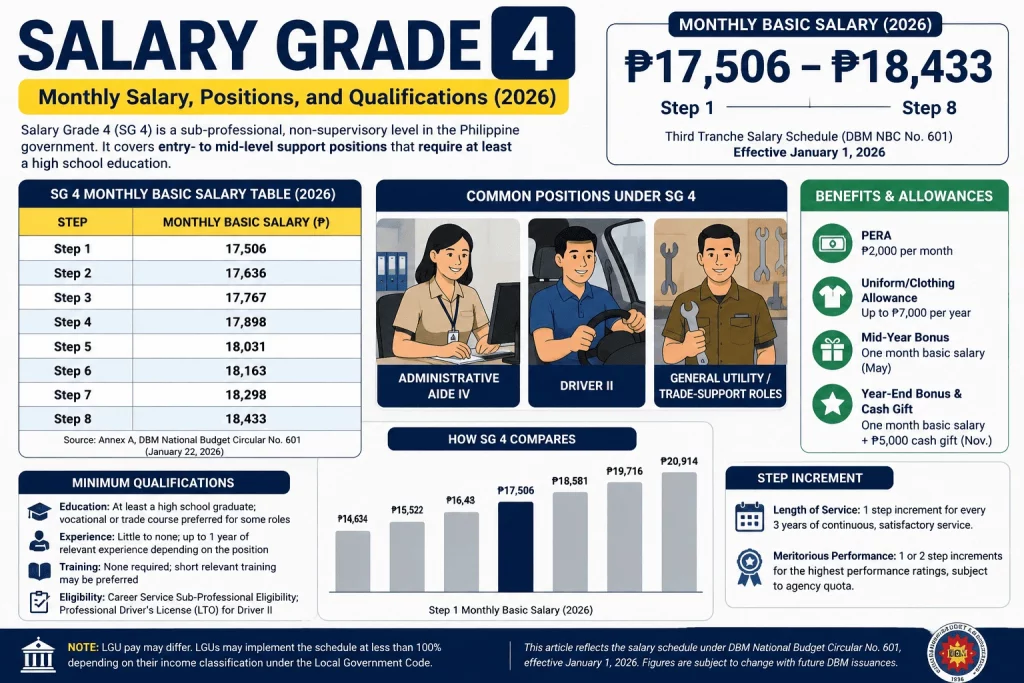
Salary Grade 4 (SG 4) is a Philippine government pay level currently paying between ₱17,506 (Step 1) and ₱18,433 (Step 8) a month in basic salary, under the Third Tranche of the Updated Salary Schedule (Executive Order No. 64, s. 2024, implemented through DBM National Budget Circular No. 601). It typically covers entry- to mid-level support positions such as Administrative Aide IV, Driver II, and similar utility, clerical, or trade-support roles that require little more than a high school education.
What Is Salary Grade 4?
Salary Grade (SG) is the numerical rank assigned to a government position under the Compensation and Position Classification System (CPCS), the framework the Department of Budget and Management (DBM) and the Civil Service Commission (CSC) use to standardize pay across every branch and agency of government. Instead of each office setting its own wages, every plantilla position — permanent, itemized government post — is slotted into one of 33 salary grades, from SG 1 (the lowest) to SG 33 (reserved for the President).
SG 4 Monthly Salary Table
The figures below come directly from Annex A of DBM National Budget Circular No. 601 (signed January 22, 2026), which implements the Third Tranche of the salary schedule under Executive Order No. 64, s. 2024. This tranche took effect retroactively on January 1, 2026 and remains the current, active schedule.
| Step | Monthly Basic Salary (₱) |
|---|---|
| Step 1 | 17,506 |
| Step 2 | 17,636 |
| Step 3 | 17,767 |
| Step 4 | 17,898 |
| Step 5 | 18,031 |
| Step 6 | 18,163 |
| Step 7 | 18,298 |
| Step 8 | 18,433 |
Source: Annex A, DBM National Budget Circular No. 601 (January 22, 2026), “Third Tranche Monthly Salary Schedule for the Civilian Personnel of the National Government,” effective January 1, 2026.
A few things worth noting about this table:
- Step 1 is the hiring rate. Every new appointee to an SG 4 position starts here, regardless of age, prior private-sector experience, or educational attainment beyond the minimum requirement.
- Step 8 is the ceiling for the grade. An employee can’t earn more within SG 4 without a promotion to a higher-graded position.
- The gap between steps is modest — roughly ₱130 to ₱150 per step — which is typical for the lower salary grades. Higher grades tend to have wider peso gaps between steps, even though the percentage increases are similar.
- These are basic salary figures only. Allowances, bonuses, and government-mandated deductions are calculated separately and are covered further down.
Where SG 4 Sits in the Bigger Picture
For context, here’s how SG 4 compares to the grades immediately around it under the same schedule:
| Salary Grade | Step 1 (₱) | Step 8 (₱) |
|---|---|---|
| SG 1 | 14,634 | 15,456 |
| SG 2 | 15,522 | 16,342 |
| SG 3 | 16,486 | 17,360 |
| SG 4 | 17,506 | 18,433 |
| SG 5 | 18,581 | 19,565 |
| SG 6 | 19,716 | 20,761 |
| SG 7 | 20,914 | 22,022 |
Moving from SG 3 to SG 4 adds roughly ₱1,000 to the starting salary; moving from SG 4 to SG 5 adds a similar amount. The increments in this lower band of the schedule are fairly even, unlike the wider jump you see later — for example, between SG 10 and SG 11, where entry-level professional roles like Teacher I pull ahead sharply.
What Positions Fall Under Salary Grade 4?
Salary grade is attached to the position, not the person, so what determines your SG isn’t your diploma or your years of experience — it’s the job description on file with the CSC and DBM. SG 4 positions are typically classified under the Index of Occupational Services as sub-professional, non-supervisory roles requiring minimal formal education. Common examples include:
- Administrative Aide IV — one of the most frequently posted SG 4 items across national agencies, local government units (LGUs), and state universities and colleges (SUCs). Depending on the office, this item may carry a functional title such as Driver II, Bookbinder II, or similar support role.
- Driver II — operates and maintains agency vehicles, often requiring a valid professional driver’s license from the Land Transportation Office (LTO) in place of formal training hours.
- General utility and trade-support roles — including junior technical aides in maintenance, reproduction, or general services sections.
- Various LGU and SUC support items carrying local functional titles but graded at SG 4 under the standard classification.
If you’re looking at a specific job posting, always check the plantilla item number and salary grade printed on the vacancy notice — job titles can vary slightly between agencies even when the salary grade is the same, since agencies sometimes attach a functional title (like “Driver II”) to a generic aide item.
Minimum Qualifications for SG 4 Positions
Under CSC Memorandum Circular No. 24, s. 2017, and the broader Qualification Standards (QS) framework, positions in the SG 1–6 range generally require:
- Education: At least a high school graduate; some SG 4 items may prefer or require completion of a relevant vocational or trade course (TESDA-certified, for example).
- Experience: Little to none required for entry; some positions in the SG 4–6 range may ask for up to one year of relevant experience, depending on the specific item.
- Training: Generally minimal — a few hours of relevant training may be preferred but is rarely mandatory at this level.
- Eligibility: Most SG 4 positions call for Career Service Sub-Professional eligibility. For specialized roles like Driver, a valid Professional Driver’s License from the LTO can substitute for the usual eligibility requirement under Category III of CSC rules.
Individual agencies can raise these requirements (never lower them) through an agency-specific Merit Selection Plan approved by the CSC, so always check the qualification standards attached to the specific vacancy you’re applying for.
How Much Do You Actually Take Home?
The ₱17,506–₱18,433 range in the table above is basic salary only — the figure your paycheck deductions are computed from, not your full monthly compensation. Two categories of adjustment apply on top of it: allowances added on, and mandatory contributions taken out.
Allowances Added on Top
- PERA (Personnel Economic Relief Allowance): ₱2,000 per month, unchanged since 2009 and paid to practically all covered government personnel regardless of grade.
- Uniform/Clothing Allowance: Up to ₱7,000 per year, authorized under the General Provisions of the annual General Appropriations Act.
- Mid-Year Bonus: Equivalent to one month’s basic salary, released around May under Executive Order No. 201, s. 2016.
- Year-End Bonus and Cash Gift: One month’s basic salary plus a ₱5,000 cash gift, released in November under Republic Act No. 6686, as amended.
So an SG 4, Step 1 employee earning ₱17,506 in basic pay has a recurring monthly gross closer to ₱19,506 once PERA is added, before factoring in the annual bonuses.
Standard Deductions
- GSIS contribution: 9% of basic salary, deducted from the employee, with the agency contributing another 12% — this applies uniformly with no salary ceiling. For an SG 4, Step 1 employee, that’s roughly ₱1,575.54 a month.
- PhilHealth and Pag-IBIG contributions: Standard government-employee rates apply, calculated on basic salary.
- Withholding tax: Applied according to the BIR’s compensation tax table; take-home impact depends on total taxable compensation and any exemptions.
For Contractual or Casual Personnel
If you’re hired on a casual basis against an SG 4 item, NBC 601 sets the daily-rate conversion: divide the monthly rate by 22 workdays. At Step 1, that works out to roughly ₱795.73 per day (₱17,506 ÷ 22).
How Step Increments Work
Nobody stays at Step 1 forever unless they leave the position. There are two paths to a higher step within the same grade:
- Length of service. Under Joint CSC-DBM Circular No. 1, s. 1990 (as amended), an employee earns one step increment for every three years of continuous, satisfactory service in the same position. It’s an entitlement, not a discretionary raise, though agencies still need to process a Notice of Step Increment (NOSI) for it to reflect on payroll.
- Meritorious performance. Joint CSC-DBM Circular No. 1, s. 2012 allows one or two step increments for employees with the highest performance ratings, subject to a cap on how many employees per agency can qualify each year.
A promotion to a higher salary grade works differently — the employee moves to the new grade at whichever step pays closest to (but not lower than) their current salary, rather than resetting to Step 1.
SG 4 and the Civil Service Exam
For jobseekers reviewing for the Civil Service Exam, it helps to know that passing the Sub-Professional level CSE is generally the eligibility route associated with SG 1–10 positions, including SG 4. Career Service Professional Eligibility, by contrast, is generally required for many first-level professional positions, though qualification requirements ultimately depend on the specific position’s approved Qualification Standards rather than salary grade alone. If your goal is to qualify for an SG 4 item like Administrative Aide IV, the Sub-Professional exam — plus, for driver-designated items, a valid professional driver’s license — covers the standard eligibility requirement.
Why the Salary Schedule Changed: The Legal Chain Behind SG 4’s Current Rate
Government pay doesn’t move on its own — every peso in the table above traces back to a specific law and a specific circular. Understanding that chain helps explain why the numbers are what they are, and when they’ll change again.
The starting point is Republic Act No. 11466, the Salary Standardization Law of 2019 (SSL V), which ran its own four tranches from 2020 to 2023. Once that schedule was fully implemented, it became the baseline for the next round of adjustments. In August 2024, President Ferdinand Marcos Jr. signed Executive Order No. 64, s. 2024, adopting a new, updated salary schedule for civilian government personnel — sometimes referred to informally as SSL VI — to be implemented over four annual tranches:
- First Tranche: January 1, 2024
- Second Tranche: January 1, 2025
- Third Tranche: January 1, 2026 (the schedule shown in this article)
- Fourth Tranche: January 1, 2027
Each tranche requires its own DBM National Budget Circular to actually authorize and release the funds. The Third Tranche — the one currently governing SG 4 pay — is implemented through National Budget Circular No. 601, signed by Acting DBM Secretary Rolando U. Toledo on January 22, 2026, with rates applied retroactively to January 1, 2026.
Coverage and Exclusions
NBC 601 applies broadly: civilian personnel across the Executive, Legislative, and Judicial branches, the Constitutional Commissions and other constitutional offices, state universities and colleges, and government-owned or -controlled corporations (GOCCs) that are not governed by the separate compensation system under RA No. 10149 and EO No. 95, s. 2025.
It does not apply to:
- Military and uniformed personnel (PNP, AFP, BJMP, BFP, and similar), who follow a separate base pay schedule under Executive Order No. 107, s. 2025.
- Agencies specifically exempted from RA No. 6758 that run their own DBM- and President-approved compensation systems.
- Consultants, individuals under job order (JO) or contract of service (COS) arrangements, student workers, apprentices, and laborers paid on a piecework (pakyaw) basis — none of whom hold plantilla positions and therefore aren’t assigned a salary grade at all.
This last point matters for anyone applying to government offices: a “Utility Worker” hired under a Job Order isn’t earning SG 4 pay in the legal sense, even if their daily task list looks identical to a plantilla Administrative Aide IV. JO and COS workers are compensated under a separate arrangement entirely, without the step increments, GSIS coverage, or standard bonuses that come with a plantilla SG 4 item.
How LGUs Handle the Schedule Differently
National government agencies, SUCs, and covered GOCCs implement NBC 601 at full rates starting January 1, 2026. Local government units are a different story. Under the Local Government Code, an LGU’s ability to adopt the updated schedule depends on its income classification and its own council-approved budget:
| LGU Classification | Provinces & Cities | Municipalities |
|---|---|---|
| Special Cities / 1st Class | 100% | 90% |
| 2nd Class | 95% | 85% |
| 3rd Class | 90% | 80% |
| 4th Class | 85% | 75% |
| 5th Class | 80% | 70% |
| 6th Class | 75% | 65% |
In practical terms, an SG 4, Step 1 Administrative Aide IV working for a special city or a first-class province should be earning the full ₱17,506 shown in the national table. The same position in a sixth-class municipality could legally be paying as little as 65% of that — around ₱11,379 — if the LGU hasn’t yet caught up to the full schedule due to budget constraints. If your payslip doesn’t match the national table and you work for an LGU, this is usually why; it isn’t necessarily an error.
Sample Take-Home Pay Computation
To make the numbers concrete, here’s a simplified illustration for a newly hired Administrative Aide IV (SG 4, Step 1) working for a national government agency:
Monthly Basic Salary: ₱17,506
Add:
- PERA: ₱2,000
Recurring Monthly Gross: ₱19,506
Deduct (standard mandatory contributions):
- GSIS (9% of basic salary): approximately ₱1,575.54
- PhilHealth premium: based on the current PhilHealth contribution table
- Pag-IBIG contribution: typically a small fixed percentage of basic salary
- Withholding tax: depends on total taxable compensation; many entry-level government salaries at this bracket fall within the minimum or lower withholding tax brackets
After GSIS, PhilHealth, Pag-IBIG, and applicable withholding tax, the net take-home pay for a Step 1 SG 4 employee typically lands somewhere in the ₱16,500–₱17,500 range per payroll cycle, though this varies by agency, region, and individual tax situation. On top of the recurring monthly figure, the employee also receives a mid-year bonus (one month’s basic salary, around May) and a year-end bonus plus ₱5,000 cash gift (around November) — both computed on basic salary alone, not on the PERA-inclusive gross.
This is a general illustration, not a payroll computation — actual net pay depends on your agency’s specific deduction schedule, your tax status, and whether any other allowances or deductions apply to your position.
SG 4 Compared to the Private-Sector Minimum Wage
A common question from jobseekers weighing a government offer against a private-sector job is how SG 4 stacks up against the regional minimum wage. Because the Salary Standardization Law sets government pay through a nationwide schedule rather than region-specific wage orders, SG 4’s basic pay can sit close to, above, or below the private minimum wage in a given region, depending on where that region’s wage order currently stands. Unlike private employment, though, an SG 4 government position also carries GSIS-backed retirement coverage, PhilHealth and Pag-IBIG membership, guaranteed leave credits, mid-year and year-end bonuses, and — for permanent plantilla appointees — a stronger form of job security than most private-sector at-will employment offers. Jobseekers comparing the two should weigh the full compensation and benefits package, not the basic salary figure alone.
Career Progression From SG 4
SG 4 is rarely a terminal position for someone building a government career. The most common paths upward are:
- Step increments within SG 4 — the slow, steady route through length of service or merit, described earlier.
- Promotion to a higher-graded item within the same occupational group — for example, an Administrative Aide IV (SG 4) advancing to Administrative Aide V or VI (SG 5–6) as vacancies open and qualifications are met.
- Lateral movement into a clerical or technical track — some SG 4 incumbents use the position as an entry point while completing additional units toward a college degree, which later qualifies them for professional-track, SG 11-and-above positions such as Administrative Officer or Administrative Assistant roles.
- Passing the Career Service Professional exam — while SG 4 itself only requires Sub-Professional eligibility, employees who later complete a bachelor’s degree and pass the Professional-level exam open up eligibility for a much wider range of higher-graded positions.
None of these paths are automatic — they depend on vacancies, agency staffing patterns, and the employee’s own qualifications — but SG 4 is commonly treated as a stepping-stone grade rather than a career ceiling.
How to Apply for an SG 4 Position
Government vacancies at SG 4 are posted the same way as other plantilla items: through the CSC’s official job portal, individual agency websites, the Civil Service Commission’s Bulletin of Vacant Positions, and, for LGU-based items, the local government unit’s own HR office. When applying, a few practical points are worth keeping in mind:
- Match the plantilla item, not just the job title. Two postings labeled “Administrative Aide” in different offices can carry different salary grades depending on the roman-numeral level (I through VI) attached to the item. Always confirm the salary grade printed on the vacancy announcement itself.
- Prepare the standard application requirements early. These typically include a Personal Data Sheet (CS Form No. 212, downloadable from the CSC website), a certificate of eligibility or license (Sub-Professional CSE certificate, or a Professional Driver’s License for driver-designated items), a certificate of employment for any relevant prior experience, proof of educational attainment, and certificates for any relevant training attended.
- Check whether the posting is for a national agency, SUC, or LGU item. As covered above, this affects whether you’ll be paid the full national schedule or a percentage of it under your LGU’s income classification.
- Track the vacancy’s status. Government hiring timelines can run several weeks to a few months from posting to appointment, depending on the agency’s Human Resource Merit Promotion and Selection Board (HRMPSB) process.
Frequently Asked Questions
How much is Salary Grade 4 in the Philippines right now?
SG 4 pays between ₱17,506 (Step 1) and ₱18,433 (Step 8) a month in basic salary, under the Third Tranche of the Updated Salary Schedule effective January 1, 2026, per DBM National Budget Circular No. 601.
What positions are under Salary Grade 4?
Common SG 4 positions include Administrative Aide IV, Driver II, and other sub-professional, non-supervisory support roles across national agencies, LGUs, and SUCs. The exact functional title varies by agency, but the pay grade and qualification standards stay consistent.
What is the minimum educational requirement for an SG 4 position?
Generally a high school diploma, sometimes paired with a relevant vocational or trade certificate. Positions with a driving function require a valid Professional Driver’s License from the LTO.
Is PERA included in the SG 4 salary figures?
No. The ₱17,506–₱18,433 range is basic salary only. The ₱2,000 monthly PERA, mid-year bonus, and year-end bonus are added separately on top of basic pay.
How do I move from Step 1 to a higher step in SG 4?
Through three years of continuous satisfactory service in the same position (length-of-service increment) or through a meritorious performance rating, subject to agency quotas, under existing CSC-DBM joint circulars.
Is Salary Grade 4 the same across all government agencies?
The basic salary schedule is uniform for national government agencies, SUCs, and most GOCCs. Local government units, however, may implement the schedule at less than 100% depending on their income classification, so an LGU-based SG 4 position may pay somewhat less than the national schedule shown here until the LGU catches up.
Does a Job Order or Contract of Service worker doing SG 4-type tasks earn SG 4 pay?
No. Job Order and Contract of Service personnel are engaged without an employer-employee relationship in the CPCS sense and are paid from non-Personnel Services budgets. They are excluded from NBC 601 entirely and don’t receive step increments, GSIS coverage, or the standard salary-grade-linked bonuses, even if their day-to-day tasks resemble those of a plantilla SG 4 employee.
What eligibility do I need to qualify for an SG 4 position?
Most SG 4 items require Career Service Sub-Professional eligibility. For driver-designated items specifically, a valid Professional Driver’s License from the LTO can substitute for the usual eligibility requirement under Category III of Civil Service rules.
Can an SG 4 employee get promoted without taking another exam?
Promotion to a higher salary grade generally requires that the employee already hold the eligibility required by the higher position, along with a vacant, budgeted item and a satisfactory performance record. If the target position’s Qualification Standards call for Career Service Professional Eligibility, the employee typically needs to pass that exam first — requirements are set position by position rather than by salary grade alone.
Key Takeaways
- SG 4 currently pays ₱17,506 to ₱18,433 a month in basic salary (Steps 1–8), under the Third Tranche of EO No. 64, s. 2024, per DBM NBC No. 601.
- It’s a sub-professional, non-supervisory grade, typically requiring only a high school education and Career Service Sub-Professional eligibility, or a Professional Driver’s License for driving-designated items.
- Common SG 4 positions include Administrative Aide IV and Driver II, across national agencies, LGUs, and SUCs.
- The table figure is basic salary only — PERA, mid-year bonus, and year-end bonus are added on top; GSIS, PhilHealth, Pag-IBIG, and tax are deducted from it.
- LGU pay may differ from the national schedule depending on the local government’s income classification.
- A Fourth Tranche takes effect January 1, 2027, with rates already set out in EO 64’s annexes and an implementing DBM circular expected in early 2027.
Related Topics
To learn more about navigating your career in the Philippine government, explore our deep-dive guides:
- Salary Grade 6 Philippines: Salary, Steps, Positions, and Career Guide
- Salary Grade 7 Philippines: Salary, Benefits & Positions
- Salary Grade 8 Philippines: Salary, Steps, Positions, Benefits, and Career Guide
- Salary Grade 10 Philippines: Salary, Positions, Benefits, and Career Guide
- Salary Grade 11 Philippines 2026: Complete Guide
- Salary Grade 12 Philippines 2026: Salary, Positions & Benefits
- Salary Grade 13 Philippines 2026: Complete Salary & Positions Guide
- Salary Grade 14 Philippines 2026: Complete Salary & Positions Guide
- Salary Grade 15 Philippines: Salary, Positions, Qualifications, and Career Guide
- Salary Grade 19 Philippines 2026: How Much Do SG 19 Employees Earn?
- Salary Grade 24 Philippines 2026: Salary & Benefits
- Salary Grade 25 Philippines: Salary, Positions, Benefits, and Career Guide
- Government Jobs in the Philippines 2026: Complete Job Search Guide
- How to Apply for Government Jobs in the Philippines: Step-by-Step Guide
- Government Salary Grade 2026: Complete Guide to the Philippine Salary Schedule
References
- Department of Budget and Management (DBM). National Budget Circular No. 601 – Implementation of the Third Tranche Compensation Adjustment for Civilian Government Personnel pursuant to Executive Order No. 64, s. 2024.
- Civil Service Commission (CSC). Position Qualification Standards and Civil Service eligibility policies.
- Official Gazette of the Republic of the Philippines. Executive Orders, laws, and official government issuances relating to the Salary Standardization Law
Disclaimer
This guide is intended for informational purposes only and is based on official government issuances available at the time of writing. While every effort has been made to ensure accuracy, salary schedules, qualification standards, benefits, and implementing rules may change through subsequent laws, executive orders, DBM circulars, CSC issuances, or other government regulations.
Readers should always consult the latest official publications of the Department of Budget and Management (DBM), Civil Service Commission (CSC), and the Official Gazette for the most current and authoritative information.