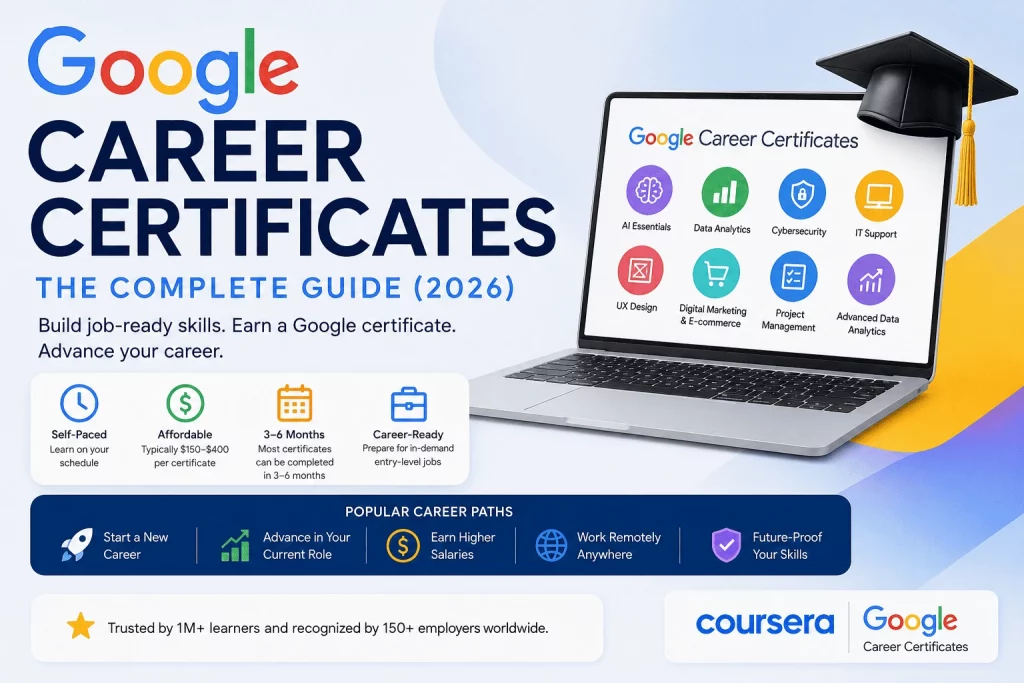
Google Career Certificates are a family of beginner-level, self-paced online credentials designed to prepare learners for real entry-level jobs — without requiring a college degree, prior experience, or technical background. Delivered through a partnership with Coursera, the certificates cover fields like data analytics, cybersecurity, IT support, UX design, digital marketing, project management, and increasingly, artificial intelligence.
Google launched the program to address a mismatch it saw across the labor market: millions of well-paying jobs sat unfilled not because candidates lacked ability, but because they lacked a recognized, affordable way to prove job-readiness without a four-year degree. The company built each certificate with input from its own hiring teams and industry partners — organizations like the Project Management Institute, Tableau, and Figma have all consulted on curriculum design — so the skills taught map directly to what employers actually look for.
The Coursera partnership is central to how the program works. Google writes and maintains the curriculum, but Coursera hosts the video lessons, hands-on labs, quizzes, and peer-reviewed assignments, and handles the subscription billing. Coursera itself is an independent company, not part of Google or Alphabet — it’s simply the delivery platform.
Who should enroll? Broadly: career changers with no formal background in the field they’re targeting, recent graduates who want a practical skill on top of their degree, government and administrative employees looking to formalize existing informal skills, and working professionals who want to pivot into a faster-growing field without quitting their job to go back to school.
Employers recognize these certificates for a few concrete reasons. First, scale — with more than a million graduates and counting, hiring managers at large companies have simply seen the credential enough times to know what it represents. Second, Google’s own employer consortium, which includes more than 150 companies, actively considers Career Certificate graduates for open roles. Third, and most importantly, the certificates are built around real deliverables — dashboards, security incident reports, wireframes, project plans — that give candidates something concrete to show, not just a line item on a resume.
So, is it worth it in 2026? For the right learner — someone starting from zero in a given field, willing to put in consistent part-time hours over a few months, and realistic about needing to build a portfolio alongside the certificate — yes. This guide breaks down exactly which certificate fits which goal, what it costs, how long it takes, and how to turn it into an actual job.
Why this guide exists. With eleven distinct certificates now in the portfolio — spanning AI, data, security, IT, design, marketing, and project management — the single hardest decision most learners face isn’t whether to enroll, it’s which certificate to start with. Search for “Google Career Certificates” and you’ll find dozens of surface-level overviews that list the programs without helping you actually choose between them, compare their difficulty, or understand how they stack together into a real career path. This guide is built to solve that specific problem: every comparison table, decision matrix, and roadmap below exists to shorten the distance between “I want to change careers” and “I know exactly which certificate to enroll in today, and what I’ll do with it once I finish.”
Quick Verdict
| Category | Verdict |
|---|---|
| Best For | Career changers, beginners, and professionals adding a new skill without going back to school |
| Difficulty | Beginner-friendly across the core certificates; a few advanced tracks assume some prior math or coding exposure |
| Cost | Typically $150–$400 total per certificate, depending on completion speed |
| Duration | 3–6 months part-time for most certificates; shorter “Essentials” programs run 1–4 weeks |
| Career Potential | Strong for entry-level roles; average reported post-completion salaries in the US exceed $100,000 across the portfolio, though this varies significantly by track and role |
| Beginner Friendly | Yes for the core six certificates; advanced tracks (Advanced Data Analytics, Business Intelligence, IT Automation with Python) assume foundational knowledge |
| Overall Rating | 4.5 / 5 for learners matching the intended beginner audience |
What Are Google Career Certificates?
Career-focused certificates. Unlike a general education course, every Google Career Certificate is built around a specific job function — data analyst, cybersecurity analyst, UX designer — with curriculum reverse-engineered from the actual skills those roles require day to day.
Beginner friendly. The core certificates assume no prior background in the subject. Terminology, tools, and frameworks are introduced from the ground up, which is a deliberate design choice to keep the barrier to entry low.
No degree required. None of the certificates require a high school diploma, college degree, or any other prerequisite credential to enroll. This is arguably the single biggest differentiator from traditional post-secondary education.
Self-paced. There are no live class times or hard deadlines. Learners move through video lessons, readings, and assessments on their own schedule, fitting study time around work or family obligations.
Employer-recognized. Beyond Google’s own consortium of hiring partners, the certificates are broadly recognized across industries as a credible signal of structured, job-relevant training — particularly for entry-level and coordinator-level roles.
Complete List of Google Career Certificates
| Certificate | Level | Best For |
|---|---|---|
| AI Essentials | Beginner | AI literacy and prompting fundamentals |
| AI Professional Certificate | Beginner–Intermediate | AI-focused careers and applied generative AI skills |
| Data Analytics | Beginner | Data-driven careers, entry-level analyst roles |
| Advanced Data Analytics | Intermediate | Python, statistics, and machine learning basics for those with some data background |
| Business Intelligence | Intermediate | Dashboarding and reporting-focused analyst roles |
| Cybersecurity | Beginner | Security careers, entry-level SOC analyst roles |
| IT Support | Beginner | IT help desk and technical support careers |
| IT Automation with Python | Intermediate | IT professionals wanting to script and automate tasks |
| UX Design | Beginner | Design and product-adjacent careers |
| Digital Marketing & E-commerce | Beginner | Marketing coordinator and e-commerce roles |
| Project Management | Beginner | Coordination, planning, and management-track careers |
(For an in-depth breakdown of any single certificate, see the dedicated review — for example, our full Google Project Management Professional Certificate Review.)
A closer look at each certificate:
AI Essentials is Google’s shortest credential in the portfolio, built as a focused, single-course introduction to using generative AI tools responsibly and effectively at work. It covers prompt writing, understanding AI’s capabilities and limitations, and practical use cases across common office tasks. Because it’s shorter than the full six-course certificates, it’s often taken as a supplement to a primary certificate rather than a standalone career-launching credential.
AI Professional Certificate is a newer, more comprehensive program covering machine learning concepts, generative AI tools, prompt engineering, and real-world business applications in depth. It’s positioned for learners who want AI to be a core part of their next role, not just a supporting skill.
Data Analytics teaches the full analyst workflow: cleaning and organizing data, using spreadsheets and SQL to query it, visualizing findings in tools like Tableau, and presenting insights to stakeholders. It remains one of the most popular certificates in the entire portfolio, with millions of learners enrolled.
Cybersecurity covers network security fundamentals, threat detection, SIEM (Security Information and Event Management) tools, Linux command-line basics, and enough Python to automate basic security tasks. It’s widely considered the strongest certificate in the portfolio for near-term job market demand.
IT Support builds foundational troubleshooting, networking, operating systems, and customer service skills aimed at help-desk and technical support roles — historically the certificate with the largest total enrollment, since it requires the least prior technical comfort of any technical track.
UX Design teaches the end-to-end design process: user research, wireframing, prototyping in Figma, and usability testing. Like most design fields, actual hiring outcomes depend heavily on the strength of a learner’s portfolio, not the certificate alone.
Digital Marketing & E-commerce covers SEO, SEM, email marketing, social media strategy, and e-commerce fundamentals including basic Shopify store management, aimed at marketing coordinator and e-commerce specialist roles.
Project Management walks learners through the full project lifecycle — initiation, planning, execution, and closing — plus a dedicated Agile and Scrum course, aimed at coordinator and junior project manager roles across virtually any industry.
Advanced Data Analytics sits above the standard Data Analytics certificate, adding Python, statistics, regression, and introductory machine learning for learners who already have some data or spreadsheet background.
Business Intelligence is a newer, more advanced program focused on data pipelines, BigQuery, and Looker Studio dashboards, aimed at business intelligence analyst roles and assuming some prior data analytics exposure.
IT Automation with Python teaches learners to write Python scripts that automate common IT administrative tasks, positioned as a natural next step after IT Support for learners who want to move toward more technical, developer-adjacent IT roles.
Google Career Certificates Learning Paths
Rather than treating each certificate as a standalone endpoint, most learners get the most value by thinking in tracks:
AI Track: AI Essentials → AI Professional Certificate → Advanced AI Learning (specialized generative AI or machine learning coursework beyond the core certificates)
Data Track: Data Analytics → Business Intelligence → Advanced Data Analytics
IT Track: IT Support → Cybersecurity → Cloud (a natural extension into cloud platform certifications once foundational IT and security skills are in place)
Each track is designed so the first certificate builds foundational vocabulary and tools, the second adds specialization, and the third pushes toward more technical or senior-track skills. Very few learners need to complete an entire track before applying to jobs — many land an entry-level role after the first certificate and complete the second while working.
How Google Career Certificates Work
Coursera subscription. Access requires either a per-certificate monthly subscription or a Coursera Plus subscription that unlocks a broader course catalog, including many of the certificates on this list.
Self-paced learning. Learners set their own schedule and can speed up, slow down, or pause without losing progress, aside from needing an active subscription to access new material.
Video lessons. Each course is built around short instructional videos, often featuring actual Google employees explaining concepts from their own career experience.
Hands-on labs. Technical certificates — Cybersecurity, IT Support, Data Analytics, IT Automation with Python — include interactive labs where learners practice in real or simulated tool environments rather than just watching demonstrations.
Quizzes. Auto-graded knowledge checks appear throughout each course to reinforce concepts before learners move on to graded assignments.
Capstone projects. Every certificate ends with a capstone that requires applying the full skill set to a realistic, sustained project — a dashboard, a security incident response plan, a UX case study, a project charter and execution plan — which becomes the centerpiece of a learner’s portfolio.
A typical week inside the program. Most courses follow a consistent rhythm: a handful of short instructional videos (usually 5–15 minutes each) introduce a concept, followed by a reading that goes deeper, then a low-stakes practice quiz, and finally a graded activity — either an auto-graded assessment or a peer-reviewed assignment where you submit a real artifact for feedback. Technical certificates intersperse hands-on labs throughout this rhythm, giving learners a sandbox environment to practice tools like the Linux terminal, SQL queries, or Figma without needing to install anything locally. Discussion forums sit alongside every course, where learners compare notes, ask for help on confusing concepts, and occasionally form informal study groups — a resource that’s easy to overlook but genuinely useful when you get stuck.
How Long Does It Take?
Fast learners. Someone treating the certificate like a temporary full-time commitment — 20-plus hours a week — can often finish a standard six-course certificate in 4–6 weeks.
Part-time learners. At a more typical pace of 8–10 hours a week, most certificates take 3–4 months to complete.
Working professionals. Learners squeezing in 3–5 hours a week around a full-time job commonly take 5–7 months, which is why picking a realistic pace upfront (see the study plans in our Project Management deep-dive) matters more than the specific certificate chosen.
Shorter “Essentials” programs, like AI Essentials, are a different animal entirely — often completable in 1–4 weeks even at a light, part-time pace, since they’re built as focused, single-course credentials rather than full six-course programs.
Cost Breakdown
Monthly subscription. In the US and Canada, standalone access to a certificate typically costs around $49 per month, billed until you complete the program or cancel.
Coursera Plus. For learners planning to take more than one certificate, a Coursera Plus subscription — commonly priced in the range of $60/month or a discounted annual rate around $200–$400 depending on current promotions — can be more cost-effective, since it unlocks a much wider course catalog beyond a single certificate.
Financial Aid. Coursera offers need-based financial aid on eligible courses within the Career Certificates program, which can reduce or eliminate the subscription cost for qualifying learners. This is underused — many eligible learners never apply because the option isn’t prominently advertised at signup.
Free Trial. New subscribers typically receive a seven-day free trial, enough time to get a real feel for a certificate’s pacing and content style before committing financially.
Total estimated cost. Most learners completing a single certificate within three to six months land in the $150–$400 range, with total cost scaling directly with how long the subscription stays active — finishing efficiently is the single biggest cost-control lever a learner has.
Skills You’ll Learn
Across the certificate portfolio, learners build both technical and durable, transferable skills. On the technical side: AI literacy and prompt engineering, Data Analytics using spreadsheets, dashboards, and query languages, Excel and spreadsheet modeling, SQL for querying and manipulating datasets, Python for automation, scripting, and basic data science in the advanced tracks, UX research and prototyping tools like Figma, Cybersecurity fundamentals including network security and SIEM tools, Project Management frameworks spanning Waterfall and Agile, and Digital Marketing skills covering SEO, SEM, and e-commerce analytics. On the durable-skills side, nearly every certificate reinforces communication, structured problem-solving, stakeholder management, and the ability to document and present work clearly — skills that transfer across every one of these career tracks regardless of which technical specialty a learner chooses.
Career Opportunities
Graduates commonly target roles such as: Data Analyst, IT Support Specialist, Cybersecurity Analyst, UX Designer, Digital Marketer, Project Coordinator, and AI Specialist. These roles share a common thread — they’re structured as genuine entry points that value demonstrated, portfolio-backed skills over years of prior experience, which is exactly the gap Google Career Certificates were built to fill.
Atlas Career Certificate Selection Guide™
A simple decision path for picking your first certificate:
| If you… | Choose |
|---|---|
| Want AI literacy across any role | AI Essentials |
| Need to work with data and numbers | Data Analytics |
| Love design and visual problem-solving | UX Design |
| Want a technical entry point into IT | IT Support |
| Need leadership and coordination skills | Project Management |
| Want marketing and e-commerce skills | Digital Marketing & E-commerce |
If more than one of these resonates, start with the one tied to the industry you already work in or want to work in next — the certificate is most valuable when it’s paired with a clear job target, not chosen in the abstract.
Atlas Career Roadmap™
Beginner → Google Career Certificate → Entry-Level Job → Professional Certification → Senior Specialist → Leadership
This roadmap reflects the typical arc: the certificate gets you in the door at the coordinator or associate level, a few years of real experience plus an industry-specific credential (CAPM/PMP, CompTIA Security+, a Tableau or Microsoft certification) moves you into a specialist role, and continued delivery and team leadership eventually opens the door to management or director-level positions.
Atlas Career Matching Matrix™
| Goal | Recommended Certificate |
|---|---|
| AI | AI Essentials |
| Data | Data Analytics |
| IT | IT Support |
| Security | Cybersecurity |
| Design | UX Design |
| Marketing | Digital Marketing & E-commerce |
| Project Management | Project Management |
Atlas Salary Comparison™
Reported entry-to-mid-level salary ranges vary meaningfully by track and are highly dependent on region, industry, and role seniority. As a general US-centric guide: Cybersecurity and IT Automation with Python tend to sit at the higher end of the entry-level range given strong technical demand, often starting in the $65,000–$85,000 band. Data Analytics and Business Intelligence roles commonly start in the $60,000–$80,000 range. Project Management coordinator roles typically start around $50,000–$65,000, rising quickly with experience. UX Design entry-level roles vary widely by market but often start in the $55,000–$75,000 range. Digital Marketing roles tend to start slightly lower, often $45,000–$60,000, though e-commerce-specific and analytics-heavy marketing roles trend higher. These figures move constantly with the labor market, so treat them as directional rather than fixed.
What drives the spread within each track. Even within a single certificate track, salary outcomes vary far more by industry and company size than by the certificate itself. A cybersecurity analyst at a regional bank, for example, often earns meaningfully more than one at a small nonprofit, even with identical credentials — financial services and large technology firms consistently pay above the median for equivalent entry-level technical roles. Geographic cost of living plays a similarly large role: the same job title can carry a 30–50% pay difference between a major metro tech hub and a smaller regional market. The practical implication is that certificate choice sets your floor and your general direction, but industry and location decisions have just as much influence on your eventual paycheck as which certificate you complete.
Atlas Difficulty Meter™
| Certificate | Difficulty (1 = easiest, 5 = hardest) |
|---|---|
| Project Management | 2 |
| Digital Marketing & E-commerce | 2 |
| UX Design | 3 |
| IT Support | 3 |
| Data Analytics | 3 |
| AI Essentials | 1 |
| Cybersecurity | 4 |
| AI Professional Certificate | 4 |
| Business Intelligence | 4 |
| Advanced Data Analytics | 5 |
| IT Automation with Python | 5 |
The pattern here is consistent: certificates involving coding, scripting, or advanced statistical concepts rank higher in difficulty, while certificates built around frameworks, communication, and tool familiarity rank lower — which is exactly why Project Management and Digital Marketing are frequently recommended as first certificates for complete beginners.
Atlas Time-to-Complete Comparison™
| Pace | AI Essentials | Core Certificates (Data Analytics, PM, UX, etc.) | Advanced Tracks |
|---|---|---|---|
| 1 month | Comfortable | Achievable at 15–20 hrs/week | Difficult without prior background |
| 3 months | N/A (already finished) | Comfortable at 8–10 hrs/week | Achievable at 10–15 hrs/week |
| 6 months | N/A | Very comfortable, part-time | Comfortable, sustainable pace |
Atlas ROI Meter™
| Factor | Rating |
|---|---|
| Cost | Low relative to degrees or bootcamps |
| Time | Moderate — 3–6 months for most core certificates |
| Salary | Strong for technical tracks; moderate-to-strong for non-technical tracks |
| Demand | High across nearly all tracks, especially Cybersecurity and Data |
| Learning Curve | Low for core certificates; steeper for advanced technical tracks |
| Overall ROI | High for beginners entering a new field, particularly in technical tracks |
Atlas Job Demand™
Technology. The single largest hiring category across nearly every certificate track, from IT support desks to cybersecurity operations centers to data and AI teams.
Healthcare. A growing employer of IT support, data analytics, and project management graduates as health systems digitize records and coordinate large-scale technology rollouts.
Finance. Strong demand for data analytics, cybersecurity, and project management skills, particularly around compliance, fraud detection, and systems modernization projects.
Government. Consistent demand for project coordinators, IT support staff, and cybersecurity analysts, especially as public-sector agencies modernize legacy systems.
Education. Growing demand for IT support and data analytics roles as schools and universities expand their own digital infrastructure and reporting needs.
Retail. A major employer of digital marketing, e-commerce, and data analytics graduates, particularly as retailers invest further in online sales channels and customer analytics.
Atlas Decision Matrix™
| Certificate | Difficulty | Salary Potential | Time | ROI | Beginner Friendly |
|---|---|---|---|---|---|
| Project Management | Low | Moderate | 3–6 months | High | Yes |
| Data Analytics | Medium | High | 3–6 months | High | Yes |
| Cybersecurity | Medium–High | High | 4–6 months | High | Yes |
| IT Support | Medium | Moderate | 3–5 months | High | Yes |
| UX Design | Medium | Moderate–High | 4–6 months | Medium–High | Yes |
| Digital Marketing & E-commerce | Low–Medium | Moderate | 3–5 months | Medium | Yes |
| AI Essentials | Low | N/A (supplemental) | 1–4 weeks | High (as a supplement) | Yes |
| AI Professional Certificate | Medium–High | High | 4–6 months | High | Somewhat |
| Advanced Data Analytics | High | High | 4–6 months | High | No — assumes prior data background |
| Business Intelligence | Medium–High | High | 3–5 months | High | No — assumes prior data background |
| IT Automation with Python | High | High | 4–6 months | High | No — assumes coding comfort |
Atlas Best Certificate by Career Goal™
Best for Career Change: Project Management or Data Analytics — both offer a broad, cross-industry skill set that transfers well from almost any prior career.
Best for Remote Work: Digital Marketing & E-commerce and Data Analytics, since both fields have a high concentration of fully remote job postings.
Best for Government Employees: Project Management, given its direct relevance to program coordination work already common in public-sector roles.
Best for Students: AI Essentials or Data Analytics — short enough or broadly relevant enough to complement an existing degree program without derailing coursework.
Best for Beginners: Project Management or AI Essentials — the lowest technical barrier to entry of the entire portfolio.
Best for Highest Salary: Cybersecurity and the AI Professional Certificate consistently report the strongest entry-level salary outcomes.
Best for AI: AI Essentials as a starting point, followed by the AI Professional Certificate for deeper, career-track skills.
Best for IT: IT Support as an entry point, with Cybersecurity or IT Automation with Python as natural next steps.
Best for Marketing: Digital Marketing & E-commerce, particularly for learners targeting retail or e-commerce-heavy employers.
Google Career Certificates vs Traditional Degrees
Cost. A Google Career Certificate typically costs a few hundred dollars total; a traditional two- or four-year degree commonly costs tens of thousands of dollars even at public institutions, before accounting for lost wages during full-time study.
Time. Most certificates take 3–6 months part-time; degrees take two to four years.
Flexibility. Certificates are entirely self-paced with no live class times; degree programs, even online ones, typically involve more structure, deadlines, and sometimes cohort-based pacing.
Job Readiness. Certificates are built narrowly around specific job functions and include hands-on, tool-based practice; degrees provide broader theoretical grounding and are often required or preferred for roles with regulatory, research, or advanced technical requirements. Neither fully replaces the other — certificates are best understood as a faster, cheaper path into entry-level roles, not a direct substitute for degree-required professions like law, medicine, or engineering.
When a degree still matters more. For roles in regulated professions, research-heavy fields, or large enterprises with rigid HR screening criteria that explicitly require a bachelor’s degree, a certificate alone won’t clear the initial filter, no matter how strong the portfolio behind it. Where certificates shine is in the much larger pool of roles — the majority of entry-level coordinator, analyst, and technical support positions — where hiring managers increasingly say they care more about demonstrated skill than the specific educational pathway used to get there.
Google Career Certificates vs Bootcamps
Bootcamps are typically far more expensive — often $10,000–$20,000 — and more intensive, frequently full-time for 8–16 weeks with live instruction and cohort accountability. Some include job placement support or guarantees that Google’s self-paced certificates don’t offer. Google Career Certificates are slower-paced, dramatically cheaper, and self-directed, which suits learners who need flexibility around a job or family obligations but sacrifices some of the built-in accountability and instructor access a bootcamp provides. For learners who thrive with structure and can afford the upfront cost, a bootcamp may deliver faster job outcomes; for learners on a tight budget or with limited free time, the certificate model is considerably lower-risk.
Google Career Certificates vs AWS Certifications
AWS certifications validate deep, vendor-specific technical expertise in cloud infrastructure and typically assume some existing IT or development background — they’re not designed as zero-experience entry points the way Google’s core certificates are. AWS credentials tend to carry more weight for cloud engineering and infrastructure roles specifically, while Google Career Certificates cover a broader range of non-cloud-specific career paths. Many learners use Google’s IT Support or Cybersecurity certificate as a foundation, then pursue an AWS certification once they have enough context to make sense of cloud-specific material.
Google Career Certificates vs Microsoft Certifications
Microsoft’s certification ecosystem (spanning Azure, Microsoft 365, and Power BI, among others) is similarly vendor-specific and often technical, targeting IT professionals who already work within Microsoft-centric environments. Google’s certificates are more platform-agnostic and beginner-oriented by design. A common and effective pairing: complete Google’s Data Analytics or Business Intelligence certificate for foundational skills, then pursue a Microsoft Power BI certification if you land in a role at a company standardized on the Microsoft stack.
Google Career Certificates vs Coursera Professional Certificates
Coursera hosts Professional Certificates from many providers beyond Google — IBM, Meta, and various universities among them. Google’s certificates are generally considered some of the most beginner-accessible and broadly employer-recognized in that catalog, partly due to sheer enrollment scale and partly due to Google’s own employer consortium. IBM’s certificates, by comparison, often lean slightly more technical even at the entry level, while university-branded Professional Certificates on Coursera sometimes carry more academic prestige but less of a direct, built-in employer pipeline. The right choice depends on the specific role you’re targeting — for pure beginners without a strong preference, Google’s certificates remain a reliable, low-risk starting point.
Success Tips
- Study consistently — a steady, scheduled few hours a week beats sporadic bursts of long study sessions
- Finish capstones properly rather than rushing them, since they become your primary portfolio artifact
- Build a portfolio immediately after each certificate rather than waiting until you’ve collected several
- Update LinkedIn as soon as you finish, including specific tools and frameworks, not just the certificate title
- Practice real projects beyond the coursework — volunteer, freelance, or personal projects reinforce and demonstrate the skills far more convincingly than the certificate alone
Why consistency beats intensity. Because every certificate in this portfolio is self-paced with no external deadlines, the biggest single risk to completion isn’t the difficulty of the material — it’s momentum loss. Learners who set a fixed weekly study block, treat it like a recurring appointment, and pick a real target completion date consistently finish at much higher rates than those who study only when they feel motivated. If you’re serious about finishing, write the date down somewhere visible and tell at least one other person your plan — external accountability closes the gap between intention and completion more reliably than willpower alone.
Common Mistakes
- Skipping projects and watching only the videos, which leaves no portfolio evidence of actual capability
- Ignoring quizzes and assuming they don’t matter, when in fact they reinforce concepts tested more deeply in graded assignments
- Rushing modules just to finish quickly, at the cost of genuinely understanding the frameworks well enough to discuss them in an interview
- Not networking during or after the program — many jobs come through referrals and community connections, not cold applications alone
- Not updating your resume and LinkedIn promptly, which delays the point at which recruiters can actually discover your new skill set
- Choosing a certificate based on hype rather than fit — enrolling in Cybersecurity because it has strong headline salary numbers, for example, when your actual interest and aptitude points toward Data Analytics or UX Design, tends to backfire during the harder middle stretch of any program
- Letting a subscription lapse and restart repeatedly, which not only wastes money on repeated free-trial-adjacent months but also breaks the study momentum that consistency depends on
28. Atlas Resume Builder™
On your resume: List each certificate under a dedicated “Certifications” section with the full official name and completion year, then pull specific tools and frameworks (SQL, Figma, Agile, SIEM) into your experience bullet points wherever relevant — even for past roles that didn’t formally use those terms.
On LinkedIn: Add each certificate under “Licenses & Certifications” with the shareable credential link, and consider working the most relevant one into your headline if you’re actively job searching in that field.
On job applications: Reference specific capstone deliverables (a dashboard, a security incident report, a UX case study) in application questions or cover letters that ask about relevant experience — concrete artifacts consistently outperform vague credential name-drops.
Atlas LinkedIn Optimization™
Profile headline. Lead with the role you’re targeting, not just your certificate — “Aspiring Data Analyst | Google Data Analytics Certified” reads far better than a headline that only names the credential.
Skills section. Add the specific tools and frameworks each certificate covered (SQL, Tableau, Figma, Scrum, SIEM) rather than only the broad category, since recruiters frequently search LinkedIn by specific skill keywords.
Certificates. Attach every completed certificate with its shareable Coursera link so recruiters can verify it directly rather than taking your word for it.
Featured section. Pin your best capstone project or portfolio piece here — a dashboard screenshot, a case study PDF, or a project charter — so it’s the first thing a visitor to your profile sees after your headline.
Atlas Portfolio Builder™
Portfolio ideas by certificate: for Data Analytics, publish a cleaned dataset with a dashboard and a short write-up of your findings. For UX Design, package a full case study — research, wireframes, prototype, and usability testing notes — for one project. For Cybersecurity, document a mock incident response walkthrough or a home-lab network security setup. For IT Support, write up a troubleshooting guide or a documented help-desk ticket resolution process. For Digital Marketing, build a mock campaign plan complete with target audience research, channel strategy, and projected metrics. For Project Management, package a full charter, risk register, schedule, and lessons-learned document from your capstone into a single shareable case study (see our detailed Atlas Project Management Toolkit for the full template set).
Atlas Interview Preparation™
Behavioral questions commonly include “Tell me about a project or task that didn’t go as planned” and “Describe a time you had to learn something new quickly” — draw directly from your certificate capstone or any real project work, even informal.
Technical questions vary heavily by track: expect SQL query challenges for Data Analytics roles, a live wireframing or critique exercise for UX Design roles, and scenario-based troubleshooting questions for IT Support and Cybersecurity roles.
Portfolio presentation. Nearly every entry-level interview in these fields now includes some version of “walk me through a project you’re proud of.” Practice narrating your capstone or portfolio piece out loud, in under three minutes, hitting the problem, your approach, and the outcome — this single piece of preparation consistently separates strong candidates from average ones.
Salary by Country
| Country | Average Annual Salary (Entry–Mid Level, Technical Tracks) |
|---|---|
| United States | $60,000–$100,000 |
| Canada | CA$55,000–CA$90,000 |
| United Kingdom | £28,000–£48,000 |
| Australia | AU$70,000–AU$100,000 |
| Singapore | S$48,000–S$78,000 |
| Philippines | ₱380,000–₱750,000 |
These are broad, directional ranges across the technical certificate tracks (Data Analytics, Cybersecurity, IT Support); non-technical tracks like Digital Marketing and Project Management often sit toward the lower end of each range at the entry level. Actual pay depends heavily on employer, city, and specific role.
Hiring Companies
Google’s employer consortium and the broader market recognition of these certificates mean graduates are considered — directly or indirectly — by a wide range of major employers, including Google, Accenture, IBM, Deloitte, Amazon, Microsoft, Capgemini, and Infosys. As with any credential, being recognized by these companies doesn’t guarantee an interview; it means recruiters are less likely to screen the certificate out as unfamiliar, which matters most at the initial resume-screening stage. Small and mid-sized employers, government agencies, and nonprofits are often more directly accessible for a first role, since they typically place less weight on requiring years of prior experience for entry-level and coordinator positions.
How the employer consortium actually functions. It’s worth being precise about what this partnership does and doesn’t do. Graduating doesn’t automatically forward your resume to any of these companies — you still apply through each employer’s normal careers page or recruiting process. What the consortium relationship changes is familiarity: recruiters and hiring managers at these organizations have seen the certificate structure before, understand what a graduate has actually learned, and are less likely to dismiss it the way they might an unfamiliar credential from a smaller provider. Some consortium members also run dedicated early-career programs, apprenticeships, or referral pipelines specifically for Career Certificate graduates — worth checking each employer’s careers site directly, since these programs change frequently and aren’t always advertised prominently.
Beyond the household names. A large share of successful graduates land their first role at companies far smaller than the names above — regional agencies, local government offices, healthcare systems, and small-to-mid-sized tech companies — where hiring managers are often more willing to take a chance on a certificate-and-portfolio combination in place of years of formal experience. Many professionals use that first role as the credential that actually opens the door to larger employers a few years later.
Pros
- No degree or prior experience required across the core certificates
- Low cost relative to degrees and bootcamps
- Self-paced, fitting around full-time work or family obligations
- Broad portfolio of tracks covering both technical and non-technical career paths
- Built-in capstone projects that produce real, shareable portfolio artifacts
- Backed by a large, active employer consortium
- Clear learning paths for stacking multiple certificates over time
- Financial aid available for qualifying learners
Cons
- Market saturation in some tracks (Data Analytics and UX Design in particular) means the certificate alone increasingly needs to be paired with a strong portfolio to stand out
- Peer-graded assignments can be inconsistent in quality and turnaround time
- Advanced tracks assume prior technical background that beginners may not have
- Ongoing subscription cost means slower completion directly increases total price
- Doesn’t replace years of real work experience for mid-level or senior roles
- Some employers outside Google’s consortium may still weigh a degree more heavily, particularly in regulated or highly technical fields
Is Google Career Certificates Worth It?
For students, these certificates are a low-cost way to add a practical, job-ready skill alongside a degree, particularly useful for students in fields without an obvious direct career pipeline.
For career changers, this is arguably the strongest use case — a structured, affordable, and credible way to build real skills and a portfolio in a new field without returning to school full-time.
For government employees, certificates like Project Management and IT Support formalize skills many are already using informally, supporting internal promotion cases and eligibility for further professional credentials.
For professionals already working in an adjacent field, a certificate is a relatively low-risk way to add a recognized credential and open doors to lateral moves or promotions.
For freelancers, certificates — particularly Digital Marketing, UX Design, and Project Management — provide a credible signal to prospective clients who don’t have the context to evaluate raw skill directly, and the accompanying portfolio work doubles as marketing material.
Frequently Asked Questions
Are Google Career Certificates worth it? For beginners and career changers targeting entry-level roles, yes — especially when paired with genuine portfolio work built from the capstone projects.
Are they recognized by employers? Yes, broadly, and directly by Google’s own employer consortium of more than 150 companies, though recognition varies somewhat by industry and region.
Do I need a degree? No — none of the certificates require a prior degree or diploma to enroll.
Can beginners enroll? Yes, the core certificates (Data Analytics, Cybersecurity, IT Support, UX Design, Digital Marketing, Project Management, AI Essentials) are all designed for complete beginners.
Are they available worldwide? Yes, though pricing, employer recognition, and job-market impact vary by country.
Is financial aid available? Yes, Coursera offers need-based financial aid on eligible certificate courses.
Which certificate has the highest salary? Cybersecurity and the AI Professional Certificate consistently report among the strongest entry-level salary outcomes in the portfolio.
Which certificate is easiest? AI Essentials and Project Management are generally considered the most accessible for complete beginners.
Can I get a remote job? Yes, particularly in Data Analytics, Digital Marketing, and UX Design, all of which have a high proportion of remote-friendly job postings.
Which certificate should I take first? Start with whichever track most directly aligns with the industry or role you’re targeting next — when in doubt, Data Analytics or Project Management offer the broadest cross-industry applicability.
How much does a Google Career Certificate cost overall? Most learners spend $150–$400 total per certificate, depending on completion speed and subscription plan.
Can I complete more than one certificate? Yes, and many learners do, particularly by pairing a core certificate with a shorter supplement like AI Essentials or moving into an advanced track like Business Intelligence.
Do these certificates expire? No, once earned they don’t expire, though the specific tools and software referenced will naturally evolve over time.
Is the coursework self-paced or does it have deadlines? Fully self-paced — there are no fixed deadlines, only your active subscription status.
How are assignments graded? Through a mix of auto-graded quizzes and peer-reviewed assignments evaluated against detailed rubrics.
Can I complete a certificate on my phone? Yes, Coursera’s mobile app supports most lesson types, though longer written assignments are easier to complete on desktop.
Do these certificates count toward professional credentials like PMP or CompTIA? Some do — the Project Management certificate counts toward PMI’s CAPM training-hour requirements, for example — but this varies by certificate and target credential.
Is prior computer experience required? Basic computer literacy helps, but the core certificates don’t assume any specialized technical background beyond that.
Are the advanced tracks harder than the core certificates? Yes — tracks like Advanced Data Analytics, Business Intelligence, and IT Automation with Python assume prior exposure to data concepts or coding logic.
Can I switch tracks partway through? Yes, your Coursera subscription generally gives access to start a different certificate at any point, though progress in an abandoned certificate is simply paused, not transferred.
Do employers verify these certificates? Yes, each certificate includes a shareable, verifiable credential link that employers or recruiters can check directly.
Is one certificate enough to change careers? Often yes for entry-level roles, particularly when paired with a strong capstone portfolio, networking, and consistent applications — though it’s rarely sufficient completely on its own.
How do I know which industries are hiring for each certificate? Check current job postings directly on LinkedIn or Indeed for your target role and note which skills and tools appear most frequently — this is a more reliable, real-time signal than any single guide.
Are these certificates accredited like a university degree? No, they are industry credentials, not academic accreditation, though they are increasingly accepted by some universities and employers as contributing toward other qualifications.
Can I list a Google Career Certificate if I haven’t finished the capstone yet? It’s best to wait until full completion — the shareable credential and verification link only activate once every course, including the capstone, is finished, and listing an incomplete certificate can raise questions in an interview.
What happens if Google updates the curriculum after I’ve enrolled? Enrolled learners typically retain access to updated content as courses are refreshed, since the certificates are periodically revised to keep pace with new tools and industry practices — you generally don’t need to re-enroll or pay extra to receive these updates.
Is there a difference between taking a certificate through Coursera versus Google’s own Skills platform? The core content is the same either way; the main difference is the enrollment and billing experience, since Google’s Skills platform is essentially a branded entry point into the same Coursera-hosted courses.
Can I put “Google Certified” on my resume? It’s more accurate and specific to name the exact certificate — for example, “Google Data Analytics Professional Certificate” — rather than the generic phrase “Google Certified,” which can read as vague or even slightly misleading to a careful recruiter.
Do these certificates help with visa or immigration-related job applications? In some cases, a recognized credential can support a case for specialized skills, but immigration requirements vary enormously by country, and this is a question best directed to an immigration professional rather than answered generically here.
How often should I revisit or refresh a certificate’s material? There’s no formal renewal requirement, but because tools and best practices evolve quickly — especially in AI, data, and cybersecurity — many professionals informally revisit key modules or take a newer, related certificate every couple of years to stay current.
Conclusion
Google Career Certificates have grown into one of the most accessible, affordable on-ramps into a genuinely wide range of careers — from data and cybersecurity to design, marketing, and project management, with AI-focused tracks now rounding out the portfolio. Who should take one depends entirely on the goal: students looking to add practical skills, career changers seeking a structured and low-cost pivot, government employees formalizing existing informal skills, and working professionals adding a new specialty without stepping away from their job.
Career opportunities span entry-level and coordinator-level roles across nearly every industry, with clear paths toward more advanced credentials and senior positions as real experience accumulates. Salary potential varies significantly by track — technical certificates like Cybersecurity and the AI Professional Certificate tend to report the strongest entry-level outcomes, while non-technical tracks like Digital Marketing and Project Management still offer solid, broadly applicable earning potential.
The best study strategy remains consistency over intensity: pick a realistic weekly pace, protect that time on your calendar, and treat the capstone project as the most important deliverable in the entire program, not an afterthought. Do that, build a genuine portfolio from the work, and update your resume and LinkedIn the moment you finish — and the final recommendation holds up clearly: for the beginner and career-changer audience these certificates were built for, Google Career Certificates remain one of the smartest, most affordable career investments available in 2026.
Related Guides
- Microsoft Certifications Guide (2026): The Complete Certification Roadmap
- AI-900 Review (2026): Is Azure AI Fundamentals Worth It?
- AZ-104 Microsoft Azure Administrator Review (2026): Is It Worth It?
- Azure Certifications Guide (2026): The Complete Azure Certification Roadmap
- Free Online Courses for Skill Upgrade in 2026: The Complete Global Guide
- Best Time Management Courses in 2026 (For Government Employees & Professionals)
- Google AI Essentials Review (2026): Everything You Need to Know Before You Enroll
- Google AI Professional Certificate: The Complete 2026 Review
- Google Data Analytics Professional Certificate: The Complete Review
- Google Cybersecurity Professional Certificate Review (2026): Is It Worth It?
- Google IT Support Professional Certificate Review (2026): Is It Worth It?
- Google UX Design Professional Certificate Review (2026): Is It Worth It?
- Google Digital Marketing & E-commerce Professional Certificate Review: Is It Worth It
- AWS Certified Developer Associate (DVA-C02): The Complete 2026 Guide
- AWS Certified Cloud Practitioner (2026): Complete Certification Guide
- AWS Certifications Guide (2026): The Complete AWS Certification Roadmap