If you’ve been scrolling through Coursera trying to decide between two of Google’s most talked-about Career Certificates, you’re probably stuck on the same question thousands of learners ask every month: should I go all-in on AI, or is data analytics still the safer bet for landing a job?
Both certificates carry the Google name. Both promise no degree, no experience, and a real shot at a new career. But they lead to genuinely different jobs, require different kinds of thinking, and fit different types of people. This guide breaks the decision down piece by piece — cost, difficulty, curriculum, career paths, salary expectations, and who each certificate is actually built for — so you can pick with confidence instead of guessing.
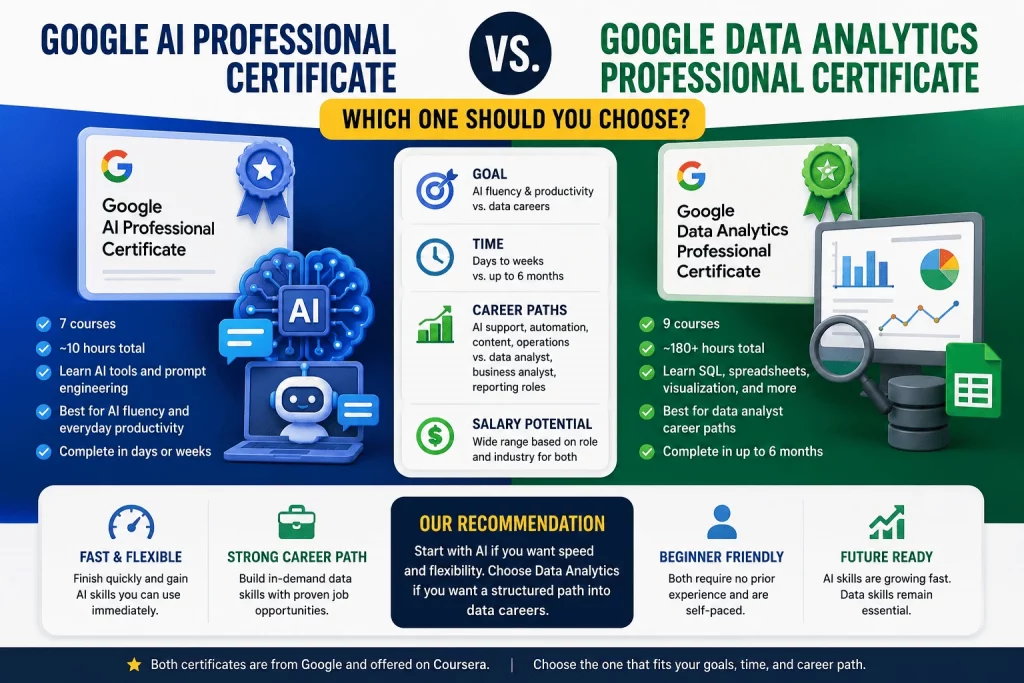
Quick answer: If you want the fastest, lowest-effort way to become “AI fluent” for your current job or to explore emerging tech roles, choose the Google AI Professional Certificate. If you want a structured, in-demand career path into data analyst, business analyst, or reporting roles with strong hiring demand across industries, choose the Google Data Analytics Professional Certificate. If you can only afford time for one certificate and you’re not sure which industry you’ll end up in, Data Analytics has the longer track record of employer recognition — but AI is the faster-growing skill category going into the back half of this decade.
Why Learners Keep Comparing These Two Certificates
Google’s Career Certificates program has grown into one of the most recognized non-degree credential systems in the world, and these two programs sit at the center of the current wave of interest. Data Analytics built its reputation over several years as one of the most enrolled professional certificates on Coursera, with a well-documented hiring pipeline through Google’s employer consortium. The AI Professional Certificate is newer, built specifically to answer the explosion in demand for practical, everyday AI skills across every job function — not just technical roles.
The comparison matters because these aren’t just two courses fighting for your attention. They represent two different bets on where the job market is heading. Data analytics represents an established, still-growing discipline with clear job titles, clear tools, and a decade of hiring history behind it. AI fluency represents a newer, faster-moving skill set that’s becoming a baseline expectation across nearly every job function, from marketing to operations to customer support.
Growing Demand for Both Fields
Employer surveys consistently show that AI literacy is now considered a core workplace skill rather than a specialized one, with a large majority of managers saying employees who can use AI tools effectively are more valuable to their teams. At the same time, data analytics continues to post strong job growth, with data-related roles regularly appearing among the highest-volume postings on major job boards. Neither field is going away — the real question is which one matches your goals, your learning style, and the kind of job you actually want to wake up and do.
Who Should Read This Comparison
This guide is for:
- Career changers deciding where to invest their limited study hours
- Students choosing a first professional credential
- Working professionals who want to upskill without quitting their job
- Government and private-sector employees exploring digital transformation roles
- Business owners and freelancers who want practical skills they can apply immediately
- Anyone comparing Google Career Certificates before spending money on a Coursera Plus subscription
Quick Recommendation
- Want to work with data, spreadsheets, SQL, and dashboards → Data Analytics
- Want to work faster with AI tools across any job → AI Professional Certificate
- Want the shorter, lower-commitment certificate → AI Professional Certificate
- Want the certificate with a longer employer-recognition track record → Data Analytics
- Not sure yet and want to explore both → Start with AI Professional Certificate (it’s short), then decide if Data Analytics is worth the deeper six-month commitment
Quick Verdict
| Category | Winner |
|---|---|
| Beginner Friendly | Tie — both require zero prior experience |
| Fastest to Complete | Google AI Professional Certificate |
| Deepest Technical Skill Set | Google Data Analytics Professional Certificate |
| More Established Job Titles | Google Data Analytics Professional Certificate |
| Broadest Applicability Across Jobs | Google AI Professional Certificate |
| Higher Long-Term Earning Ceiling | Depends on specialization — both can lead to six-figure paths |
| Easier to Learn | Google AI Professional Certificate |
| Stronger for a Full Career Pivot | Google Data Analytics Professional Certificate |
| Best for Remote Work | Tie — both support remote-friendly roles |
| Best ROI for Time Invested | Google AI Professional Certificate |
| Overall Winner | Depends on goal — see Atlas Decision Matrix™ below |
There is no universal “better” certificate here. The honest verdict is that these two credentials solve different problems, and the right choice comes down to what kind of job you’re trying to get.
At a Glance Comparison
| Feature | Google AI Professional Certificate | Google Data Analytics Professional Certificate |
|---|---|---|
| Provider | Google (Grow with Google) | Google (Grow with Google) |
| Platform | Coursera | Coursera |
| Course Count | 7 courses | 9 courses (previously 8) |
| Total Study Time | Roughly 10 hours total, self-paced | Roughly 180+ hours, self-paced |
| Typical Completion Time | A few days to a few weeks | Under 6 months at under 10 hours/week |
| Cost Model | Coursera subscription (monthly or Coursera Plus) | Coursera subscription (monthly or Coursera Plus) |
| Certificate Issued | Yes, shareable Google certificate | Yes, shareable Google certificate |
| Beginner Friendly | Yes, no experience required | Yes, no experience or degree required |
| Includes Capstone Project | Applied AI projects throughout | Yes, full data capstone project |
| Core Tools Taught | Generative AI tools, prompt frameworks, AI workflow design | Spreadsheets, SQL, R programming, Tableau |
| Coding Involved | Minimal to none | Yes — SQL and R (introductory level) |
| Career Support | Resume tools, employer connections | Resume tools, employer consortium (150+ employers) |
| Best Fit | Any employee wanting to work faster with AI | Aspiring data analysts and business analysts |
Atlas Decision Matrix™
Use this simple decision path if you want a fast answer without reading the whole guide.
Do you want to become fluent in using AI tools at your current or future job, regardless of industry? → Choose Google AI Professional Certificate
Do you want a defined entry-level career path into data, reporting, or business analytics? → Choose Google Data Analytics Professional Certificate
Do you want to automate repetitive tasks, write better prompts, and use AI as a daily productivity layer? → Choose Google AI Professional Certificate
Do you need to build dashboards, clean messy datasets, and present data-driven recommendations to stakeholders? → Choose Google Data Analytics Professional Certificate
Are you applying for jobs that explicitly list “data analyst,” “business analyst,” or “reporting analyst” in the title? → Choose Google Data Analytics Professional Certificate
Are you applying for jobs where “AI-proficient” or “comfortable with AI tools” appears as a preferred (not required) skill? → Choose Google AI Professional Certificate
Program Overview
Google AI Professional Certificate
The Google AI Professional Certificate is built for people who want to use AI effectively at work, not build AI systems from scratch. It grew out of Google’s AI Essentials course, which became one of the most-enrolled courses on Coursera, and expands that foundation into a full professional credential. The program is organized into seven short courses covering prompt engineering, generative AI fundamentals, evaluating AI output for bias and accuracy, and identifying where AI can realistically save time in a real job. It’s designed to be completed in roughly ten hours total, which makes it one of the fastest professional certificates Google offers.
This certificate does not teach you to code, train models, or work as a machine learning engineer. It teaches you to use AI tools — including prompting frameworks, workflow analysis, and responsible AI practices — as a practical productivity skill that applies across marketing, operations, customer service, HR, project management, and dozens of other functions.
Course-by-course breakdown (Google AI Professional Certificate):
- AI Fundamentals — Introduces core generative AI concepts, sets up the mental model for how large language models work at a practical level, and lays the foundation for prompting.
- Prompting Essentials — Teaches a structured framework for writing prompts that consistently produce usable, high-quality output instead of vague or generic responses.
- Evaluating AI Output — Focuses on checking generated content for accuracy, bias, and reliability before it’s used in real work, which is one of the more overlooked but genuinely important skills in the program.
- Responsible AI Use — Covers ethical considerations, data privacy, and the boundaries of appropriate AI use in a professional setting.
- AI for Workflow Analysis — Teaches learners to map their own job tasks and identify which ones are realistic candidates for AI assistance versus which ones aren’t.
- Applied AI Projects — Hands-on practice applying prompting and evaluation skills to real workplace scenarios across different functions.
- Capstone / Portfolio Course — Consolidates everything into a portfolio-ready set of AI-assisted work samples that can be shown to employers or used to demonstrate impact internally.
Because each course runs about an hour, the entire sequence is genuinely completable in a single focused weekend, though most learners spread it across one to three weeks alongside their normal schedule.
Google Data Analytics Professional Certificate
The Google Data Analytics Professional Certificate is a longer, more traditional career-changer program. It’s structured around the full data analytics lifecycle: asking the right questions, preparing and cleaning data, processing it, analyzing it, visualizing it, and sharing insights with stakeholders. Spread across nine courses and roughly 180 or more hours of instruction, it’s designed to be completed in under six months at fewer than ten hours a week, though motivated learners often finish faster.
Learners come out with hands-on experience in spreadsheets, SQL, R programming, and Tableau, plus a portfolio-ready capstone project. Google connects graduates with an employer consortium of more than 150 U.S. companies, including well-known names like Deloitte, Target, and Verizon, giving the certificate a stronger direct-to-hiring pipeline than most self-paced online credentials.
Course-by-course breakdown (Google Data Analytics Professional Certificate):
- Foundations: Data, Data, Everywhere — Introduces what data analytics is, the analytics lifecycle, and the day-to-day responsibilities of a data analyst.
- Ask Questions to Make Data-Driven Decisions — Focuses on structuring business problems into answerable analytical questions, a skill that underpins everything that follows.
- Prepare Data for Exploration — Covers data types, data privacy, bias, and how to organize raw data for analysis.
- Process Data from Dirty to Clean — Introduces spreadsheet functions and SQL basics for cleaning and organizing messy, real-world datasets.
- Analyze Data to Answer Questions — Goes deeper into SQL for querying, sorting, filtering, and combining datasets to extract insights.
- Share Data Through the Art of Visualization — Introduces Tableau and the principles of effective, honest data visualization and dashboard design.
- Data Analysis with R Programming — Adds statistical analysis and R programming to the toolkit, extending beyond spreadsheets and SQL into more advanced analysis.
- Google Data Analytics Capstone: Complete a Case Study — Learners apply everything from prior courses to a full, portfolio-ready case study from raw data to final presentation.
- Additional Career Readiness / Employability Course — Covers resume building, interview preparation, and connecting with Google’s employer network, rounding out the program with job-search support.
The sequencing matters here: each course genuinely builds on the last, which is part of why skipping ahead tends to backfire for beginners, and why the program is structured to take months rather than weeks.
Curriculum Comparison
| Module Stage | Google AI Professional Certificate | Google Data Analytics Professional Certificate |
|---|---|---|
| Foundations | AI fundamentals, generative AI concepts | Foundations of data analytics, thinking like an analyst |
| Core Skill Building | Prompt engineering frameworks, evaluating AI output | Data cleaning, spreadsheets, data collection |
| Applied Tools | AI workflow integration across job functions | SQL for querying and analysis |
| Advanced Skill | Identifying high-impact AI use cases, responsible AI use | R programming for statistical analysis |
| Communication | Presenting AI-assisted work, workplace application | Data visualization and storytelling with Tableau |
| Capstone | Applied AI mini-projects throughout the program | Full data analytics capstone project |
The AI certificate is intentionally compressed — every course is short, and the emphasis is on immediate application rather than depth. The Data Analytics certificate builds skills sequentially, with each course assuming the previous one as a foundation, which is part of why it takes significantly longer to complete.
Skills Comparison
| Skill | Google AI Professional Certificate | Google Data Analytics Professional Certificate |
|---|---|---|
| Prompt Engineering | Strong focus | Not covered |
| Generative AI Tools | Strong focus | Light exposure only |
| Machine Learning Concepts | Light exposure only | Not covered |
| Python | Not covered | Not covered (see Advanced Data Analytics for this) |
| SQL | Not covered | Strong focus |
| R Programming | Not covered | Strong focus |
| Spreadsheets | Light exposure only | Strong focus |
| Data Visualization | Not covered | Strong focus |
| Statistics | Not covered | Moderate focus |
| Workplace Productivity | Strong focus | Moderate focus |
Atlas Skills Radar™
Rating each certificate from 1 (minimal) to 5 (strong emphasis) across core skill categories:
| Skill Category | Google AI | Google Data Analytics |
|---|---|---|
| Technical Depth | 2 | 4 |
| Programming | 1 | 3 |
| Mathematics/Statistics | 1 | 3 |
| Creativity | 4 | 2 |
| Communication | 4 | 4 |
| Business Application | 5 | 4 |
| AI Literacy | 5 | 1 |
| Analytics Rigor | 2 | 5 |
The radar makes the split obvious: the AI certificate is wide and shallow by design — it wants you productive fast across many contexts. The Data Analytics certificate is narrow and deep — it wants you job-ready for one specific role.
Learning Difficulty
Google AI Professional Certificate Difficulty
This is one of the more approachable professional certificates Google has released. There’s no coding, no statistics, and no prerequisite knowledge. The hardest part for most learners is not the content itself but building the habit of applying AI tools thoughtfully rather than passively. Because each course takes about an hour, momentum is easy to maintain, and most learners don’t experience the mid-program drop-off that longer certificates see.
Google Data Analytics Difficulty
This certificate is beginner-friendly on paper, but it’s a genuinely longer and more demanding commitment. SQL and R are new territory for most learners, and while the courses are designed to teach from zero, the learning curve steepens noticeably once queries and statistical concepts are introduced. The six-month runway (even at a relaxed pace) means motivation management becomes part of the challenge — a real number of learners who start this certificate don’t finish it, which is common across all long-form online certificates, not unique to Google’s program.
Atlas Learning Curve™
Google AI Professional Certificate: Beginner → Comfortable within days → Practical mastery within the first two weeks of consistent real-world use.
Google Data Analytics Professional Certificate: Beginner → Intermediate by course 4 or 5 (once SQL is introduced) → Advanced application by the capstone project, typically months 4 through 6.
The AI certificate front-loads the payoff — you’re using the skill almost immediately. The Data Analytics certificate back-loads the payoff — the real value shows up once you can combine SQL, visualization, and storytelling together near the end of the program.
Time to Complete
| Learner Type | Google AI Professional Certificate | Google Data Analytics Professional Certificate |
|---|---|---|
| Fast Learner (heavy daily study) | 2 to 5 days | 6 to 8 weeks |
| Working Professional (moderate weekly hours) | 1 to 2 weeks | 4 to 6 months |
| Weekend Learner (a few hours on weekends only) | 2 to 3 weekends | 8 to 10 months |
Cost Comparison
Both certificates sit inside Coursera’s subscription model rather than being sold as one-time purchases, which means the real cost depends heavily on how fast you move.
Coursera Subscription Model: Access to either certificate typically runs in the neighborhood of $49 to $59 per month for a standalone certificate subscription, or through a Coursera Plus annual plan (regularly priced near $399, though Coursera runs frequent discount promotions that bring it well below that). Coursera Plus gives you access to thousands of other courses in addition to the certificate, which is worth it if you plan to keep learning after you finish.
Financial Aid: Coursera offers financial aid applications for learners who qualify, which can reduce or eliminate the subscription cost for the audit-and-certify path. It’s worth checking eligibility before assuming the certificate is out of reach financially.
Real Cost by Speed:
- Google AI Professional Certificate: Because it only takes about ten hours to complete, most learners finish inside a single billing cycle — meaning the realistic out-of-pocket cost is close to one month’s subscription, roughly $49 to $59 total if you move with intention.
- Google Data Analytics Professional Certificate: At the target pace of under six months, expect to pay for multiple billing cycles — commonly cited real-world totals land between $150 and $300 for learners who move steadily, or the cost of a Coursera Plus annual plan if you take longer or want to explore other courses simultaneously.
The practical takeaway: the AI certificate is dramatically cheaper in total dollars simply because it takes far less time to finish, even though the monthly subscription price is the same for both.
A note on subscription pricing. Coursera has adjusted its subscription pricing more than once in recent years, and promotional pricing (free trials, discounted first months, limited-time Coursera Plus deals) is common throughout the year. Always check the current price on Coursera’s site before budgeting, since the exact monthly figure can shift and promotional windows can meaningfully change your total cost, especially for the longer Data Analytics program where a well-timed annual-plan discount can end up cheaper than paying month to month.
Hidden cost considerations. The real cost of either certificate isn’t just the subscription fee — it’s the opportunity cost of your study time. Because the AI certificate asks for roughly ten hours total, the time cost is genuinely minimal even for someone with a demanding schedule. The Data Analytics certificate’s six-month runway means the “cost” also includes months of consistent weekly effort, which is worth weighing honestly against your current workload, family responsibilities, and energy levels before committing to the full program.
Career Opportunities
Google AI Career Paths
- AI-Enabled Specialist (marketing, HR, operations, or any function that adopts AI workflows)
- Prompt Engineer (entry-level roles, often in content, product, or support teams)
- AI Consultant or Trainer (helping teams and businesses adopt AI tools)
- Automation and Workflow Specialist
- AI-savvy roles layered onto an existing job title (e.g., “Marketing Specialist, AI-focused”)
Realistically, the AI certificate is less likely to hand you a brand-new job title and more likely to make you significantly more competitive for jobs you’re already qualified for, or to open doors into emerging hybrid roles that combine AI fluency with an existing skill set.
It’s worth being honest about this distinction upfront: the AI certificate works best as a multiplier on top of an existing career rather than a standalone launchpad into a brand-new job title. A customer support agent who becomes genuinely skilled at using AI to draft responses, summarize tickets, and identify patterns in customer complaints becomes measurably more valuable in that same job — and that value is usually easier to demonstrate to a current employer than to a stranger reading a resume for the first time. The certificate’s biggest wins tend to show up as internal promotions, expanded responsibilities, or a stronger case for a raise, rather than a completely new job title landing in your inbox.
Google Data Analytics Career Paths
- Data Analyst
- Business Analyst
- Operations Analyst
- Reporting Analyst
- Marketing Analyst
These are established job titles with predictable listings on job boards across nearly every industry, from healthcare to retail to logistics to government. This is the certificate’s biggest structural advantage: employers already know what a “Data Analyst” does, which makes the credential easier to translate into an actual job search.
Atlas Career Path™
Google AI Track: Junior AI-Enabled Employee → AI Workflow Specialist → Senior AI Strategist / AI Consultant → AI Enablement Lead or Trainer
Google Data Analytics Track: Junior Data Analyst → Business Analyst → Senior Data Analyst → Analytics Manager
Notice the shape of each path. The Data Analytics track follows a familiar corporate ladder with well-worn job titles at every rung. The AI track is still forming — the titles above are directionally accurate, but the market hasn’t fully standardized AI-specific job titles yet, which is both the opportunity (less competition, first-mover advantage) and the risk (less predictable hiring pipeline) of choosing this path right now.
Atlas Salary Comparison™
Salary figures vary significantly by country, industry, experience level, and company size, and AI-specific roles in particular are still stabilizing as a job category. Treat the ranges below as general orientation rather than guarantees, and always check current listings for your specific country and city before making a decision based on salary alone.
| Country | AI-Enabled / AI Support Roles (Entry-Level Range) | Data Analyst (Entry-Level Range) |
|---|---|---|
| USA | Roughly $55,000–$85,000, with wide variation by role and industry | Around $60,000–$97,000, with Google itself citing a median entry-level salary near $97,000 |
| Canada | Roughly CAD $50,000–$75,000 | Roughly CAD $55,000–$80,000 |
| UK | Roughly £28,000–£45,000 | Roughly £28,000–£42,000 |
| Australia | Roughly AUD $65,000–$90,000 | Roughly AUD $65,000–$95,000 |
| Singapore | Roughly SGD $45,000–$70,000 | Roughly SGD $48,000–$72,000 |
| Philippines | Roughly ₱25,000–₱45,000/month for hybrid AI-enabled roles | Roughly ₱25,000–₱50,000/month for entry-level data analyst roles, higher in BPO/multinational firms |
Data Analytics currently has the more documented, more consistently reported salary data because it’s an older, more standardized job category. AI-related compensation is trending upward quickly but is harder to pin down precisely because the job titles themselves are still being defined by the market.
A few important nuances worth understanding before you anchor a career decision to salary numbers alone:
- Data analyst salaries scale predictably with experience. A junior analyst’s pay typically climbs in fairly well-mapped steps as they move toward senior analyst, then analytics manager, then director-level roles. Because this ladder is well established, it’s easier to forecast your five-year earning trajectory.
- AI-related pay is currently more bimodal. Employees who add AI fluency to an existing, well-paid role (engineering, marketing leadership, finance) tend to see compensation bumps layered on top of their existing salary band. Employees pursuing AI-first entry-level roles are often paid closer to general administrative or junior specialist bands, at least until AI-specific job titles mature and standardize industry-wide.
- Industry matters more than certificate choice in both cases. A data analyst in finance or tech typically out-earns one in retail or nonprofit work by a wide margin, and the same is true for AI-enabled roles — a company already investing heavily in AI adoption will pay more for the skill than one just starting to explore it.
- Location remains one of the biggest variables. Remote-friendly roles in both fields can sometimes pay closer to the hiring company’s home-market rate rather than the employee’s local market rate, which is worth researching directly with prospective employers rather than assuming.
The honest takeaway is that neither certificate is a shortcut to a guaranteed salary number. Both function as a credible entry ticket into a job category — what you earn from there depends heavily on industry, negotiation, portfolio quality, and how quickly you build real-world experience on top of the certificate.
Atlas ROI Meter™
Scoring each certificate from 1 (low) to 5 (high) on return-on-investment factors:
| Factor | Google AI | Google Data Analytics |
|---|---|---|
| Cost Efficiency | 5 | 3 |
| Time Efficiency | 5 | 2 |
| Salary Ceiling | 3 | 4 |
| Market Demand Right Now | 4 | 4 |
| Ease of Achieving ROI | 5 | 3 |
The AI certificate wins on speed-to-value — you spend very little time and money before you’re already using the skill productively. The Data Analytics certificate asks for a bigger upfront investment of time but pays off with a more established, more easily verified career path once you’re through it.
Atlas Future Demand™
AI: Future Outlook
AI fluency is moving from “nice to have” to baseline expectation across nearly every white-collar job function. The trajectory strongly favors continued growth — the open question isn’t whether AI skills will matter, but how quickly employers formalize AI-specific job titles and pay bands. Early movers who build AI fluency now are positioning themselves ahead of a market that’s still catching up to the skill.
Data Analytics: Future Outlook
Data analytics remains a stable, high-demand field with a long track record. Automation and AI tools are changing parts of the analyst workflow — particularly repetitive cleaning and basic reporting — but the demand for people who can interpret data, ask the right questions, and communicate insights to decision-makers isn’t going away. If anything, analysts who also understand how to use AI tools within their analytics workflow are becoming more valuable, not less.
Job Market
Both certificates report connections to Google’s employer consortium, which includes more than 150 U.S. companies across industries. Data Analytics has the longer track record here, with more graduates and more documented hiring outcomes. The AI certificate is newer, so its employer-pipeline data is still accumulating, but the underlying demand signal — AI skills appearing in job postings across nearly every department — is strong and growing.
Remote work is realistic for both paths. Data analyst roles are commonly remote or hybrid across industries. AI-enabled roles, especially ones layered onto existing remote jobs like content, marketing, or operations, are similarly remote-friendly. Freelancing is more mature in the data analytics space, where platforms have long-established categories for SQL, dashboarding, and reporting work. AI-related freelance work — prompt engineering, AI workflow consulting, AI training — is growing quickly but is a newer, less standardized freelance category.
Government and public-sector hiring increasingly lists both skill sets as preferred qualifications, particularly for digital transformation, ICT, and planning roles, which we cover in more detail below.
Hiring companies. Data Analytics graduates have a documented path into Google’s employer consortium, which spans technology, retail, consulting, telecommunications, and finance. The AI certificate doesn’t yet have the same multi-year track record of named employer partnerships, but AI fluency itself is showing up as a preferred or required skill inside job postings across nearly every one of those same industries — meaning the practical hiring value often shows up indirectly, by making you a stronger candidate for jobs that were never labeled “AI roles” in the first place.
Demand by sector. Retail, logistics, healthcare, and financial services are consistently among the heaviest hirers of data analysts, largely because these industries generate enormous volumes of operational and customer data that need regular interpretation. AI-enabled hiring demand is more evenly spread — content and marketing teams, customer support operations, HR departments, and software teams are all actively looking for people who can integrate AI tools into daily workflows, which is part of why the AI certificate’s applicability feels broader but less concentrated in any one sector.
Remote and hybrid trends. Both fields benefit from the broader shift toward remote and hybrid work. Data analyst roles are particularly well suited to remote work because the core deliverables — queries, dashboards, reports — are naturally digital and asynchronous. AI-enabled roles inherit the remote-friendliness of whatever underlying job they’re attached to, so a remote marketing role with AI fluency requirements stays just as remote-friendly as it was before.
Freelance and contract work. Freelance platforms have long-established categories for SQL, Excel, and Tableau work, with clear pricing norms and reviewable portfolios, making it easier for a new Data Analytics graduate to find freelance gigs. AI-related freelance categories — prompt engineering consulting, AI workflow audits, AI training for small teams — are growing quickly but still lack the same standardized pricing and review history, which means early movers in this space are partly building the market as they go.
Atlas Best Choice By Goal™
- Want the highest realistic salary ceiling long-term? → Data Analytics, especially if you continue into advanced analytics or analytics management
- Want the easiest career change with the clearest job-title match? → Data Analytics
- Want the fastest path to a usable, resume-boosting skill? → AI Professional Certificate
- Want to stay in your current job but become significantly more valuable in it? → AI Professional Certificate
- Want a business-facing career with room to grow into leadership? → Data Analytics
- Want minimal coding and technical overhead? → AI Professional Certificate
- Want to work in an emerging, fast-moving technology category? → AI Professional Certificate
Atlas Personality Match™
| Personality Type | Best Choice |
|---|---|
| Creative, likes experimenting | Google AI Professional Certificate |
| Analytical, detail-oriented | Google Data Analytics Professional Certificate |
| Natural problem solver who likes structured challenges | Google Data Analytics Professional Certificate |
| Business-minded, likes influencing decisions | Either — Data Analytics for reporting-driven influence, AI for productivity-driven influence |
| Tech enthusiast who wants to stay on the cutting edge | Google AI Professional Certificate |
| Strong communicator who likes translating complexity for others | Google Data Analytics Professional Certificate |
Atlas Beginner Score™
Google AI Professional Certificate: 9.5 out of 10 for beginner friendliness. No coding, no math, no prerequisites, and a short enough program that beginners rarely lose momentum before finishing.
Google Data Analytics Professional Certificate: 8 out of 10 for beginner friendliness. Genuinely designed for zero prior experience, but the introduction of SQL and R, combined with the six-month timeline, makes it a bigger beginner commitment than the AI certificate.
Atlas Government Employee Guide™
Government and public-sector workers exploring digital skills training often ask which certificate fits their specific role best. Here’s a practical breakdown:
- Administrative roles: AI Professional Certificate — faster productivity gains with less disruption to daily workflow
- Planning and policy roles: Data Analytics — reporting and data-driven planning are core to the work
- ICT and digital transformation roles: Either, though many ICT units benefit from starting with Data Analytics for the technical foundation, then adding AI skills afterward
- Research roles: Data Analytics — statistical literacy and data visualization are directly applicable
- Statistics offices and reporting units: Data Analytics is the clear fit given the SQL, R, and visualization curriculum
For government employees juggling limited study time around full-time responsibilities, the AI certificate’s short time commitment makes it an easier first step, with Data Analytics as a strong follow-up credential once the basics of AI-assisted work are in place.
Atlas Career Transition Planner™
| Current Role | Recommended Certificate |
|---|---|
| Teacher | Google AI Professional Certificate (classroom and administrative productivity) |
| Accountant | Google Data Analytics Professional Certificate (natural extension of spreadsheet and reporting skills) |
| Administrative Assistant | Either — both add real value depending on target department |
| Engineer | Google AI Professional Certificate (fastest complement to existing technical skill) |
| Marketing Professional | Google Data Analytics Professional Certificate, especially for roles leaning into campaign performance and reporting |
Atlas Portfolio Comparison™
AI Certificate Portfolio Pieces
- A documented prompt library showing structured, reusable prompt frameworks
- Applied AI mini-projects completed throughout the program
- Examples of workflow automation or task redesign using AI tools
Data Analytics Portfolio Pieces
- A polished capstone project covering the full analytics lifecycle
- Interactive dashboards built in Tableau
- SQL queries demonstrating data extraction and analysis
- Cleaned datasets in spreadsheets showing before-and-after data quality work
The Data Analytics portfolio is generally more “visual” and easier for a hiring manager to evaluate at a glance — dashboards and cleaned datasets are concrete, familiar artifacts. The AI certificate’s portfolio is newer territory for most hiring managers, so pairing it with a short write-up explaining the business impact of each project goes a long way.
Atlas Resume Comparison™
Listing the AI Certificate: Frame it around outcomes, not just the credential name. Instead of only listing “Google AI Professional Certificate,” add a line describing a specific workflow you improved or a task you automated using AI tools during the program.
Listing the Data Analytics Certificate: Lean into the tools by name — SQL, Tableau, R — since these are keywords that applicant tracking systems and hiring managers actively scan for. Pair the certificate with a link to your capstone project or dashboard portfolio.
Atlas LinkedIn Strategy™
For AI: Add “AI-Enabled [Your Role]” language to your headline, share a short post about a real workflow you improved using AI, and add prompt engineering and generative AI tools to your skills section.
For Data Analytics: Add “Data Analyst” or “Aspiring Data Analyst” to your headline, pin your capstone dashboard as a featured post, and list SQL, Tableau, and R explicitly in your skills section since recruiters commonly filter by these exact terms.
Pros
Google AI Professional Certificate Pros
- Extremely fast to complete — realistically finishable in days to a couple of weeks
- Low cost in total dollars due to the short timeline
- No coding or math prerequisites
- Immediately applicable to almost any job function
- Backed by Google’s brand and the momentum of AI Essentials, one of Coursera’s most enrolled courses
Google Data Analytics Professional Certificate Pros
- Long track record of graduates and documented hiring outcomes
- Clear, established job titles that employers recognize instantly
- Teaches genuinely marketable technical tools: SQL, R, Tableau
- Strong employer consortium with direct application pathways
- High enrollment and strong average learner ratings
Cons
Google AI Professional Certificate Cons
- Job titles for AI-specific roles are still forming, making the direct job-search path less predictable
- Shallower technical depth compared to a full analytics or engineering credential
- Salary and hiring data for AI-specific roles is less mature and harder to benchmark
Google Data Analytics Professional Certificate Cons
- Significant time commitment — up to six months even at a relaxed pace
- Higher total cost due to the longer subscription period
- SQL and R represent a real learning curve for complete beginners
- Market is more saturated than it was several years ago, meaning portfolio quality matters more than ever for standing out
Who Should Choose Google AI?
Students: Ideal as a fast, low-cost way to add a recognizable AI credential before graduating, without derailing academic coursework.
Professionals: A strong fit for anyone who wants to become noticeably more efficient in their current role without switching careers entirely.
Career Changers: Best used as a stepping stone or complement to a more specialized credential, rather than a standalone career-change certificate on its own.
Government Employees: Useful for administrative, communications, and public-facing roles where productivity gains matter more than deep technical reporting.
Business Owners: A practical, fast way to learn how to fold AI tools into daily operations, marketing, and customer communication without hiring outside help.
Who Should Choose Google Data Analytics?
Students: A strong first professional certificate for students aiming directly at entry-level analyst roles after graduation.
Professionals: Well-suited for professionals in adjacent fields — accounting, marketing, operations — looking to formally pivot into a data-focused role.
Career Changers: One of the more proven non-degree pathways into a genuinely new career, backed by a real employer hiring consortium.
Government Employees: A strong fit for planning, research, statistics, and ICT units where structured reporting and data visualization are core job functions.
Managers: Even for those not becoming full-time analysts, the certificate builds the data literacy needed to manage analyst teams and make data-informed decisions.
Atlas Career Decision Quiz™
Still torn between the two? Answer these six questions in order and follow the path — it takes less than a minute and gives you a clear, personalized recommendation.
Question 1: Do you enjoy working with numbers?
- Yes → Go to Question 2
- No → Your answer is Google AI Professional Certificate
Question 2: Do you like the idea of learning SQL?
- Yes → Your answer is Google Data Analytics Professional Certificate
- No → Your answer is Google AI Professional Certificate
Question 3: Do you want the fastest certificate to finish?
- Yes → Google AI Professional Certificate
- No → Go to Question 4
Question 4: Do you want the highest long-term salary ceiling?
- Yes → Google Data Analytics Professional Certificate
- No → Go to Question 5
Question 5: Do you want the easiest possible learning curve, with no coding at all?
- Yes → Google AI Professional Certificate
- No → Go to Question 6
Question 6: Do you want the strongest, most established employer hiring pipeline?
- Yes → Google Data Analytics Professional Certificate
- No → Google AI Professional Certificate
Your Recommended Certificate
Tally up which certificate you landed on the most across your answers:
- Mostly Google AI Professional Certificate ⭐⭐⭐⭐⭐ — You value speed, simplicity, and immediate application. Start here, and consider Data Analytics later once you’ve built momentum.
- Mostly Google Data Analytics Professional Certificate ⭐⭐⭐⭐⭐ — You value depth, structure, and a well-mapped career ladder. The longer timeline is worth it for the payoff you’re looking for.
- A close split between both — That’s a genuine signal, not a failure of the quiz. Many learners in this exact position start with the AI certificate first, since it only takes about ten hours, then use that momentum to decide if the six-month Data Analytics commitment is worth it.
Atlas Final Recommendation™
| If you want… | Choose… |
|---|---|
| The fastest possible credential to add to your resume | Google AI Professional Certificate |
| A defined, employer-recognized new career path | Google Data Analytics Professional Certificate |
| To boost your current job without switching careers | Google AI Professional Certificate |
| To build a technical portfolio with SQL and dashboards | Google Data Analytics Professional Certificate |
| The lowest total cost | Google AI Professional Certificate |
| The deepest skill set and strongest hiring track record | Google Data Analytics Professional Certificate |
| To explore both eventually | Start with AI Professional Certificate, then move to Data Analytics |
There’s a strong case for taking both, in that order. The AI certificate takes so little time that it functions almost like a warm-up — you finish it, immediately start applying AI tools to your work, and then decide with much more clarity whether the longer, deeper commitment of the Data Analytics certificate is the right next step for your specific goals.
Frequently Asked Questions
Which certificate pays more? Data Analytics currently has more documented, verifiable salary data because it’s a more established job category. AI-specific roles are trending upward but are harder to benchmark precisely since job titles are still standardizing across the market.
Which certificate is easier? The Google AI Professional Certificate is easier and significantly faster, with no coding or statistics involved.
Which certificate has more job openings right now? Data Analytics has more listings under clearly matching job titles today. AI-related skills appear in a growing number of job postings, but often as a preferred skill within other job titles rather than a standalone role.
Can complete beginners take the AI certificate? Yes. No prior experience, technical background, or coding knowledge is required.
Do I need to know how to code for either certificate? The AI certificate requires no coding. The Data Analytics certificate teaches SQL and R from a beginner level, so no prior coding experience is required to start, but you will learn some coding as part of the program.
Which certificate is better for government employees? It depends on the role. Administrative and public-facing roles benefit more from the AI certificate. Planning, research, and statistics roles benefit more from Data Analytics.
Can I take both certificates? Yes, and many learners do. A common approach is completing the AI certificate first since it’s short, then moving into the longer Data Analytics program.
Which one should I study first? If you’re unsure, start with the AI Professional Certificate. It’s short enough to complete quickly, gives you an immediate skill boost, and helps you decide with more confidence whether you want to commit to the longer Data Analytics path.
Is the Google AI Professional Certificate worth it? For most learners, yes, given how little time and money it requires relative to the productivity gains from becoming AI fluent at work.
Is the Google Data Analytics Professional Certificate worth it? For learners genuinely interested in a data-focused career, yes — it remains one of the more proven non-degree pathways into entry-level analyst roles, backed by a real employer hiring network.
How long does the AI certificate actually take? Around ten hours of coursework total, though how quickly you finish depends on your pace — many learners complete it within one to two weeks of casual study.
How long does the Data Analytics certificate actually take? Google targets under six months at fewer than ten hours per week, though motivated learners who study more intensively often finish in two to three months.
What tools does the Data Analytics certificate teach? Spreadsheets, SQL, R programming, and Tableau, along with general data cleaning and visualization workflows.
What tools does the AI certificate teach? Generative AI tools and prompting frameworks, along with methods for evaluating AI output and identifying practical use cases at work.
Does either certificate guarantee a job? No certificate guarantees employment. Both improve your qualifications and, in the case of Data Analytics, connect you with an employer consortium, but landing a job still depends on your portfolio, interview performance, and the broader job market.
Which certificate is better for a resume with no prior experience? Data Analytics tends to carry more weight for a complete career change because it demonstrates a defined technical skill set tied to a specific job title. The AI certificate is stronger when paired with existing experience in another field.
Are these certificates recognized by employers? Both carry the Google name and are part of Google’s broader Career Certificates program. Data Analytics has a longer track record of employer recognition; the AI certificate is newer but is backed by the same employer-partnership infrastructure.
Can I complete either certificate for free? Coursera allows auditing course content for free in many cases, but you won’t receive the shareable certificate without an active subscription or approved financial aid.
Which certificate is better for freelancing? Data Analytics has more mature freelance categories (SQL work, dashboarding, reporting) on major freelance platforms. AI-related freelance work is growing but is a newer, less standardized category.
Do I need a Coursera Plus subscription for these certificates? Not necessarily. You can subscribe to a single certificate on its own, though Coursera Plus can be more cost-effective if you plan to take multiple courses or certificates over time.
Which certificate is more future-proof? Both are positioned well, but for different reasons. AI skills are becoming a baseline expectation across almost every job. Data analytics remains a stable, well-established discipline that continues to see strong hiring demand.
Is prior experience with Excel required for Data Analytics? No. The certificate teaches spreadsheet skills from the ground up, though basic familiarity can help you move faster through the early courses.
Will the AI certificate teach me to build my own AI models? No. It focuses on using existing AI tools effectively, not building or training models. For model-building skills, a machine learning or data science credential would be a better fit.
Which certificate is better for marketing professionals? Many marketing professionals benefit from starting with the AI certificate for immediate productivity gains, then adding Data Analytics later for campaign performance analysis and reporting.
How difficult is the Data Analytics capstone project? It’s designed to be completable by someone who has finished the earlier courses in the program, applying the skills learned rather than introducing entirely new concepts.
Does the AI certificate cover ethical or responsible AI use? Yes, evaluating AI output for accuracy and bias, and using AI responsibly, are core parts of the curriculum.
Can these certificates count toward a degree? Some Coursera professional certificates offer credit recommendations or pathways toward certain degree programs, but this varies and should be confirmed directly with your target institution.
Which certificate has better reviews? Both certificates carry strong average learner ratings on Coursera, generally in the 4.7 to 4.8 range out of 5, reflecting consistently positive learner experiences.
What happens after I finish either certificate? You receive a shareable certificate from Google, can add the credential to your resume and LinkedIn profile, and — for Data Analytics specifically — gain access to Google’s employer consortium for direct job applications.
Can I switch from Data Analytics to AI, or vice versa, partway through? Yes. Since both are subscription-based on Coursera, you can pause one certificate and start the other at any time; your progress on the paused certificate is typically saved for when you return.
Which certificate is better for someone with no computer background at all? The AI Professional Certificate is the gentler starting point, since it involves no coding and a much shorter time commitment. Learners who are still building basic computer confidence often find it easier to gain momentum with the AI certificate before attempting the longer, more technical Data Analytics program.
Is the Google Data Analytics certificate outdated now that AI tools exist? No. While AI tools are changing parts of the analyst workflow, particularly repetitive cleaning tasks, the certificate itself has continued to evolve, and the core skills — asking the right questions, understanding data structure, and communicating findings clearly — remain central to the job regardless of which tools are used to get there.
Do employers actually check which Google certificate you completed? Employers generally care more about demonstrated skills and portfolio evidence than the exact certificate name. That said, recruiters scanning resumes and applicant tracking systems do look for specific keywords, which is why naming the tools you learned (SQL, Tableau, prompting frameworks) tends to matter more than the certificate title alone.
Can international learners, including those in the Philippines, take these certificates? Yes. Both certificates are available globally through Coursera, and Google’s Career Certificates program has a significant international learner base, including strong enrollment across Southeast Asia.
Which certificate is better if I eventually want to move into a technical AI or data science role? Neither certificate is designed to get you directly into machine learning engineering or data science. Data Analytics is the closer stepping stone, since it introduces SQL, R, and statistical thinking, and pairs naturally with Google’s Advanced Data Analytics Professional Certificate as a next step. The AI Professional Certificate is better viewed as a fluency credential rather than a technical on-ramp into AI engineering.
How much time per week should I realistically budget for each certificate? For the AI certificate, even one or two short sessions total can be enough to finish, since the whole program is roughly ten hours. For Data Analytics, budgeting five to ten hours per week is realistic if you want to hit the under-six-month target; less than that will simply extend your timeline rather than make the certificate harder.
Does completing either certificate come with any kind of guarantee from Google? No. Google frames these as skills-building and career-preparation programs with employer connections, not as employment guarantees. Outcomes depend on the learner’s effort, portfolio, local job market, and how the certificate is positioned during the job search.
Which certificate looks better to a non-technical hiring manager? Data Analytics tends to read as more concretely “technical” to a non-technical hiring manager, since terms like SQL and Tableau are widely recognized as data skills. The AI certificate can actually require a bit more explanation on a resume or cover letter, since AI fluency as a formal credential is still a newer concept for many hiring managers to evaluate.
Is one certificate more respected than the other in the current job market? Respect is less about the certificate itself and more about how well it’s paired with demonstrated results. Data Analytics currently has the edge in name recognition simply because it’s been around longer and has more visible graduate success stories. The AI certificate is newer but is backed by the same Google Career Certificates infrastructure and is likely to build its own track record quickly given how fast AI adoption is moving across industries.
Conclusion
There’s no single “winner” between the Google AI Professional Certificate and the Google Data Analytics Professional Certificate — and that’s actually the most useful thing to take away from this comparison. They aren’t competing for the same job. One makes you faster and more capable in whatever role you already have or want next. The other builds you a new, well-mapped career path with tools employers already know how to evaluate.
If speed, low cost, and immediate day-to-day impact matter most to you, the AI Professional Certificate is the clear starting point — you can realistically finish it in under two weeks and start applying it the same day. If you’re aiming for a defined career change into an established, in-demand role with a longer hiring track record, the Data Analytics Professional Certificate is worth the bigger time investment.
And if you’re still not sure, that’s fine too. Run through the Atlas Career Decision Quiz™ above, or simply start with the AI certificate first since it costs you almost nothing in time or money, then use that experience to decide with real clarity whether the deeper six-month Data Analytics path is your next move. Either way, both certificates carry the same underlying promise: no degree required, real skills you can use immediately, and a credible Google credential to show for it.
Related Guides
- Microsoft Certifications Guide (2026): The Complete Certification Roadmap
- AI-900 Review (2026): Is Azure AI Fundamentals Worth It?
- AZ-104 Microsoft Azure Administrator Review (2026): Is It Worth It?
- Azure Certifications Guide (2026): The Complete Azure Certification Roadmap
- Free Online Courses for Skill Upgrade in 2026: The Complete Global Guide
- Best Time Management Courses in 2026 (For Government Employees & Professionals)
- Google AI Essentials Review (2026): Everything You Need to Know Before You Enroll
- Google AI Professional Certificate: The Complete 2026 Review
- Google Data Analytics Professional Certificate: The Complete Review
- Google Cybersecurity Professional Certificate Review (2026): Is It Worth It?
- Google IT Support Professional Certificate Review (2026): Is It Worth It?
- Google UX Design Professional Certificate Review (2026): Is It Worth It?
- Google Digital Marketing & E-commerce Professional Certificate Review: Is It Worth It
- AWS Certified Developer Associate (DVA-C02): The Complete 2026 Guide
- AWS Certified Cloud Practitioner (2026): Complete Certification Guide
- AWS Certifications Guide (2026): The Complete AWS Certification Roadmap
- Google AI Professional Certificate vs Google Data Analytics Professional Certificate