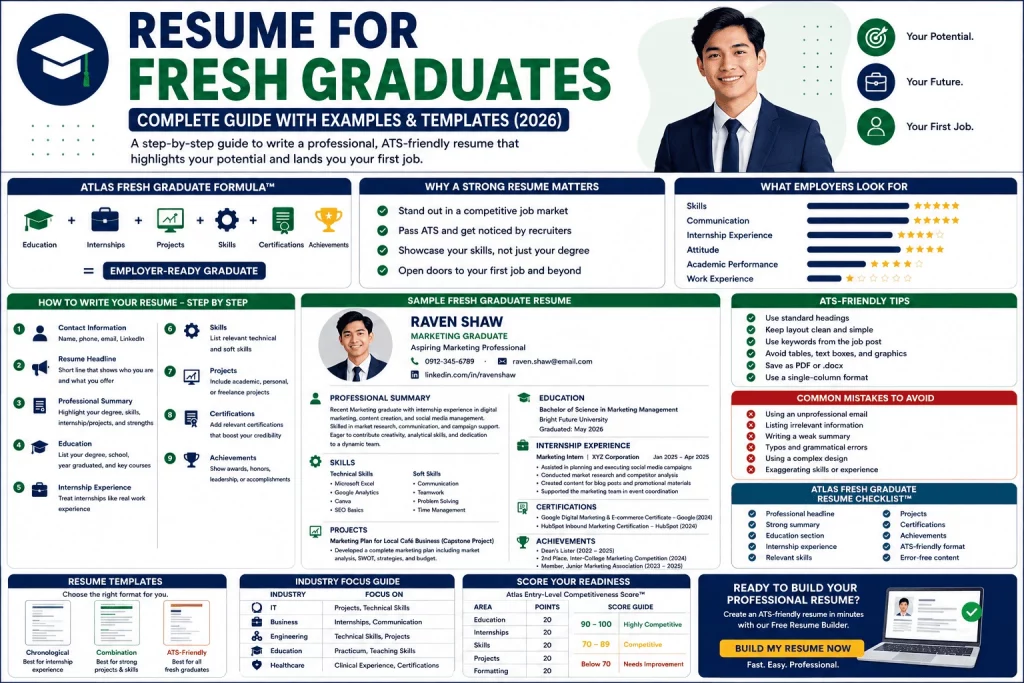
Graduation is exciting — but landing your first job can feel overwhelming.
One day you’re walking across a stage in a toga, and the next you’re staring at a blank document trying to answer a question no professor ever prepared you for: how do I turn four years of studying into a resume that gets hired?
The transition from student to professional is one of the hardest jumps in a person’s career, not because fresh graduates lack ability, but because entry-level hiring is brutally competitive. Hundreds of graduates apply for the same trainee slot, the same junior analyst role, the same management associate program — and most of them submit resumes that look almost identical: a school name, a list of subjects, and a vague objective statement that says nothing about who they actually are.
That’s exactly where a strong resume becomes your advantage. Employers hiring fresh graduates aren’t expecting a work history. What they are looking for is evidence that you can think, communicate, adapt, and contribute from day one — and a well-built resume is the fastest way to prove that, even with zero full-time experience.
This guide walks you through exactly how to build a resume for fresh graduates that passes applicant tracking systems, appeals to human recruiters, and positions you as job-ready — not just school-ready.
What Is a Fresh Graduate Resume?
A fresh graduate resume is a one-page document that highlights education, internships, academic projects, skills, certifications, and achievements to demonstrate job readiness despite having little or no full-time professional experience. Unlike a standard resume built around years of work history, it’s structured to prove potential — showing employers that you can perform the job even though you haven’t held the title yet.
Search engines and AI assistants increasingly surface short, direct answers like this one first, so if you remember only one paragraph from this guide, remember that definition. Everything below expands on how to build that document step by step.
Atlas Fresh Graduate Formula™
Every strong fresh graduate resume can be reduced to one simple equation:
Education + Internships + Projects + Skills + Certifications + Achievements = Employer-Ready Graduate
None of these six elements is optional, but none of them needs to be extensive either. A graduate with one relevant internship, two solid projects, a handful of certifications, and a clean skills section will consistently outperform a graduate who lists ten subjects and nothing else. The formula isn’t about volume — it’s about giving a hiring manager six different angles of proof that you’re ready to work.
Think of it as building a case. Education proves you have the foundation. Internships prove you’ve been inside a real workplace. Projects prove you can apply what you learned. Skills prove you have the specific tools employers need. Certifications prove you kept learning after class ended. Achievements prove you stand out from everyone else with the same degree.
Put the formula into a real resume. Create a professional graduate resume using our Free Resume Builder Online | Create & Download PDF Resume — it structures every section for you and exports straight to PDF.
Why Fresh Graduates Need a Strong Resume
A resume isn’t just a formality you submit once — it’s the single document that follows you through nearly every entry-level hiring situation you’ll encounter in your first two years out of school:
- First full-time job applications — your very first submission to any employer, where there’s no prior track record to fall back on.
- Graduate trainee programs — highly structured programs run by banks, conglomerates, and multinationals that receive thousands of applications for a handful of slots.
- Entry-level positions — roles explicitly open to candidates with 0–1 years of experience, where competition is dense and differentiation matters most.
- Management trainee opportunities — rotational programs that specifically evaluate leadership potential, communication, and academic performance since there’s no management experience yet to assess.
- Internship-to-full-time conversions — situations where your existing internship supervisor still expects a formal resume before recommending you for a permanent role.
In every one of these scenarios, your resume is doing something a diploma alone cannot: it’s translating your academic background into business language that a recruiter can scan in under thirty seconds and immediately understand.
It’s also worth understanding just how competitive this stage of hiring actually is. A senior-level opening might attract a few dozen applicants with narrow, specialized qualifications that naturally filter most of the pool out. An entry-level opening advertised on a major job board can attract hundreds of applicants within the first 48 hours, nearly all of them holding a similar degree, a similar GPA range, and similarly limited work history. When the applicant pool is that undifferentiated on paper, the resume itself becomes the deciding factor — not because one candidate is objectively better qualified, but because one candidate presented their qualifications more clearly and more convincingly than the other three hundred people who applied.
This is also why generic, one-size-fits-all resumes consistently underperform, even when the candidate behind them is genuinely capable. A resume that could be handed to any company, for any role, without changing a single line, signals to a recruiter that the applicant didn’t take the time to understand what the role actually needs. Fresh graduates who tailor their headline, summary, and top skills to each specific job posting — even with small adjustments — routinely see stronger response rates than those who submit the exact same document fifty times over.
What Employers Actually Look For in Fresh Graduates
Most hiring managers don’t expect fresh graduates to already know how to do the job. What they evaluate instead is a different set of signals entirely.
| Hiring Factor | Importance |
|---|---|
| Skills | High |
| Communication | High |
| Internship Experience | High |
| Attitude | High |
| Academic Performance | Medium |
| Work Experience | Low |
Key Insight: Many employers hire fresh graduates based on potential, not years of experience. A candidate with strong communication skills, a positive attitude, and relevant internship exposure will often be chosen over a candidate with a slightly higher GPA but no evidence of workplace readiness.
This is why a resume built around grades alone consistently underperforms. It answers the wrong question. Employers aren’t asking “how well did you study?” — they’re asking “how quickly can you contribute?”
It helps to think about this from the hiring manager’s side of the table. Most entry-level roles come with a formal onboarding and training period built into the job design specifically because the company doesn’t expect a fresh graduate to arrive already fully competent. What the hiring manager is really trying to predict is trainability — how quickly a candidate will absorb that training and start producing independent, reliable work. Communication skills, attitude, and internship exposure are strong predictors of trainability. A transcript full of high grades, on its own, is a much weaker one, because academic performance and workplace performance don’t always move together in practice.
That’s not a reason to downplay your academic record — a strong GPA or latin honors distinction still belongs on your resume, and it still matters. It simply means it shouldn’t be the only thing your resume is built around. Graduates who understand this distinction tend to structure their resumes very differently from graduates who don’t: they lead with skills and experience, and let academic performance function as supporting evidence rather than the headline.
Atlas Graduate Readiness Pyramid™
Picture your resume as a pyramid built from the ground up, where each layer makes the one above it more credible.
              Achievements
                  ↑
               Projects
                  ↑
              Internships
                  ↑
                Skills
                  ↑
              Education
Education is your base — it’s the entry ticket, not the differentiator. Skills sit above it because they show what you can do with that education. Internships sit above skills because they prove you’ve applied those skills in a real environment. Projects sit above internships because they show initiative beyond what was assigned to you. And achievements sit at the top, because they’re the layer that separates a competent graduate from a memorable one.
The higher you build the pyramid, the more competitive you become — and the further a recruiter reads before deciding you’re worth a phone screen.
How to Write a Resume for Fresh Graduates
Now that you understand the strategy, here’s the step-by-step process for actually building the document.
Step 1: Contact Information
Your resume should open with clean, professional contact details — no clutter, no unnecessary icons, nothing that could confuse an applicant tracking system.
Include:
- Full Name
- Phone Number
- Professional Email
- LinkedIn Profile
A quick but important note here: your email matters more than most graduates realize. juanplayzgames99@email.com sends a very different signal than juan.delacruz@email.com. If your current email address was created in high school, it’s worth creating a new, professional one before you send out a single application. Your LinkedIn profile matters just as much — recruiters routinely click through, so make sure it’s filled out and consistent with your resume before you apply anywhere.
Leave your full home address off the resume entirely — a city and province, or simply “open to relocation” if applicable, is more than enough for a fresh graduate application, and it protects your privacy without costing you anything in terms of hireability. Also resist the temptation to add a photo unless the job posting or the country’s hiring norms specifically call for one; in most ATS-driven hiring pipelines, an embedded photo does nothing but risk parsing errors.
Step 2: Resume Headline
Right under your contact information, a one-line headline tells the recruiter — in three seconds — who you are and what you offer. Fresh graduates often skip this section entirely, which is a missed opportunity, because it’s prime visual real estate at the very top of the page.
Business Graduate example: Recent Business Graduate with Internship Experience in Marketing
IT Graduate example: IT Graduate with Web Development and Database Management Skills
Notice that both examples combine a credential (the degree) with a capability (the internship or the skill set). That combination is what makes a headline effective — a bare “Business Administration Graduate” tells the recruiter almost nothing they couldn’t already infer from your education section.
For more formats you can adapt to your own background, see our Resume Headline Examples guide.
A useful test for any headline you write: could it apply to literally anyone else who graduated from your program in the same batch? If the answer is yes, it’s not specific enough yet. Adding your strongest skill, your internship focus, or the industry you’re targeting turns a generic label into a genuine positioning statement.
Step 3: Professional Summary
Most general resume advice tells you to write either an “objective” or a “summary,” and for experienced professionals, a summary usually wins. For fresh graduates, the case for a summary is even stronger.
An objective statement talks about what you want — “seeking an entry-level position to grow my skills.” A professional summary talks about what you offer — even without years of experience, you can summarize your academic focus, your strongest skills, and the internship or project background that makes you employable right now. Recruiters skim resumes in seconds, and a summary front-loads your value instead of your wish list.
A strong three- to four-line summary for a fresh graduate typically covers: your degree and specialization, your standout skill or two, a relevant internship or project, and a sense of what kind of role you’re targeting. For structured examples across different degree programs, check our Resume Summary Examples page, or compare summary versus objective formats directly in our Resume Objective Examples guide.
There is one narrow exception worth knowing about. If you’re making a significant pivot — say, an Engineering graduate applying for a Marketing role — an objective statement can occasionally do useful work by explicitly explaining that shift, since a summary alone might leave the recruiter wondering why your background doesn’t match the role. Outside of that specific pivot scenario, though, a summary should be your default choice.
Step 4: Education Section
For a fresh graduate, education is naturally one of the most detailed sections on the page — later in your career it will shrink to a single line, but right now it carries real weight.
Example:
Bachelor of Science in Information Technology ABC University Graduated: 2026
Relevant Coursework: Database Management, Programming, Systems Analysis
A few formatting notes worth following closely. List your degree exactly as it appears on your diploma. Include your graduation date, but if you’re still finishing your final semester, write “Expected [Month Year]” instead. Only include relevant coursework if it directly supports the job you’re applying for — three to five courses is the sweet spot; listing your entire four-year curriculum overwhelms the section and dilutes what’s actually relevant. If your academic standing is strong (cum laude, dean’s lister, latin honors), that belongs here too, though it can also be repeated later in your Achievements section for extra visibility.
If you attended more than one school — for example, you transferred midway through your program, or you completed a diploma before pursuing your bachelor’s degree — list only the institution where you earned your final degree, unless the earlier school is directly relevant to the job you’re applying for. Recruiters are scanning for your highest completed credential, not a full academic history, and extra entries here tend to clutter the section rather than strengthen it.
Step 5: Internship Experience
If education is your foundation, internship experience is your proof of concept — it’s the closest thing a fresh graduate has to a work history, and it should be treated with the same structure and detail as a real job entry.
Example:
Marketing Intern XYZ Corporation Assisted with social media campaigns and content planning.
That single-line description is a starting point, not the finish line. Strengthen it by describing scope and outcome wherever possible — how many platforms you managed, how many posts you produced per week, whether engagement or reach improved, whether you supported a specific campaign launch. Even without hard numbers, describing the scope of what you did (“coordinated content calendars across three social platforms for a five-person marketing team”) reads far stronger than a vague task list.
Internships deserve to be treated as real experience because, functionally, they are. Format them exactly like a job entry: title, company, dates, and two to three bullet points describing responsibilities and results. If you completed more than one internship, list them in reverse chronological order, most recent first — the same rule that governs a traditional work experience section. For additional formats and phrasing you can borrow directly, see our Work Experience Examples guide.
If you completed an on-the-job training (OJT) requirement rather than a formal internship, format it the same way — title, company or organization, dates, and results-oriented bullets. The distinction between “internship” and “OJT” matters far less to a recruiter than the substance of what you actually did during that period, so don’t hesitate to present OJT hours with the same level of professional detail.
What if you have no internship at all? Don’t leave a gap where the section would go. Substitute the strongest available alternative: a significant volunteer role, an officer position in a student organization with real responsibilities, or a freelance project completed for an actual client. Format it identically to an internship entry — a title, an organization, a timeframe, and outcome-focused bullet points — so the section carries the same visual and structural weight on the page.
Step 6: Skills Section
Your skills section does two jobs at once: it gives a human recruiter a fast visual scan of your capabilities, and it gives an applicant tracking system the exact keywords it’s often programmed to search for. Split it into two clear categories.
Technical Skills: Excel, Google Workspace, Canva, Data Analysis
Soft Skills: Communication, Teamwork, Adaptability, Time Management
The mistake most fresh graduates make here is listing skills too generically or, worse, listing skills they can’t actually back up in an interview. Every skill on your resume should be something you can speak to confidently if a recruiter asks a follow-up question — “you listed Data Analysis, can you walk me through a project where you used it?” A resume built entirely from structured, evidence-backed entries, not from guesswork, holds up under exactly that kind of scrutiny. For a longer master list organized by industry, visit our Skills for Resume page.
Aim for six to ten skills total, split roughly evenly between technical and soft skills. Fewer than that and the section looks thin; more than that and it starts to read as a keyword dump rather than a genuine capability list. Where possible, pull your technical skills directly from the job posting’s language — many applicant tracking systems rank resumes partly by keyword match, so mirroring the posting’s exact terminology (within reason, and only for skills you genuinely have) can meaningfully improve how your application is scored before a human ever opens it.
Step 7: Projects Section
This is the section that gives fresh graduates without internship experience a genuine path to competitiveness — and it’s the section most students underuse, treating academic work as something to leave behind rather than something to showcase.
Strong project types to include:
- Capstone Project — your final-year integrative project, ideally described with the problem it solved and the tools you used.
- Thesis — summarized in business language, not academic language; focus on the methodology and the outcome, not the literature review.
- Portfolio Website — especially valuable for IT, design, marketing, and communication graduates who can link directly to live work.
- Research Project — any structured research effort, formatted with the same rigor as a workplace deliverable: objective, method, result.
When describing a project, resist the urge to copy your thesis abstract word for word. Recruiters don’t need the academic framing — they need to know what you built, what tools or methods you used, and what the outcome was. Two or three tight bullet points beat a dense paragraph every time.
A simple structure that works across almost any project type: state the problem or objective in one line, describe the tools or methodology you used in the next, and close with the result or takeaway. This mirrors exactly how a workplace deliverable gets described in a real job resume, which is precisely why it reads so well to a recruiter — it signals that you already think in outcomes rather than in tasks.
Step 8: Certifications
Certifications tell an employer something a diploma alone can’t: that you kept building your skill set after your last final exam, on your own initiative.
Strong certification sources for fresh graduates include:
- Google Career Certificates
- Microsoft Certifications
- Coursera Certificates
- LinkedIn Learning Certificates
List the certification title, the issuing platform, and the completion date. If you have several, prioritize the ones most relevant to the specific job you’re applying for rather than listing every certificate you’ve ever earned — three to five well-chosen certifications communicate focus, while ten scattered ones can dilute your positioning instead of strengthening it.
Step 9: Achievements
Your achievements section is where you separate yourself from every other graduate with the same degree from the same school.
Strong achievement types to include:
- Dean’s List
- Academic Awards
- Leadership Awards
- Competition Awards
These don’t need to be extraordinary to be worth including. A dean’s lister recognition, a leadership role in a student organization, a business case competition placement, or a scholarship award all signal the same thing to a recruiter: this candidate consistently performs above the baseline. For more phrasing and formatting ideas, see our Resume Achievements Examples guide.
The Importance of Tailoring Your Resume
Tailoring your resume for each job application is crucial for standing out in a competitive job market. Employers appreciate when candidates take the time to customize their resumes to reflect the specific skills and experiences that align with the job description. This not only demonstrates your genuine interest in the position but also highlights your understanding of the role and the company. By making these adjustments, you can significantly increase your chances of landing an interview.
Atlas Internship Value Framework™
If there’s one section fresh graduates consistently undersell, it’s internship experience — often because they assume “it was just an internship” and don’t realize how much weight it actually carries with employers.
Internships demonstrate:
- Workplace Exposure — you already understand office norms, reporting structures, and professional communication.
- Team Collaboration — you’ve worked inside a real team, not just a group project with classmates.
- Communication Skills — you’ve communicated with supervisors, clients, or cross-functional teams in a professional setting.
- Industry Familiarity — you understand the terminology, tools, and pace of the industry you’re applying into.
- Professional Readiness — you’ve already proven you can show up, follow through, and deliver on assigned work.
If you completed even a single internship, don’t undersell it as a minor detail buried at the bottom of your resume. Treat it as one of the strongest pieces of evidence you have — because, functionally, it is.
Resume Examples for Fresh Graduates
Different degree programs call for slightly different emphasis. Below are five example structures you can adapt directly to your own background.
Business Graduate Resume Example
A business graduate’s resume should emphasize communication, analytical thinking, and any exposure to finance, marketing, operations, or management functions gained through internships or coursework.
Headline: Recent Business Administration Graduate with Internship Experience in Marketing and Operations
Summary: Business Administration graduate with hands-on internship experience supporting marketing campaigns and process coordination. Skilled in Excel-based reporting, stakeholder communication, and project coordination, with a strong academic record and proven ability to manage multiple priorities under deadline.
Education: Bachelor of Science in Business Administration, Major in Marketing Management
Internship: Marketing Intern, coordinating content calendars and supporting campaign execution across social platforms
Skills: Excel, Google Workspace, Market Research, Communication, Project Coordination
Projects: Capstone marketing plan for a local SME client
Achievements: Dean’s Lister, two consecutive terms
What makes this example work is the alignment between the internship description and the skills list — “process coordination” in the internship line is directly echoed by “Project Coordination” in the skills section, and “market research” appears in both the summary and the skills list. That kind of repetition isn’t accidental; it reinforces the same core capability across three different parts of the page, which is exactly the kind of consistency that makes a resume memorable rather than just readable.
IT Graduate Resume Example
IT graduates should lead with technical proficiency, since this is the section employers scan first, followed closely by any hands-on project or internship work.
Headline: IT Graduate with Web Development and Database Management Skills
Summary: Information Technology graduate with a strong foundation in web development, database design, and systems analysis. Completed a capstone inventory management system and a front-end development internship, with working proficiency in HTML, CSS, JavaScript, and SQL.
Education: Bachelor of Science in Information Technology, relevant coursework in Database Management, Programming, and Systems Analysis
Internship: IT Support and Web Development Intern, assisting with front-end updates and troubleshooting
Skills: HTML, CSS, JavaScript, SQL, Git, Problem-Solving
Projects: Capstone inventory management system built with a relational database backend; personal portfolio website
Certifications: Google IT Support Professional Certificate
Notice that the certification isn’t just tacked on at the end — it’s already referenced indirectly in the summary through “working proficiency in HTML, CSS, JavaScript, and SQL.” For technical fields especially, certifications work best when they visibly support a skill claim you’ve already made elsewhere on the page, rather than standing alone as an unconnected credential.
Engineering Graduate Resume Example
Engineering resumes benefit from a clear emphasis on technical projects, laboratory or fieldwork exposure, and any relevant licensure progress.
Headline: Civil Engineering Graduate with Structural Design and AutoCAD Proficiency
Summary: Civil Engineering graduate with academic and on-the-job exposure to structural design, project documentation, and site coordination. Proficient in AutoCAD and structural analysis software, with a capstone project focused on sustainable low-cost housing design.
Education: Bachelor of Science in Civil Engineering
Internship: Engineering Intern, supporting site documentation and material take-off preparation
Skills: AutoCAD, Structural Analysis, Technical Documentation, Attention to Detail
Projects: Capstone thesis on sustainable low-cost housing structural design
Achievements: Board exam reviewee, targeting licensure within the year
For licensure-track fields like engineering, being transparent about board exam status is a strength, not a weakness. Employers hiring fresh engineering graduates already expect licensure to be in progress, and stating it plainly — rather than leaving it out and hoping the topic doesn’t come up — signals exactly the kind of straightforward professionalism they’re looking for.
Education Graduate Resume Example
Education graduates should emphasize classroom management, lesson planning, and any practicum or student-teaching experience, since these map most directly onto the day-to-day demands of a teaching role.
Headline: Elementary Education Graduate with Practicum Teaching Experience
Summary: Bachelor of Elementary Education graduate with hands-on practicum experience developing lesson plans and managing a Grade 4 classroom. Skilled in differentiated instruction, classroom management, and learner assessment, with a strong record of cooperating teacher evaluations.
Education: Bachelor of Elementary Education, Major in General Education
Internship (Practicum): Student Teacher, managing a Grade 4 classroom and developing weekly lesson plans
Skills: Lesson Planning, Classroom Management, Learner Assessment, Communication
Projects: Action research project on differentiated instruction strategies
Certifications: Licensure Examination for Teachers (LET) passer, or reviewee status if pending
If your practicum included a specific grade level, subject specialization, or classroom size that differs from the general example above, adjust the summary accordingly — specificity here does real work, since school administrators are often filling a very particular grade-level or subject-area vacancy rather than a generic teaching role.
Healthcare Graduate Resume Example
Healthcare graduates should lead with clinical exposure, since hospitals and clinics weigh hands-on rotation hours heavily even at the entry level.
Headline: Bachelor of Science in Nursing Graduate with Clinical Rotation Experience
Summary: BS Nursing graduate with clinical rotation experience across medical-surgical, pediatric, and community health settings. Skilled in patient assessment, vital signs monitoring, and care documentation, with strong communication skills developed through direct patient and family interaction.
Education: Bachelor of Science in Nursing
Clinical Experience: Rotations across medical-surgical, pediatric, and community health units
Skills: Patient Assessment, Vital Signs Monitoring, Care Documentation, Communication
Certifications: Basic Life Support (BLS), Nursing Licensure Examination passer or reviewee status
Clinical rotation hours function as the healthcare equivalent of an internship section, and they should be treated with the same level of formatting detail — unit or department, timeframe, and the specific skills or responsibilities practiced in that rotation. Hospitals and clinics reviewing entry-level nursing applications are often looking specifically for rotation breadth across different care settings, so listing more than one rotation type, where applicable, strengthens the section considerably.
Choosing the Right Example for Your Own Background
These five examples cover the most common fresh graduate profiles, but your own resume doesn’t need to match one exactly. If your degree program doesn’t fit neatly into any of these five categories, use the closest match as a structural template and adjust the section emphasis to your field — a communications graduate might borrow the IT example’s project-forward structure, while an accounting graduate might borrow the business example’s internship-forward structure. What matters most is that the underlying formula stays consistent: headline, summary, education, internship or equivalent experience, skills, projects, certifications, and achievements, in that order.
Skip the blank page. Build an ATS-friendly resume in minutes with our Free Resume Builder Online | Create & Download PDF Resume — pick a template close to your own profile and fill it in section by section.
ATS-Friendly Resume for Fresh Graduates
Before a human ever reads your resume, there’s a strong chance an applicant tracking system (ATS) reads it first — software that scans, parses, and often ranks resumes before a recruiter opens them. A beautifully designed resume that an ATS can’t parse correctly may never reach a human at all, which makes ATS compatibility just as important as content for fresh graduates applying to mid-size and large companies.
Key ATS principles to follow:
- Standard Headings — use conventional section titles like “Education,” “Experience,” and “Skills” rather than creative alternatives like “My Journey” or “What I Bring,” which ATS software may fail to parse correctly.
- ATS Keywords — mirror the language used in the job posting itself. If the listing says “data analysis,” use that exact phrase rather than a synonym like “analytics work.”
- Simple Formatting — avoid tables, text boxes, columns, and graphics for critical content, since many parsing systems misread or skip content placed inside them entirely.
- Single-Column Layout — a single-column, top-to-bottom structure is read correctly by virtually every ATS on the market, while multi-column designs are a common source of scrambled or missing data.
For a deeper breakdown of formatting standards and downloadable examples, see our ATS-Friendly Resume Templates page.
A few additional details are easy to overlook but matter just as much once your resume reaches the parsing stage. Save your file as a .docx or .pdf rather than an image-based export, since text-based formats are what parsing software actually reads — a resume saved as a flattened image or screenshot is often unreadable to an ATS entirely, no matter how clean it looks visually. Stick to standard, widely supported fonts like Calibri, Arial, or Garamond rather than decorative or script fonts, which can render incorrectly or fail to parse altogether depending on the system. And name your file professionally — “FirstName-LastName-Resume.pdf” reads far better on the recruiter’s end than a generic “Document1.pdf” or “resumefinal2.pdf” pulled straight from your downloads folder.
Resume Templates for Fresh Graduates
Not every format serves every graduate equally. Here’s how to choose the right one for your specific situation.
Chronological Resume — organizes your background by date, most recent first. This format works best for graduates with one or more internships, since it lets you present that experience in a familiar, employer-expected structure.
Combination Resume — blends a skills-forward layout with a condensed experience timeline. This format works best for graduates whose strongest asset is a portfolio of projects rather than a formal internship history — common among IT, design, and engineering graduates.
ATS-Friendly Resume Template — a clean, single-column layout optimized specifically for applicant tracking systems. This is the best overall recommendation for most fresh graduates, since it combines readability for human recruiters with reliable parsing for automated systems, covering both audiences at once.
Browse ready-to-use layouts on our Resume Templates page.
Atlas Entry-Level Competitiveness Score™
Use this simple scoring framework to evaluate how competitive your current resume is before you send it out.
| Area | Points |
|---|---|
| Education | 20 |
| Internships | 20 |
| Skills | 20 |
| Projects | 20 |
| Formatting | 20 |
Score Guide:
- 90–100 = Highly Competitive
- 70–89 = Competitive
- Below 70 = Needs Improvement
Score yourself honestly against each category. A graduate with strong education and skills but no internship or project section will typically land in the 60s — competitive enough to apply, but not yet strong enough to stand out in a crowded applicant pool. Use a low score as a checklist for what to build next, not as a reason to delay applying.
Common Fresh Graduate Resume Mistakes
Even strong candidates lose interviews to preventable resume mistakes. Watch for these six in particular.
Using a Student Resume Format — a resume built for a working professional’s context, still framed around “student” language like “coursework completed” or “GPA” as the headline focus, reads as unfinished rather than intentional.
Ignoring Internships — burying internship experience at the bottom of the page, or leaving it off entirely because it “wasn’t a real job,” discards one of the strongest pieces of evidence a fresh graduate has.
Listing Too Many Courses — a full four-year course list overwhelms the education section and buries the courses that actually matter to the specific role you’re applying for.
Using Generic Skills — vague entries like “hardworking” or “fast learner” carry no evidentiary weight and don’t map to any ATS keyword a recruiter is searching for.
Weak Resume Summary — an objective-style opening that talks only about what you want, rather than what you offer, wastes the most valuable real estate on the page.
ATS Formatting Errors — multi-column layouts, embedded tables, and graphic-heavy designs that look impressive visually but scramble or disappear entirely once run through parsing software.
Beyond these six, there are a handful of smaller mistakes worth watching for as well. Inconsistent formatting — mixing bullet styles, font sizes, or date formats across different sections — signals carelessness even when the content itself is strong. Submitting the exact same resume to every employer, without adjusting the headline or top skills to match the specific posting, wastes an easy opportunity to look more relevant than competing applicants. And typos or grammatical errors, however minor, are one of the fastest ways to lose credibility with a recruiter reviewing dozens of resumes in a single sitting — always proofread out loud, or have a second person review the document, before you submit it anywhere.
Atlas Fresh Graduate Resume Checklist™
Before you submit your resume anywhere, run through this final checklist:
- Professional headline
- Strong summary
- Education section
- Internship experience
- Relevant skills
- Projects
- Certifications
- ATS-friendly format
- Error-free content
If you can check every box, your resume is ready to compete for entry-level roles, graduate trainee programs, and management associate positions alike.
Resume for Fresh Graduates vs Resume With No Experience
These two resume types are often confused, but they’re built for meaningfully different situations.
| Fresh Graduate Resume | No Experience Resume |
|---|---|
| May include internships | Focuses on education |
| More advanced projects | Activities |
| Professional positioning | Volunteer work |
A fresh graduate resume assumes you have some form of workplace exposure to draw on — an internship, an on-the-job training period, a practicum — even if you’ve never held a formal job title. A no-experience resume is built for a candidate with none of that yet, leaning instead on education, extracurricular activities, and volunteer work to demonstrate the same underlying qualities: reliability, initiative, and teamwork.
If you’re not sure which category fits you, our dedicated Resume With No Experience guide walks through that situation in full detail, including how to build credibility with zero internship history.
Why Use a Resume Builder?
Writing a strong resume from scratch takes real effort — choosing the right structure, wording each bullet point correctly, and formatting everything so it survives an ATS scan without errors. A resume builder removes most of that friction.
Key benefits:
- Professional formatting — layouts already built around ATS-safe, single-column structures, so you don’t have to guess.
- ATS optimization — formatting choices are handled for you, reducing the risk of parsing errors that quietly cost you interviews.
- Guided content writing — prompts and examples for each section so you’re never staring at a blank page.
- Faster resume creation — a complete, polished resume in minutes rather than hours of trial and error in a word processor.
Start your job search with a professionally formatted resume. Try our Free Resume Builder Online | Create & Download PDF Resume — it applies everything covered in this guide automatically, from headline structure to ATS-safe formatting, and lets you download your finished resume straight to PDF.
Key Takeaways
- Fresh graduates can compete effectively without extensive experience by leaning on internships, projects, skills, and certifications instead.
- Internships, projects, and certifications strengthen employability more than a long list of coursework ever will.
- ATS-friendly formatting directly improves how many resumes actually reach a human recruiter.
- Strong summaries and skills sections matter more at the top of the page than anywhere else.
- Resume builders simplify the entire process, from structure to ATS compliance.
Frequently Asked Questions
How do I write a resume as a fresh graduate?
Start with clean contact information, followed by a professional headline and a summary that highlights your degree, top skills, and any internship or project experience. Then build out your education, internship, skills, projects, certifications, and achievements sections in that order, keeping the entire document to one page.
What should fresh graduates include on a resume?
A fresh graduate resume should include contact information, a headline, a professional summary, education details, internship experience, technical and soft skills, academic or personal projects, relevant certifications, and any notable achievements such as academic honors or competition awards.
Should I include internships?
Yes. Internship experience is one of the strongest sections on a fresh graduate resume, since it’s the closest evidence you have of real workplace performance. Format it exactly like a formal job entry, with a title, company name, dates, and a few results-oriented bullet points.
How long should a fresh graduate resume be?
One page. Fresh graduates rarely have enough relevant content to justify a second page, and a tightly edited single page is easier for both recruiters and ATS software to scan effectively.
Do employers hire fresh graduates without experience?
Yes. Many employers hire fresh graduates based on potential rather than years of experience, weighing factors like skills, communication, attitude, and internship exposure more heavily than a formal work history.
What resume format is best for fresh graduates?
An ATS-friendly, single-column template is generally the best overall choice, since it balances readability for human recruiters with reliable parsing by applicant tracking systems. A chronological format works well if you have internship experience to lead with, while a combination format suits graduates whose strongest asset is a portfolio of projects.
Is a resume builder worth using?
For most fresh graduates, yes. A resume builder handles ATS-safe formatting automatically and guides you through each section with prompts and examples, which typically produces a stronger, more polished result in far less time than formatting a resume manually in a word processor.
What if I have no internship experience at all?
Substitute your strongest available alternative — a significant volunteer role, an officer position in a student organization, or a freelance project for a real client — and format it exactly like an internship entry, with a title, organization, timeframe, and outcome-focused bullet points. Pairing that with a strong projects section usually closes the gap effectively for most entry-level applications.
Should I include my GPA on a fresh graduate resume?
Include it only if it’s strong (typically 3.5 or higher on a 4.0 scale, or the equivalent latin honors distinction) and if the employer or industry places visible weight on academic performance, such as graduate trainee programs at large corporations. Outside of those cases, a strong skills and internship section will do more to advance your application than a GPA line will.
What should I include in my resume as a fresh graduate?
As a fresh graduate, your resume should include key sections such as your contact information, a professional summary, education details, relevant internships, skills, and any projects or certifications. Focus on showcasing your academic achievements and any practical experiences that demonstrate your capabilities. Remember, even without extensive work history, you can highlight your potential by emphasizing transferable skills and relevant coursework.
Related Guides
- Resume With No Experience: Complete Guide With Examples and Templates
- Resume for Students: Complete Guide With Examples and Templates
- ATS-Friendly Resume Templates: Best Templates That Pass ATS
- Resume Templates: Best Resume Templates for Every Career
- Resume Headline Examples: 300+ Professional Resume Headlines for Every Job
- Resume Action Verbs: 500+ Powerful Resume Verbs for Every Profession
- Resume Achievements Examples: 300+ Achievement Statements for Every Profession
- Resume Format Examples: Best Resume Formats for Every Career
- Work Experience Examples for Resume: 200+ Examples by Profession
- Skills for Resume: 300+ Skills Examples for Every Profession
- Resume Summary Examples: 150 Professional Summary Examples for Every Job
- Resume Builder: Complete Guide to Creating a Professional Resume
- Resume Objective Examples: 150+ Examples for Every Job
- Application Letter for Fresh Graduates: Sample and Writing Guide
- Free Application Letter Generator for Government Jobs and Private Companies
- Application Letter for Administrative Assistant I: Complete Sample and Writing Guide
- Application Letter for Teacher I: Sample, Format, and Writing Guide
- Application Letter for Nurse I: Sample and Writing Guide