Last updated: July 2026 · Applicable tranche: Third Tranche, SSL VI (EO No. 64, s. 2024), effective January 1, 2026 🔍 verify against NBC No. 601 Reviewed against: Department of Budget and Management (DBM) issuances, Civil Service Commission (CSC) rules, and the Official Gazette.
Salary Grade (SG) 20 is one of the compensation levels under the Philippine government’s standardized salary system, covering specific plantilla positions in national government agencies, state universities and colleges, GOCCs under the national compensation framework, and other offices that follow the government’s Position Classification and Compensation System. If you’re applying for a government job, planning a public-sector career, or simply researching government pay, this guide walks through what SG 20 means, the current salary table, how salary steps work, common SG 20 positions, how it compares with SG 19 and SG 21, and how to move up from it — all sourced from official DBM and CSC references.
Quick Answer
Salary Grade 20 (SG 20) is a compensation level under the Philippine government’s Position Classification and Compensation System. It is commonly assigned to supervisory, technical, and professional positions across national government agencies and other government offices that follow the standardized compensation framework.
An employee’s actual monthly salary depends on their salary step (Step 1 to Step 8), while eligibility for the position depends on the qualification standards established by the Civil Service Commission (CSC). Salary schedules are issued by the Department of Budget and Management (DBM) under the applicable Salary Standardization Law (SSL).
💡 Also preparing for the Civil Service Exam? Practice with our free CSE Reviewer — mock exams, drills, and lessons for Verbal, Numerical, Analytical, and Clerical ability. Start practicing for free →
At a Glance
Before looking at the salary table, here are the most important things to know about Salary Grade 20.
- Salary Grade 20 is a position classification, not a specific job title.
- Employees under SG 20 may receive different salaries depending on their salary step.
- SG 20 commonly covers experienced professionals, supervisors, and technical specialists.
- Promotion to Salary Grade 21 requires appointment to a higher-classified position—it is not automatic.
- Government employees may receive additional compensation such as PERA, bonuses, clothing allowance, and other benefits, subject to applicable rules.
What Is Salary Grade 20?
The Philippine government uses a standardized salary structure known as the Position Classification and Compensation System (PCCS). Every regular government position is assigned a Salary Grade (SG) ranging from Salary Grade 1 to Salary Grade 33.
Salary Grade 20 belongs to the upper-middle level of this compensation system. Positions at this level typically involve:
- Supervisory responsibilities
- Technical or professional expertise
- Policy implementation
- Project management
- Decision-making authority
- Team leadership
Unlike entry-level government positions, SG 20 roles usually require several years of relevant experience together with higher educational qualifications and, for many positions, an appropriate Civil Service eligibility or professional license.
Salary Grade vs. Salary Step
Many applicants confuse Salary Grade with Salary Step, but they serve different purposes.
| Salary Grade | Salary Step |
| Classifies the government position | Determines the employee’s current salary within that position |
| Changes after promotion or reclassification | Changes through authorized step increments |
| Reflects the level of responsibility | Reflects progression within the same position |
| Shared by employees holding the same position classification | Can differ among employees with the same Salary Grade |
Example
Two employees may both hold a Salary Grade 20 position.
- Employee A is newly appointed and starts at Step 1.
- Employee B has served for several years and has progressed to Step 8.
Although both hold the same Salary Grade, Employee B receives a higher monthly basic salary because of the higher salary step.
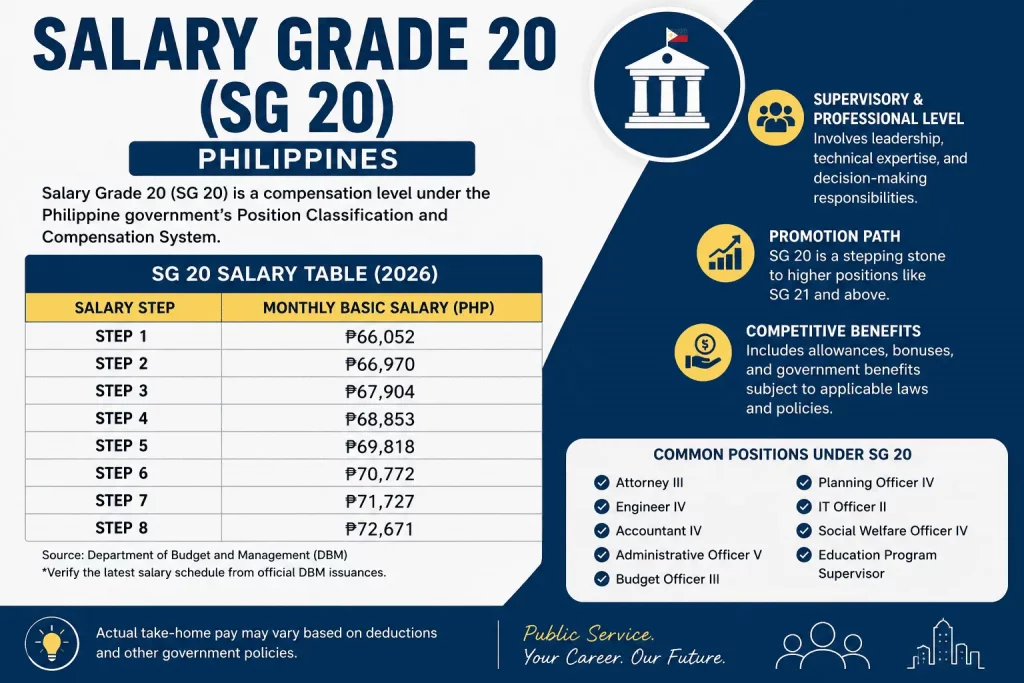
Salary Grade 20 Salary Table (2026)
The Department of Budget and Management (DBM) publishes the official Salary Grade schedule through its implementing issuances under the Salary Standardization Law.
Always verify the latest salary schedule directly from the DBM before making employment or financial decisions.
| Salary Step | Monthly Basic Salary (PHP)* |
| Step 1 | ₱66,052 |
| Step 2 | ₱66,970 |
| Step 3 | ₱67,904 |
| Step 4 | ₱68,853 |
| Step 5 | ₱69,818 |
| Step 6 | ₱70,772 |
| Step 7 | ₱71,727 |
| Step 8 | ₱72,671 |
*Verify these figures against the latest DBM Salary Standardization schedule before publication.
Information Gain: How Much Can Your Salary Increase Within SG 20?
One question many applicants ask is whether it’s worth staying in the same Salary Grade for several years.
Using the current salary schedule:
- Starting salary (Step 1): ₱66,052
- Maximum salary (Step 8): ₱72,671
That represents an increase of approximately ₱6,619 per month without changing Salary Grade, provided the employee qualifies for step increments under applicable government rules.
This illustrates an important point:
A higher salary does not always require a promotion. Employees may receive salary increases through authorized step progression while remaining in the same SG 20 position.
Where Does Salary Grade 20 Fit in the Government Career Ladder?
The table below shows how SG 20 compares with nearby salary grades.
| Salary Grade | Career Level |
| SG 18 | Experienced Professional |
| SG 19 | Senior Professional / Supervisor |
| SG 20 | Senior Technical or Supervisory Level |
| SG 21 | Division-Level Senior Professional |
| SG 22–24 | Management Positions |
| SG 25–33 | Executive and Senior Leadership Positions |
Rather than viewing SG 20 as an endpoint, many government employees consider it a stepping stone toward higher supervisory and management roles within their agency.
What’s Next?
The next section explains:
- Which government positions are commonly classified under Salary Grade 20
- Career progression opportunities
- Promotion requirements
- Benefits and allowances
- Estimated take-home pay
- Frequently asked questions
Government Positions Under Salary Grade 20
Salary Grade 20 is not a job title—it is a compensation classification. Multiple government agencies may assign different positions to Salary Grade 20 depending on their approved plantilla and the position classification issued by the Department of Budget and Management (DBM).
Some positions commonly associated with Salary Grade 20 include:
| Position | Primary Responsibility |
| Attorney III | Provides legal opinions, litigation support, and legal representation. |
| Engineer IV | Supervises engineering projects, technical planning, and project implementation. |
| Accountant IV | Manages accounting operations, financial reporting, and compliance. |
| Administrative Officer V | Oversees administrative services, procurement, and human resource operations. |
| Budget Officer III | Plans, prepares, and monitors agency budgets. |
| Planning Officer IV | Leads strategic planning, policy analysis, and program evaluation. |
| Information Technology Officer II | Manages IT infrastructure, cybersecurity, and digital systems. |
| Social Welfare Officer IV | Supervises social welfare and community development programs. |
| Education Program Supervisor | Oversees curriculum implementation and educational programs. |
Important: Position classifications may differ between agencies. Always verify the Salary Grade listed in the official job posting or approved Plantilla of Personnel before applying.
How Do You Move from Salary Grade 20 to Salary Grade 21?
One of the biggest misconceptions is that government employees are automatically promoted after several years of service.
In reality, promotion is based on appointment to a higher-classified position, not simply on tenure.
Promotion to Salary Grade 21 generally requires:
- Meeting the qualification standards for the position
- Appropriate Civil Service eligibility or professional license (when required)
- Required education and training
- Relevant work experience
- Satisfactory or higher performance ratings
- Availability of a vacant SG 21 position
Years of service alone do not guarantee promotion.
Information Gain: SG 20 Promotion Checklist
Before applying for an SG 21 position, ask yourself the following:
✅ Do I meet the educational requirements?
✅ Do I possess the required Civil Service eligibility or professional license?
✅ Have I completed the required training hours?
✅ Do I have the required years of relevant experience?
✅ Have I consistently received satisfactory or higher performance ratings?
✅ Is there an available SG 21 plantilla position?
The more boxes you can check, the stronger your chances of qualifying for promotion.
📚 Before you can reach SG 20 or higher, you’ll first need to pass the Civil Service Exam. Review for the CSE now →
Salary Grade 20 Benefits and Allowances
Monthly basic salary is only one part of a government employee’s total compensation.
Depending on eligibility and agency policies, SG 20 employees may also receive:
- Personnel Economic Relief Allowance (PERA)
- Mid-Year Bonus
- Year-End Bonus
- Cash Gift
- Clothing or Uniform Allowance
- Productivity Enhancement Incentive (PEI)
- Performance-Based Bonus (PBB), where applicable
- Collective Negotiation Agreement (CNA) Incentive, when authorized
- GSIS benefits
- PhilHealth coverage
- Pag-IBIG Fund benefits
- Vacation and Sick Leave credits
- Maternity, Paternity, Solo Parent, and other statutory leave benefits
Actual benefits vary depending on employment status, agency policies, and current government issuances.
Basic Salary vs. Take-Home Pay
Many applicants assume that the published SG 20 salary is the amount they receive every month.
This is not the case.
Your monthly take-home pay is lower because several mandatory deductions are withheld before your salary is released.
Common deductions include:
- GSIS contributions
- PhilHealth contributions
- Pag-IBIG contributions
- Withholding tax (when applicable)
- Loan repayments (if any)
As a result, two employees with the same Salary Grade may receive different take-home pay depending on their deductions and payroll obligations.
Information Gain: What Determines Your Actual Monthly Income?
Think of your government compensation in four layers:
Monthly Basic Salary
+
Allowances & Incentives
–
Mandatory Deductions
=
Estimated Take-Home Pay
Understanding these four components provides a more realistic picture of your monthly income than looking at the salary table alone.
National Government vs. LGU vs. GOCC vs. SUC
Another common misconception is that every government employee under Salary Grade 20 receives exactly the same compensation.
While the Salary Grade framework is standardized, implementation can vary depending on the organization.
| Agency Type | Notes |
| National Government Agencies | Generally follow the DBM Salary Standardization schedule. |
| Local Government Units (LGUs) | Compensation may depend on local government income classification and applicable regulations. |
| Government-Owned and Controlled Corporations (GOCCs) | Some GOCCs operate under separate compensation frameworks. |
| State Universities and Colleges (SUCs) | Certain positions follow specialized compensation systems or university-specific implementation rules. |
If you are comparing job offers, always review the salary and benefits stated in the official vacancy announcement instead of assuming every SG 20 position provides identical compensation.
Career Outlook for Salary Grade 20 Employees
Salary Grade 20 is often viewed as a significant milestone in a government career.
Employees at this level typically supervise teams, manage programs, oversee technical operations, or contribute to policy implementation.
Common career paths after SG 20 include:
- Division Chief positions
- Senior technical specialist roles
- Program management positions
- Executive or management-level appointments
- Higher Salary Grades (SG 21 and above)
For many professionals, SG 20 serves as the bridge between technical expertise and leadership responsibilities, making it an important stage in long-term career development.
Frequently Asked Questions
What is Salary Grade 20 in the Philippine government?
Salary Grade 20 (SG 20) is a compensation level under the Philippine government’s Position Classification and Compensation System. It is generally assigned to supervisory, technical, and professional positions that require substantial responsibility and experience.
How much is the Salary Grade 20 salary in 2026?
The monthly basic salary depends on the employee’s salary step (Step 1 to Step 8) under the salary schedule issued by the Department of Budget and Management (DBM). Always verify the latest figures using the most recent DBM salary schedule before making employment or financial decisions.
Does every Salary Grade 20 employee receive the same salary?
No.
Employees holding the same Salary Grade may receive different salaries because their salary step can differ. A newly appointed employee usually starts at a lower step, while employees with approved step increments receive a higher monthly basic salary.
Can I be promoted automatically from Salary Grade 20 to Salary Grade 21?
No.
Promotion requires appointment to a higher-classified position. Employees must meet the qualification standards established by the Civil Service Commission (CSC), satisfy education, training, experience, and eligibility requirements, and compete for an available plantilla position.
What benefits do Salary Grade 20 employees receive?
Eligible employees may receive:
Personnel Economic Relief Allowance (PERA)
Mid-Year Bonus
Year-End Bonus
Clothing or Uniform Allowance
Productivity Enhancement Incentive (PEI)
Performance-Based Bonus (PBB)
GSIS, PhilHealth, and Pag-IBIG benefits
Vacation and Sick Leave credits
Benefits depend on employment status and applicable government rules.
Is Salary Grade 20 the same in every government agency?
Not always.
Although the Salary Grade framework is standardized, position titles, duties, qualification standards, and certain compensation policies may vary among National Government Agencies, Local Government Units (LGUs), Government-Owned and Controlled Corporations (GOCCs), and State Universities and Colleges (SUCs).
Where can I verify the official Salary Grade 20 salary?
The most reliable sources are:
Department of Budget and Management (DBM)
Civil Service Commission (CSC)
Official Gazette of the Republic of the Philippines
Always rely on official government issuances rather than third-party websites when verifying salary schedules.
Before You Apply for a Salary Grade 20 Position
Use this checklist before submitting your application.
Qualifications
✓ Required educational attainment
✓ Appropriate Civil Service eligibility or professional license
✓ Relevant work experience
✓ Required training hours
✓ Position-specific competencies
Employment Requirements
✓ Updated Personal Data Sheet (PDS)
✓ Work Experience Sheet (if required)
✓ Eligibility documents
✓ Transcript of Records
✓ Training certificates
✓ Performance ratings (if applicable)
Career Planning
✓ Understand the salary range
✓ Review employee benefits
✓ Compare agencies
✓ Review promotion opportunities
✓ Confirm plantilla status
Preparing these documents in advance can make the application process smoother and help you determine whether an SG 20 position aligns with your long-term career goals.
🎯 Ready to take the Civil Service Exam? Maximize your chances of passing with our 170-item full mock exam and practice drills covering all subjects. Start your free CSE Reviewer →
Final Thoughts
Salary Grade 20 represents an important milestone in a government career. It typically marks the transition from technical or professional work to positions with greater supervisory responsibility and leadership expectations.
While the monthly salary is an important consideration, applicants should also evaluate the complete compensation package, opportunities for promotion, job security, retirement benefits, and long-term career growth.
Understanding how Salary Grade, Salary Step, benefits, and qualification standards work together allows both job applicants and current government employees to make better-informed career decisions.
Whether you are preparing for your first government application or planning your next promotion, always verify current salary schedules and qualification requirements using official government sources before making important employment decisions.
Related Topics
To learn more about navigating your career in the Philippine government, explore our deep-dive guides:
- Salary Grade 6 Philippines: Salary, Steps, Positions, and Career Guide
- Salary Grade 7 Philippines: Salary, Benefits & Positions
- Salary Grade 8 Philippines: Salary, Steps, Positions, Benefits, and Career Guide
- Salary Grade 10 Philippines: Salary, Positions, Benefits, and Career Guide
- Salary Grade 11 Philippines 2026: Complete Guide
- Salary Grade 12 Philippines 2026: Salary, Positions & Benefits
- Salary Grade 13 Philippines 2026: Complete Salary & Positions Guide
- Salary Grade 14 Philippines 2026: Complete Salary & Positions Guide
- Salary Grade 15 Philippines: Salary, Positions, Qualifications, and Career Guide
- Salary Grade 19 Philippines 2026: How Much Do SG 19 Employees Earn?
- Salary Grade 24 Philippines 2026: Salary & Benefits
- Salary Grade 25 Philippines: Salary, Positions, Benefits, and Career Guide
- Government Jobs in the Philippines 2026: Complete Job Search Guide
- How to Apply for Government Jobs in the Philippines: Step-by-Step Guide
- Government Salary Grade 2026: Complete Guide to the Philippine Salary Schedule
References
Official Government Sources
- Department of Budget and Management (DBM). National Budget Circular No. 601 – Implementation of the Third Tranche Compensation Adjustment for Civilian Government Personnel pursuant to Executive Order No. 64, s. 2024.
- Executive Order No. 64, s. 2024. Modifying the Salary Schedule for Civilian Government Personnel and Authorizing the Grant of Additional Benefits.
- Civil Service Commission (CSC). Position Qualification Standards and Civil Service eligibility policies.
- Official Gazette of the Republic of the Philippines. Executive Orders, laws, and official government issuances relating to the Salary Standardization Law.
- Government Service Insurance System (GSIS). Official information on retirement, insurance, and employee benefits.
- PhilHealth. Official guidelines on the National Health Insurance Program for government employees.
- Home Development Mutual Fund (Pag-IBIG Fund). Official membership, savings, and housing benefit information.
Disclaimer
This guide is intended for informational purposes only and is based on official government issuances available at the time of writing. While every effort has been made to ensure accuracy, salary schedules, qualification standards, benefits, and implementing rules may change through subsequent laws, executive orders, DBM circulars, CSC issuances, or other government regulations.
Readers should always consult the latest official publications of the Department of Budget and Management (DBM), Civil Servic