Last updated: July 2026 | Based on Executive Order No. 64, s. 2024, and DBM National Budget Circular No. 601 implementing the third tranche of the salary schedule, effective January 1, 2026. Always verify current figures against the latest official DBM issuance before making employment or financial decisions.
Quick Answer
Salary Grade 22 is a senior government salary grade under the Philippine Salary Standardization system. Employees receive a monthly basic salary based on their assigned salary step, with Step 1 as the entry rate and Step 8 as the highest regular step within the grade. The applicable schedule is issued by the DBM under Executive Order No. 64 and updated through the corresponding National Budget Circular for each implementation tranche.
Key Takeaways
- SG22 is intended for high-level professional, supervisory, and managerial government positions.
- Monthly compensation varies by salary step.
- Executive Order No. 64 provides the legal basis for the current multi-year salary schedule.
- SG22 employees may also receive authorized allowances and benefits separate from basic salary, subject to applicable laws.
What Is Salary Grade 22?
SG22 is a compensation level under the government’s Compensation and Position Classification System, assigned to senior professional, supervisory, managerial, and executive positions requiring substantial technical expertise, leadership responsibility, and decision-making authority. An employee’s actual monthly basic salary depends on both the assigned salary grade and salary step, as set by DBM National Budget Circular No. 601 implementing Executive Order No. 64.
Under the salary grading system:
- Salary Grade (SG) determines a position’s overall compensation level.
- Salary Step recognizes length of service and satisfactory performance within the same grade.
- Higher grades generally mean greater responsibility and broader supervisory scope.
| Salary Grade | Salary Step |
|---|---|
| The compensation level assigned to a position | Progression within the same grade based on service and performance |
SG22 employees are typically entrusted with leading divisions, managing specialized programs, directing technical operations, or performing highly specialized professional functions — including supervising large units, developing agency policy, managing budgets and personnel, and advising executives on strategic decisions.
Official Salary Grade 22 Salary Table
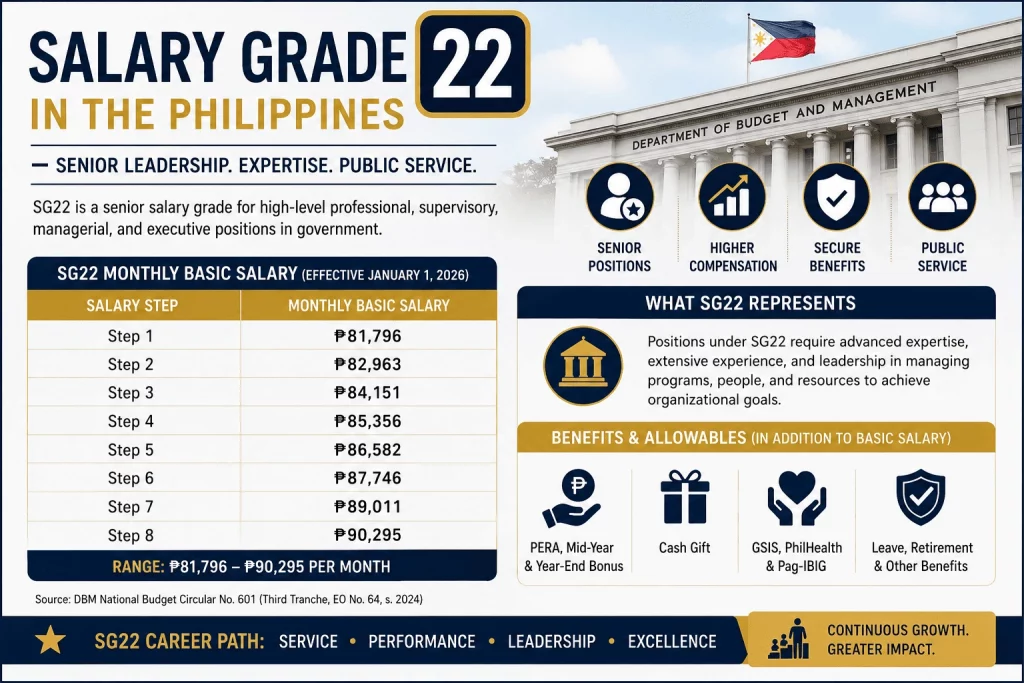
For the third tranche effective January 1, 2026, SG22 has a monthly basic salary ranging from ₱81,796 at Step 1 to ₱90,295 at Step 8, depending on the employee’s assigned step.
| Salary Step | Monthly Basic Salary |
|---|---|
| Step 1 | ₱81,796 |
| Step 2 | ₱82,963 |
| Step 3 | ₱84,151 |
| Step 4 | ₱85,356 |
| Step 5 | ₱86,582 |
| Step 6 | ₱87,746 |
| Step 7 | ₱89,011 |
| Step 8 | ₱90,295 |
Source: Annex A of DBM National Budget Circular No. 601 implementing the third tranche of Executive Order No. 64, effective January 1, 2026.
Estimated Annual Basic Salary
| Salary Step | Monthly | Estimated Annual |
|---|---|---|
| Step 1 | ₱81,796 | ₱981,552 |
| Step 8 | ₱90,295 | ₱1,083,540 |
Annual figures assume 12 months of basic salary and exclude bonuses, allowances, and other benefits.
A newly appointed SG22 employee generally starts at Step 1 unless a higher step is authorized. Movement to higher steps happens after meeting required service and performance standards under CSC and DBM rules — it is not automatic, and it does not include allowances such as PERA, Mid-Year Bonus, Year-End Bonus, Cash Gift, or GSIS/PhilHealth/Pag-IBIG benefits, which are governed separately.
Salary Steps Explained
SG22 has eight salary steps. Step 1 is the entry rate; Step 8 is the highest regular step within the grade. Advancement through the steps depends on qualifying government service, satisfactory performance, compliance with CSC/DBM regulations, and — where applicable — funding availability. It is not automatic simply because time has passed; employees should consult their agency’s Human Resource Management Office (HRMO) for eligibility guidance.
Salary Step vs. Promotion — these are commonly confused but are different mechanisms:
| Salary Step Increase | Promotion |
|---|---|
| Remains within the same salary grade | Moves to a higher salary grade |
| Increases monthly basic salary | Usually includes higher salary and greater responsibilities |
| Does not change job title | Usually involves appointment to a different position |
| Recognizes continued service and performance | Recognizes advancement to a higher-level position |
An employee may advance from SG22 Step 1 to SG22 Step 5 while remaining in the same position. A promotion, by contrast, means appointment from SG22 to SG23, subject to qualification standards, vacancy, and appointment requirements.
Government Salary Progress Workflow
Appointment to SG22 → Assigned Salary Step → Qualifying Government Service
→ Performance Evaluation → Step Increment (Subject to Rules)
→ Higher Monthly Basic Salary → Promotion Opportunity to Higher Salary Grade
Step progression and promotion are separate career mechanisms: steps reward continued service in the same position, while promotion means appointment to a higher-graded position with broader responsibilities.
Sample Government Positions Under Salary Grade 22
SG22 is commonly assigned to senior-level positions requiring extensive experience, specialized technical expertise, or significant managerial responsibility. Identical job titles can carry different classifications depending on the approved plantilla and agency mandate, so the list below is illustrative, not exhaustive.
| Position | Primary Responsibility |
|---|---|
| Division Chief (selected agencies) | Leads a division and manages personnel, programs, and resources |
| Chief Administrative Officer | Oversees administrative services and operational support |
| Chief Financial Management Officer | Directs financial planning, budgeting, accounting, and fiscal management |
| Chief Accountant | Supervises government accounting operations and financial reporting |
| Senior Attorney | Provides legal advice, represents the agency, ensures legal compliance |
| Senior Engineer | Leads engineering projects, technical evaluations, infrastructure programs |
| Senior Information Technology Officer | Manages enterprise IT systems, cybersecurity, digital transformation |
| Senior Planning Officer | Directs strategic planning, policy development, performance monitoring |
Important: Job titles alone do not determine Salary Grade. The official classification depends on the DBM-approved plantilla position, organizational structure, and applicable position classification rules.
SG22 positions typically share these traits: leadership over teams or units, advanced or specialized expertise, significant decision-making authority, responsibility for planning/budgeting/compliance, and accountability for organizational outcomes. Common qualification requirements include a relevant bachelor’s degree, appropriate Civil Service eligibility or professional license, several years of progressively responsible experience, relevant training aligned with CSC Qualification Standards, and demonstrated leadership capability. Always confirm specifics against the official vacancy announcement or the CSC Qualification Standards Manual.
SG22 Career Decision Matrix
| Career Situation | Recommended Action |
|---|---|
| New government employee | Build experience and meet qualification standards before targeting SG22 |
| Mid-level professional | Strengthen supervisory experience, complete required training |
| Current SG21 employee | Focus on performance and readiness for promotion when vacancies arise |
| Existing SG22 employee | Develop executive competencies for SG23 and above |
Typical Qualification Requirements by Category
Requirements differ by position, but SG22 roles generally cluster into a few patterns:
| Position Type | Typical Education | Typical Experience Emphasis |
|---|---|---|
| Legal (e.g., Senior Attorney) | Bachelor of Laws, Bar eligibility | Litigation, legal advisory, compliance oversight |
| Technical/Engineering (e.g., Senior Engineer) | Bachelor’s in relevant engineering field, PRC license | Project leadership, technical evaluation, infrastructure programs |
| Financial (e.g., Chief Accountant, Chief Financial Management Officer) | Bachelor’s in Accountancy or related field, CPA license where required | Budgeting, financial reporting, fiscal management |
| Administrative/Managerial (e.g., Chief Administrative Officer, Division Chief) | Bachelor’s degree, sometimes a Master’s | Personnel management, program oversight, organizational planning |
| IT/Digital (e.g., Senior IT Officer) | Bachelor’s in Computer Science, IT, or related field | Enterprise systems, cybersecurity, digital transformation initiatives |
Because these categories draw on different CSC Qualification Standards, applicants should never assume that qualifying for one SG22 role automatically qualifies them for another — always check the specific vacancy announcement.
🎯 Want to Qualify for High-Paying Government Positions?
Many Salary Grade 22 positions require Civil Service Eligibility in addition to education, experience, and training.
Prepare for the Civil Service Exam with our free reviewer:
✅ 170-Item Mock Exam
✅ Numerical Ability Reviewer
✅ Verbal Ability Reviewer
✅ Analytical Ability Reviewer
👉 Start Free Civil Service Reviewer
Legal Basis for Salary Grade 22
SG22 is part of the government’s Compensation and Position Classification System established under the Salary Standardization Law (SSL). The SSL creates a unified compensation framework meant to promote equitable pay across agencies, align salaries with duties, support recruitment and retention, and maintain a standardized grading system. Every plantilla position is assigned a Salary Grade reflecting its responsibility, complexity, and qualification requirements.
Executive Order No. 64, signed in 2024, authorizes a multi-year, four-tranche rollout of the updated salary schedule. It approves the revised schedule, specifies the implementation period, and authorizes the DBM to issue implementing guidelines. The full text is available through the Official Gazette. For 2026, DBM National Budget Circular No. 601 contains the official schedule for the third tranche, published on the DBM website.
While DBM sets compensation schedules, the CSC oversees qualification standards, appointment and promotion rules, civil service eligibility, and merit-based personnel administration. It does not set salary rates but determines who may qualify for SG22 positions.
| Authority | Primary Role |
|---|---|
| Congress of the Philippines | Enacts the Salary Standardization Law |
| President of the Philippines | Issues Executive Orders implementing salary adjustments |
| DBM | Publishes official salary schedules and implementation guidelines |
| CSC | Administers qualification standards, appointments, promotions, personnel policies |
| Government Agencies | Implement the approved salary schedules |
Because compensation policy can change through new executive issuances or circulars, always verify current figures against official DBM and CSC publications before relying on them for employment or financial planning.
Why the tranche system matters. Executive Order No. 64 rolls out the revised salary schedule in four tranches rather than all at once, which is why the effectivity date attached to any SG22 figure matters as much as the figure itself. Each tranche typically takes effect on January 1 of a given year and raises the basic salary schedule incrementally across all salary grades. This is also why online salary tables can go stale quickly: a figure that was accurate for the second tranche will understate current pay once the third tranche takes effect, and vice versa for anyone comparing against a not-yet-effective future tranche. When verifying a salary figure, it helps to check three things together — the salary grade, the salary step, and the specific tranche and effectivity date the figure is drawn from — rather than treating a single peso amount as permanently fixed.
Salary Grade 22 Benefits and Allowances
SG22 employees may be entitled to benefits beyond basic salary, though eligibility depends on applicable laws, DBM circulars, CSC policies, the General Appropriations Act, and agency-specific rules — benefits are not automatically determined by salary grade alone.
| Benefit | Description |
|---|---|
| PERA | Monthly allowance for qualified personnel under DBM rules |
| Mid-Year Bonus | Equivalent to one month’s basic salary, subject to eligibility |
| Year-End Bonus | Equivalent to one month’s basic pay as of October 31 |
| Cash Gift | Fixed benefit under applicable DBM circulars |
| PEI | Subject to annual DBM guidelines and budget availability |
| GSIS | Retirement, life insurance, disability, survivorship, loans |
| PhilHealth | National health insurance coverage |
| Pag-IBIG Fund | Housing, savings, multi-purpose loans |
Depending on position and agency, SG22 employees may also qualify for Representation and Transportation Allowance (RATA), Uniform/Clothing Allowance, Loyalty Award, leave monetization, overtime or compensatory time off, Night Shift Differential, Performance-Based Bonus (PBB), and Magna Carta benefits for covered personnel (e.g., public health or S&T workers).
Quick eligibility checklist: regular plantilla appointment; GSIS, PhilHealth, and Pag-IBIG membership; PERA eligibility; qualification for Mid-Year/Year-End Bonus and Cash Gift; agency qualification for PBB; and entitlement to RATA or other special allowances. Use this to guide a conversation with your HRMO or Finance Office — rules change through new legislation or annual appropriations, so confirm current entitlements officially rather than assuming they carry over year to year.
Why basic salary and total compensation are different numbers. A common point of confusion is treating the ₱81,796–₱90,295 range as the full picture of what an SG22 employee takes home. In practice, total compensation is the basic salary plus whatever combination of the benefits above an employee actually qualifies for, minus mandatory deductions such as GSIS premiums, PhilHealth contributions, Pag-IBIG contributions, and applicable withholding tax. Two SG22 employees at the same step can end up with different net pay simply because one is entitled to RATA or Magna Carta benefits and the other is not. For budgeting or financial planning purposes, it’s more accurate to think of the published salary table as the baseline rather than the total, and to confirm the specific allowances attached to a given position before making assumptions about take-home pay.
SG21 vs. SG22 vs. SG23 Comparison
As salary grade increases, positions generally involve greater leadership responsibility, broader organizational scope, more complex decision-making, and higher compensation. SG22 sits in the middle of this trio.
Official Salary Comparison (Effective January 1, 2026)
| Salary Grade | Step 1 | Step 8 | Difference from SG22 (Step 1) |
|---|---|---|---|
| SG21 | ₱73,303 | ₱80,831 | −₱8.493 |
| SG22 | ₱81,796 | ₱90,295 | — |
| SG23 | ₱91,306 | ₱101,318 | +₱9.510 |
Source: DBM National Budget Circular No. 601, third tranche of Executive Order No. 64.
Note: These SG21 figures reflect the third tranche (effective January 1, 2026). Earlier tranches published different SG21 rates — if you’ve seen another number elsewhere, check which tranche and effectivity date it refers to before comparing.
| Area | SG21 | SG22 | SG23 |
|---|---|---|---|
| Leadership Scope | Supervisory | Senior supervisory / managerial | Senior managerial / executive |
| Decision-Making | Operational | Tactical and strategic | Organization-wide strategic |
| Program Responsibility | Unit-level | Division or major program | Bureau, service, or major function |
| Technical Expertise | Advanced | Highly specialized | Expert or executive-level |
Career progression generally flows: Entry-Level Position → Professional Position → SG21 → SG22 → SG23 → Higher Executive Positions. Actual promotion at each step depends on a vacant position, compliance with CSC qualification standards, merit-based selection, relevant experience, and agency staffing needs — it is never automatic.
SG22 is often an appropriate target if you have substantial government experience, are ready for supervisory or managerial responsibility, meet higher-level qualification standards, and intend to keep progressing toward executive positions. For many professionals, it marks the shift from technical expertise to organizational leadership.
Career Progression to Salary Grade 22
Reaching SG22 is typically the result of sustained professional growth and appointment to a higher-classified position — not simply years of service. Employees must satisfy CSC qualification standards, compete through merit-based selection, and meet the experience, education, training, and eligibility requirements of the specific position.
Progression generally follows: Entry-Level Position (learn operations, build technical competence) → Professional/Technical Position (build specialized expertise) → Supervisory Position (manage teams or units) → SG22 Position (lead divisions, oversee programs) → Executive-Level Position (direct major units or agency-wide initiatives).
Readiness framework — ask yourself: Do I meet the educational requirements? Do I have the required eligibility or license? Have I gained sufficient progressively responsible experience? Have I completed relevant leadership training? Have I successfully led teams or initiatives? Do my performance evaluations support greater responsibility? The more of these you can answer yes to, the more competitive you are for SG22 vacancies.
Practical strategies: strengthen technical expertise, seek supervisory opportunities, complete leadership training, maintain strong performance evaluations, monitor CSC and agency vacancy announcements, and build experience in policy, planning, budgeting, or program management. Common obstacles include limited vacant plantilla positions, strong competition, agency-specific staffing requirements, qualification gaps, and organizational restructuring — since promotion follows the merit and fitness principle, meeting minimum qualifications doesn’t guarantee appointment. Reviewing your Individual Development Plan, documenting measurable accomplishments, and pursuing continuous learning all improve long-term readiness.
A realistic timeline. There’s no fixed number of years that guarantees SG22 eligibility, since it depends on agency structure and vacancy cycles rather than a uniform schedule. That said, most employees who reach SG22 have typically spent several years each in entry-level, professional/technical, and supervisory roles first — building the progressively responsible experience that qualification standards require. Employees sometimes ask whether they can skip a grade entirely; this is possible if they meet the qualification standards for the higher position outright and are selected through the merit process, but agencies more commonly fill SG22 vacancies with candidates who already hold supervisory experience at SG20 or SG21. Treating SG22 as the product of a multi-year trajectory, rather than a single application, tends to produce more realistic career planning than treating it as a near-term goal.
The role of the plantilla. It’s worth understanding that SG22 openings only exist where an agency’s DBM-approved staffing pattern includes an SG22-classified plantilla item. An employee cannot simply “grow into” SG22 by taking on more responsibility in an SG20 or SG21 position — appointment to a higher grade requires a formal, budgeted position to exist and become vacant, and for the employee to be formally appointed to it through the proper selection process.
Common Mistakes About Salary Grade 22
“SG22 salary equals take-home pay.” Incorrect — published figures are basic salary only; mandatory deductions (GSIS, PhilHealth, Pag-IBIG, taxes) reduce net pay, while allowances may increase total compensation. Two SG22 employees can have different net pay.
“Salary Grade and Salary Step are the same.” Incorrect — grade classifies the position and determines the salary range; step determines the exact amount within that range. An SG22 Step 1 employee earns less than an SG22 Step 8 employee despite sharing the same grade.
“Promotion from SG21 to SG22 is automatic after enough years.” Incorrect — it requires a vacant position, compliance with CSC standards, merit-based selection, and appointment by the proper authority.
“Every agency uses the same job titles for the same grade.” Incorrect — agencies may assign different grades to similar titles depending on organizational structure and DBM classification. Always verify the official plantilla position.
“Any salary table online is reliable.” Incorrect — schedules change with new Executive Orders or circulars, and outdated figures persist on some sites. Verify through the DBM, Official Gazette, or CSC.
Best practices: verify schedules using official DBM publications, distinguish salary grade from salary step and total compensation, review CSC qualification standards before applying, consult your HRMO, and stay current with new Executive Orders and DBM circulars.
Best Practices for Employees Targeting Salary Grade 22
Reaching SG22 takes more than meeting minimum qualifications. Since appointments follow the merit and fitness principle, long-term planning matters:
- Understand qualification standards early — review educational requirements, eligibility, experience, training hours, and specialized competencies for your target role.
- Develop leadership experience — lead project teams, supervise employees, coordinate inter-office activities, chair committees, or manage agency-wide initiatives.
- Invest in continuous learning — leadership/management training, public administration courses, financial and project management programs, IT and digital transformation training, and policy/regulatory seminars.
- Maintain strong performance ratings — meet targets consistently, complete assignments accurately, show initiative, and support agency priorities.
- Monitor government vacancies — check CSC announcements, agency HRMO postings, and official recruitment portals regularly, and confirm you meet all requirements before applying.
- Build a long-term career plan — set multi-year objectives, identify competency gaps, seek mentorship, and pursue assignments that broaden your organizational experience.
- Stay updated on compensation policy — Executive Orders, DBM circulars, the General Appropriations Act, and CSC issuances can all shift current rules.
Readiness checklist: educational requirements met; required eligibility or license held; required work experience and training completed; supervisory experience demonstrated; strong performance evaluations; communication and leadership skills developed; relevant vacancies monitored; updated PDS and supporting documents ready.
🚀 Ready to Build Your Government Career?
Passing the Civil Service Exam is one of the most important steps toward qualifying for permanent government positions.
Practice with our free reviewer and improve your confidence before applying.
What’s Included
- ✅ Full Mock Exams
- ✅ Practice Questions
- ✅ Instant Explanations
- ✅ Mobile-Friendly Review
People Also Ask
Is SG22 considered a high government salary grade? Yes. Within the Compensation and Position Classification System, SG22 sits well above entry- and mid-level grades and generally corresponds to substantial managerial, supervisory, or highly specialized professional responsibility.
What kind of employees typically hold SG22 positions? Experienced professionals who have already advanced through supervisory roles — engineers, accountants, lawyers, planning officers, and administrative managers who now lead divisions or specialized programs rather than individual projects.
Is it hard to get promoted to SG22? It’s competitive rather than automatic. Promotion depends on a vacant plantilla position being available, meeting CSC qualification standards, and succeeding in a merit-based selection process — strong performance and leadership experience help, but none of these alone guarantees appointment.
Does length of government service guarantee promotion to SG22? No. Years of service build the experience base needed to qualify, but promotion still requires a vacancy, compliance with qualification standards, and a competitive selection process.
Frequently Asked Questions
What is Salary Grade 22?
A senior-level compensation classification for positions requiring advanced technical expertise, leadership, or managerial responsibility.
What is the SG22 monthly basic salary in 2026?
₱81,796 (Step 1) to ₱90,295 (Step 8), third tranche effective January 1, 2026.
Does promotion automatically increase my salary grade?
No — it requires appointment to a higher-classified position and compliance with CSC and agency rules.
Are allowances included in the published SG22 salary?
No — the schedule reflects basic salary only; eligible employees receive additional benefits under separate rules.
Can two SG22 employees receive different salaries?
Yes, depending on their assigned salary step.
Who determines the official SG22 salary schedule?
The DBM, pursuant to applicable laws and executive issuances.
Can employees move from SG22 to SG23 automatically?
No — it requires meeting CSC qualification standards, applying for a vacant position, competing through merit-based selection, and receiving a valid appointment.
Is SG22 the same across all agencies?
Rates are standardized, but which positions carry the SG22 classification varies by agency staffing pattern and organizational structure.
Final Verdict
Salary Grade 22 represents a significant milestone in the Philippine government’s career progression framework, generally assigned to senior professional, technical, supervisory, and managerial positions requiring advanced expertise and substantial responsibility. For the third tranche effective January 1, 2026, the official monthly basic salary ranges from ₱81,796 (Step 1) to ₱90,295 (Step 8), per DBM National Budget Circular No. 601 implementing Executive Order No. 64 — basic salary only, excluding allowances, bonuses, and other benefits.
Employees aspiring to SG22 should focus on more than salary alone: meeting CSC qualification standards, building progressively responsible experience, demonstrating leadership, completing relevant education and training, maintaining strong performance, and preparing strategically for merit-based promotion. Because schedules and policies can be revised through future issuances, always verify the latest information against official government sources before making employment or financial decisions.
📚 Continue Your Government Career Journey
If you’re planning to apply for a permanent government position, don’t stop at learning the salary.
Prepare for the Civil Service Exam with our free online reviewer.
✔ 170-Item Mock Exam
✔ Numerical Reviewer
✔ Verbal Reviewer
✔ Analytical Reviewer
Related Topics
To learn more about navigating your career in the Philippine government, explore our deep-dive guides:
- Salary Grade 6 Philippines: Salary, Steps, Positions, and Career Guide
- Salary Grade 7 Philippines: Salary, Benefits & Positions
- Salary Grade 8 Philippines: Salary, Steps, Positions, Benefits, and Career Guide
- Salary Grade 10 Philippines: Salary, Positions, Benefits, and Career Guide
- Salary Grade 11 Philippines 2026: Complete Guide
- Salary Grade 12 Philippines 2026: Salary, Positions & Benefits
- Salary Grade 13 Philippines 2026: Complete Salary & Positions Guide
- Salary Grade 14 Philippines 2026: Complete Salary & Positions Guide
- Salary Grade 15 Philippines: Salary, Positions, Qualifications, and Career Guide
- Salary Grade 19 Philippines 2026: How Much Do SG 19 Employees Earn?
- Salary Grade 24 Philippines 2026: Salary & Benefits
- Salary Grade 25 Philippines: Salary, Positions, Benefits, and Career Guide
- Government Jobs in the Philippines 2026: Complete Job Search Guide
- How to Apply for Government Jobs in the Philippines: Step-by-Step Guide
- Government Salary Grade 2026: Complete Guide to the Philippine Salary Schedule
References
Official Government Sources
- Department of Budget and Management (DBM). National Budget Circular No. 601 – Implementation of the Third Tranche Compensation Adjustment for Civilian Government Personnel pursuant to Executive Order No. 64, s. 2024.
- Executive Order No. 64, s. 2024. Modifying the Salary Schedule for Civilian Government Personnel and Authorizing the Grant of Additional Benefits.
- Civil Service Commission (CSC). Position Qualification Standards and Civil Service eligibility policies.
- Official Gazette of the Republic of the Philippines. Executive Orders, laws, and official government issuances relating to the Salary Standardization Law.
Disclaimer
This guide is intended for informational purposes only and is based on official government issuances available at the time of writing. While every effort has been made to ensure accuracy, salary schedules, qualification standards, benefits, and implementing rules may change through subsequent laws, executive orders, DBM circulars, CSC issuances, or other government regulations.
Readers should always consult the latest official publications of the Department of Budget and Management (DBM), Civil Service