Last updated: July 25, 2026 · Reviewed against DBM National Budget Circular No. 601 and Executive Order No. 64
Quick Answer
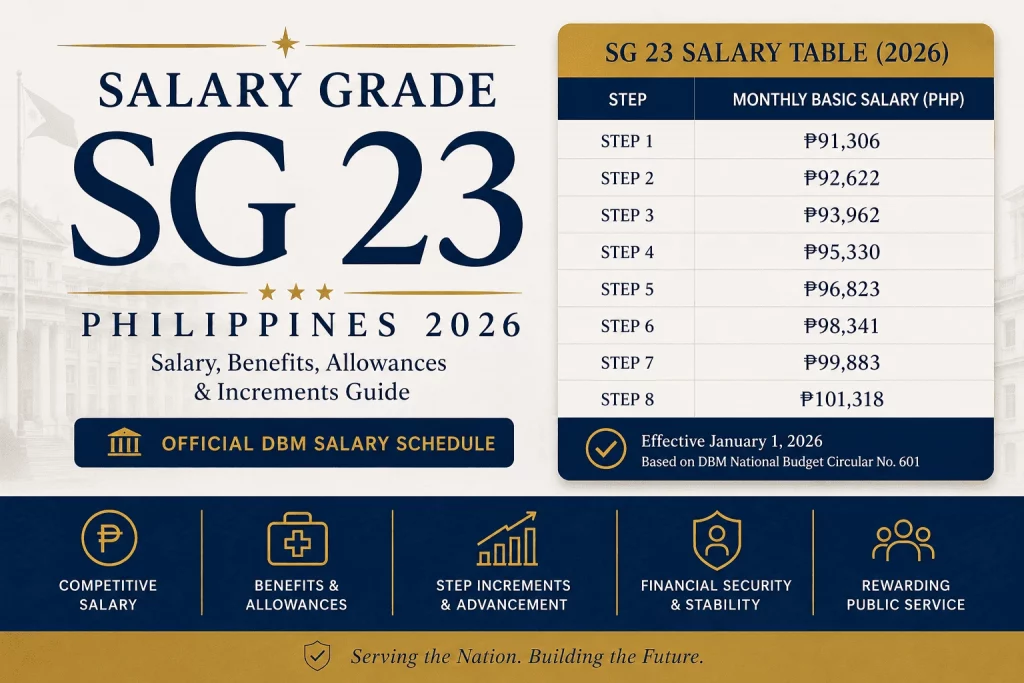
Salary Grade 23 (SG 23) is a high-level compensation grade under the Philippine government’s Compensation and Position Classification System. Employees assigned to SG 23 receive a monthly basic salary of ₱91,306 to ₱101,318, depending on Salary Step (1–8), effective January 1, 2026, under DBM National Budget Circular No. 601, which implements the third tranche of Executive Order No. 64. This figure excludes PERA, GSIS-related benefits, PhilHealth, Pag-IBIG, hazard pay, and other agency-specific allowances.
Employees in SG 23 are typically experienced professionals, technical specialists, managers, or executives who meet Civil Service Commission (CSC) qualification standards. Because pay follows salary steps, two employees in SG 23 may earn different monthly amounts based on length of service, merit, or authorized increments.
Key Takeaways
- SG 23 is a senior-level grade for professionals, managers, and technical experts with significant responsibility.
- Monthly basic salary (2026 schedule): ₱91,306 (Step 1) to ₱101,318 (Step 8).
- The published figure is basic pay only — PERA, GSIS, PhilHealth, Pag-IBIG, hazard pay, and incentives are separate.
- New employees generally start at Step 1; movement to higher steps follows DBM/CSC rules on service, performance, and merit.
- SG 23 positions typically require Civil Service eligibility, specific education, relevant training, and substantial experience.
Before applying, verify: the official salary schedule, the plantilla position and salary grade, qualification standards, applicable salary step, and the agency’s authorized benefits.
What Is Salary Grade 23?
Salary Grade 23 (SG 23) is a compensation level under the Philippine government’s Compensation and Position Classification System (CPCS). It applies to positions requiring advanced technical expertise, managerial responsibility, policy implementation, or specialized professional work. Employees at this level typically exercise independent judgment, supervise programs or personnel, and contribute meaningfully to their agency’s objectives.
Each plantilla position is assigned a salary grade based on:
- Complexity of duties and responsibilities
- Level of accountability
- Required education and professional qualifications
- Required training and work experience
- Scope of supervision and decision-making authority
The Department of Budget and Management (DBM) publishes the official salary schedules; the Civil Service Commission (CSC) prescribes qualification standards.
Where SG 23 Sits in the Overall Structure
| Salary Grade | General Level |
|---|---|
| SG 1–10 | Entry-level and administrative positions |
| SG 11–18 | Professional and technical positions |
| SG 19–22 | Supervisory and senior professional positions |
| SG 23 | Senior managerial and highly specialized professional positions |
| SG 24–28 | Executive and senior management positions |
| SG 29–33 | Top executive and constitutional positions |
SG 23 bridges senior supervisory roles and higher executive positions.
Official Salary Table (Effective January 1, 2026)
Under DBM National Budget Circular No. 601, implementing the third tranche of Executive Order No. 64, the following schedule took effect January 1, 2026:
| Salary Step | Monthly Basic Salary |
|---|---|
| Step 1 | ₱91,306 |
| Step 2 | ₱92,622 |
| Step 3 | ₱93,962 |
| Step 4 | ₱95,330 |
| Step 5 | ₱96,823 |
| Step 6 | ₱98,341 |
| Step 7 | ₱99,883 |
| Step 8 | ₱101,318 |
Figures reflect the official Salary Schedule (Annex A) under NBC No. 601. Basic salary only — excludes allowances and deductions. Subject to future updates via new Executive Orders or DBM issuances.
What the Table Does Not Include
- Personnel Economic Relief Allowance (PERA)
- Representation and Transportation Allowance (RATA), where applicable
- Hazard Pay
- Mid-Year and Year-End Bonus, Cash Gift
- Clothing/Uniform Allowance
- GSIS, PhilHealth, and Pag-IBIG employer contributions
- Other agency-specific incentives
Who Starts at Step 1?
- Newly appointed employees generally receive Step 1 pay for their assigned grade.
- Incumbents retain their existing step during salary adjustments unless otherwise provided.
- Advancement to higher steps depends on merit, length of service, or other authorized personnel actions under CSC/DBM guidelines.
Salary Steps Explained
A Salary Step marks an employee’s position within a salary grade. Every grade (SG 1–33) has eight steps, each corresponding to a higher monthly basic salary. Movement between steps is not automatic — it depends on DBM/CSC rules covering performance, length of service, or merit-based increments approved by the agency.
Example: Employee A (Step 1) earns ₱91,306/month; Employee B (Step 6) earns ₱98,341/month — despite both holding SG 23 positions.
Higher steps mean a higher monthly basic salary and a higher computation base for certain benefits tied to basic pay, without requiring a promotion in grade.
Common Positions Under Salary Grade 23
Position titles vary by agency mandate and staffing pattern. Always confirm the salary grade via the agency’s approved plantilla and official vacancy announcement — the same title can carry a different grade elsewhere.
| Position | Primary Responsibilities |
|---|---|
| Director II | Manages a division or major unit; oversees program and policy implementation |
| Chief Administrative Officer | Supervises HR, finance, procurement, and general services |
| Chief Financial Management Specialist | Leads financial planning, budgeting, and fiscal management |
| Chief Science Research Specialist | Directs research programs and technical teams |
| Chief Education Program Specialist | Oversees planning, monitoring, and evaluation of education programs |
| Chief Health Program Officer | Manages public health initiatives and policy development |
| Chief Agriculturist | Leads agricultural development and extension services |
| Chief Engineer | Supervises engineering projects and infrastructure planning |
| Senior Legal Officer | Provides legal advice, prepares opinions, ensures regulatory compliance |
| Senior Information Technology Officer | Oversees IT systems, cybersecurity, and digital transformation |
Typical Minimum Qualifications
- Bachelor’s degree relevant to the position (some roles require a master’s degree)
- Appropriate Civil Service eligibility or professional license
- Several years of progressively responsible experience
- Specialized supervisory or technical training
- Managerial or supervisory competencies appropriate to the role
Benefits and Allowances
Basic salary is only part of total compensation. Actual take-home pay varies by agency, funding, employment status, and eligibility for additional benefits.
| Benefit / Allowance | Description |
|---|---|
| Personnel Economic Relief Allowance (PERA) | Monthly allowance offsetting cost of living |
| Mid-Year Bonus | Equivalent to one month’s basic salary, subject to eligibility |
| Year-End Bonus | Annual bonus per DBM guidelines |
| Cash Gift | Annual cash incentive |
| Clothing/Uniform Allowance | Annual allowance for official uniforms |
| Productivity Enhancement Incentive (PEI) | Incentive based on existing budget rules |
| Loyalty Award | For completing required years of continuous service |
| Leave Benefits | Vacation/sick leave credits, monetizable under existing rules |
Mandatory Government Insurance
- GSIS — retirement, life insurance, disability, survivorship, and loans
- PhilHealth — health insurance for employees and dependents
- Pag-IBIG Fund (HDMF) — housing and multi-purpose loans, savings
- Employees’ Compensation Program (ECP) — work-related sickness, injury, disability, or death compensation
Possible Agency-Specific Benefits
RATA (for qualified officials), Hazard Pay, Subsistence and Laundry Allowance, Magna Carta benefits (health workers, scientists, educators), Performance-Based Bonus (PBB), and CNA Incentive — availability depends on position, agency, and funding.
Mandatory Deductions
GSIS, PhilHealth, and Pag-IBIG contributions, withholding tax, and any voluntarily authorized deductions (e.g., salary loans) reduce net take-home pay.
Compensation Checklist
- [ ] Monthly basic salary and salary step confirmed
- [ ] PERA eligibility checked
- [ ] Mid-Year/Year-End Bonus and PBB eligibility confirmed
- [ ] RATA or position-specific allowances reviewed
- [ ] Hazard/special allowances checked, if applicable
- [ ] GSIS, PhilHealth, Pag-IBIG coverage confirmed
- [ ] Mandatory deductions understood
- [ ] Agency-specific incentives reviewed
- [ ] Total estimated take-home pay calculated
Qualification Standards
SG 23 has no single uniform qualification standard — requirements vary by position and agency, based on four CSC categories: education, experience, training, and eligibility.
| Qualification | Typical Requirement |
|---|---|
| Education | Bachelor’s degree relevant to the position; some require a master’s degree |
| Experience | Several years of progressively responsible professional/supervisory experience |
| Training | Relevant supervisory, managerial, or technical training programs |
| Eligibility | Career Service Professional Eligibility, Bar Eligibility, board licensure, RA 1080, or other CSC-recognized eligibility |
🎯 Preparing for Government Service?
Most permanent government positions require Civil Service Eligibility.
If you’re planning to qualify for higher Salary Grade positions like SG 23, start preparing early with our free Civil Service Exam Reviewer.
✅ Practice Questions
✅ Timed Mock Exams
✅ Instant Explanations
👉 Start Free Civil Service Reviewer
Competencies Commonly Assessed
Leadership and people management, strategic planning, communication, policy development, financial and resource management, analytical/problem-solving ability, and decision-making under complex conditions.
Where to Verify Requirements
- The hiring agency’s official vacancy announcement
- The agency’s approved Qualification Standards Manual
- CSC issuances
- The approved plantilla position and Position Description Form
Career Progression
| Career Level | Typical Salary Grades | Description |
|---|---|---|
| Entry-Level | SG 1–10 | Administrative, clerical, technical support |
| Professional Level | SG 11–18 | Specialized professional/technical roles |
| Supervisory Level | SG 19–22 | Team, project, or program leads |
| Managerial / Senior Specialist | SG 23 | Division heads, chief specialists, senior managers |
| Executive Level | SG 24–28 | Directors, senior executives |
| Top Executive Level | SG 29–33 | Undersecretaries, Commissioners, Constitutional officials |
Promotion Requirements
- Meeting CSC qualification standards for the target position
- Required Civil Service eligibility or professional license
- Required education and relevant training
- Sufficient supervisory/managerial experience
- Consistently satisfactory or outstanding performance
- Success in the agency’s merit-based selection process
Promotion also depends on the availability of a vacant plantilla position — meeting qualifications alone does not guarantee appointment.
🚀 Want to Qualify for Higher Salary Grades?
Promotion isn’t based on salary alone. Many government positions require the right education, experience, training, and Civil Service Eligibility.
Build your confidence before applying.
✔ Practice with our Free Civil Service Reviewer
Promotion Readiness Checklist
- [ ] Relevant bachelor’s degree (or higher, if required)
- [ ] Civil Service eligibility or professional license
- [ ] Required years of work experience
- [ ] Required training completed
- [ ] Supervisory or managerial experience
- [ ] Strong performance evaluation record
- [ ] Leadership and communication skills
- [ ] Complete application documents
SG 22 vs. SG 23 vs. SG 24
Salary Comparison (Effective Jan 1, 2026)
| Salary Grade | Step 1 | Step 8 | Increase from Prior Grade (Step 1) |
|---|---|---|---|
| SG 22 | ₱84,555 | ₱93,847 | — |
| SG 23 | ₱91,306 | ₱101,318 | +₱6,751 |
| SG 24 | ₱98,185 | ₱108,956 | +₱6,879 |
Position-Level Comparison
| Salary Grade | Typical Level | General Responsibility |
|---|---|---|
| SG 22 | Senior Supervisory / Senior Professional | Supervises units, manages projects, provides technical expertise |
| SG 23 | Managerial / Chief Specialist | Leads divisions or major programs, formulates policy, supervises multiple teams |
| SG 24 | Director-Level / Senior Executive | Oversees multiple divisions, sets strategic direction |
Progression from SG 22 to SG 24 involves more than a raise — it means broader organizational oversight, policy authority, and stronger leadership/decision-making expectations at each step.
Legal Basis
| Reference | Purpose | Link |
|---|---|---|
| Executive Order No. 64 (signed Aug 2, 2024) | Legal authority for the compensation adjustment program (tranches) | Official Gazette |
| DBM National Budget Circular No. 601 | Official salary schedule effective Jan 1, 2026 (third tranche of EO 64) | DBM |
| Department of Budget and Management | Publishes salary schedules and compensation policy | dbm.gov.ph |
| Civil Service Commission | Issues qualification standards and personnel policy | csc.gov.ph |
| Official Gazette | Publishes executive orders, laws, and issuances | officialgazette.gov.ph |
EO 64 authorizes continued implementation of the government’s compensation adjustment program, aiming to maintain a competitive, equitable salary structure and improve recruitment and retention of qualified public servants. NBC No. 601 implements the third tranche, covering salary adjustment rules for incumbents, rates for new appointees, step implementation, and funding provisions.
Note: This guide references publicly available circular and order numbers as commonly cited in government compensation coverage. Always cross-check the current text of NBC No. 601 and EO 64 directly via the DBM and Official Gazette links above before relying on these figures for official transactions.
Common Mistakes to Avoid
- Assuming basic salary equals take-home pay. GSIS, PhilHealth, Pag-IBIG, tax, and loan deductions all reduce net pay.
- Believing all SG 23 employees earn the same amount. Salary depends on the assigned step (1–8).
- Assuming every agency has identical SG 23 positions. Titles and duties differ — always check the official vacancy announcement.
- Thinking promotion is automatic. It requires a vacant position, qualification compliance, and a competitive selection process.
- Ignoring qualification standards in favor of focusing only on salary.
- Relying on unofficial salary tables from blogs or forums instead of DBM/CSC/Official Gazette sources.
Mistake Prevention Checklist
- [ ] Using the latest official DBM salary table
- [ ] Understand basic salary vs. take-home pay
- [ ] Verified the salary step
- [ ] Meet all qualification standards
- [ ] Reviewed the official vacancy announcement
- [ ] Understand available allowances and deductions
- [ ] Confirmed the position’s salary grade in the approved plantilla
Best Practices
- Verify the official salary schedule via DBM, CSC, the Official Gazette, or the hiring agency’s website — not social media or unofficial blogs.
- Review qualification standards carefully for the specific position, not just the salary grade generally.
- Strengthen leadership competencies — strategic planning, decision-making, communication, conflict resolution, project management.
- Continue professional development through CSC-accredited training, graduate studies, and updated certifications.
- Maintain strong performance records — consistency, initiative, and accountability matter in promotion decisions.
- Monitor vacancy announcements through the CSC Job Portal, agency websites, and HR offices.
Career Success Framework
| Step | Recommended Action |
|---|---|
| 1. Verify | Confirm the position’s salary grade against the latest DBM schedule |
| 2. Qualify | Meet education, experience, training, and eligibility requirements |
| 3. Develop | Build leadership, technical, and managerial competencies |
| 4. Prepare | Update your Personal Data Sheet (PDS) and supporting documents |
| 5. Apply | Submit within the deadline, following agency procedure |
| 6. Grow | Keep developing performance and leadership skills for future roles |
Beginner and Expert Tips
For Employees Early in Their Career
- Understand the difference between Salary Grade (compensation level) and Salary Step (specific pay within that grade).
- Build relevant experience through fieldwork, project involvement, and leadership assignments.
- Invest in continuous learning via CSC programs, training, and relevant graduate study.
- Keep employment records (PDS, eligibility certificates, licenses, transcripts, training certificates) organized and current.
- Monitor official vacancies through the CSC Job Portal and agency HR offices.
For Experienced Professionals Targeting SG 23 and Beyond
- Develop specialized expertise in a specific discipline (finance, engineering, IT, public health, education, law, HR, R&D).
- Strengthen management skills — strategic planning, change management, budget management, stakeholder engagement.
- Build a professional portfolio documenting major projects, awards, publications, and certifications.
- Expand your network through inter-agency working groups, professional associations, and conferences.
- Prepare early for executive responsibilities — governance, risk management, policy analysis, and organizational transformation — since SG 23 is often a stepping stone to SG 24–28.
Frequently Asked Questions
What is Salary Grade 23?
A compensation level under the Philippine government’s CPCS assigned to managerial, supervisory, and highly specialized professional positions. Pay follows Salary Steps 1–8 under the DBM’s official schedule.
How much is the Salary Grade 23 salary?
Effective January 1, 2026: ₱91,306 (Step 1) to ₱101,318 (Step 8), basic salary only — excluding allowances, bonuses, and deductions.
What positions are classified under Salary Grade 23?
Examples include Director II, Chief Administrative Officer, Chief Financial Management Specialist, Chief Science Research Specialist, Chief Education Program Specialist, Chief Health Program Officer, Chief Agriculturist, Chief Engineer, Senior Legal Officer, and Senior IT Officer — actual classification depends on the agency’s approved plantilla.
Do all SG 23 employees receive the same salary?
No — pay depends on the employee’s assigned salary step (1 through 8).
Does the SG 23 salary include allowances?
No. PERA, Mid-Year/Year-End Bonus, Cash Gift, PEI, clothing allowance, RATA (where applicable), and other incentives are separate and depend on eligibility.
Who can apply for an SG 23 position?
Applicants meeting CSC qualification standards and the hiring agency’s specific requirements for education, eligibility, experience, training, and competencies. Meeting minimum qualifications does not guarantee appointment.
How can an employee be promoted to Salary Grade 23?
Through an available plantilla position, compliance with qualification standards, a strong performance record, and successful completion of the agency’s merit-based recruitment process.
Can a newly hired employee be appointed directly to SG 23?
Yes, provided they meet all qualification requirements and are appointed to an approved SG 23 plantilla position. New appointees typically start at Step 1 unless another step is authorized.
How do employees move between salary steps?
Through DBM/CSC-governed increments based on merit, length of service, or other authorized personnel actions — not automatically.
Where can I verify the official Salary Grade 23 salary?
The DBM, CSC, Official Gazette, and official agency vacancy announcements.
Final Verdict
Salary Grade 23 (SG 23) is a senior Philippine government compensation level for managerial, supervisory, and highly specialized professional positions, paying ₱91,306 to ₱101,318 monthly (basic pay, effective January 1, 2026) depending on salary step. Total compensation can be considerably higher once mandated benefits, bonuses, and allowances are included — but obtaining and retaining an SG 23 position requires meeting CSC qualification standards, securing a vacant plantilla position, and succeeding in a merit-based recruitment process.
At a Glance
| Category | Details |
|---|---|
| Salary Grade | 23 |
| Monthly Basic Salary | ₱91,306 – ₱101,318 |
| Salary Steps | 8 (Step 1–Step 8) |
| Coverage | Managerial, supervisory, highly specialized professional positions |
| Qualification Standards | Education, experience, training, and eligibility (CSC + hiring agency) |
| Implementing Authority | Department of Budget and Management (DBM) |
| Effective Salary Schedule | January 1, 2026 (Third Tranche of Executive Order No. 64) |
Closing note: Government compensation policy changes through new laws, executive orders, and DBM issuances. Always confirm current figures via DBM, CSC, and the Official Gazette before making employment or career decisions.
Planning a Government Career?
If you’re aiming for permanent government employment, passing the Civil Service Exam is one of the most important milestones.
Thousands of aspiring government employees use the ApplySmart PH Civil Service Reviewer to prepare.
✅ 170-Item Mock Exam
✅ Numerical Ability Reviewer
✅ Verbal Ability Reviewer
✅ Analytical Ability Reviewer
✅ Instant Results
Related Topics
To learn more about navigating your career in the Philippine government, explore our deep-dive guides:
- Salary Grade 6 Philippines: Salary, Steps, Positions, and Career Guide
- Salary Grade 7 Philippines: Salary, Benefits & Positions
- Salary Grade 8 Philippines: Salary, Steps, Positions, Benefits, and Career Guide
- Salary Grade 10 Philippines: Salary, Positions, Benefits, and Career Guide
- Salary Grade 11 Philippines 2026: Complete Guide
- Salary Grade 12 Philippines 2026: Salary, Positions & Benefits
- Salary Grade 13 Philippines 2026: Complete Salary & Positions Guide
- Salary Grade 14 Philippines 2026: Complete Salary & Positions Guide
- Salary Grade 15 Philippines: Salary, Positions, Qualifications, and Career Guide
- Salary Grade 19 Philippines 2026: How Much Do SG 19 Employees Earn?
- Salary Grade 24 Philippines 2026: Salary & Benefits
- Salary Grade 25 Philippines: Salary, Positions, Benefits, and Career Guide
- Government Jobs in the Philippines 2026: Complete Job Search Guide
- How to Apply for Government Jobs in the Philippines: Step-by-Step Guide
- Government Salary Grade 2026: Complete Guide to the Philippine Salary Schedule
References
Official Government Sources
- Department of Budget and Management (DBM). National Budget Circular No. 601 – Implementation of the Third Tranche Compensation Adjustment for Civilian Government Personnel pursuant to Executive Order No. 64, s. 2024.
- Executive Order No. 64, s. 2024. Modifying the Salary Schedule for Civilian Government Personnel and Authorizing the Grant of Additional Benefits.
- Civil Service Commission (CSC). Position Qualification Standards and Civil Service eligibility policies.
- Official Gazette of the Republic of the Philippines. Executive Orders, laws, and official government issuances relating to the Salary Standardization Law.
Disclaimer
This guide is intended for informational purposes only and is based on official government issuances available at the time of writing. While every effort has been made to ensure accuracy, salary schedules, qualification standards, benefits, and implementing rules may change through subsequent laws, executive orders, DBM circulars, CSC issuances, or other government regulations.
Readers should always consult the latest official publications of the Department of Budget and Management (DBM), Civil Service