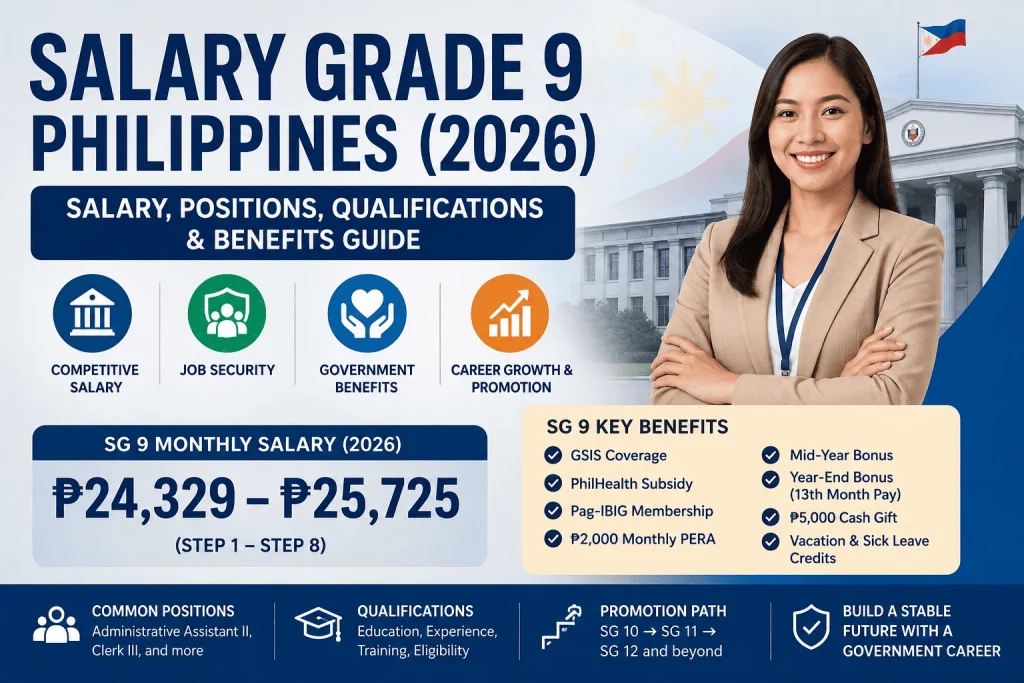
A Salary Grade 9 (SG 9) government employee in the Philippines receives a monthly basic salary of ₱24,329 to ₱25,725 (Step 1–8, effective January 1, 2026, Third Tranche of EO 64, s. 2024), plus a full package of statutory benefits: GSIS life insurance, retirement, and salary loan coverage; PhilHealth premium subsidy; Pag-IBIG membership and loan eligibility; ₱2,000 monthly PERA; a Mid-Year Bonus; a Year-End Bonus (13th month pay); a ₱5,000 Cash Gift; and accumulating Vacation and Sick Leave credits. Together, these benefits typically add 15–25% to an SG 9 employee’s effective annual compensation on top of basic pay.
What Salary Grade 9 Really Pays
If you’ve landed a Salary Grade 9 (SG 9) position — or you’re studying for the Civil Service Exam with SG 9 roles in mind — you already know the basic salary number matters. But the basic salary is only one part of the picture. Philippine government compensation is built on two pillars: the Salary Standardization Law (SSL), which sets your monthly basic pay by grade and step, and a separate layer of statutory benefits governed by GSIS, PhilHealth, Pag-IBIG, and Civil Service Commission (CSC) rules.
Many applicants focus entirely on the salary table and never look closely at the benefits side — which is a mistake, because for SG 9 employees, benefits routinely add several thousand pesos a month in value once you count government-side insurance premiums, bonuses, and leave conversion.
This guide walks through every benefit an SG 9 employee is entitled to in 2026, explains how SG 9 stacks up against the grades directly above and below it, and lays out a realistic promotion roadmap if your goal is to move beyond SG 9 over the next several years.
It’s worth pausing on why this distinction — basic pay versus total compensation — matters so much at the SG 9 level specifically. Positions in this band tend to attract two very different kinds of applicants: private-sector workers considering a switch to government service, and Job Order (JO) or contract-of-service personnel hoping to convert into a permanent plantilla item. Both groups often compare SG 9’s basic salary directly against a private-sector job offer or their current JO pay, without factoring in employer-side GSIS and PhilHealth contributions, the twin annual bonuses, the cash gift, or the long-term value of leave credits that convert to cash at retirement. Once those are added in, SG 9’s effective compensation package looks considerably stronger than the basic salary figure alone suggests — which is exactly why this guide treats benefits as a first-class part of the SG 9 conversation, not a footnote.
SG 9 Quick Snapshot (2026)
| Item | Details |
|---|---|
| Salary Grade | SG 9 |
| Monthly Salary | ₱24,329 – ₱25,725 |
| Position Level | Junior Technical / Administrative |
| Common Positions | Administrative Assistant II, Clerk III |
| Eligibility | Usually CSC Professional or Subprofessional |
| Promotion Path | SG 10–12 |
| Benefits | GSIS, PhilHealth, Pag-IBIG, PERA, Bonuses |
Understanding Salary Grade 9 in the 2026 Salary Schedule
Salary Grade 9 sits in the lower-middle band of the Philippine government’s 33-grade Compensation and Position Classification System (CPCS). It is most commonly assigned to entry-to-junior-level technical, clerical, and administrative plantilla positions — roles that require a specific eligibility or a bachelor’s degree relevant to the post, but not yet the supervisory scope associated with SG 11 and above.
Under DBM National Budget Circular No. 601, implementing the Third Tranche of Executive Order No. 64, s. 2024, effective January 1, 2026, SG 9’s monthly basic salary runs as follows:
| Step | Approximate Monthly Basic Salary (2026) |
|---|---|
| Step 1 | ₱24,329 |
| Step 8 | ₱25,725 |
New hires typically start at Step 1. Employees generally move one step every three years of continuous, satisfactory service, though qualifying performance ratings and length-of-service rules under CSC regulations can affect the exact timeline. On top of this basic salary, every covered employee also receives the standard ₱2,000 monthly Personnel Economic Relief Allowance (PERA), discussed in detail below.
A fourth and final tranche of salary adjustments under EO 64 is scheduled for 2027, so SG 9’s basic pay is expected to rise again next year.
Common Salary Grade 9 Positions
Salary Grade 9 is commonly assigned to administrative, clerical, and support positions in government agencies.
Examples may include:
- Administrative Assistant II
- Clerk III
- Records Management Support Staff
- Accounting Clerk
- Human Resource Support Staff
- Administrative Support Personnel
Actual salary grade assignments may vary depending on the agency and approved plantilla positions.
Qualifications for Salary Grade 9 Positions
Qualification requirements vary depending on the agency and position.
Education
- Senior High School
- College units completed
- Bachelor’s degree (for some positions)
Experience
- Relevant administrative or clerical experience
- Office support experience
Training
- Position-specific training
- Government-related seminars
Eligibility
- CSC Professional Eligibility
- CSC Subprofessional Eligibility
- Other recognized eligibility pathways
Related Reading: CSC Eligibility Requirements | Professional vs Subprofessional Eligibility | RA 1080 Guide | PD 907 Guide
SG 9 Readiness Assessment™
Use this checklist to evaluate your readiness for a typical SG 9 government position.
| Question | Yes | No |
|---|---|---|
| Do you have Civil Service Eligibility? | ☐ | ☐ |
| Do you have office or clerical experience? | ☐ | ☐ |
| Can you use Microsoft Office applications? | ☐ | ☐ |
| Can you prepare reports and maintain records? | ☐ | ☐ |
Results
4 Yes Answers ✅ Ready to Apply
3 Yes Answers 🟡 Nearly Ready
0–2 Yes Answers 🔵 Preparation Needed
Government Benefits for SG 9 Employees
Below is a complete rundown of every major benefit category an SG 9 government employee is entitled to under existing Philippine law and CSC/DBM issuances.
GSIS: Insurance, Retirement, and Loan Coverage
The Government Service Insurance System (GSIS) is the compulsory social insurance program for all government employees, including those at SG 9. Membership is automatic upon appointment to a permanent, casual, or temporary plantilla position, and monthly contributions are deducted directly from payroll — the employee contributes a percentage of monthly compensation, and the government agency contributes a larger employer share on top.
For an SG 9 employee, GSIS membership covers several distinct benefit lines:
- Life insurance — automatic coverage against death and total permanent disability, with proceeds payable to designated beneficiaries.
- Retirement benefits — SG 9 service years accumulate toward retirement eligibility under RA 8291, with payout options including lump sum and pension depending on age and years of service at separation.
- Disability and survivorship benefits — coverage for permanent or temporary disability arising from employment, and survivorship pension for qualified dependents.
- Salary and policy loans — SG 9 employees become eligible for GSIS salary loans, emergency loans, and policy loans once minimum premium-paying requirements are met, usually after the first year of continuous contributions.
- GSIS eCard and Members’ Portal access — used to track contributions, apply for loans, and monitor retirement fund status online.
Because GSIS contributions are computed as a percentage of the monthly basic salary, an SG 9 employee’s GSIS-related benefits scale automatically as they move up salary steps or grades.
One detail SG 9 employees often overlook: GSIS retirement computation depends heavily on both length of service and average monthly compensation near the point of retirement. This means an employee who enters at SG 9 and is later promoted to higher grades will have their eventual retirement benefit calculated using the higher, later-career salary base — which is one of the strongest financial arguments for pursuing promotion rather than staying at SG 9 for an entire career, even though SG 9 itself is a perfectly stable long-term position. New SG 9 employees should also register early for the GSIS Members’ Portal, since delays in updating personal records (dependents, beneficiaries, employment history from previous agencies) can slow down loan approvals and future retirement claims.
PhilHealth: Health Insurance Coverage
Every SG 9 government employee is automatically enrolled in the Philippine Health Insurance Corporation (PhilHealth) program as a member under the direct-contributory group. Monthly premiums are shared between the employee and the government agency as employer, and are computed based on the employee’s monthly basic salary under the current PhilHealth premium schedule.
PhilHealth coverage for SG 9 employees includes:
- In-patient hospitalization benefits at PhilHealth-accredited hospitals and facilities nationwide.
- Case-rate benefit packages covering a wide range of medical and surgical procedures.
- Outpatient benefits, including primary care, dialysis, and select outpatient surgeries.
- Coverage extension to qualified dependents (spouse, children, and in some cases parents), subject to PhilHealth’s dependent qualification rules.
- Continued membership portability if the employee transfers between government agencies or later moves to private-sector employment.
Because PhilHealth premiums are salary-based, they rise modestly as an employee advances through SG 9’s steps or is promoted to a higher grade.
For SG 9 employees with young families, the dependent-coverage feature is often the single most valuable part of PhilHealth membership — it means hospitalization costs for a spouse or children are partially or fully covered under the same policy, without requiring separate enrollment or a separate premium, as long as the dependents meet PhilHealth’s documentation requirements (marriage certificate for a spouse, birth certificates for children, and so on).
Pag-IBIG: Housing and Savings Benefits
The Home Development Mutual Fund (Pag-IBIG Fund) is the third mandatory contribution for SG 9 employees, combining a forced-savings program with access to some of the most affordable housing loans available in the Philippines.
Key Pag-IBIG benefits for SG 9 employees include:
- Monthly savings contributions, matched by an employer counterpart, which accumulate with dividends and can be withdrawn upon retirement, resignation, or after a set number of years of continuous membership.
- Pag-IBIG Housing Loan eligibility — SG 9 employees, once they meet minimum contribution and membership requirements, can apply for housing loans at rates generally lower than commercial bank mortgages, making Pag-IBIG one of the more practical paths to home ownership on a government salary.
- Multi-Purpose Loan (MPL) — a short-term loan facility for personal needs, calculated against accumulated Pag-IBIG savings.
- Calamity Loan — emergency access to funds following a declared calamity in the employee’s area.
Of all the mandatory contributions SG 9 employees make, Pag-IBIG is arguably the one with the most direct, tangible payoff. The forced-savings design means an employee who might not otherwise set aside money each month ends up with a growing balance that earns dividends — typically outperforming a basic savings account — while simultaneously building eligibility for a housing loan. For SG 9 employees in their late 20s to 30s who are thinking about buying their first property, pairing several years of Pag-IBIG contributions with the annual bonuses discussed below (used toward a down payment) is one of the more common financial strategies among long-serving government employees.
PERA: Personnel Economic Relief Allowance
The Personnel Economic Relief Allowance (PERA) is a fixed, non-taxable monthly allowance paid to all covered government personnel, including SG 9 employees, currently set at ₱2,000 per month. Unlike the basic salary, PERA is a flat amount that does not vary by salary grade or step — an SG 1 employee and an SG 9 employee both receive the same ₱2,000.
PERA is paid on top of the basic salary and is factored separately from GSIS, PhilHealth, and Pag-IBIG contribution computations, which are generally based on basic salary alone. For a deeper look at PERA alongside related allowances like RATA (Representation and Transportation Allowance) and Hazard Pay, see our PERA, RATA, and Hazard Pay Guide.
Mid-Year Bonus
SG 9 employees are entitled to the Mid-Year Bonus, typically released around May, equivalent to one month’s basic salary. This bonus was institutionalized to give government employees a guaranteed pay boost around the middle of the fiscal year, mirroring the private sector’s mid-year incentives in some industries.
For an SG 9 employee at Step 1, this means a Mid-Year Bonus of roughly ₱24,329 — paid in a single lump sum, separate from regular monthly payroll. For the exact release schedule, eligibility rules (including proration for employees who joined mid-year), and required length of service, see our full Mid-Year Bonus Guide.
Year-End Bonus and 13th Month Pay
At the close of the calendar year, SG 9 employees receive both the Year-End Bonus and the mandatory 13th Month Pay, typically released together in November. Combined, these two benefits generally amount to two months’ worth of basic salary, making the November payout one of the largest single disbursements an SG 9 employee receives all year.
This is distinct from the Mid-Year Bonus and is computed independently, based on the employee’s basic salary rate at the time of release and their length of service during the covered year.
Cash Gift
Alongside the Year-End Bonus, SG 9 employees also receive an annual Cash Gift, a fixed allowance (commonly ₱5,000, subject to the annual General Appropriations Act) released at the same time as the Year-End Bonus. Unlike the Mid-Year and Year-End Bonuses, the Cash Gift is a flat amount and does not scale with salary grade — meaning it is the same whether an employee is at SG 1 or SG 20.
Leave Credits
SG 9 employees accrue both Vacation Leave (VL) and Sick Leave (SL) credits at the standard government rate of 1.25 days per month each, for a combined 15 days of VL and 15 days of SL per year (30 days total) once fully accrued.
Leave credits for SG 9 employees can be used in several ways:
- Taken as paid time off for personal, family, or medical reasons.
- Accumulated without a cap in many agencies, allowing long-serving employees to build a substantial leave balance.
- Monetized (converted to cash) — accumulated leave credits, particularly unused VL and SL beyond a certain threshold, can be converted to a cash equivalent, either during active service (subject to agency rules) or upon retirement/separation, where terminal leave pay based on total accumulated credits and final salary rate can be a significant lump-sum benefit.
For SG 9 employees planning a long government career, leave credits — especially when preserved and monetized at retirement — often represent one of the more underappreciated long-term financial benefits of public service.
SG 9’s Total Annual Compensation: Putting the Numbers Together
It helps to see how all these benefits stack up over a full calendar year rather than reading about them one at a time. Using an SG 9 employee at Step 1 (₱24,329 monthly basic) as an example, a simplified annual compensation picture looks roughly like this:
- 12 months of basic salary: ₱24,329 × 12 = ₱291,948
- Mid-Year Bonus: approximately ₱24,329
- Year-End Bonus: approximately ₱24,329
- 13th Month Pay: approximately ₱24,329
- Cash Gift: approximately ₱5,000
- PERA: ₱2,000 × 12 = ₱24,000
Adding these together brings total cash compensation for the year to roughly ₱394,000, before factoring in the monetary value of employer-side GSIS and PhilHealth contributions, or the future cash value of accumulated leave credits. That’s an effective uplift of about 35% over the basic salary figure alone — a gap that’s easy to miss if you only look at the monthly payslip number, but that materially changes how SG 9 compares to job offers in other sectors.
This is also why comparing an SG 9 job offer to a private-sector offer purely on “monthly salary” terms can be misleading in either direction. A private-sector role might advertise a higher gross monthly salary, but SG 9’s combination of guaranteed bonuses, cash gift, employer-subsidized insurance, and long-term retirement benefits under GSIS often closes — or even reverses — that gap once both offers are evaluated on a full-year, total-compensation basis.
Salary Grade 9 vs. Salary Grade 8
SG 9 sits one full grade above SG 8, and the gap between them is a useful reference point for employees currently at SG 8 who are weighing whether a lateral move or reclassification to SG 9 is worth pursuing.
| Factor | SG 8 | SG 9 |
|---|---|---|
| Salary | ₱22,423 (Step 1) to ₱23,883 (Step 8) monthly basic | ₱24,329 (Step 1) to ₱25,725 (Step 8) monthly basic |
| Position Level | Entry-level clerical and administrative roles (e.g., Administrative Assistant II); limited independent decision-making | Junior technical/administrative roles requiring more specific qualifications; slightly greater task ownership and coordination responsibility |
| Promotion Potential | Strong upward mobility, since SG 8 is often a stepping-stone grade with several SG 9–10 positions to apply into | Solid promotion runway toward SG 10–12 supervisory-adjacent roles, particularly for employees who complete relevant eligibility and training |
In practical terms, moving from SG 8 to SG 9 typically means a basic salary increase of roughly ₱1,800–₱1,900 per month at equivalent steps, alongside a modest step-up in job complexity and qualification requirements. Because GSIS, PhilHealth, and Pag-IBIG contributions (and their corresponding benefit values) are salary-based, the jump from SG 8 to SG 9 also nudges up the peso value of those benefits, along with the Mid-Year and Year-End Bonuses, which are computed as a multiple of basic salary.
Salary Grade 9 vs. Salary Grade 10
Looking one grade up, SG 10 is the next natural target for SG 9 employees pursuing promotion, and understanding the gap helps with realistic career planning.
| Factor | SG 9 | SG 10 |
|---|---|---|
| Salary | ₱24,329 (Step 1) to ₱25,725 (Step 8) monthly basic | ₱26,917 (Step 1) to ₱28,456 (Step 8) monthly basic |
| Qualifications | Relevant bachelor’s degree or specific eligibility; limited years of experience required for entry | Bachelor’s degree closely aligned to the position, often with CSC Professional eligibility and a minimum number of years of relevant experience or training |
| Career Growth | Foundational grade for building administrative and technical experience toward mid-level roles | Recognized stepping stone into technical/supervisory tracks, often qualifying employees for SG 11–15 roles with additional training |
The salary difference between SG 9 and SG 10 is approximately ₱2,500–₱2,700 per month at comparable steps — a meaningful jump, especially once it compounds through higher Mid-Year and Year-End Bonuses and larger GSIS/PhilHealth contribution bases.
The ApplySmartPH Promotion Readiness Framework™
Reaching SG 9 is a milestone, but for most applicants it’s a stepping stone rather than a final destination. The ApplySmartPH Promotion Readiness Framework™ breaks the path from SG 9 to higher-level government roles into five sequential stages, so you can see exactly where you stand and what comes next.
The framework is intentionally sequential rather than a checklist to complete all at once. Skipping ahead — for example, applying for SG 11–12 positions before building a documented performance record at Stage 1 — is one of the most common reasons SG 9 employees get passed over in promotion boards, even when they’re technically eligible on paper. Agencies weigh demonstrated readiness alongside formal qualifications, so treating each stage as a genuine milestone rather than a formality tends to produce faster, more durable promotions.
Stage 1 — Entry
- Obtain SG 9 position
- Learn government procedures
- Build performance record
This is the foundation stage. The priority here is not speed — it’s building a documented, positive performance history and genuinely understanding how your agency’s internal processes, procurement rules, and reporting lines work. Employees who rush past this stage without a solid performance record often stall later when applying for promotions that require verified ratings.
Stage 2 — Qualification Building
- Obtain higher eligibility
- Complete trainings
- Develop administrative skills
Once you’re comfortable in the role, the focus shifts to qualifications. This typically means pursuing a higher-level Civil Service eligibility (such as the CSC Professional level, if you currently hold Sub-Professional), attending CSC- or agency-sponsored trainings, and deliberately developing skills — report writing, basic budgeting, systems and records management — that higher-grade positions require.
Stage 3 — Advancement
- Apply for SG 10–12 positions
- Accept additional responsibilities
With eligibility and training in place, this stage is about actively applying for open SG 10–12 plantilla positions, whether through promotion within your current agency or transfer to another. Volunteering for additional responsibilities — even informally — also builds the track record hiring committees look for.
Stage 4 — Professional Growth
- Complete degree programs
- Pursue specialized government roles
For employees aiming beyond mid-level administrative work, this stage often involves finishing a bachelor’s degree (if not yet completed) or pursuing a relevant master’s degree, along with targeting specialized technical or program-specific roles that require deeper subject-matter expertise.
Stage 5 — Leadership Track
- Officer-level positions
- Supervisory roles
- Management opportunities
The final stage is the leadership track — Officer-level designations, supervisory positions with direct staff oversight, and eventually management or division-chief-level roles. Employees who reach this stage typically have a decade or more of combined experience, eligibility, and training behind them.
SG 9 Career Planner™
Pairing the promotion framework above with a simple year-by-year timeline can help you set realistic expectations. Here’s how a typical SG 9 career path can unfold:
Year 1–3
- Build experience
- Improve office skills
- Earn positive evaluations
Year 3–5
- Pursue promotion opportunities
- Complete training programs
Year 5–10
- Move into higher salary grades
- Develop leadership skills
Year 10+
- Pursue supervisory or officer positions
This timeline isn’t fixed — some employees move faster, especially those who enter SG 9 with a relevant degree and eligibility already in hand — but it reflects the typical progression pattern across most Philippine government agencies, where step increments occur roughly every three years and promotions depend on both position vacancies and documented readiness.
Why Many Applicants Target Salary Grade 9
SG 9 consistently ranks among the more sought-after entry-to-junior salary grades for Civil Service Exam passers and career government applicants, for a few clear reasons:
- Higher salary than entry-level grades. At ₱24,329–₱25,725 monthly basic, SG 9 pays noticeably more than SG 1–7 positions, while still being achievable without requiring years of prior government experience.
- Better promotion opportunities. SG 9 sits close enough to the SG 10–15 band that with the right eligibility and training, promotion timelines are realistic rather than distant.
- Strong government benefits. The combination of GSIS, PhilHealth, Pag-IBIG, PERA, twin bonuses, cash gift, and leave credits adds substantial value beyond the basic salary figure.
- Career stability. Plantilla positions at SG 9 offer job security that’s difficult to match in many private-sector entry roles, particularly for employees who achieve permanent appointment status.
Who Should Apply for Salary Grade 9 Positions?
Salary Grade 9 positions may be suitable for:
- Civil Service passers
- Administrative professionals
- Clerical and office workers
- Job Order personnel seeking plantilla positions
- Applicants pursuing long-term government careers
Preparing for an SG 9 Government Career?
Many Salary Grade 9 vacancies attract competitive applicants.
To improve your chances:
- Build your Civil Service eligibility
- Strengthen clerical and administrative skills
- Improve Microsoft Office proficiency
- Practice analytical and numerical skills
ApplySmartPH provides reviewer resources, mock exams, and practice questions designed to help aspiring government employees prepare more effectively.
📝 Ready to start reviewing? Try the CSE Reviewer App — free practice questions, mock exams, and a review tracker built to help you pass the Civil Service Exam and qualify for SG 9 and higher plantilla positions.
Frequently Asked Questions
How much is Salary Grade 9 in 2026?
As of January 1, 2026, under the Third Tranche of Executive Order No. 64, s. 2024, Salary Grade 9’s monthly basic salary ranges from ₱24,329 at Step 1 to ₱25,725 at Step 8. This figure covers basic pay only; it does not include the ₱2,000 monthly PERA or other benefits such as bonuses and cash gift.
What positions are under Salary Grade 9?
Salary Grade 9 generally covers entry-to-junior technical and administrative government positions that require a relevant bachelor’s degree or a specific Civil Service eligibility, but do not yet carry supervisory authority over other staff. Exact position titles vary by agency, since each government office classifies its own plantilla items, but SG 9 roles are typically one step above general clerical positions (SG 7–8) and one step below early supervisory or specialist tracks (SG 10–11).
Is CSC eligibility required for SG 9?
In most cases, yes — a permanent SG 9 plantilla appointment generally requires an appropriate Civil Service eligibility (commonly CSC Professional, though this depends on the specific position’s qualification standards) in addition to the relevant educational background. Some agencies may accept employees on a temporary or coterminous basis pending eligibility, but permanent appointment typically requires it.
Can Senior High School graduates apply for SG 9 positions?
Generally, no — most SG 9 positions require at least a relevant bachelor’s degree as part of their qualification standards, since SG 9 sits above the purely clerical grades (SG 1–7) that are more commonly accessible with a high school diploma or Sub-Professional eligibility alone. Senior High School graduates are typically better positioned for SG 1–6 entry-level roles first, with SG 9 becoming attainable after completing a college degree or gaining equivalent qualifying experience, depending on the specific agency’s requirements.
What benefits do SG 9 employees receive?
SG 9 employees receive the full standard package of Philippine government benefits: GSIS life insurance, retirement, and loan coverage; PhilHealth health insurance; Pag-IBIG savings and housing loan eligibility; a ₱2,000 monthly PERA; a Mid-Year Bonus; a Year-End Bonus plus 13th Month Pay; an annual Cash Gift; and accumulating Vacation and Sick Leave credits that can later be monetized.
Is Salary Grade 9 a good government position?
For many applicants, yes — SG 9 offers a meaningfully higher basic salary than entry-level grades, a full statutory benefits package, and a realistic promotion path toward SG 10–12 roles within a few years, provided the employee pursues additional eligibility and training. It’s particularly attractive for Job Order personnel seeking to convert into a permanent plantilla position and for administrative professionals looking for long-term career stability rather than the highest possible starting pay.
How long does it take to move from Step 1 to Step 8 within SG 9?
Under standard step-increment rules, employees typically advance one salary step every three years of continuous, satisfactory service, which means moving from Step 1 to Step 8 within SG 9 alone would take roughly 21 years absent a promotion to a higher grade. In practice, most employees are promoted to a higher salary grade well before reaching Step 8, since promotion usually offers a larger and faster salary increase than waiting out step increments within the same grade.
Does SG 9 basic salary already include PERA and other allowances?
No. The ₱24,329–₱25,725 figure for SG 9 represents basic salary only, as set under the DBM salary schedule. PERA (₱2,000/month), Mid-Year Bonus, Year-End Bonus, 13th Month Pay, and Cash Gift are all computed and paid separately, on top of basic salary, under their own respective rules.
Related Topics
To learn more about navigating your career in the Philippine government, explore our deep-dive guides:
- Salary Grade 1 in the Philippines (2026): Complete Guide to Pay, Steps, and Eligibility
- Salary Grade 2 in the Philippines (2026): Complete Guide to Pay, Steps, and Eligibility
- Salary Grade 3 in the Philippines (2026): Complete Guide to Pay, Steps, and Eligibility
- Salary Grade 4 (SG 4): Salary, Positions, and Qualifications
- Salary Grade 5 Philippines (2026): Salary, Positions, Qualifications, and Benefits Guide
- Salary Grade 6 Philippines: Salary, Steps, Positions, and Career Guide
- Salary Grade 7 Philippines: Salary, Benefits & Positions
- Salary Grade 8 Philippines: Salary, Steps, Positions, Benefits, and Career Guide
- Salary Grade 10 Philippines: Salary, Positions, Benefits, and Career Guide
- Salary Grade 11 Philippines 2026: Complete Guide
- Salary Grade 12 Philippines 2026: Salary, Positions & Benefits
- Salary Grade 13 Philippines 2026: Complete Salary & Positions Guide
- Salary Grade 14 Philippines 2026: Complete Salary & Positions Guide
- Salary Grade 15 Philippines: Salary, Positions, Qualifications, and Career Guide
- Salary Grade 19 Philippines 2026: How Much Do SG 19 Employees Earn?
- Salary Grade 24 Philippines 2026: Salary & Benefits
- Salary Grade 25 Philippines: Salary, Positions, Benefits, and Career Guide
- Government Jobs in the Philippines 2026: Complete Job Search Guide
- How to Apply for Government Jobs in the Philippines: Step-by-Step Guide
References
- Department of Budget and Management (DBM). National Budget Circular No. 601 – Implementation of the Third Tranche Compensation Adjustment for Civilian Government Personnel pursuant to Executive Order No. 64, s. 2024.
- Civil Service Commission (CSC). Position Qualification Standards and Civil Service eligibility policies.
- Official Gazette of the Republic of the Philippines. Executive Orders, laws, and official government issuances relating to the Salary Standardization Law
Disclaimer
This guide is intended for informational purposes only and is based on official government issuances available at the time of writing. While every effort has been made to ensure accuracy, salary schedules, qualification standards, benefits, and implementing rules may change through subsequent laws, executive orders, DBM circulars, CSC issuances, or other government regulations.
Readers should always consult the latest official publications of the Department of Budget and Management (DBM), Civil Service Commission (CSC), and the Official Gazette for the most current and authoritative information.