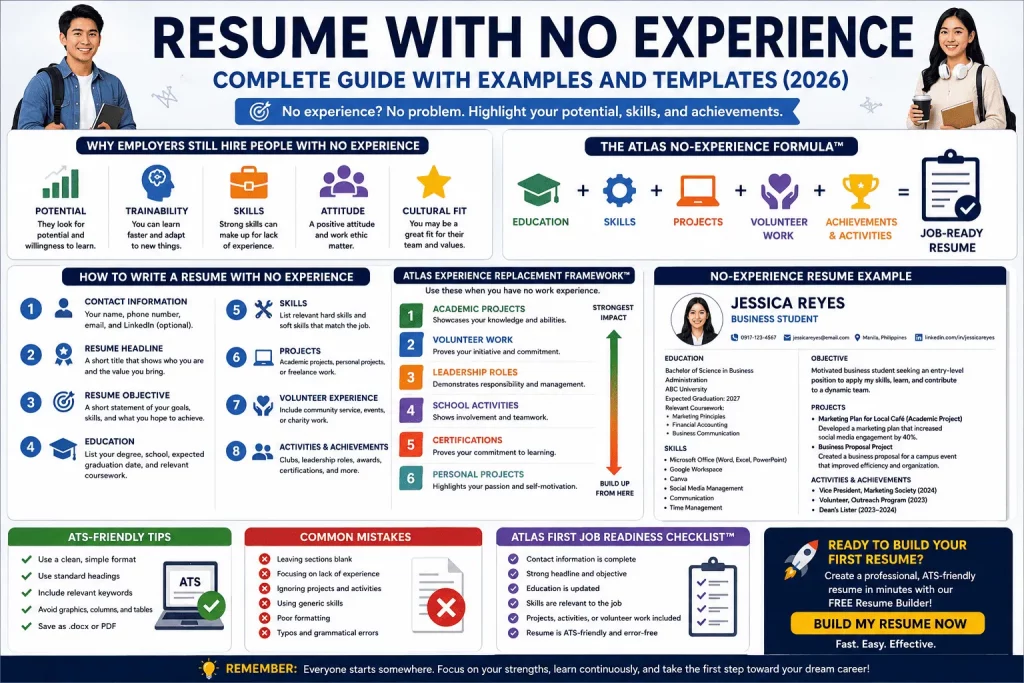
No work experience? You’re not alone.
Every single professional who has a resume full of achievements today once had a resume with none. Students, recent graduates, career changers, and first-time job seekers all start from the same place: a blank page and a nagging worry that “no experience” means “no chance.” It doesn’t.
Employers who post entry-level jobs already know their applicant pool won’t be packed with ten-year veterans. They expect candidates to be new to the workforce, and they build their hiring criteria around that reality. What they’re really screening for isn’t a long job history — it’s potential, coachability, and evidence that you can show up, learn quickly, and contribute.
That’s the shift this guide is built around. A resume with no experience isn’t a weaker version of a normal resume. It’s a different kind of resume — one that trades “what I’ve done at past jobs” for “what I can already do, and how fast I’ll pick up the rest.” Done well, it can be just as compelling, sometimes more compelling, than a resume padded with forgettable job titles.
In this guide, you’ll learn exactly how to build that resume: what sections to include, how to write each one, which skills and achievements to highlight instead of job history, and how to format everything so it passes through Applicant Tracking Systems (ATS) and lands in front of a real hiring manager. You’ll also find resume examples for high school students, college students, first-time job seekers, and internship applicants, plus a breakdown of the most common mistakes to avoid.
It helps to remember why this situation feels harder than it should. Job postings are often written using templates originally designed for mid-level roles, so even a listing labeled “entry-level” can end up with language like “1–2 years preferred.” That phrasing discourages a lot of qualified first-time applicants from ever hitting submit. But “preferred” is not the same as “required,” and hiring managers routinely interview and hire candidates who don’t meet every line of the wish list — especially when the rest of the resume shows clear signs of capability and motivation. Understanding this distinction alone should change how you approach the job search: don’t self-select out of opportunities before an employer even gets the chance to look at what you bring.
This guide is organized so you can either read start to finish or jump straight to the part you need. If you already know your background — high school student, college student, recent graduate, or career changer — skip ahead to the relevant example later in this guide, then circle back to the sections on formatting and ATS optimization before you finalize anything.
Can You Create a Resume With No Experience?
Yes. A resume without formal work experience can absolutely impress employers — as long as it’s built around the right substitutes. Instead of leaning on job history, a no-experience resume highlights:
- Education — degrees, coursework, honors, GPA (if strong)
- Skills — both technical (hard) skills and interpersonal (soft) skills
- Academic projects — class assignments, capstones, research
- Volunteer work — community service, church activities, nonprofit involvement
- Leadership roles — student government, club officer positions, team captaincies
- Certifications — online courses, industry credentials, workshops
- Extracurricular activities — clubs, sports, hobbies with transferable value
The goal isn’t to hide the absence of a job history. It’s to reframe the resume so that job history was never the point in the first place.
The Formula for a Strong Resume Without Experience
Here’s the simplest way to think about it:
Education + Skills + Projects + Volunteer Work + Achievements + Activities = Job-Ready Resume
Each of these categories does a piece of the work that “5 years at Company X” would normally do. Education proves foundational knowledge. Skills prove capability. Projects prove applied ability. Volunteer work and activities prove character, reliability, and teamwork. Achievements prove you go beyond the minimum. Stack them together, and you have a resume that reads as complete — not as a resume that’s missing something.
🚀 Ready to get started? Create your first professional resume using our Free Resume Builder — no experience required.
Why Employers Still Hire Candidates Without Experience
It can feel like every job posting demands experience you don’t have yet, which is a frustrating paradox for anyone trying to get started. But entry-level hiring works differently than it looks from the outside. Here’s what’s actually driving those “yes” decisions.
Potential Matters
Hiring managers for entry-level and junior roles are often evaluating a five-year trajectory, not just day-one output. A candidate who shows strong fundamentals, curiosity, and a track record of learning quickly can be more valuable long-term than someone who’s already plateaued in a narrow skill set.
Trainability Matters
Many employers actively prefer to train someone from scratch rather than un-train bad habits picked up elsewhere. A candidate with no experience has no baggage — no outdated processes to unlearn, no assumptions to correct. That’s a real, practical advantage in industries with proprietary systems or specific workflows.
Skills Matter
Whether those skills come from a classroom, a personal project, a volunteer role, or a part-time gig, employers care about what you can actually do. A demonstrated skill is a demonstrated skill regardless of where it was built.
Attitude Matters
Reliability, communication, and a positive, coachable attitude are consistently ranked by hiring managers as more important than technical polish for entry-level hires. These are things you can prove even without a job history — through how you present yourself, how you talk about your goals, and how you’ve shown up in school, volunteer settings, or extracurriculars.
Cultural Fit Matters
Especially for entry-level roles on larger teams, employers are hiring for team chemistry as much as skill. Someone new to the workforce, without ingrained habits from another company culture, can often integrate faster into how a specific team likes to work.
What Employers Are Really Evaluating
| Factor | Importance for Entry-Level Hiring |
|---|---|
| Willingness to Learn | High |
| Communication Skills | High |
| Reliability | High |
| Technical Skills | Medium |
| Prior Experience | Low |
Notice what’s at the bottom of that list. Experience is real, but it’s not the deciding factor for entry-level roles — willingness to learn and reliability are. That should change how you think about your resume. You’re not trying to fake experience you don’t have. You’re trying to prove the things that actually top the list.
What This Means for How You Write
Once you internalize that experience sits at the bottom of the priority list for entry-level hiring, the rest of your resume strategy follows naturally. Every section should be written to answer one of the questions employers actually care about:
- Will this person learn quickly? → Show it through coursework, certifications, and how fast you picked up a skill for a project.
- Will this person communicate well? → Show it through leadership roles, group projects, and any customer-facing volunteer work.
- Will this person show up and follow through? → Show it through consistent volunteer commitments, sports team participation, or completed personal projects.
- Does this person have baseline technical ability? → Show it through your skills section and specific project outcomes.
- Will this person fit the team? → This one is harder to prove on paper, but a clear, professional, well-organized resume is itself a small signal of how you’ll show up to the job.
Keep this framework in mind as you move through each resume section below. Every bullet point you write should be quietly answering one of these five questions, even if you never state the question directly.
How to Write a Resume With No Experience
Below is a step-by-step walkthrough of every section your resume needs, in the order they should appear, with concrete examples for each.
Step 1: Contact Information
Keep this section clean, accurate, and professional. At the top of your resume, include:
- Full name
- Phone number
- Professional email address (avoid old, casual usernames — create a simple one using your name if needed)
- LinkedIn URL (optional, but recommended if your profile is complete)
- City and state (a full mailing address is generally unnecessary)
Skip anything unprofessional or unnecessary: no nicknames, no outdated emails, no personal social media links unless they’re directly relevant to the job (a portfolio site, a GitHub, a design portfolio).
A quick note on email addresses, since this trips up more first-time applicants than you’d expect: an address like “coolgamer2019@email.com” was fine for signing up for a game forum, but it sends the wrong signal on a job application. Creating a new, simple email — firstname.lastname@provider.com, or a close variation if that’s taken — takes about two minutes and removes a small but avoidable red flag before a hiring manager reads a single word about your qualifications.
If you’re applying to jobs in a specific city or region, including your city and state (without a full street address) helps employers and ATS systems confirm you’re a realistic, local candidate — this matters more than most applicants realize, since some systems automatically deprioritize resumes without location data.
Step 2: Resume Headline
A resume headline is a short, one-line phrase placed near the top of the resume, right under your name, that instantly tells the reader who you are and what you’re looking for. For a no-experience resume, this is a chance to frame yourself with confidence before the reader even gets to the rest of the page.
Examples by candidate type:
- High School Student: “Motivated Student Seeking Entry-Level Opportunities”
- College Student: “Detail-Oriented Business Student with Strong Communication Skills”
- Career Changer: “Customer-Focused Professional Transitioning into Digital Marketing”
- Recent Graduate: “Organized and Analytical Recent Graduate in Computer Science”
A strong headline does two things: it names a relevant strength, and it signals direction. Avoid vague headlines like “Hardworking Individual” — they say nothing a hiring manager can act on.
Step 3: Resume Objective
For resumes with little or no experience, a resume objective typically works better than a traditional resume summary. A summary is built to highlight years of accomplishments; an objective is built to highlight goals, strengths, and intent — which is exactly what a no-experience candidate has to offer.
A good resume objective for a no-experience candidate should:
- State who you are (student, recent graduate, career changer)
- Mention 1–2 relevant strengths or skills
- State what you’re aiming for and what you bring to the role
Example:
“Motivated recent graduate with a Bachelor’s degree in Marketing and hands-on experience managing social media for a student organization. Seeking an entry-level marketing coordinator role to apply strong writing, analytics, and organizational skills.”
This kind of objective does real work: it names a credential, names a concrete accomplishment (managing social media for an organization), and names a specific target role — all in two sentences.
A few more objective examples across different situations:
“Enthusiastic high school senior with strong customer service instincts developed through two years of volunteer work at a local community center, seeking a part-time retail associate role.”
“Detail-oriented associate degree graduate in Culinary Arts with hands-on kitchen experience from coursework and a semester-long externship, seeking an entry-level line cook position.”
“Former retail team lead transitioning into administrative work, bringing strong organizational skills, scheduling experience, and a proven ability to manage competing priorities under pressure.”
Notice that even the career-changer example doesn’t dwell on the lack of experience in the new field — it leads with transferable strengths from the old one. That’s the core skill of writing a strong objective: always translate what you have into what the new role needs.
One rule to keep in mind: avoid objectives that are entirely about what you want (“Looking for a job that pays well and offers growth opportunities”). Every objective should be at least half about what you bring to the employer, not just what you’re hoping to get from them.
Step 4: Education Section
For a no-experience resume, education often becomes one of the most important sections on the page — sometimes the most important. Move it near the top, right after your headline and objective.
Include:
- Degree or diploma name
- School name
- Graduation date (or expected graduation date)
- GPA, if 3.5 or higher (optional otherwise)
- Relevant coursework, especially for students applying in a technical or specialized field
- Academic honors (Dean’s List, scholarships, honor societies)
Example:
Bachelor of Science in Information Technology
XYZ University — Expected Graduation: 2027

Relevant Coursework:
Database Management | Programming Fundamentals | Web Development
Listing relevant coursework is a simple, often-overlooked tactic that lets you show alignment with a job’s requirements even without direct experience. If a listing asks for “familiarity with databases,” and you’ve taken a Database Management course, that’s a direct, honest match.
On GPA specifically: a strong GPA (generally 3.5 or above on a 4.0 scale) is worth including because it functions as a quick, quantifiable proof point of diligence — something a no-experience resume otherwise lacks. If your GPA is lower, it’s completely fine to leave it off; nothing requires you to disclose it, and omitting it draws no negative attention on its own.
On academic honors: Dean’s List appearances, scholarship awards, honor society memberships, and departmental awards all belong in this section. They function the same way a performance review or promotion would on an experienced candidate’s resume — as third-party validation of your work, rather than just your own claim about it.
If you attended multiple schools (for example, a community college before transferring, or a study-abroad program), you can list more than one entry, but keep the focus on your most recent or highest-level credential, since that’s what employers weigh most heavily.
Step 5: Skills Section
Skills are the backbone of a no-experience resume. This section should be specific, relevant to the job you’re applying for, and split into two categories: hard skills and soft skills.
Hard skills are teachable, measurable abilities:
- Microsoft Office (Word, Excel, PowerPoint)
- Data Entry
- Canva
- Google Workspace (Docs, Sheets, Slides)
- Basic coding languages (if relevant)
- Point-of-sale (POS) systems
- Social media management
Soft skills are interpersonal and behavioral strengths:
- Teamwork
- Communication
- Time Management
- Problem Solving
- Adaptability
- Attention to Detail
Tip: Don’t just list soft skills as isolated words — where possible, tie them to a brief example elsewhere in your resume (in your projects or activities section). “Teamwork” listed alone is a claim. “Teamwork” backed by “Led a 4-person group project that earned the top grade in the class” is proof.
Always tailor your skills list to the specific job posting. Many entry-level job postings list required or preferred skills directly — mirror that language exactly where it’s true, since this also helps your resume pass ATS keyword scans (more on that below).
How many skills should you list? Aim for 6–10 total, split roughly evenly between hard and soft skills. Listing 20+ skills dilutes the section and can look like you’re padding — a shorter, more targeted list reads as more credible and more relevant to the specific role.
Skills by industry, as a starting point:
- Retail/Customer Service: POS systems, cash handling, inventory management, conflict resolution, upselling
- Office/Administrative: Microsoft Office, data entry, scheduling, file organization, professional email etiquette
- Tech/Software: specific programming languages, Git/version control, debugging, basic SQL, familiarity with agile workflows
- Marketing/Social Media: Canva, content scheduling tools, basic analytics reading, copywriting, platform-specific knowledge (Instagram, TikTok, LinkedIn)
- Food Service/Hospitality: food safety knowledge, multitasking under pressure, POS systems, customer service, teamwork in fast-paced settings
Use this list as a starting point, not a script — only include skills you can genuinely speak to in an interview.
Step 6: Projects Section
This is one of the single most powerful tools available to a no-experience candidate: projects can directly replace work experience on a resume, especially for technical, creative, and analytical roles.
Types of projects worth including:
- School projects — class assignments, capstone projects, group presentations
- Research projects — independent studies, lab work, thesis work
- Personal projects — a website you built, a budget spreadsheet you designed, an app you coded, a small business you started
- Freelance projects — even unpaid or one-off freelance work (designing a flyer for a local business, managing social media for a friend’s shop) counts
Example entry:
Personal Project: Budget Tracking App
Designed and built a budget-tracking web app using HTML, CSS, and
JavaScript to help users log expenses and visualize monthly spending.
Format project entries the same way you’d format a job entry: project name, a short description, and 1–3 bullet points showing what you did and what the result was. This gives hiring managers something concrete to evaluate, rather than a list of abstract claims.
More project examples across different fields:
- Business/Marketing: “Designed a go-to-market strategy for a class simulation, presenting to a panel of local business owners as judges.”
- Writing/Communications: “Wrote and self-published a 10-article blog covering [topic], growing readership to 500+ monthly visitors.”
- Data/Analytics: “Cleaned and analyzed a public dataset using Excel and basic statistics to identify trends, presenting findings in a 5-page report.”
- Design: “Created a full brand identity package — logo, color palette, and social templates — for a mock client as a class final project.”
- Engineering: “Built and tested a small robotics prototype as part of a semester-long team project, placing 2nd in a regional student competition.”
Even if a project was assigned for a grade rather than initiated independently, it still counts as legitimate evidence of skill — don’t undersell classwork just because it wasn’t “your idea.” What matters to an employer is that you produced something real and can describe how you built it.
Step 7: Volunteer Experience
Volunteer work is treated by most hiring managers as real experience — because it is. It demonstrates reliability, initiative, and the ability to show up and contribute without being paid to do so, which is often a stronger signal of character than a paid job.
Examples of volunteer experience worth listing:
- Community outreach programs
- Church or religious organization activities
- School event planning and support
- Nonprofit organization involvement
- Fundraising campaigns
- Tutoring or mentoring
Format volunteer entries just like a job entry — organization name, your role, dates, and 1–2 bullet points describing what you did and any measurable impact (“Organized a food drive that collected over 500 items for the local shelter”).
Step 8: Extracurricular Activities
Extracurricular activities round out a no-experience resume by showing commitment, leadership, and interests outside the classroom. This section is especially useful for high school and early college students who haven’t had time to build a long project or volunteer history yet.
Strong extracurricular activities to include:
- Student government positions
- School clubs (debate, robotics, business, media)
- Sports teams (especially captain or leadership roles)
- Leadership organizations (National Honor Society, Key Club, etc.)
Where possible, attach a leadership title or measurable outcome: “Captain, Varsity Soccer Team” carries more weight than just “Soccer Team.”
The Experience Replacement Framework
When you have no formal work history, think of your resume content in tiers. Use as many of the following as genuinely apply to you, starting from the top:
- Academic Projects — direct evidence of applied skill
- Volunteer Work — evidence of reliability and initiative
- Leadership Roles — evidence of responsibility and people skills
- School Activities — evidence of commitment and interests
- Certifications — evidence of self-directed learning
- Personal Projects — evidence of initiative and technical ability
You don’t need all six. Even two or three strong entries, written with specific detail, can carry a resume. What matters is depth over breadth — one well-described project beats five vague, one-line activities.
Putting It All Together: Section Order
While every resume should be tailored to the individual, a strong default order for a no-experience resume looks like this:
- Contact Information
- Resume Headline
- Resume Objective
- Education
- Skills
- Projects
- Volunteer Experience
- Extracurricular Activities / Leadership
- Certifications (if applicable)
If one section is unusually strong — say, you have an especially impressive volunteer leadership role — it’s fine to move it higher, closer to the top of the page, so it gets more attention. Resume order isn’t fixed; it should highlight your strongest material first.
Resume With No Experience Examples
Here’s how the sections above come together for different types of candidates. Use these as structural templates, adapting the content to your own background.
High School Student Resume Example
JORDAN MILLER
(555) 123-4567 | jordan.miller@email.com | Austin, TX

Motivated Student Seeking Entry-Level Opportunities

OBJECTIVE
Reliable and detail-oriented high school junior seeking a part-time
retail position to apply strong customer service and organizational
skills gained through school leadership and volunteer work.

EDUCATION
Austin High School — Expected Graduation: 2027
GPA: 3.7 | Honor Roll (2025–2026)

SKILLS
Customer Service | Cash Handling | Microsoft Office | Time Management
| Teamwork | Communication

ACTIVITIES & LEADERSHIP
Treasurer, Student Council (2025–Present)
Managed a $2,000 annual budget and coordinated three school fundraisers.

Volunteer, Local Food Bank (2024–Present)
Sort and pack donations weekly; assisted in organizing a food drive
that collected 500+ items.

Member, Varsity Track Team (2024–Present)
College Student Resume Example
TAYLOR NGUYEN
(555) 234-5678 | taylor.nguyen@email.com | linkedin.com/in/taylornguyen

Detail-Oriented Business Student with Strong Communication Skills

OBJECTIVE
Business Administration student with hands-on experience managing
budgets and coordinating events for a student organization, seeking
an entry-level marketing internship to apply analytical and
communication skills.

EDUCATION
Bachelor of Business Administration, Marketing Concentration
State University — Expected Graduation: 2027
Relevant Coursework: Marketing Principles, Consumer Behavior,
Business Analytics

SKILLS
Social Media Management | Canva | Google Workspace | Data Analysis
| Public Speaking | Project Coordination

PROJECTS
Marketing Plan, Business Analytics Course
Developed a full marketing plan for a fictional startup, including
market research, target audience analysis, and a proposed ad budget.

LEADERSHIP & ACTIVITIES
Marketing Chair, Business Student Association (2025–Present)
Manage the organization's Instagram account, growing followers by 40%
in one semester through consistent content planning.
First Job Resume Example
CASEY ROBERTS
(555) 345-6789 | casey.roberts@email.com | Chicago, IL

Reliable and Motivated First-Time Job Seeker

OBJECTIVE
Recent high school graduate with strong communication and
organizational skills developed through volunteer work and school
leadership, seeking an entry-level position to begin building
professional experience.

EDUCATION
High School Diploma
Lincoln High School — Graduated 2026

SKILLS
Customer Service | Communication | Reliability | Basic Computer
Skills | Teamwork | Problem Solving

VOLUNTEER EXPERIENCE
Volunteer Coordinator Assistant, Community Center (2025–2026)
Helped organize weekly community events and coordinated volunteer
schedules for a team of 10.

ACTIVITIES
Member, Debate Club (2024–2026)
Competed in regional tournaments, developing strong public speaking
and quick-thinking skills.
Internship Resume Example
MORGAN LEE
(555) 456-7890 | morgan.lee@email.com | linkedin.com/in/morganlee

Detail-Oriented Computer Science Student

OBJECTIVE
Computer Science sophomore with hands-on project experience in Python
and web development, seeking a software engineering internship to
apply technical skills in a real-world environment.

EDUCATION
Bachelor of Science in Computer Science
Tech University — Expected Graduation: 2028
Relevant Coursework: Data Structures, Algorithms, Web Development

SKILLS
Python | JavaScript | HTML/CSS | Git | Problem Solving | Teamwork

PROJECTS
Personal Portfolio Website
Built and deployed a responsive personal portfolio site using HTML,
CSS, and JavaScript.

Group Project: Task Management App
Collaborated with a 3-person team to design and build a task
management app using Python, applying agile development principles.

ACTIVITIES
Member, Coding Club (2025–Present)
Participate in weekly coding challenges and a semesterly hackathon.
✅ Like what you see? Build a job-ready resume in minutes using our Resume Builder — just plug in your own details.
Resume Templates for No Experience
Choosing the right resume format matters just as much as what you put in it. There are three main resume formats, and they’re not equally suited to a no-experience resume.
Chronological Template
Organizes content by date, with the most recent entry first in each section. This format works best when you have a solid history of jobs, internships, or roles to list in order. For a true no-experience resume, it can end up looking sparse, since it’s built around a timeline you don’t have much of yet.
Functional Template
Organizes content by skill category rather than by date. Instead of leading with a job history, a functional resume leads with a Skills or Qualifications section, grouping your abilities (technical skills, communication skills, leadership skills) with supporting bullet points underneath each.
This is the best format for most no-experience candidates. It puts your strongest material — skills, projects, and achievements — front and center, rather than drawing attention to a short or missing job history.
Combination Template
Blends elements of both: it leads with a skills summary (like a functional resume) but still includes a chronological education, project, and activity timeline underneath. This works well for candidates who have at least a few relevant entries (an internship, a part-time job, or several strong projects) to show alongside their skills.
Recommendation: For most first-time resumes, a functional or combination template is the strongest choice. It lets you lead with what you can do, not with how long you’ve been doing it.
ATS-Friendly Resume for Beginners
Before a human ever reads your resume, there’s a good chance software will. Applicant Tracking Systems (ATS) are used by most mid-size and large employers to scan, sort, and rank resumes before they reach a hiring manager. If your resume isn’t formatted correctly, it may never be seen by a person at all — regardless of how strong your content is.
Here’s how to make sure your no-experience resume passes ATS screening:
Use Standard Section Headings
ATS software is trained to recognize common headings like “Education,” “Skills,” “Experience,” and “Projects.” Avoid creative alternatives like “My Journey” or “What I Bring” — they can confuse the parser and cause your content to be misread or skipped entirely.
Match Keywords From the Job Posting
Most ATS platforms rank resumes partly by keyword match. Read the job description carefully and mirror the exact language it uses for skills and qualifications — as long as it’s honestly true of you. If the posting says “customer service,” use “customer service,” not just “client interaction.”
Stick to a Single-Column Layout
Multi-column resumes, text boxes, and complex graphics can confuse ATS parsers, causing entire sections to be skipped or scrambled. A clean, single-column layout with clear headings is the safest choice for both ATS software and human readers.
Use Standard Fonts and Simple Formatting
Stick to widely supported fonts (Calibri, Arial, Georgia, Times New Roman) and avoid excessive use of tables, icons, or unusual bullet styles. Save your final resume as a .docx or .pdf file, since both are broadly compatible with most ATS platforms — but check the job posting, since some systems specifically request one format over the other.
Avoid Headers and Footers for Key Information
Some ATS systems fail to scan headers and footers properly. Keep your name, contact information, and core content in the main body of the document rather than in a header or footer.
How to Score Your No-Experience Resume
Before you submit, it helps to evaluate your resume the way an ATS or hiring manager might — section by section. Use the simple scoring framework below to self-assess.
| Area | Points Available |
|---|---|
| Education | 20 |
| Skills | 20 |
| Projects | 20 |
| Activities | 20 |
| Formatting | 20 |
How to interpret your score:
- 90–100: Excellent — your resume is well-rounded and ready to submit.
- 70–89: Good — solid foundation, but one or two sections likely need more specific detail.
- Below 70: Needs Improvement — go back through the weakest sections and add concrete, specific examples before applying.
Score yourself honestly in each category. If your Skills section only has three generic words and no context, that’s not a 20. If your Projects section is empty, that’s a 0 — and a strong opportunity to add one, even a small one, before you apply.
Common Mistakes When Writing a Resume With No Experience
Even strong candidates undercut themselves with a few avoidable resume mistakes. Watch out for these.
Leaving Sections Blank
An empty “Experience” section with nothing underneath it looks unfinished, not honest. If you don’t have traditional work experience, rename or replace that section entirely — with Projects, Volunteer Experience, or Activities — rather than leaving a blank space that draws attention to what’s missing.
Focusing on Lack of Experience
Don’t state the absence directly. Reframe it around what you do have.
Bad:
“I have no work experience.”
Good:
“Strong academic background with leadership and project experience.”
The information a hiring manager needs — that you’re new to the workforce — is already obvious from your resume’s structure and content. There’s no need to say it outright, and doing so only draws unnecessary attention to a perceived weakness instead of your actual strengths.
Ignoring Projects
This is one of the most common missed opportunities. Many first-time job seekers have completed relevant class projects, personal projects, or freelance work and simply don’t think to include them because they weren’t paid or “official.” If it demonstrates a real skill, it belongs on your resume.
Using Generic Skills
Listing “hardworking” and “team player” without any supporting evidence is easy to write and easy to ignore. Wherever possible, tie a skill to a specific, brief example so it reads as demonstrated rather than claimed.
Poor Formatting
Inconsistent fonts, uneven spacing, and cluttered layouts make a resume look unpolished before a single word is even read. Keep formatting clean, consistent, and simple — one font family, consistent bullet styles, and clear section breaks.
ATS Mistakes
Fancy templates with graphics, columns, or unusual fonts might look appealing to the eye, but many are poorly parsed by ATS software. When in doubt, prioritize a simple, ATS-friendly format over a visually elaborate one — especially for online applications.
First Job Readiness Checklist
Before you submit your resume, run through this quick checklist:
- ✅ Resume headline — clear, specific, relevant to the role
- ✅ Resume objective — states who you are, your strengths, and your goal
- ✅ Education — degree/diploma, school, dates, relevant coursework
- ✅ Skills — tailored to the job posting, split into hard and soft skills
- ✅ Projects — at least one or two specific, described examples
- ✅ Volunteer work — included if applicable, formatted like a job entry
- ✅ Activities — leadership roles and relevant extracurriculars listed
- ✅ ATS-friendly format — standard headings, single column, simple fonts
- ✅ Proofreading — no typos, consistent tense, consistent formatting
Go through each line before you hit submit. A resume that checks every box on this list is genuinely competitive for entry-level roles, regardless of how short your work history is.
Tailoring Your Resume for Each Application
One resume rarely works for every job, even at the entry level. A single generic version might get you a few interviews, but a resume tailored to each specific posting will consistently outperform it — and tailoring a no-experience resume is actually easier than it sounds, since most of the work is just re-ordering and re-wording material you already have.
Read the Job Posting Like a Checklist
Before you touch your resume, go through the job posting line by line and highlight every skill, tool, and qualification mentioned. This becomes your keyword list. Then check your existing resume against it: which of these do you already have evidence for, even if it’s not phrased the same way?
Match Language, Not Just Meaning
If a posting asks for “strong verbal communication skills” and your resume currently says “public speaking,” consider whether adjusting the phrasing to match the posting’s exact language would strengthen your ATS match — without ever claiming a skill you don’t actually have.
Reorder, Don’t Just Rewrite
Tailoring doesn’t always mean writing new content. Often it just means moving your most relevant project, skill, or activity higher up the page for a given application. A marketing-relevant volunteer role might sit near the top of your resume for a marketing internship application, and lower down (or omitted) for a completely unrelated retail application.
Keep a Master Resume
Maintain one longer “master” version of your resume that includes every project, skill, and activity you might ever want to mention — even ones that don’t fit on a single page. For each specific application, copy from this master document and trim it down to the most relevant one-page version. This saves significant time over rewriting from scratch for every job.
Should You Include a Cover Letter?
When you don’t have a strong work history to lean on, a cover letter becomes an especially valuable tool — it gives you room to explain, in your own words, why your background (even without direct experience) makes you a strong fit for a specific role. A resume shows what you’ve done; a cover letter explains why it matters for this job.
A strong no-experience cover letter typically includes:
- An opening line that names the role and shows genuine interest in the company specifically — not a generic template opening.
- A short paragraph connecting your background to the role, using a specific example from your education, projects, or volunteer work.
- A closing paragraph restating your enthusiasm and inviting the employer to reach out for an interview.
Even when a job posting marks a cover letter as “optional,” submitting a well-written one can meaningfully set you apart from other no-experience candidates who skip it — since a strong number of applicants take the “optional” label as permission not to bother.
Resume With No Experience vs. Resume for Students
These two resume types overlap heavily, but they’re not identical, and it’s worth understanding the distinction.
Similarities
- Both lead with education rather than work history.
- Both rely on projects, activities, and skills to fill gaps left by limited or no employment history.
- Both benefit from a functional or combination format.
- Both should be built around a clear objective statement rather than a summary.
Differences
| Resume With No Experience | Resume for Students | |
|---|---|---|
| Primary audience | Anyone entering the workforce for the first time, at any age | Current students, specifically |
| Education emphasis | Included, but framed around transferable skills | Often the single largest section, including GPA, coursework, and honors |
| Common use case | First job, career change with no formal history in the field | Internships, part-time jobs, work-study, campus jobs |
| Typical length | Often kept to one page regardless of age | Almost always one page |
In short: every student resume is a type of no-experience resume, but not every no-experience resume is a student resume. A 24-year-old career changer with a completed degree and volunteer history builds a no-experience resume very differently than a 17-year-old high school junior applying for a first part-time job — even though both are working from the same underlying formula.
Why Use a Resume Builder?
Writing a resume from scratch — choosing a layout, formatting sections consistently, adjusting margins and fonts — takes real time, and small formatting mistakes can hurt your chances with ATS software before a human ever sees your resume. A resume builder removes most of that friction.
Key benefits of using a resume builder:
- Professional formatting — clean, tested layouts without manual design work
- ATS optimization — templates built to parse correctly through common ATS platforms
- Guided writing — prompts and examples for each section, especially useful when you’re unsure how to phrase a project or volunteer entry
- Faster resume creation — a complete, polished resume in a fraction of the time it takes to build one manually
- Easy customization — quickly tailor a resume for each job application without starting over
For a first-time job seeker especially, a resume builder takes a lot of the guesswork out of structure and formatting, letting you focus your energy on writing strong, specific content for each section.
Ready to put this guide into action? Create your first professional resume using a free resume builder — build a job-ready resume in minutes, even with no experience, and start applying with confidence.
🔥 Start creating an ATS-friendly resume even without experience — try our Resume Builder free today.
Key Takeaways
- Lack of work experience does not mean lack of value. Education, skills, projects, and activities can carry a resume just as effectively as a job history.
- Employers hire potential. For entry-level roles, willingness to learn, communication, and reliability consistently outrank prior experience in hiring decisions.
- Projects, education, and volunteer work can replace traditional experience — format them the same way you would a job entry, with clear roles and specific outcomes.
- ATS-friendly formatting increases visibility. Standard headings, a single-column layout, and keyword alignment with the job posting help your resume get seen by a human in the first place.
- Resume builders simplify resume creation, especially for first-time job seekers who are unsure how to structure or word their first resume.
Frequently Asked Questions
How do I write a resume if I have no experience?
Start with a clear resume headline and objective, then build the rest of your resume around education, skills, projects, volunteer work, and extracurricular activities. Format each of these sections the way you would a job entry — with clear titles, dates, and specific bullet points describing what you did — so the resume reads as complete rather than as missing a section.
Can I get a job with no experience?
Yes. Most entry-level positions are specifically designed for candidates without prior work experience, and employers hiring for these roles typically weigh reliability, communication skills, and willingness to learn more heavily than a job history. A well-structured resume that highlights education, skills, and relevant projects can be highly competitive for these roles.
What skills should I put on my resume?
Include a mix of hard skills (technical, teachable abilities like Microsoft Office, data entry, or specific software) and soft skills (interpersonal strengths like communication, teamwork, and time management). Always tailor your skills list to match the specific language used in the job posting you’re applying to, as long as it’s honestly true of your abilities.
What should replace work experience?
Academic projects, volunteer work, leadership roles, school activities, certifications, and personal projects can all substitute for traditional work experience. Format each of these the same way you’d format a job — with a title, dates, and 1–3 bullet points showing what you did and, ideally, a measurable result.
How long should a no-experience resume be?
One page. For candidates with limited work history, a one-page resume is not only sufficient but preferred — it forces you to prioritize your strongest, most relevant content rather than padding the page with less relevant detail.
Should I include volunteer work?
Yes. Volunteer work is treated as legitimate experience by most hiring managers and can be especially valuable for a no-experience resume, since it demonstrates reliability, initiative, and commitment. Format it just like a job entry, with an organization name, your role, dates, and a short description of your contributions.
Are resume builders useful for beginners?
Yes. Resume builders are particularly useful for first-time job seekers because they provide tested, ATS-friendly formatting along with guided prompts for each section — which removes much of the uncertainty around structure and wording for someone building their very first resume.
What resume format is best with no experience?
A functional or combination resume format is generally best for candidates with no work experience, since both formats lead with skills and qualifications rather than a chronological job history. A traditional chronological format, which is organized primarily around dates of employment, tends to work against a no-experience candidate by drawing attention to an empty or thin timeline.
Do I need a cover letter if I have no experience?
While not always required, a cover letter is especially valuable for no-experience candidates because it provides space to directly explain how your education, projects, or volunteer background make you a strong fit for a specific role — context that a resume’s bullet points alone can’t fully convey.
What should I avoid putting on a resume with no experience?
Avoid vague, unsupported claims (“hardworking,” “team player”) without any backing example, irrelevant personal details (age, marital status, a photo, in most regions), an unprofessional email address, and any direct statement drawing attention to your lack of experience. Also avoid dense paragraphs — stick to short, scannable bullet points throughout.
How do I list a project I did for a class as if it were real experience?
Format it exactly like a job entry: give the project a clear title, note the course or context it came from if relevant, and add 1–3 bullet points describing specifically what you did and what the outcome was, using action verbs. Employers care about demonstrated skill and results, not whether the work was graded or paid.
Is it okay to use a resume objective instead of a summary if I have no experience?
Yes, and it’s typically the better choice. A resume summary is designed to highlight a track record of accomplishments built over time, which a first-time job seeker doesn’t yet have. A resume objective instead focuses on your relevant strengths and your goals for the role, which plays to a no-experience candidate’s actual strengths.
Related Guides
- Resume for Students: Complete Guide With Examples and Templates
- ATS-Friendly Resume Templates: Best Templates That Pass ATS
- Resume Templates: Best Resume Templates for Every Career
- Resume Headline Examples: 300+ Professional Resume Headlines for Every Job
- Resume Action Verbs: 500+ Powerful Resume Verbs for Every Profession
- Resume Achievements Examples: 300+ Achievement Statements for Every Profession
- Resume Format Examples: Best Resume Formats for Every Career
- Work Experience Examples for Resume: 200+ Examples by Profession
- Skills for Resume: 300+ Skills Examples for Every Profession
- Resume Summary Examples: 150 Professional Summary Examples for Every Job
- Resume Builder: Complete Guide to Creating a Professional Resume
- Resume Objective Examples: 150+ Examples for Every Job
- Application Letter for Fresh Graduates: Sample and Writing Guide
- Free Application Letter Generator for Government Jobs and Private Companies
- Application Letter for Administrative Assistant I: Complete Sample and Writing Guide
- Application Letter for Teacher I: Sample, Format, and Writing Guide
- Application Letter for Nurse I: Sample and Writing Guide