Last Updated: July 5, 2026
Effective Salary Schedule: January 1, 2026 (Third Tranche)
Verified Against: Executive Order No. 64, s. 2024; DBM National Budget Circular No. 601; Civil Service Commission (CSC); Official Gazette
Reviewed On: July 5, 2026
Next Review Schedule: Upon the release of a new DBM salary schedule or by January 2027, whichever comes first.
Understanding Salary Grade 18 is important for anyone pursuing or advancing a career in the Philippine government. Salary Grade (SG) 18 is a mid-to-upper level compensation grade assigned to many professional, technical, supervisory, and specialized government positions. The exact monthly salary depends on the employee’s salary step, length of service, and the current salary schedule implemented by the government.
Under the updated government compensation system, civilian government salaries are being implemented in tranches pursuant to Executive Order No. 64. The Department of Budget and Management (DBM) publishes the official salary schedules through National Budget Circulars, while the Civil Service Commission (CSC) establishes qualification standards for government positions. The third tranche of the updated salary schedule took effect on January 1, 2026 under DBM National Budget Circular No. 601.
This guide explains what Salary Grade 18 means, the official salary rates, salary steps, common government positions, career progression, benefits, and practical considerations for applicants and current government employees.
Quick Answer
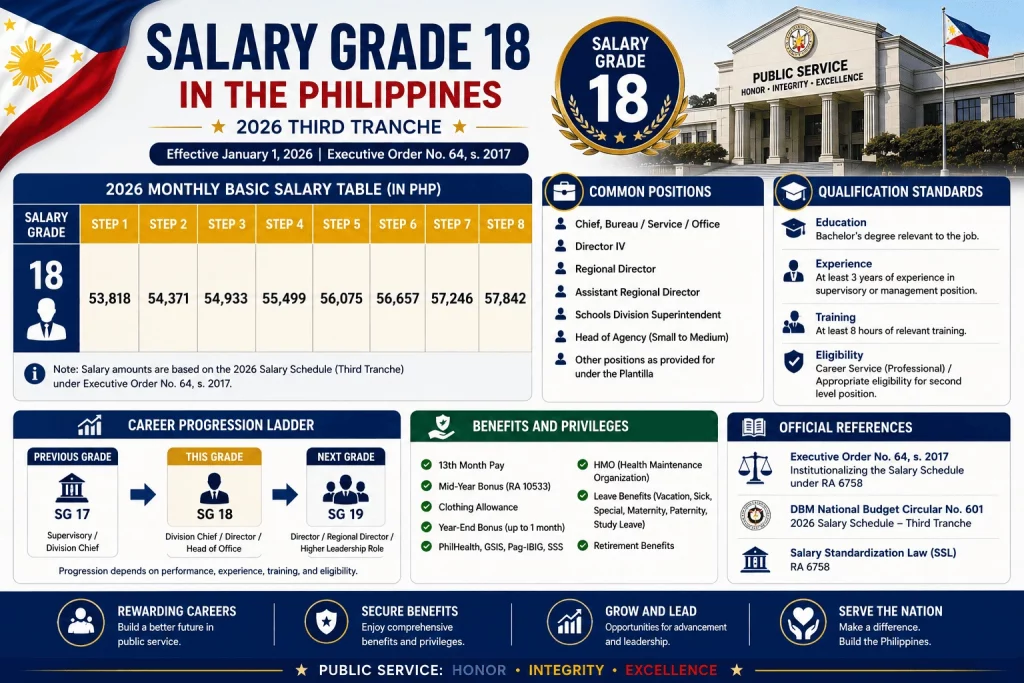
Salary Grade 18 is a compensation level in the Philippine government’s Compensation and Position Classification System. Under the official third tranche salary schedule effective January 1, 2026, employees in Salary Grade 18 receive a monthly basic salary ranging from ₱53,818 (Step 1) to ₱57,842 (Step 8), depending on their salary step. Salary progression is based on factors such as length of service and applicable government rules, while appointments remain subject to position-specific qualification standards established by the CSC.
💡 Aiming for a government position like this? You’ll need to pass the Civil Service Exam first. Practice for free with our CSE Reviewer — mock exams and drills for all subjects. Start practicing free →
Key Takeaways
- Salary Grade 18 is a mid-to-upper government compensation level.
- The official monthly salary depends on the employee’s salary step.
- As of the third tranche effective January 1, 2026, SG18 ranges from ₱53,818 to ₱57,842 per month.
- Many supervisory, technical, and professional government positions are classified under SG18.
- Salary is only one component of total government compensation, which may also include statutory benefits and authorized allowances.
TL;DR
If you’re applying for or currently occupying a Salary Grade 18 government position, you can expect a monthly basic salary based on your assigned salary step under the latest DBM salary schedule. Beyond the salary itself, understanding qualification standards, promotion opportunities, and government benefits is essential for long-term career planning.
What Is Salary Grade 18?
Salary Grade 18 is one of the compensation levels used by the Philippine government to determine the monthly basic salary of civilian employees. It groups together positions with comparable responsibilities, complexity, and qualification requirements, ensuring consistent compensation across government agencies under the government’s standardized salary system.
Detailed Explanation
The Philippine government uses a structured salary grading system to classify civilian positions. Each plantilla position is assigned a salary grade, while each salary grade contains multiple salary steps that reward experience and continued service.
Being assigned to Salary Grade 18 does not automatically indicate a specific job title. Instead, it reflects the compensation level attached to an approved government position. Different agencies may have distinct SG18 positions, provided these have been authorized under the government’s position classification system.
Salary Grade 18 commonly represents positions requiring:
- Professional or technical expertise
- Significant work experience
- Supervisory or management responsibilities
- Compliance with CSC qualification standards
- Appointment to an approved plantilla position
Example
For example, an employee appointed to an SG18 position starts at the salary step authorized in the appointment. Future movement through higher salary steps depends on applicable government rules governing step increments rather than automatic annual increases.
Key Point Summary
Salary Grade 18 identifies the compensation level of a government position—not the position title itself—and serves as the basis for determining an employee’s monthly basic salary under the official government salary schedule.
Official Salary Grade 18 Salary Table
Under the Third Tranche Monthly Salary Schedule implemented through Executive Order No. 64 (s. 2024) and Department of Budget and Management (DBM) National Budget Circular No. 601, Salary Grade 18 has a monthly basic salary ranging from ₱53,818 (Step 1) to ₱57,842 (Step 8), effective January 1, 2026. The exact amount depends on the employee’s assigned salary step.
Official Salary Grade 18 Salary Steps (Effective January 1, 2026)
| Salary Step | Monthly Basic Salary |
| Step 1 | ₱53,818 |
| Step 2 | ₱54,371 |
| Step 3 | ₱54,933 |
| Step 4 | ₱55,515 |
| Step 5 | ₱56,099 |
| Step 6 | ₱56,682 |
| Step 7 | ₱57,262 |
| Step 8 | ₱57,842 |
The salary schedule above is taken from Annex A of DBM National Budget Circular No. 601, which implements the third tranche of the updated salary schedule for civilian government personnel effective January 1, 2026.
What Do Salary Steps Mean?
Each salary grade is divided into eight salary steps. While the salary grade reflects the compensation level assigned to a position, the salary step recognizes an employee’s progression within that grade.
Generally:
- Step 1 is the starting salary for newly appointed employees.
- Higher salary steps are granted in accordance with applicable laws, DBM rules, and CSC-DBM regulations, including step increments due to length of service or meritorious performance where applicable.
- Moving to a higher salary step does not change an employee’s salary grade; it increases the monthly basic salary within the same grade. New hires are generally appointed at Step 1 of the salary grade allocated to the position unless another rule applies.
Legal Basis
The current Salary Grade 18 rates are based on the following official issuances:
| Item | Details |
| Executive Order | Executive Order No. 64, s. 2024 |
| Implementing Issuance | DBM National Budget Circular No. 601 |
| Issuing Agency | Department of Budget and Management |
| Coverage | Civilian government personnel covered by the Compensation and Position Classification System |
| Effectivity | January 1, 2026 |
These issuances implement the third tranche of the government’s updated salary schedule and prescribe the salary adjustment rules for covered civilian personnel.
Salary Grade 18 Decision Matrix
The matrix below can help prospective applicants evaluate whether an SG18 position aligns with their career goals.
| Consideration | If Yes | If No |
| You meet the CSC qualification standards | Proceed with the application | Gain the required qualifications first |
| You have supervisory or specialized experience | SG18 may be an appropriate level | Consider positions at lower salary grades to build experience |
| You seek long-term government career growth | SG18 offers strong promotion potential | Evaluate whether another career path better fits your goals |
| You understand that benefits extend beyond base salary | Government service may offer competitive total compensation | Compare total compensation—not just monthly salary—with other opportunities |
Key Point Summary
Salary Grade 18 offers an official monthly basic salary of ₱53,818 to ₱57,842, depending on the employee’s salary step. The applicable rate is determined under the DBM Third Tranche Salary Schedule, while movement between salary steps follows the rules prescribed by DBM and the CSC.
Salary Steps Explained
A salary step determines an employee’s exact monthly basic salary within a particular salary grade. While Salary Grade 18 establishes the compensation level assigned to a position, the salary step reflects the employee’s progression within that grade based on applicable government compensation rules. Employees generally begin at Step 1 upon original appointment unless otherwise authorized by law or applicable regulations.
Detailed Explanation
The Philippine government’s compensation system separates salary grade from salary step to recognize both the value of the position and the employee’s progression over time.
- Salary Grade identifies the compensation level assigned to a government position.
- Salary Step identifies the employee’s current salary within that grade.
Each salary grade contains eight salary steps, with each successive step providing a higher monthly basic salary.
For Salary Grade 18, the progression is as follows:
| Step | Monthly Salary | Increase from Previous Step |
| 1 | ₱53,818 | — |
| 2 | ₱54,371 | ₱553 |
| 3 | ₱54,933 | ₱562 |
| 4 | ₱55,515 | ₱582 |
| 5 | ₱56,099 | ₱584 |
| 6 | ₱56,682 | ₱583 |
| 7 | ₱57,262 | ₱580 |
| 8 | ₱57,842 | ₱580 |
From Step 1 to Step 8, an SG18 employee’s monthly basic salary increases by ₱4,024, excluding any authorized allowances, bonuses, or other compensation.
How Employees Move to Higher Salary Steps
Progression from one salary step to the next is not automatic. Step increments are governed by existing laws, Civil Service Commission (CSC) policies, Department of Budget and Management (DBM) issuances, and agency-specific personnel rules.
Factors that may influence salary step progression include:
- Length of satisfactory service
- Meritorious performance, when authorized
- Compliance with applicable DBM and CSC rules
- Availability of appropriations and implementation guidelines
Because these requirements may vary depending on the applicable regulations, employees should consult their agency’s Human Resource Management Office (HRMO) for the specific rules governing salary step advancement.
Salary Grade vs. Salary Step
One of the most common misconceptions is that a higher salary step is the same as a promotion. In reality, they represent different aspects of government compensation.
| Salary Grade | Salary Step |
| Refers to the compensation level assigned to a position | Refers to the employee’s salary progression within that grade |
| Usually changes when promoted to another position | Changes while remaining in the same position, subject to applicable rules |
| Based on position classification | Based on authorized salary step progression |
| May involve increased duties and responsibilities | Does not necessarily change the employee’s position or duties |
Understanding this distinction helps employees plan their careers more effectively and set realistic expectations regarding salary growth.
Example Scenario
Suppose Maria is newly appointed to an SG18 position.
- She is initially appointed at Salary Grade 18, Step 1 with a monthly basic salary of ₱53,818.
- After meeting the applicable requirements for salary step progression, she may eventually advance through higher salary steps while remaining in the same SG18 position.
- If she is later promoted to an SG19 position, both her salary grade and corresponding salary rate will change based on the applicable appointment and salary schedule.
This example illustrates that salary step progression rewards continued service within the same position, while promotion generally results in movement to a higher salary grade.
SG18 Career Progression Workflow
Use the following workflow to understand a typical progression path within government service:
Appointment to SG18 Position
│
▼
Assigned to Salary Step 1
│
▼
Satisfactory Performance
│
▼
Eligible Salary Step Progression
│
▼
Higher Monthly Basic Salary
│
▼
Acquire Additional Experience
│
▼
Meet CSC Qualification Standards
│
▼
Apply for Higher Salary Grade Position
This workflow highlights that salary step progression and promotion are related but distinct aspects of career development in government service.
Key Point Summary
Salary Grade 18 contains eight salary steps, each providing progressively higher monthly basic pay. While the salary grade identifies the compensation level of the position, the salary step reflects an employee’s authorized progression within that grade. Advancing to a higher salary step increases monthly salary but does not, by itself, constitute a promotion to a higher salary grade.
Common Government Positions Under Salary Grade 18
Salary Grade 18 is commonly assigned to professional, technical, supervisory, and specialized positions in the Philippine government. While the salary grade indicates the compensation level, the actual position title and responsibilities vary by agency. The final salary grade assigned to a position depends on the approved staffing pattern, position classification, and compensation plan authorized by the government.
Detailed Explanation
Government agencies classify positions according to the Compensation and Position Classification System (CPCS). Under this system, positions with similar levels of responsibility, complexity, accountability, and qualification requirements are assigned the same salary grade.
Consequently, two employees working in different agencies may both hold Salary Grade 18 positions even though their job titles and daily responsibilities differ.
SG18 positions generally involve:
- Supervisory responsibilities
- Technical or professional expertise
- Independent decision-making
- Program or project management
- Policy implementation
- Administrative leadership
Many SG18 employees supervise junior personnel while also serving as subject matter experts in their respective fields.
Typical Positions Classified as Salary Grade 18
The following are examples of government positions that are commonly classified under Salary Grade 18, depending on the agency’s approved staffing pattern and DBM-approved position allocation.
| Position (Examples) | Functional Area |
| Engineer IV | Engineering |
| Accountant IV | Finance and Accounting |
| Budget Officer III | Budget Management |
| Administrative Officer V | Administration |
| Planning Officer IV | Planning and Development |
| Information Officer III | Public Information |
| Human Resource Management Officer III | Human Resources |
| Attorney II* | Legal Services |
| Agriculturist IV | Agriculture |
| Social Welfare Officer IV | Social Services |
| Statistician III | Statistics and Research |
| Librarian III | Library and Information Services |
Note: Actual salary grades may vary depending on the position classification approved by the Department of Budget and Management (DBM), agency-specific staffing patterns, and subsequent reclassification. Always verify the salary grade indicated in the official Plantilla of Personnel or published vacancy announcement.
Where Salary Grade 18 Positions Are Found
SG18 positions exist across many sectors of the Philippine government, including:
- National government agencies
- Constitutional commissions
- State universities and colleges (SUCs)
- Government-owned and controlled corporations (where applicable)
- Regulatory agencies
- Research institutions
- Local government units (for positions covered by the applicable compensation system)
Examples of agencies that may have SG18 positions include:
- Department of Budget and Management (DBM)
- Civil Service Commission (CSC)
- Department of Education (DepEd)
- Department of Health (DOH)
- Department of Agriculture (DA)
- Department of Public Works and Highways (DPWH)
- Department of Social Welfare and Development (DSWD)
- Bureau of Internal Revenue (BIR)
- Commission on Audit (COA)
The specific SG18 positions available depend on each agency’s organizational structure and approved plantilla.
Typical Qualifications
Although qualification standards differ by position, many SG18 roles commonly require:
- A bachelor’s degree relevant to the position
- Appropriate professional eligibility or Civil Service eligibility, when required
- Several years of relevant work experience
- Relevant training hours
- Specialized technical or supervisory competencies
Certain regulated professions may also require:
- Professional Regulation Commission (PRC) license
- Membership in professional organizations (where mandated)
- Specialized certifications
- Continuing professional development
Applicants should always refer to the Civil Service Commission Qualification Standards Manual and the vacancy announcement issued by the hiring agency.
✅ Most SG18 positions require Civil Service eligibility. Prepare for the CSE now →
Career Opportunities After SG18
Salary Grade 18 often serves as an important milestone in a government career.
Employees may eventually become eligible for higher-level positions such as:
- Division Chief positions
- Senior technical specialists
- Program managers
- Regional supervisors
- Executive or managerial positions
- Salary Grade 19 and above positions
Promotion depends on:
- Vacancy availability
- Merit and fitness
- Performance evaluation
- Qualification standards
- Agency selection process
SG18 Position Readiness Checklist
Use this checklist before applying for an SG18 government position.
| Question | Yes | No |
| Do you possess the required educational qualification? | ☐ | ☐ |
| Do you meet the required Civil Service or professional eligibility? | ☐ | ☐ |
| Do you satisfy the required years of experience? | ☐ | ☐ |
| Have you completed the required training hours? | ☐ | ☐ |
| Can you demonstrate supervisory or technical competence? | ☐ | ☐ |
| Have you reviewed the official qualification standards? | ☐ | ☐ |
| Have you prepared all documentary requirements? | ☐ | ☐ |
Completing this checklist before submitting an application can improve your readiness and reduce the likelihood of disqualification due to incomplete qualifications or documentation.
Key Point Summary
Salary Grade 18 encompasses a wide range of professional and supervisory government positions rather than a single job title. While examples such as Engineer IV, Accountant IV, and Planning Officer IV are commonly associated with SG18, applicants should always verify the salary grade and qualification requirements in the official vacancy announcement and the agency’s approved plantilla.
Qualification Standards
Qualification standards for Salary Grade 18 are not determined by the salary grade alone. Instead, they are established for each specific position by the Civil Service Commission (CSC) through the applicable Qualification Standards Manual and reflected in the hiring agency’s approved plantilla and vacancy announcement. While many SG18 positions require a bachelor’s degree, relevant experience, training, and appropriate eligibility, the exact requirements vary by position.
Detailed Explanation
The Philippine government uses Qualification Standards (QS) to ensure that individuals appointed to government positions possess the minimum competencies necessary to perform their duties effectively.
Each qualification standard consists of four primary components:
| Qualification Requirement | Description |
| Education | Required educational attainment for the position |
| Experience | Minimum relevant work experience |
| Training | Required hours of relevant training or professional development |
| Eligibility | Civil Service or professional eligibility required by law or regulation |
Meeting all four components is generally necessary before an applicant may be considered qualified for appointment.
Education Requirements
Most Salary Grade 18 positions require at least a bachelor’s degree that is directly related to the duties of the position.
Examples include:
| Position | Typical Educational Requirement |
| Engineer IV | Bachelor’s degree in Engineering |
| Accountant IV | Bachelor’s degree in Accountancy |
| Planning Officer IV | Bachelor’s degree relevant to Planning or Public Administration |
| Human Resource Management Officer III | Bachelor’s degree relevant to Human Resource Management |
| Agriculturist IV | Bachelor’s degree in Agriculture |
Certain specialized positions may require graduate studies if prescribed by the applicable qualification standards or agency requirements.
Experience Requirements
Many SG18 positions require several years of progressively responsible experience related to the work of the position.
Relevant experience often includes:
- Supervisory responsibilities
- Technical specialization
- Project management
- Policy implementation
- Administrative leadership
- Program coordination
The exact number of years varies depending on the position and the CSC-approved qualification standards.
Training Requirements
Government positions frequently require applicants to complete relevant training programs before appointment.
Examples include:
- Leadership and management training
- Financial management
- Procurement
- Strategic planning
- Human resource management
- Project management
- Technical seminars related to the profession
Training requirements are measured in training hours and differ among positions.
Eligibility Requirements
Eligibility requirements depend on the nature of the position.
Common examples include:
| Position Type | Typical Eligibility |
| Administrative and professional positions | Career Service Professional Eligibility or equivalent |
| Licensed professions | Appropriate Professional Regulation Commission (PRC) license |
| Legal positions | Membership in the Philippine Bar, where required |
| Specialized positions | Eligibility prescribed by law or CSC rules |
Applicants should verify the required eligibility stated in the official vacancy announcement, as some positions require a specific professional license in addition to Civil Service eligibility.
Where to Verify Qualification Standards
Before submitting an application, verify the requirements through official sources:
- Civil Service Commission Qualification Standards
- Official agency vacancy announcements
- Approved Plantilla of Personnel
- Agency Human Resource Management Office (HRMO)
These sources provide the authoritative qualification requirements applicable to each position.
SG18 Application Readiness Framework
Use the READY Framework to evaluate your preparedness for an SG18 position.
| Component | Question |
| R – Relevant Degree | Do you possess the required educational qualification? |
| E – Experience | Do you meet the required years of relevant experience? |
| A – Appropriate Eligibility | Do you have the required Civil Service or professional eligibility? |
| D – Development | Have you completed the required training hours? |
| Y – Your Documents | Are all documentary requirements complete and up to date? |
If you can answer “Yes” to all five components, you are generally well prepared to apply, subject to the specific requirements of the vacancy.
📋 Checking off “Civil Service eligibility” on this list? Take our free practice exam →
Common Reasons Applications Are Disqualified
Applicants may be declared not qualified if they:
- Lack the required educational qualification.
- Do not possess the required eligibility or professional license.
- Fail to meet the minimum experience requirement.
- Have insufficient training hours.
- Submit incomplete or inaccurate documents.
- Apply for positions outside their qualifications.
Reviewing the qualification standards carefully before applying can save time and improve the likelihood of a successful application.
Key Point Summary
Salary Grade 18 does not have a single universal qualification standard. The required education, experience, training, and eligibility are determined by the specific position and established through the Civil Service Commission’s qualification standards and the hiring agency’s official vacancy announcement. Applicants should always rely on these official sources rather than assuming that all SG18 positions have identical requirements.
- ation while continuing to build toward managerial positions.
For many professionals, SG18 represents a transition from senior technical work to broader leadership and organizational responsibilities.
Common Misconceptions
| Misconception | Reality |
| Every SG18 employee performs the same work. | Duties vary depending on the position and agency. |
| Promotion depends only on years of service. | Promotion is based on merit, qualifications, vacancy, and applicable government rules. |
| Higher salary grade guarantees managerial status. | Some highly specialized technical positions carry higher salary grades without being managerial. |
| Salary is the only benefit of promotion. | Promotion may also bring broader responsibilities, leadership opportunities, and long-term career growth. |
Key Point Summary
Salary Grade 18 sits between SG17 and SG19 in the government’s compensation structure. It offers higher compensation and typically greater responsibility than SG17 while serving as a common stepping stone toward more senior supervisory and managerial positions classified under SG19 and above. Career advancement depends on qualifications, performance, and available vacancies—not solely on length of service.
Career Progression
Career progression from a Salary Grade 18 (SG18) position is achieved through promotion to higher-classified positions, not simply through salary step increases. While salary step progression rewards continued service within the same position, promotion to Salary Grade 19 or higher generally requires meeting qualification standards, competing for a vacant position, and demonstrating merit, competence, and readiness for increased responsibilities.
How Career Progression Works
The Philippine Civil Service follows the merit and fitness principle, meaning appointments and promotions are based on qualifications and competence rather than tenure alone.
An employee in an SG18 position can continue progressing in two ways:
- Salary Step Progression
- Remains within Salary Grade 18
- Results in higher monthly basic salary
- Does not change the employee’s position
- Promotion
- Moves to a higher Salary Grade
- Involves appointment to a new position
- Usually carries greater authority and responsibility
Understanding this distinction helps employees create realistic long-term career plans.
Typical Career Path
Although every government agency has its own organizational structure, many professional careers follow a progression similar to the one below.
| Career Stage | Typical Salary Grade |
| Entry-Level Professional | SG11–SG15 |
| Senior Professional | SG16–SG17 |
| Professional Supervisor / Senior Specialist | SG18 |
| Senior Supervisor / Division-Level Specialist | SG19–SG22 |
| Division Chief | SG24–SG26 |
| Director and Executive Positions | SG27–SG33 |
This progression is illustrative only. Actual career paths vary depending on the agency, occupational group, and available plantilla positions.
Requirements for Promotion
Employees seeking promotion beyond SG18 should typically focus on strengthening the following qualifications:
| Area | Why It Matters |
| Education | Higher-level positions may require advanced academic qualifications. |
| Experience | Relevant supervisory or specialized experience demonstrates readiness. |
| Training | Leadership and technical training strengthen promotion eligibility. |
| Eligibility | Required Civil Service or professional eligibility must be satisfied. |
| Performance | Strong performance evaluations support promotion decisions. |
| Leadership | Higher salary grades often require managing people, programs, or resources. |
Meeting the minimum qualification standards does not automatically result in promotion; employees must still compete through the agency’s selection process.
Building a Strong Promotion Profile
Employees can improve their long-term career prospects by:
- Pursuing relevant graduate education where appropriate.
- Completing leadership and management training.
- Volunteering for high-impact projects.
- Developing technical expertise in their field.
- Strengthening communication and supervisory skills.
- Maintaining excellent performance ratings.
- Keeping professional licenses and certifications current.
These activities enhance both competence and competitiveness for future vacancies.
SG18 Career Advancement Roadmap
Use this roadmap to guide your professional development toward higher salary grades.
| Stage | Recommended Action | Expected Outcome |
| 1. Establish Expertise | Master the technical aspects of your current role. | Increased credibility and stronger performance. |
| 2. Expand Responsibilities | Lead projects, mentor colleagues, or supervise teams when opportunities arise. | Demonstrated leadership capability. |
| 3. Invest in Professional Development | Complete relevant training, certifications, or graduate studies. | Improved qualifications for higher positions. |
| 4. Build a Performance Record | Consistently achieve high performance ratings and measurable accomplishments. | Stronger promotion profile. |
| 5. Monitor Vacancies | Apply for positions aligned with your qualifications and career goals. | Greater opportunity for advancement to SG19 and beyond. |
Career Planning Tips
If your goal is long-term government service, consider the following strategies:
- Understand the qualification standards for your target position before applying.
- Maintain an updated Personal Data Sheet (PDS) and supporting documents.
- Develop expertise in areas that are in demand within your agency.
- Build a reputation for reliability, integrity, and professionalism.
- Seek feedback from supervisors to identify areas for improvement.
- Stay informed about agency vacancy announcements and promotion opportunities.
Planning ahead allows you to acquire the qualifications needed before higher-level positions become available.
Key Point Summary
Salary Grade 18 is often a significant milestone in a government career, representing a transition into more advanced professional or supervisory responsibilities. Long-term career progression depends on continuous professional development, strong performance, compliance with qualification standards, and successfully competing for higher-classified positions. Employees who invest in their skills, leadership abilities, and credentials are generally better positioned to advance to Salary Grade 19 and beyond.
Common Mistakes
Many applicants and government employees misunderstand how Salary Grade 18 (SG18) works. Common mistakes include assuming that SG18 guarantees a specific position, believing that salary increases are automatic, overlooking qualification standards, or comparing only the monthly salary without considering the total government compensation package. Avoiding these misconceptions can help you make better career decisions and prepare more effectively for promotion.
Mistake 1: Assuming Every SG18 Position Is the Same
One of the most frequent misconceptions is that all SG18 positions have identical duties and responsibilities.
In reality:
- Job descriptions vary by agency.
- Responsibilities differ according to organizational needs.
- Supervisory functions may differ even within the same salary grade.
- Qualification standards are position-specific.
For example, an Engineer IV and a Human Resource Management Officer III may both be classified under SG18, but their duties, required competencies, and career paths are entirely different.
What to do instead
Read the official Position Description Form (PDF), qualification standards, and vacancy announcement before applying.
Mistake 2: Focusing Only on the Monthly Salary
Many applicants compare SG18 with private-sector jobs using only the monthly basic salary.
This often leads to an incomplete comparison.
Government employment may also include:
- Personnel Economic Relief Allowance (PERA)
- Mid-Year Bonus
- Year-End Bonus
- Cash Gift
- Productivity Enhancement Incentive (when authorized)
- GSIS benefits
- PhilHealth coverage
- Pag-IBIG membership
- Leave credits
- Retirement benefits
Evaluating the total compensation package provides a more accurate picture of the position’s overall value.
Mistake 3: Confusing Salary Step with Promotion
A higher salary step does not mean an employee has been promoted.
| Salary Step Increase | Promotion |
| Same salary grade | Higher salary grade |
| Same position | New position |
| Higher monthly salary | Higher salary and greater responsibility |
| Rewards progression within the grade | Results from appointment to another position |
Understanding this distinction helps employees set realistic expectations for career advancement.
Mistake 4: Ignoring Qualification Standards
Some applicants assume that relevant work experience alone is enough to qualify for an SG18 position.
However, agencies evaluate applicants against official qualification standards, including:
- Education
- Experience
- Training
- Civil Service eligibility or professional license
Failing to meet any one of these minimum requirements may result in disqualification, regardless of experience or previous employment.
Mistake 5: Applying Without Reviewing the Vacancy Announcement
Each government vacancy announcement contains essential information, including:
- Position title
- Salary grade
- Salary step (when applicable)
- Qualification standards
- Documentary requirements
- Deadline for submission
Submitting an application without reviewing these details can lead to incomplete or non-compliant applications.
Mistake 6: Assuming Promotion Is Automatic
Promotion in government service is based on:
- Merit and fitness
- Availability of a vacant plantilla position
- Qualification standards
- Performance
- Agency selection process
Even highly qualified employees may need to wait for an appropriate vacancy before becoming eligible for promotion.
SG18 Application Mistake Diagnostic
Use this self-assessment before applying for an SG18 position.
| Question | Yes | No |
| Have you reviewed the official vacancy announcement? | ☐ | ☐ |
| Do you meet all qualification standards? | ☐ | ☐ |
| Have you verified the salary grade and position classification? | ☐ | ☐ |
| Have you prepared all required documents? | ☐ | ☐ |
| Have you compared the total compensation package instead of only the monthly salary? | ☐ | ☐ |
| Do you understand the difference between salary step progression and promotion? | ☐ | ☐ |
If you answered “No” to any item, address that area before submitting your application.
Best Practices to Avoid These Mistakes
To improve your chances of success:
- Verify salary information using official DBM issuances.
- Review CSC qualification standards before applying.
- Read the entire vacancy announcement carefully.
- Keep your Personal Data Sheet (PDS) and supporting documents updated.
- Compare total compensation—not just the monthly salary.
- Develop your qualifications before seeking promotion.
Key Point Summary
Most misconceptions about Salary Grade 18 arise from confusing salary grade, salary step, and promotion, or from overlooking official qualification standards. By relying on official government sources, preparing complete application documents, and evaluating the full compensation package, applicants can make better-informed career decisions and improve their prospects for success.
Best Practices
To maximize the benefits of a Salary Grade 18 (SG18) position, employees and applicants should focus on more than just the monthly salary. Understanding qualification standards, continuously improving professional competencies, maintaining excellent performance, and planning for long-term career growth are essential for succeeding in government service.
1. Verify Information Using Official Sources
Government compensation policies may change through new legislation, executive orders, or DBM issuances.
Before making career decisions, always verify information using authoritative sources such as:
- Department of Budget and Management (DBM)
- Civil Service Commission (CSC)
- Official Gazette
- Official agency websites
- Agency Human Resource Management Office (HRMO)
Avoid relying solely on unofficial blogs, social media posts, or outdated salary tables.
2. Understand the Entire Compensation Package
A government position should be evaluated based on total compensation, not only the monthly salary.
Consider:
- Monthly basic salary
- Salary step
- PERA
- Mid-Year Bonus
- Year-End Bonus
- Cash Gift
- Productivity Enhancement Incentive (when applicable)
- Performance-Based Bonus (subject to eligibility)
- GSIS benefits
- PhilHealth
- Pag-IBIG
- Leave credits
- Retirement benefits
Looking at the complete package provides a more accurate comparison with private-sector opportunities.
3. Invest in Continuous Professional Development
Employees who continually improve their knowledge and skills are generally better prepared for higher-level responsibilities.
Recommended activities include:
- Leadership training
- Technical seminars
- Graduate studies (when appropriate)
- Professional certifications
- Skills enhancement programs
- Government-sponsored learning initiatives
Professional development not only strengthens job performance but also enhances competitiveness for future promotions.
4. Maintain Excellent Performance
Performance remains one of the most important factors in career advancement.
Employees should strive to:
- Deliver quality work consistently.
- Meet deadlines.
- Demonstrate initiative.
- Support organizational goals.
- Exhibit professionalism and integrity.
- Collaborate effectively with colleagues.
A strong performance record supports future promotion opportunities and professional credibility.
5. Plan Your Career Early
Career advancement rarely happens by chance.
Develop a long-term plan by identifying:
- Your target salary grade.
- Required qualifications.
- Needed experience.
- Required training.
- Leadership competencies.
- Potential vacancies within your agency.
Early planning allows you to acquire the necessary qualifications before opportunities become available.
6. Keep Employment Documents Updated
Maintaining accurate and current records helps avoid delays during recruitment or promotion.
Important documents include:
- Personal Data Sheet (PDS)
- Civil Service Eligibility
- PRC License (if applicable)
- Certificates of Training
- Diploma and Transcript of Records
- Performance evaluations
- Service Record
Regularly updating these documents ensures readiness when vacancies are announced.
7. Develop Leadership Skills
Many SG18 positions already involve supervisory or technical leadership responsibilities.
Employees should strengthen competencies in:
- Decision-making
- Communication
- Conflict resolution
- Coaching and mentoring
- Project management
- Strategic planning
- Team leadership
These skills become increasingly valuable when pursuing higher salary grades.
SG18 Career Success Framework
Use the GROW Framework to guide your professional development.
| Component | Action |
| G – Grow Your Knowledge | Pursue continuous learning through training and education. |
| R – Refine Your Skills | Build technical expertise and leadership capabilities. |
| O – Own Your Performance | Consistently produce high-quality work and demonstrate initiative. |
| W – Work Toward Promotion | Prepare early for higher positions by meeting qualification standards and monitoring vacancies. |
This framework provides a practical roadmap for employees aiming to maximize both their performance and long-term career opportunities.
SG18 Career Planning Checklist
Before pursuing promotion beyond Salary Grade 18, confirm that you can answer “Yes” to each item.
| Checklist Item | Yes | No |
| I understand the qualification standards for my target position. | ☐ | ☐ |
| My education meets or exceeds the requirements. | ☐ | ☐ |
| I possess the necessary eligibility or professional license. | ☐ | ☐ |
| I have completed relevant training. | ☐ | ☐ |
| My performance evaluations are consistently strong. | ☐ | ☐ |
| My professional documents are current and complete. | ☐ | ☐ |
| I have identified potential promotion opportunities. | ☐ | ☐ |
Completing this checklist regularly helps ensure you remain prepared for future advancement.
Key Point Summary
Success in a Salary Grade 18 position depends on much more than receiving a competitive monthly salary. Employees who verify information through official sources, continuously develop their competencies, maintain strong performance, and strategically plan their careers are better positioned to maximize the opportunities available in Philippine government service.
Beginner Tips
If you’re planning to apply for a Salary Grade 18 (SG18) government position, start by understanding how the Philippine government compensation system works. Learn the difference between salary grade and salary step, verify the qualification standards for your target position, and rely on official government sources for salary information. Building these fundamentals early will help you make informed career decisions and improve your chances of success.
1. Learn How the Salary Grade System Works
Before applying for any government position, familiarize yourself with the structure of the Compensation and Position Classification System (CPCS).
Remember:
- Salary Grade determines the compensation level assigned to a position.
- Salary Step determines the employee’s salary within that grade.
- Promotions usually involve moving to a higher salary grade.
- Step increments generally occur within the same salary grade under applicable rules.
Understanding these concepts prevents confusion when reviewing government vacancy announcements.
2. Read the Entire Vacancy Announcement
Many first-time applicants focus only on the salary.
Instead, carefully review:
- Position title
- Salary Grade
- Salary Step (if indicated)
- Qualification standards
- Required eligibility
- Documentary requirements
- Application deadline
- Place of assignment
Reading the complete announcement helps you determine whether you’re qualified before investing time in the application process.
3. Prepare Your Documents Early
Government recruitment often requires several supporting documents.
Common requirements include:
- Personal Data Sheet (PDS)
- Transcript of Records
- Diploma
- Certificates of Employment
- Training Certificates
- Civil Service Eligibility
- PRC License (if applicable)
- Performance ratings (for internal applicants)
Preparing these documents in advance can help you respond quickly when vacancies are announced.
4. Understand Qualification Standards
Do not assume that your current experience automatically qualifies you for an SG18 position.
Always verify the required:
- Education
- Experience
- Training
- Eligibility
These requirements are determined by the specific position—not by the salary grade alone.
5. Build Relevant Experience
If you do not yet qualify for SG18, focus on gaining experience that aligns with your target career path.
Examples include:
- Supervising projects or teams
- Managing programs or budgets
- Developing technical expertise
- Participating in leadership initiatives
- Completing specialized training
These experiences strengthen your qualifications for future opportunities.
6. Keep Learning
Government agencies value employees who continuously improve their knowledge and skills.
Consider pursuing:
- Professional certifications
- Leadership courses
- Graduate education (when appropriate)
- Technical seminars
- Civil Service Commission learning programs
- Agency-sponsored development activities
Continuous learning enhances both your current performance and your long-term promotion prospects.
Beginner’s SG18 Preparation Roadmap
Follow this roadmap if your goal is to obtain an SG18 position.
| Stage | Focus | Outcome |
| 1. Learn | Understand salary grades, salary steps, and qualification standards. | Clear understanding of government compensation. |
| 2. Qualify | Complete the required education, eligibility, experience, and training. | Meet minimum appointment requirements. |
| 3. Prepare | Organize application documents and monitor vacancies. | Ready to submit complete applications. |
| 4. Apply | Submit applications to positions that match your qualifications. | Increased likelihood of being shortlisted. |
| 5. Develop | Continue improving your competencies after appointment. | Better preparation for promotion opportunities. |
Beginner-Friendly Checklist
Use this quick checklist before applying for an SG18 position.
| Question | ✓ |
| Do I understand how Salary Grade 18 works? | ☐ |
| Have I verified the official qualification standards? | ☐ |
| Are my application documents complete? | ☐ |
| Do I possess the required eligibility or license? | ☐ |
| Have I reviewed the vacancy announcement carefully? | ☐ |
| Am I comparing the total compensation package instead of only the salary? | ☐ |
If you can check every item, you’re in a stronger position to pursue an SG18 opportunity.
Common Beginner Advice
If you’re just starting your government career:
- Focus on building relevant experience rather than chasing a specific salary grade.
- Develop technical expertise and professional credibility.
- Seek opportunities to lead projects or initiatives.
- Keep your records and credentials up to date.
- Monitor official government job portals and agency websites for vacancies.
- Be patient—career progression in government is typically based on merit, qualifications, and available positions.
Key Point Summary
For beginners, the path to Salary Grade 18 starts with understanding the government compensation system, meeting the qualification standards, and preparing thoroughly before applying. Investing in education, experience, training, and professional development today can significantly improve your readiness for SG18 positions and future career advancement.
Expert Tips
Professionals aiming to maximize the value of a Salary Grade 18 (SG18) position should look beyond immediate salary increases and focus on long-term career development. Building leadership capability, expanding technical expertise, maintaining a strong performance record, and preparing for higher-level positions are key strategies for sustained success in Philippine government service.
1. Treat SG18 as a Career Milestone, Not the Final Destination
Many government professionals view SG18 as an important transition point from senior technical work to supervisory or managerial responsibilities.
Instead of focusing solely on salary progression, consider how your current role can prepare you for:
- Division-level leadership
- Program management
- Policy development
- Regional or national assignments
- Executive positions in the future
Every assignment should contribute to your long-term professional growth.
2. Build Specialized Expertise
Employees with recognized technical expertise often become valuable organizational resources.
Consider developing specialization in areas such as:
- Public financial management
- Strategic planning
- Human resource management
- Procurement
- Information technology
- Engineering
- Project management
- Research and statistics
Developing expertise increases your value to the organization and strengthens your promotion profile.
3. Develop Leadership Beyond Your Position Description
Leadership is not limited to employees holding managerial titles.
You can demonstrate leadership by:
- Mentoring junior colleagues.
- Leading cross-functional projects.
- Improving work processes.
- Sharing technical knowledge.
- Supporting organizational initiatives.
- Promoting ethical decision-making.
Consistent leadership behaviors often distinguish strong promotion candidates.
4. Build a Portfolio of Measurable Accomplishments
When applying for higher-level positions, documented achievements carry significant weight.
Maintain records of:
- Successfully completed projects
- Process improvements
- Awards and recognitions
- Major committee assignments
- Training completed
- Research publications
- Innovations introduced
- Performance ratings
Keeping a professional portfolio makes it easier to demonstrate your qualifications during promotion or selection processes.
5. Strengthen Your Professional Network
Building constructive relationships across government agencies can provide opportunities for collaboration and learning.
Consider:
- Participating in inter-agency committees
- Joining professional organizations
- Attending government conferences
- Sharing best practices
- Expanding your professional network responsibly
Professional networking supports knowledge exchange and career development while maintaining the ethical standards expected of public servants.
6. Stay Current With Policy and Regulatory Changes
Government policies evolve over time.
Regularly monitor updates issued by:
- Department of Budget and Management (DBM)
- Civil Service Commission (CSC)
- Official Gazette
- Your agency’s Human Resource Management Office
Staying informed helps ensure compliance with current rules and prepares you for changes affecting compensation, appointments, and career progression.
SG18 Leadership Competency Framework
The following framework identifies competencies that experienced SG18 employees can develop to prepare for higher-level responsibilities.
| Competency | Why It Matters | Development Strategy |
| Technical Expertise | Builds credibility and sound decision-making. | Pursue advanced training and certifications. |
| Strategic Thinking | Supports planning and policy implementation. | Participate in strategic planning initiatives. |
| Leadership | Prepares you to manage teams and programs. | Lead projects and mentor colleagues. |
| Communication | Essential for stakeholder coordination. | Strengthen presentation and writing skills. |
| Change Management | Helps organizations adapt to new policies and systems. | Volunteer for organizational improvement projects. |
| Ethics and Accountability | Reinforces public trust. | Demonstrate integrity and compliance with government standards. |
Promotion Readiness Scorecard
Evaluate your readiness for advancement beyond SG18.
| Assessment Area | Ready | Needs Improvement |
| Education meets target position requirements | ☐ | ☐ |
| Relevant supervisory experience | ☐ | ☐ |
| Required eligibility or professional license | ☐ | ☐ |
| Leadership experience | ☐ | ☐ |
| Strong recent performance evaluations | ☐ | ☐ |
| Completed advanced training | ☐ | ☐ |
| Documented accomplishments | ☐ | ☐ |
| Updated application documents | ☐ | ☐ |
A score with most items marked Ready suggests stronger preparedness for pursuing higher-classified government positions.
Expert Recommendations
Experienced government professionals should:
- Align professional development with long-term career goals.
- Seek assignments that broaden organizational experience.
- Develop both technical and leadership competencies.
- Document measurable accomplishments throughout their careers.
- Regularly review qualification standards for target positions.
- Maintain ethical conduct and professionalism in every assignment.
These practices contribute to sustained career growth and position employees for future leadership opportunities.
Key Point Summary
Salary Grade 18 is an excellent platform for building a successful government career. Employees who invest in leadership, specialized expertise, continuous learning, and measurable accomplishments are generally better prepared to compete for higher salary grades and more senior positions. Long-term success depends not only on experience but also on strategic career planning and a commitment to professional excellence.
People Also Ask (PAA)
What is the monthly salary of Salary Grade 18?
The official Salary Grade 18 monthly basic salary under the Third Tranche Salary Schedule, effective January 1, 2026, ranges from ₱53,818 (Step 1) to ₱57,842 (Step 8). The exact salary depends on the employee’s assigned salary step under the applicable government compensation rules.
Is Salary Grade 18 considered a supervisory position?
It can be, but not always.
Salary Grade 18 is assigned to a wide range of professional, technical, and supervisory positions. Whether an SG18 position includes supervisory responsibilities depends on its official position description and organizational placement rather than the salary grade itself.
What positions are usually classified under Salary Grade 18?
Examples of positions commonly associated with Salary Grade 18 include:
- Engineer IV
- Accountant IV
- Planning Officer IV
- Administrative Officer V
- Human Resource Management Officer III
- Budget Officer III
- Information Officer III
- Agriculturist IV
- Social Welfare Officer IV
- Statistician III
Actual classifications vary depending on the agency’s approved plantilla and DBM position allocation.
How do employees move from Salary Grade 18 to Salary Grade 19?
Promotion to Salary Grade 19 generally requires:
- A vacant SG19 position
- Compliance with CSC qualification standards
- Required education, experience, and training
- Appropriate eligibility or professional license
- Successful completion of the agency’s merit-based selection process
Promotion is not automatic and is not based solely on years of service.
Does Salary Grade 18 automatically increase every year?
No.
The salary grade itself does not automatically increase each year.
Employees may become eligible for salary step progression within Salary Grade 18 under applicable rules. Changes to the official salary schedule, however, occur only when authorized through new laws, executive orders, or DBM issuances.
Is Salary Grade 18 higher than Salary Grade 17?
Yes.
Salary Grade 18 is one level higher than Salary Grade 17 and generally provides:
- Higher monthly basic salary
- Greater responsibilities
- More advanced technical or supervisory duties
- Stronger opportunities for future promotion
Can newly hired employees start at Salary Grade 18?
Yes, if they are appointed to an approved SG18 position and satisfy all qualification requirements.
Most newly appointed employees begin at Salary Grade 18, Step 1, unless another salary step is authorized under applicable government compensation rules.
Are government benefits included in the Salary Grade 18 salary?
No.
The published SG18 salary schedule reflects the monthly basic salary only.
Eligible employees may also receive authorized benefits and incentives such as:
- Personnel Economic Relief Allowance (PERA)
- Mid-Year Bonus
- Year-End Bonus
- Cash Gift
- Productivity Enhancement Incentive (when authorized)
- Performance-Based Bonus (subject to eligibility)
- GSIS benefits
- PhilHealth coverage
- Pag-IBIG membership
- Leave privileges
Eligibility for these benefits depends on existing laws, DBM issuances, and agency policies.
Does Salary Grade 18 require Civil Service Eligibility?
Many SG18 positions do require Career Service Professional Eligibility or another eligibility recognized by the Civil Service Commission.
However, eligibility requirements depend on the specific position. Certain regulated professions may instead require a Professional Regulation Commission (PRC) license or another qualification prescribed by law.
Always review the official vacancy announcement for the exact eligibility requirements.
Is Salary Grade 18 a good long-term career level?
For many government professionals, yes.
Salary Grade 18 often represents an important career milestone that combines competitive compensation with opportunities for leadership and specialization. It also provides a solid foundation for advancement to Salary Grades 19 and above, particularly for employees who continue to develop their qualifications, leadership skills, and professional experience.
Key Point Summary
Salary Grade 18 is one of the most frequently researched compensation levels because it represents a significant stage in many government careers. Understanding the official salary schedule, qualification standards, promotion requirements, and benefits helps applicants and employees make informed career decisions while preparing for future advancement.
🎯 Ready to take the next step in your government career? Get exam-ready with our free 170-item full mock exam and subject-by-subject drills. Start your free CSE Reviewer →
Frequently Asked Questions (FAQ)
1. What is Salary Grade 18 in the Philippine government?
Salary Grade 18 (SG18) is a compensation level under the Philippine government’s Compensation and Position Classification System (CPCS). It is assigned to professional, technical, and supervisory positions that require higher levels of responsibility, specialized knowledge, and relevant qualifications. The monthly basic salary depends on the employee’s assigned salary step under the official DBM salary schedule.
2. What is the monthly salary for Salary Grade 18?
Effective January 1, 2026, under the Third Tranche Salary Schedule, the monthly basic salary for SG18 ranges from:
- Step 1: ₱53,818
- Step 8: ₱57,842
The exact salary depends on the employee’s assigned salary step and applicable government compensation rules.
3. How many salary steps does Salary Grade 18 have?
Salary Grade 18 has eight (8) salary steps.
Employees generally begin at Step 1 upon appointment unless otherwise authorized. Advancement to higher salary steps is governed by applicable laws, DBM issuances, and Civil Service Commission (CSC) rules.
4. What are examples of Salary Grade 18 positions?
Examples of positions commonly classified under SG18 include:
- Engineer IV
- Accountant IV
- Administrative Officer V
- Planning Officer IV
- Budget Officer III
- Human Resource Management Officer III
- Information Officer III
- Agriculturist IV
- Social Welfare Officer IV
- Statistician III
Actual salary grade assignments depend on the agency’s approved plantilla and DBM-approved position classification.
5. Does Salary Grade 18 require Civil Service Eligibility?
Many SG18 positions require Career Service Professional Eligibility or another eligibility recognized by the Civil Service Commission.
Certain professions may instead require:
- Professional Regulation Commission (PRC) license
- Membership in the Philippine Bar
- Other eligibility prescribed by law
Applicants should always verify the specific eligibility requirement stated in the official vacancy announcement.
6. Is Salary Grade 18 considered a managerial position?
Not necessarily.
Some SG18 positions involve supervisory responsibilities, while others are highly specialized technical positions without managerial authority.
The position title and official job description—not the salary grade alone—determine whether a position is managerial.
7. Can I be promoted from Salary Grade 18 to Salary Grade 19?
Yes.
Promotion typically requires:
- An available SG19 vacancy
- Compliance with CSC qualification standards
- Relevant education, training, and experience
- Appropriate eligibility or professional license
- Successful completion of the agency’s merit-based selection process
Promotion is based on merit and fitness rather than length of service alone.
8. Do Salary Grade 18 employees receive bonuses and allowances?
Qualified SG18 employees may receive benefits in addition to their monthly basic salary, including:
- Personnel Economic Relief Allowance (PERA)
- Mid-Year Bonus
- Year-End Bonus
- Cash Gift
- Productivity Enhancement Incentive (PEI), when authorized
- Performance-Based Bonus (PBB), subject to eligibility
- GSIS benefits
- PhilHealth coverage
- Pag-IBIG benefits
- Leave credits
Eligibility depends on applicable laws, DBM issuances, and agency policies.
9. How can I qualify for a Salary Grade 18 position?
Although requirements vary by position, applicants generally need to satisfy the prescribed qualification standards for:
- Education
- Experience
- Training
- Civil Service eligibility or professional license
The exact qualifications are specified in the official vacancy announcement and the CSC Qualification Standards.
10. Where can I verify the latest Salary Grade 18 salary schedule?
For the most accurate and up-to-date information, consult official government sources, including:
- Department of Budget and Management (DBM)
- Civil Service Commission (CSC)
- Official Gazette
- Official hiring agency websites
- Agency Human Resource Management Office (HRMO)
These sources publish the latest salary schedules, implementing guidelines, and qualification standards.
FAQ Summary
Salary Grade 18 is a significant compensation level within the Philippine government, offering competitive pay, opportunities for professional growth, and access to a comprehensive package of government benefits. Because salary schedules, qualification standards, and implementing rules may change over time, applicants and employees should always verify the latest information through official government issuances.
Related Topics
To learn more about navigating your career in the Philippine government, explore our deep-dive guides:
- Salary Grade 6 Philippines: Salary, Steps, Positions, and Career Guide
- Salary Grade 7 Philippines: Salary, Benefits & Positions
- Salary Grade 8 Philippines: Salary, Steps, Positions, Benefits, and Career Guide
- Salary Grade 10 Philippines: Salary, Positions, Benefits, and Career Guide
- Salary Grade 11 Philippines 2026: Complete Guide
- Salary Grade 12 Philippines 2026: Salary, Positions & Benefits
- Salary Grade 13 Philippines 2026: Complete Salary & Positions Guide
- Salary Grade 14 Philippines 2026: Complete Salary & Positions Guide
- Salary Grade 15 Philippines: Salary, Positions, Qualifications, and Career Guide
- Salary Grade 19 Philippines 2026: How Much Do SG 19 Employees Earn?
- Salary Grade 24 Philippines 2026: Salary & Benefits
- Salary Grade 25 Philippines: Salary, Positions, Benefits, and Career Guide
- Government Jobs in the Philippines 2026: Complete Job Search Guide
- How to Apply for Government Jobs in the Philippines: Step-by-Step Guide
- Government Salary Grade 2026: Complete Guide to the Philippine Salary Schedule
References
Official Government Sources
- Department of Budget and Management (DBM). National Budget Circular No. 601 – Implementation of the Third Tranche Compensation Adjustment for Civilian Government Personnel pursuant to Executive Order No. 64, s. 2024.
- Executive Order No. 64, s. 2024. Modifying the Salary Schedule for Civilian Government Personnel and Authorizing the Grant of Additional Benefits.
- Civil Service Commission (CSC). Position Qualification Standards and Civil Service eligibility policies.
- Official Gazette of the Republic of the Philippines. Executive Orders, laws, and official government issuances relating to the Salary Standardization Law.
- Government Service Insurance System (GSIS). Official information on retirement, insurance, and employee benefits.
- PhilHealth. Official guidelines on the National Health Insurance Program for government employees.
- Home Development Mutual Fund (Pag-IBIG Fund). Official membership, savings, and housing benefit information.
Disclaimer
This guide is intended for informational purposes only and is based on official government issuances available at the time of writing. While every effort has been made to ensure accuracy, salary schedules, qualification standards, benefits, and implementing rules may change through subsequent laws, executive orders, DBM circulars, CSC issuances, or other government regulations.
Readers should always consult the latest official publications of the Department of Budget and Management (DBM), Civil Service Commission (CSC), and the Official Gazette for the most current and authoritative information.