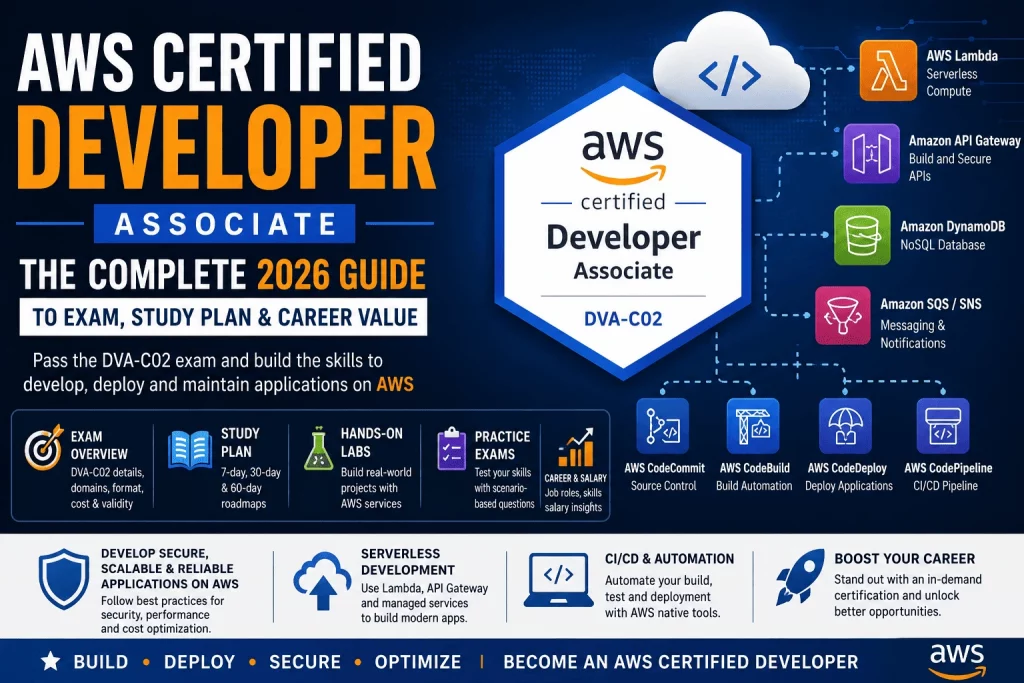
Quick Answer
The AWS Certified Developer Associate (exam code DVA-C02) is an associate-level AWS certification that proves you can develop, deploy, secure, and troubleshoot applications on AWS. It costs $150 USD (pricing varies by country), runs for 130 minutes, includes 65 questions (50 scored, 15 unscored), and requires a scaled score of 720 out of 1000 to pass. The exam is built around four weighted domains: Development with AWS Services (32%), Security (26%), Deployment (24%), and Troubleshooting and Optimization (18%). AWS recommends at least one year of hands-on experience building applications on AWS before attempting it, though this is a recommendation rather than a hard requirement — there are no mandatory prerequisites. The certification is valid for three years.
If you’re a software developer, backend engineer, or full-stack developer who works with cloud infrastructure and wants a credential that’s respected by hiring managers and recruiters, this is very likely the right certification to start with.
What Is the AWS Certified Developer Associate Certification?
The AWS Certified Developer Associate credential sits in the associate tier of Amazon Web Services’ certification framework, alongside AWS Certified Solutions Architect Associate and AWS Certified SysOps Administrator Associate. Where Solutions Architect Associate is about designing systems and SysOps is about operating them, Developer Associate is the certification that’s actually about writing and shipping code that runs on AWS.
The exam validates that a candidate can:
- Write code that interacts with AWS services through SDKs, CLI, and APIs
- Build and deploy serverless applications using services like AWS Lambda, API Gateway, and DynamoDB
- Apply security best practices to code and application configurations
- Use CI/CD tooling to deploy applications through AWS’s native pipeline services
- Identify the root cause of performance and availability problems using logging, monitoring, and tracing tools
- Choose the right AWS service for a given development scenario, including tradeoffs around cost, latency, and durability
Unlike some vendor certifications that lean heavily on memorized trivia, the DVA-C02 exam is scenario-based. Most questions describe a real development situation — an application that’s timing out, a Lambda function hitting a concurrency limit, an S3 bucket policy that’s too permissive — and ask you to pick the best fix or design choice among several plausible-sounding answers. This format rewards people who have actually built things on AWS, not just people who memorized a slide deck.
The current version of the exam, DVA-C02, replaced the older DVA-C01 in early 2023 and remains the active version as of mid-2026, with no successor version announced. The exam guide itself has been revised over time (the most recent published revision is version 2.1), but the domain structure and weighting have stayed consistent.
Why Developers Pursue This Certification
There are a few distinct reasons candidates search for and pursue this certification, and it’s worth being honest about which one applies to you, because it changes how you should prepare.
Career switchers moving into cloud development. If you’re coming from a non-cloud background — traditional on-prem development, a bootcamp, or an adjacent field like QA or data — this certification is one of the fastest ways to signal to a hiring manager that you understand modern application architecture, even without years of on-the-job AWS experience.
Working developers formalizing existing skills. A large share of candidates already use AWS daily at work but have never had their knowledge validated externally. For these developers, certification is less about learning new material and more about filling gaps (IAM policy nuances, less-common services, cost optimization patterns) and getting a credential that shows up on LinkedIn and resumes.
Consultants and freelancers. Independent contractors and consulting firms use AWS certifications as a trust signal for clients who can’t otherwise easily evaluate technical depth. Many consulting firms also require a minimum number of certified staff to maintain AWS Partner Network tier status, which creates direct employer-driven demand for certified developers.
Internal promotion or role-change requirements. Some employers, particularly larger enterprises and government contractors, tie specific certifications to job levels, billing rates, or eligibility for cloud-focused teams.
Whatever your motivation, the practical value of the certification comes from two places: the studying itself (which genuinely improves how you build on AWS) and the credential’s signaling value in recruiting pipelines, where applicant tracking systems and recruiters frequently filter or prioritize based on certification keywords.
DVA-C02 Exam Format and Structure
Here’s the exam at a glance:
| Attribute | Detail |
|---|---|
| Exam code | DVA-C02 |
| Certification level | Associate |
| Number of questions | 65 (50 scored, 15 unscored/experimental) |
| Time limit | 130 minutes |
| Question formats | Multiple choice, multiple response |
| Passing score | 720 out of 1000 (scaled scoring, range 100–1000) |
| Cost | $150 USD (varies by country) |
| Delivery | Pearson VUE testing center or online proctored |
| Validity period | 3 years |
| Retake wait period | 14 days after a failed attempt |
| Prerequisites | None formal; 1+ year hands-on AWS development experience recommended |
A few details worth understanding before you sit the exam:
Unscored questions are invisible to you. AWS mixes 15 unscored questions into the 65 total to test new content for future exam versions. You won’t know which 15 they are, so there’s no strategy for identifying and skipping them — just treat every question as if it counts.
Scaled scoring isn’t a raw percentage. A scaled score of 720/1000 does not mean you need to answer 72% of questions correctly. AWS uses statistical scaling to account for difficulty variance between exam forms, so the actual raw percentage needed to hit 720 shifts slightly depending on which question set you’re given. In practice, most successful candidates report needing to answer somewhere in the 70–75% range correctly, but don’t fixate on that number — focus on mastering the content instead.
Multiple response questions require exact matches. Some questions ask you to “select TWO” or “select THREE” correct answers. Partial credit is not given — you need every correct option and no incorrect ones to get the question right. These questions are usually a strong signal that the question is testing whether you understand a service deeply enough to distinguish similar-sounding options.
The exam is proctored either in person or online. Pearson VUE administers the exam both at physical testing centers and via online proctoring from home, with the same content and difficulty either way. Online proctoring adds requirements around your testing environment (clear desk, no second monitor, ID verification, room scan) that trip up first-time online test-takers, so if you choose that option, read the online testing policy in advance.
AWS Certified Developer Cost: Full Breakdown by Region
The AWS Certified Developer Associate exam costs $150 USD in the United States and most Western markets. However, AWS adjusts pricing by country using local purchasing power and currency, so the actual price you pay depends heavily on where you register.
United States, Canada, UK, most of Western Europe: Approximately $150 USD or the local currency equivalent (roughly £120 in the UK, €150 in the Eurozone, though these fluctuate with exchange rates).
India: AWS certification exams are typically priced lower in INR terms relative to a straight USD conversion, generally landing somewhere in the ₹8,000–₹12,000 range depending on current AWS regional pricing and applicable taxes (GST is added on top). Because AWS periodically adjusts regional pricing, always confirm the exact current price on your AWS Certification account before registering rather than relying on a fixed number from any article, including this one.
Practice exam and retake costs are separate. The $150 fee covers a single exam attempt. If you fail, you’ll pay the fee again for each retake (subject to the 14-day waiting period). AWS occasionally issues 50%-off retake vouchers to candidates who fail an exam — check your AWS Certification account after a failed attempt, as this voucher is not automatic in every region.
Free retake and discount programs. AWS runs occasional promotions — including exam-readiness programs, half-price vouchers for students, and bundled practice-exam-plus-discount packages through AWS Skill Builder. These change frequently, so treat any “free AWS certification” claim you see online with skepticism unless it links directly to an official AWS program.
Total cost of certification, realistically. Budget for more than just the $150 exam fee. Most candidates also spend money on at least one of: a video course ($15–$200 depending on platform and sale pricing), a practice exam bundle ($10–$30), and possibly AWS usage charges from hands-on labs if you go outside the AWS Free Tier. A realistic total budget for a first-time candidate is $150–$300 all-in, plus the exam fee.
Prerequisites and Requirements
This is one of the most searched questions about this certification, and the honest answer disappoints some people: there are no mandatory prerequisites. You do not need to hold any other AWS certification, complete any required course, or provide proof of work experience to register for the DVA-C02 exam. Anyone can book and sit the exam.
That said, “no requirement” is different from “no recommendation.” AWS explicitly recommends:
- At least one year of hands-on experience developing and maintaining applications on AWS
- Proficiency in at least one high-level programming language — Python, Java, JavaScript/Node.js, C#, and Go are the most common among candidates, and the exam’s code snippets and pseudocode lean toward these
- Working familiarity with AWS SDKs, the AWS CLI, and AWS APIs, since a meaningful share of exam questions describe SDK behavior or CLI commands
- Understanding of core AWS services beyond just compute — particularly IAM, S3, DynamoDB, Lambda, and API Gateway, which appear constantly across all four domains regardless of which one a question is nominally testing
- Familiarity with software development practices including version control, basic CI/CD concepts, and debugging/troubleshooting methodology
If you’re new to both software development and AWS, this is not the right certification to start with — you’ll want foundational programming experience first, and possibly the entry-level AWS Certified Cloud Practitioner certification as a warm-up, though even that is optional. If you already write code professionally but are new to AWS specifically, DVA-C02 is a reasonable and common starting point, often studied in parallel with or immediately after Cloud Practitioner.
Exam Domains Explained in Depth
The DVA-C02 exam guide organizes content into four domains with fixed weightings. Understanding not just the percentages but why AWS weights them this way will help you allocate study time correctly.
Domain 1: Development with AWS Services — 32%
This is the largest domain and the one most directly tied to day-to-day coding work. It covers writing code that uses AWS services, including:
- AWS Lambda: function configuration, memory/timeout tuning, environment variables, layers, versions and aliases, cold starts, and event source mappings
- Amazon API Gateway: REST vs. HTTP APIs, request/response transformation, authorizers, throttling, and caching
- Amazon DynamoDB: table design, partition keys vs. sort keys, secondary indexes (GSI vs. LSI), read/write capacity modes, DynamoDB Streams, and conditional writes
- Amazon S3: object operations, storage classes, event notifications, multipart uploads, and pre-signed URLs
- Messaging and integration services: Amazon SQS (standard vs. FIFO queues, visibility timeout, dead-letter queues), Amazon SNS, and Amazon EventBridge for event-driven architectures
- AWS Step Functions for orchestrating multi-step workflows
- Container basics: enough familiarity with Amazon ECS and container concepts to know when a containerized approach fits better than serverless
Expect questions phrased as code snippets or pseudocode showing an SDK call (frequently boto3 for Python), asking you to identify a bug, predict behavior, or choose the correct parameter. You will not be asked to write original code from scratch, and you don’t need to memorize exact syntax for every SDK method — but you do need to recognize correct versus incorrect usage when you see it.
Domain 2: Security — 26%
Security is the second-largest domain, larger than deployment, and it’s the domain candidates most consistently under-prepare for because it doesn’t feel like “developer” work in the traditional sense. Core topics include:
- AWS Identity and Access Management (IAM): policy structure, evaluation logic (explicit deny always wins, and an absence of an allow is an implicit deny), roles vs. users vs. groups, resource-based vs. identity-based policies, and cross-account access patterns
- Authentication for applications: Amazon Cognito user pools (authentication) versus identity pools (authorization/temporary AWS credentials) — a distinction that shows up repeatedly and trips up candidates who haven’t built with Cognito directly
- Secrets and configuration management: AWS Secrets Manager versus Systems Manager Parameter Store, including rotation, cost, and integration differences
- Encryption: AWS Key Management Service (KMS), encryption at rest versus in transit, and how services like S3, DynamoDB, and Lambda environment variables integrate with KMS
- Temporary security credentials: AWS Security Token Service (STS), assumed roles, and why hardcoded long-term credentials in application code are considered an anti-pattern the exam will test you on
- Securing serverless applications: least-privilege execution roles for Lambda functions, resource policies, and VPC configuration for functions that need private network access
If your day-to-day work hasn’t required you to configure IAM policies by hand or work directly with Cognito, this domain deserves dedicated study time beyond what feels natural for a “developer” exam.
Domain 3: Deployment — 24%
This domain tests whether you can get code from a repository into a running application safely and repeatably. Topics include:
- AWS CodePipeline, CodeBuild, and CodeDeploy — the native AWS CI/CD toolchain, including build specs (buildspec.yml), deployment configurations, and pipeline stages
- Deployment strategies: in-place, rolling, blue/green, and canary deployments, and which AWS services support which strategy natively (this is one of the most commonly tested comparison points on the exam)
- AWS Elastic Beanstalk: environment configuration, deployment policies, and .ebextensions
- Infrastructure as Code: AWS CloudFormation and AWS Serverless Application Model (SAM), including template structure, intrinsic functions, stack updates, and change sets
- Container deployment basics via Amazon ECS and Amazon ECR
- Multi-environment strategies: managing dev/staging/production separation, including how deployment configurations differ across environments
Deployment questions are often the most scenario-heavy on the exam, describing an outage or rollback situation and asking which deployment strategy would have prevented it, or which one to use going forward.
Domain 4: Troubleshooting and Optimization — 18%
The smallest domain by weight but not by difficulty, this section tests your ability to diagnose problems using AWS’s observability tooling:
- Amazon CloudWatch: metrics, alarms, custom metrics, Logs Insights queries, and dashboards
- AWS X-Ray: distributed tracing, service maps, and identifying latency bottlenecks across microservices
- AWS CloudTrail: for auditing API calls and diagnosing “who changed what” scenarios
- Performance optimization: Lambda cold start mitigation, DynamoDB throttling and hot partition issues, API Gateway caching, and connection pooling patterns
- Cost optimization as it relates to code and architecture choices, such as right-sizing Lambda memory or choosing DynamoDB on-demand versus provisioned capacity
Because this domain is smaller, some candidates deprioritize it — but questions here tend to combine concepts from all three other domains (you’re troubleshooting a security misconfiguration, or a deployment that broke something), so weak troubleshooting knowledge compounds your risk across the whole exam.
How to Register for the Exam
Registering for the DVA-C02 exam is done directly through AWS, not through a third party:
- Create or log into your AWS Certification account at the AWS Training and Certification portal. This is separate from your regular AWS account used for billing/console access, though you can link them.
- Search for “AWS Certified Developer – Associate” in the exam catalog and select DVA-C02.
- Choose your delivery method: an in-person Pearson VUE testing center near you, or online proctoring from your own location.
- Pick a date and time. Testing center availability varies by city; online proctoring generally has more flexible scheduling, including evenings and weekends in most time zones.
- Pay the exam fee ($150 USD or your local equivalent) by credit card. If you have a discount voucher from a prior AWS event, promotion, or failed-attempt retake discount, apply it at checkout.
- Prepare your identification. You’ll need a government-issued photo ID that matches the name on your registration exactly — mismatches (including missing middle names) are a common and entirely avoidable reason people get turned away at testing centers.
If you choose online proctoring, do a system check well in advance of exam day, clear your desk completely (no notes, no second monitor, no smartwatch), and expect a room scan via webcam before the exam starts.
Study Plan and Learning Path (Week by Week)
How long you need depends heavily on your starting point. As a rough guide: developers with solid existing AWS exposure typically need 6–8 weeks of part-time study (roughly 60–100 hours total), while complete newcomers to AWS — even experienced developers in other stacks — should plan for 10–12 weeks (120–160 hours).
Here’s a structured 10-week plan that works for most candidates; compress it if you have prior AWS experience.
Weeks 1–2: Foundations and account setup. Set up a free-tier AWS account. Work through the basics of IAM, S3, and EC2 even though EC2 itself is lightly tested — understanding compute fundamentals makes everything else click faster. Get comfortable navigating the console and, more importantly, start using the AWS CLI and one SDK (boto3 for Python is the most common choice for exam prep, since AWS’s own examples frequently use it).
Weeks 3–4: Domain 1 deep dive (Development). Build a small serverless application end to end: an API Gateway endpoint triggering a Lambda function that reads/writes to DynamoDB. Then add an SQS queue and an S3 event trigger to the same project. Building rather than just reading is the single highest-leverage thing you can do for this domain — the exam’s scenario questions map directly onto problems you’ll hit while building.
Weeks 5–6: Domain 2 deep dive (Security). Dedicate focused time to IAM policy JSON — write policies by hand rather than only using the visual editor. Set up Cognito user pools and identity pools and actually authenticate a request. Rotate a secret in Secrets Manager and compare the experience to Parameter Store. This domain rewards hands-on repetition more than reading.
Week 7: Domain 3 (Deployment). Build a CI/CD pipeline using CodePipeline, CodeBuild, and CodeDeploy for the application you built in weeks 3–4. Deploy the same app via SAM or CloudFormation from scratch. Compare deployment strategies by intentionally breaking a deployment and practicing rollback.
Week 8: Domain 4 (Troubleshooting). Instrument your sample application with CloudWatch alarms and X-Ray tracing. Intentionally introduce a bug (a missing IAM permission, a Lambda timeout set too low) and practice diagnosing it purely from logs and traces, as if you didn’t know what you’d broken.
Week 9: Practice exams and gap analysis. Take a full-length, timed practice exam under real conditions (no notes, no pausing). Score it by domain, not just overall percentage, and identify your weakest domain specifically. Spend the rest of the week re-studying only your weak areas rather than re-reviewing everything evenly.
Week 10: Final review and exam. Take a second practice exam to confirm improvement. Review AWS’s official sample questions and the exam guide’s task statements one more time. Book your exam for the end of this week while your knowledge is freshest.
Best Study Resources: Free and Paid
There’s no single “correct” resource — most successful candidates combine two or three of the following categories rather than relying on just one.
Official AWS resources (free):
- AWS Skill Builder — AWS’s own learning platform, including the free “Exam Prep” plan for DVA-C02 with official practice questions
- The official DVA-C02 Exam Guide PDF — published by AWS and the single source of truth for domain weights and task statements; read this before anything else
- AWS Whitepapers — particularly the AWS Well-Architected Framework, the Serverless Applications Lens, and guidance on CI/CD on AWS
- AWS documentation and “Getting Started” tutorials for each core service — free, current, and written by the people who built the services
Structured video courses (paid, typically $15–$25 during regular platform sales): Look for a course that is explicitly updated for DVA-C02 (not the retired DVA-C01), includes hands-on labs rather than slides alone, and is taught by an instructor with visible, recent AWS credentials. Course platforms with large catalogs of cloud certification content are generally a safe bet, and checking recent review dates (not just the overall star rating) helps you avoid outdated material.
Hands-on lab platforms: Sandboxed AWS environments that let you practice without running up your own AWS bill are worth the investment if you’re not already using AWS regularly at work. They’re particularly useful for practicing IAM and security scenarios, where a small misconfiguration in your own account can otherwise be costly or risky.
Community resources (free): Certification-focused subreddits and study-group communities are useful for two specific things: reading recent pass-experience reports (which tell you what the current exam actually emphasizes, since AWS updates question banks over time) and getting unstuck on a specific confusing concept. Treat crowd-sourced “exam dump” style content — verbatim leaked questions — as both against AWS’s exam policies and a poor learning strategy, since it teaches pattern-matching instead of understanding.
The Atlas Developer Project Portfolio™
Passing DVA-C02 proves you know the material. It doesn’t, by itself, give a hiring manager anything to click on. The gap almost every certified candidate hits is this: the exam is multiple choice, but the job you’re applying for wants to see things you’ve built. A certification badge on LinkedIn answers “do you know AWS.” A portfolio answers “can you ship.”
The Atlas Developer Project Portfolio™ is a five-project build list, sequenced to match the DVA-C02 domain weighting almost exactly, so that studying and portfolio-building happen as the same activity instead of two competing time commitments. Each project is scoped to be buildable inside the AWS Free Tier in a weekend or less, and each one maps directly to a domain (or domain combination) you’ll be tested on — so by the time you sit the exam, you’re not just recalling facts, you’re recalling your own repos.
| Project | Skills Practiced | Primary Exam Domain | What It Proves to an Employer |
|---|---|---|---|
| Serverless REST API | Lambda + API Gateway + IAM execution roles | Development (32%) | You can design and expose a working API without provisioning a server |
| Image Processing Pipeline | S3 + Lambda + SNS (upload trigger → resize/thumbnail → notify) | Development + Troubleshooting | You understand event-driven, asynchronous processing patterns |
| Event Notification System | EventBridge + SQS + Lambda (fan-out with a dead-letter queue) | Development + Security | You can design decoupled systems that fail gracefully, not silently |
| CRUD Application with Auth | DynamoDB + Lambda + API Gateway + Cognito | Development + Security | You can build a real application boundary, not just a demo endpoint |
| CI/CD Pipeline Demo | CodePipeline + CodeBuild + CodeDeploy (deploying one of the above) | Deployment + Troubleshooting | You understand how code actually reaches production, safely and repeatably |
How to build it alongside your study plan. Each project corresponds to a specific week in the 10-week study plan in Section 8 — build the Serverless REST API in weeks 3–4 while you’re covering the Development domain, add authentication with the CRUD Application while you’re covering Security in weeks 5–6, and wire up the CI/CD Demo in week 7 when you reach Deployment. By week 8, when you’re studying Troubleshooting and Optimization, you’ll have four real systems of your own to add CloudWatch alarms and X-Ray tracing to — which is a far more effective way to internalize observability concepts than reading about them in the abstract.
Turning it into an actual portfolio. A few practices make the difference between “I did some tutorials” and a portfolio that survives a technical interview:
- Push each project to its own public GitHub repository with a README that states the problem, the architecture (a simple diagram is enough), and one specific tradeoff you made and why — for example, why you chose an SQS standard queue over FIFO for the notification system, or why you set Lambda memory to a specific value after testing.
- Include your Infrastructure as Code, not just application code. A CloudFormation or SAM template in the repo shows you can reproduce the environment, not just click through a console once.
- Write one paragraph per project on what broke and how you diagnosed it. Hiring managers consistently rate “tell me about a time something failed and how you found the root cause” as more revealing than “walk me through your architecture” — and the Troubleshooting and Optimization domain is, not coincidentally, testing the exact same instinct.
- Tear projects down when you’re done, or use AWS Budgets alerts while they’re live. None of the five projects need to run continuously to serve as portfolio evidence — screenshots, the README, and the code are enough after the fact, and it avoids surprise charges.
Why this matters more than the certificate alone. Two candidates can hold an identical DVA-C02 badge. The one who can open a laptop in an interview and walk through five systems they designed, including the parts that didn’t work on the first attempt, is the one who gets the offer. The certification gets your resume past the filter; the portfolio is what gets you the job.
Practice Exams: What to Look For
Practice exams are, for most candidates, the single highest-value paid resource — more useful than an additional video course once you’ve covered the fundamentals once. A good DVA-C02 practice exam should have:
- Detailed explanations for every answer, including why the wrong options are wrong, not just why the right one is right
- Reference links back to AWS documentation so you can go deeper on topics you got wrong
- A timed, exam-simulation mode in addition to a review/study mode, so you build the pacing skills you’ll need on exam day
- Domain-by-domain score breakdowns, so you can see exactly which of the four domains needs more work rather than just an overall score
- Recent update dates, confirmed against the current DVA-C02 version rather than DVA-C01 content that hasn’t been refreshed
Aim to take your first full practice exam roughly two-thirds of the way through your study plan — early enough that you have time to act on the results, but late enough that the score actually reflects meaningful preparation. Most candidates report needing to consistently score 80%+ on quality practice exams before they’re truly ready, since practice exams are often slightly harder than the real thing on average, though this varies by provider.
AWS Certified Developer Associate vs. Solutions Architect Associate
This is one of the most common comparison questions candidates ask before choosing which AWS certification to pursue first, since both sit at the associate level and share a fair amount of overlapping content.
| Developer Associate (DVA-C02) | Solutions Architect Associate (SAA-C03) | |
|---|---|---|
| Primary focus | Writing and deploying application code | Designing overall system architecture |
| Best fit for | Backend/full-stack developers, software engineers | Cloud architects, infrastructure/DevOps engineers, technical leads |
| Depth on compute/networking | Lighter — enough to build, not to design network topology | Heavy — VPC design, hybrid connectivity, multi-region architecture |
| Depth on application code and SDKs | Heavy — code snippets, SDK behavior, debugging | Lighter — architecture-level service selection, less code |
| Security emphasis | Application-level (IAM roles for code, Cognito, secrets) | Infrastructure-level (network security, org-wide governance) |
| Typical background of successful candidates | Programming background, some AWS exposure | Systems/infrastructure background, less coding required |
| Exam cost | $150 | $150 |
| Format | 65 questions, 130 minutes | 65 questions, 130 minutes |
If you spend your day writing application code and occasionally touch AWS through an SDK or the console, Developer Associate is the more natural fit and will feel more directly relevant to your job. If you spend your day designing systems, choosing between services at an architectural level, or working across networking and infrastructure more than application code, Solutions Architect Associate is the better starting point.
Neither certification is a prerequisite for the other, and a large number of experienced cloud professionals eventually hold both — they test genuinely different (if overlapping) skill sets, and pursuing both across a career is common rather than redundant.
AWS Certified Developer vs. AWS Certified Generative AI Developer Professional
A newer credential, the AWS Certified Generative AI Developer – Professional (sometimes referenced by candidates simply as “AWS Certified GenAI Developer”), has generated significant search interest as AWS has expanded its certification catalog to cover generative AI specifically. It’s worth understanding how this relates to the standard Developer Associate certification, since the names sound similar but the certifications are very different in scope and difficulty.
Level: The Generative AI Developer credential sits at the professional tier, not associate — meaning it assumes substantially more hands-on experience and is a harder exam than DVA-C02.
Focus: Where DVA-C02 covers general-purpose application development on AWS, the Generative AI Developer Professional certification is narrowly focused on building, deploying, and operating production generative AI applications — foundation model selection, prompt engineering, retrieval-augmented generation (RAG) pipelines, agentic workflows, and guardrails for safety, using services like Amazon Bedrock and Amazon SageMaker.
Prerequisites: Like DVA-C02, there’s no mandatory formal prerequisite, but AWS strongly recommends substantial hands-on experience with both AWS services and applied AI/ML development before attempting it — this is not considered an entry point into either AWS or AI development.
Should you pursue it instead of, or after, DVA-C02? For most developers, DVA-C02 remains the more logical starting point — it builds the general AWS fluency (IAM, Lambda, deployment pipelines, troubleshooting) that the generative AI certification then builds on top of. If your career is specifically headed toward AI engineering roles, pairing Developer Associate with the newer AI Practitioner certification (an entry-level AI credential) before eventually attempting the Generative AI Developer Professional exam is a more common and more achievable sequence than attempting the professional-level GenAI exam without an associate-level foundation first.
Common Mistakes That Cause People to Fail
Having reviewed how the exam is structured and what it tests, here are the failure patterns that show up most consistently among candidates who don’t pass on their first attempt:
Treating it as a coding exam. The exam tests your judgment about which AWS service and configuration to use and why, not your ability to write correct syntax. Candidates who spend all their prep time practicing to write code and none of it understanding service tradeoffs tend to be surprised by how few questions ask them to read actual code.
Under-studying Security. Because “Security” doesn’t sound like core developer work, it’s the domain candidates most often shortchange in their study plans — despite it being the second-largest domain by weight, ahead of Deployment. IAM policy evaluation logic in particular is worth over-studying relative to how it feels.
Studying only theory, never building anything. Reading about DynamoDB partition keys and actually hitting a hot-partition throttling error while building something are very different levels of understanding, and the exam is written by people who expect the latter.
Ignoring the free-tier limits and never using the CLI/SDK directly. Console-only familiarity leaves gaps, since a meaningful share of questions describe CLI commands or SDK method calls rather than console clicks.
Poor time management on exam day. With 65 questions in 130 minutes, you have exactly two minutes per question on average. Candidates who get stuck deliberating on early difficult questions sometimes run out of time on the back third of the exam. Use the “mark for review and move on” function liberally — it’s there specifically for this reason.
Relying on outdated material. DVA-C01 content is still floating around the internet in old courses, blog posts, and question dumps years after it was retired. Studying retired-version material wastes time on content that’s no longer tested and can leave dangerous gaps in current-version topics like more recent service updates.
Retake Policy and What Happens If You Fail
If you don’t pass on your first attempt, here’s what happens:
- You must wait 14 days before you’re eligible to retake DVA-C02.
- There’s no annual cap on the number of attempts you can make — you can retake it as many times as needed, waiting 14 days between each attempt.
- You’ll receive a score report breaking down your performance by domain, which tells you exactly which of the four content areas to focus your re-study on.
- You’ll pay the full exam fee again for each retake, unless you have a discount voucher — AWS occasionally offers 50%-off retake vouchers to candidates after a failed attempt, though availability and terms vary and aren’t guaranteed in every region or promotional cycle.
- Your prior attempt does not count against you in any formal sense — nothing on your eventual certificate or badge indicates how many attempts it took.
The most productive thing to do after a failed attempt is treat the domain-level score breakdown as your new study plan, rather than restudying everything evenly. Most candidates who fail narrowly (just below 720) pass comfortably on their second attempt after 2–3 weeks of targeted review on their single weakest domain.
Salary and Job Market Impact
Certification alone rarely creates a job or a raise by itself — it’s evidence of skill that supports a case you’re already making, whether that’s in a job application, a performance review, or a rate negotiation as a contractor. With that caveat, the general market patterns worth knowing:
Salary uplift is real but variable. Reported salary impact from holding an AWS Developer Associate certification varies widely by region, prior experience, and whether the certification is paired with other credentials — figures commonly cited in industry salary surveys suggest a meaningful uplift, though exact numbers should be treated as directional rather than guaranteed, since they depend heavily on your specific market and role.
It matters more for candidates without a long track record. For a developer with ten years of demonstrated AWS project experience and a strong portfolio, a Developer Associate certification is a nice-to-have. For a developer with two years of experience, a career switcher, or someone whose resume doesn’t otherwise show AWS depth, it does more work — it’s often the thing that gets a resume past an initial screen or an applicant tracking system keyword filter.
Job listings frequently list it as preferred, not required. Searching current job postings shows the certification appears far more often in the “preferred” or “nice to have” section of listings than as a strict requirement, which is typical for AWS associate-level certifications generally — it’s a differentiator among similarly-qualified candidates rather than a gate.
Government and consulting roles are the exception. Government contracting roles (particularly those requiring specific compliance frameworks) and consulting firms tied to AWS Partner Network tier requirements are more likely to list it as a hard requirement, since these employers often have contractual or partnership-status reasons to need certified staff on a project or in their organization.
Career Paths After Certification
DVA-C02 is rarely a terminal certification — most candidates use it as one step in a broader path. Common next moves include:
Toward architecture: Many developers pursue AWS Certified Solutions Architect Associate next, to round out their knowledge with networking, multi-service design, and infrastructure topics they didn’t need to know deeply for DVA-C02.
Toward specialization: Developers with a strong interest in security often move to AWS Certified Security Specialty. Those drawn to CI/CD and operations often pursue AWS Certified DevOps Engineer Professional, which builds directly on both Developer Associate and Solutions Architect Associate content and is considered a meaningful step up in difficulty.
Toward AI/ML: Given the current market direction, a growing number of developers pair Developer Associate with AWS Certified AI Practitioner (entry-level) and, eventually, more advanced AI-focused credentials as they build applied experience with generative AI services on AWS.
Toward data engineering: Developers working on event-driven pipelines and data-heavy applications often pair DVA-C02 with AWS Certified Data Engineer Associate, since the two certifications’ skill sets complement each other closely in modern serverless data architectures.
Toward professional-level credentials generally: Both AWS Certified Solutions Architect Professional and AWS Certified DevOps Engineer Professional list Developer Associate–level knowledge as implicitly assumed background, even though neither has a formal prerequisite requirement, so DVA-C02 is a common and logical stepping stone toward professional-tier certifications over a multi-year career path.
Frequently Asked Questions
Is the AWS Certified Developer Associate exam hard? It’s considered moderately difficult — harder than the entry-level Cloud Practitioner exam, roughly comparable in difficulty to Solutions Architect Associate, and easier than any professional-tier AWS exam. Most candidates with genuine hands-on AWS development experience pass on their first attempt after focused preparation; candidates attempting it purely from reading without any hands-on practice report a notably higher failure rate.
How long does it take to prepare for AWS Certified Developer Associate? Typically 6–8 weeks of part-time study (60–100 hours) for developers with existing AWS exposure, and 10–12 weeks (120–160 hours) for developers new to AWS. Your existing programming background matters more than any other single factor in how fast you can move.
What is the AWS Certified Developer Associate exam cost? $150 USD in the United States and most Western markets, with regional pricing adjustments in other countries. Always confirm the exact current price in your AWS Certification account before registering, since pricing is adjusted periodically.
Do I need any prerequisites for AWS Certified Developer Associate? No formal prerequisites exist — anyone can register and sit the exam. AWS recommends at least one year of hands-on AWS development experience and proficiency in at least one programming language, but neither is enforced at registration.
How many questions are on the DVA-C02 exam, and how long is it? 65 questions (50 scored, 15 unscored) in 130 minutes.
What is the passing score for AWS Certified Developer Associate? 720 out of a possible 1000 on AWS’s scaled scoring system, which is not a direct percentage.
How long is the AWS Certified Developer Associate certification valid? Three years from the date you pass, after which you need to recertify by retaking the current version of the exam or an approved higher-level exam.
What programming languages does the exam use? Code snippets and pseudocode on the exam most commonly appear in Python (frequently using the boto3 SDK), with some Java and Node.js/JavaScript examples as well. You don’t need fluency in all of them — you need to be able to read and reason about AWS SDK calls generally, and most candidates find that skill transfers across languages once you understand the underlying service behavior.
Is AWS Certified Developer Associate worth it in 2026? For working or aspiring cloud developers, yes — it remains one of the most recognized associate-level cloud certifications in hiring pipelines, and the process of studying for it genuinely improves practical AWS skills whether or not you ultimately count the credential itself as valuable. It’s less clearly “worth it” for developers who have no interest in AWS specifically or whose career path doesn’t touch cloud infrastructure at all.
Should I take AWS Certified Developer Associate or Solutions Architect Associate first? Choose based on your actual day-to-day work: Developer Associate if you primarily write application code, Solutions Architect Associate if you primarily design systems and infrastructure. Neither is a prerequisite for the other, and many professionals eventually hold both.
Can I retake the exam if I fail? Yes, after a mandatory 14-day waiting period, with no cap on total attempts. You’ll pay the exam fee again for each attempt unless you have a discount voucher.
Does AWS offer a free AWS Certified Developer Associate practice exam? AWS Skill Builder offers a free tier with some official practice questions, and AWS publishes free official sample questions in the exam guide. Full-length, high-quality practice exam sets with detailed explanations are typically paid products from third-party providers, though pricing is usually modest (well under $50).
What jobs can I get with AWS Certified Developer Associate? Common titles include Cloud Developer, Backend Engineer (AWS-focused teams), Full-Stack Developer, DevOps Engineer (entry to mid-level), Software Engineer on cloud-native teams, and Solutions Developer at consulting firms. It’s typically listed as a preferred qualification rather than a strict requirement in most listings.
How does AWS Certified Developer Associate compare to Azure or Google Cloud developer certifications? The three major clouds each have a broadly comparable associate-level developer certification (Microsoft Certified: Azure Developer Associate, Google Associate Cloud Engineer/Professional Cloud Developer). Which one is most valuable depends entirely on which cloud platform is dominant in your target job market and industry — there’s no universal “best” among them, and many cloud professionals eventually hold certifications across more than one provider.
Sample Exam-Style Questions (With Reasoning)
Reading about the exam format is different from experiencing it. Below are three original, exam-style questions written in the spirit of DVA-C02 — not reproductions of real exam content, since actual exam questions are confidential — with reasoning through each one so you can see how the “scenario, then best answer” pattern works in practice.
Sample question 1 (Development domain). A Lambda function reads messages from an SQS standard queue and writes each one to DynamoDB. Under moderate load, some messages are being processed twice, causing duplicate records. What is the most likely cause?
The most likely explanation isn’t a DynamoDB bug — it’s that SQS standard queues guarantee at-least-once delivery, not exactly-once delivery, and can occasionally deliver a message more than once, especially under load or after a visibility timeout expires before processing finishes. The correct fix is to make the DynamoDB write idempotent (for example, using the message ID as part of the primary key so duplicate writes overwrite rather than duplicate), or switch to a FIFO queue if strict ordering and exactly-once processing are required. This question tests whether you understand SQS delivery guarantees at a conceptual level, not whether you’ve memorized a specific setting.
Sample question 2 (Security domain). An application running on Lambda needs to read a database password. The current implementation hardcodes the password as a plaintext environment variable. What is the best practice replacement?
The best-practice answer is to store the password in AWS Secrets Manager (or Systems Manager Parameter Store as a SecureString) and grant the Lambda function’s execution role least-privilege IAM permission to retrieve it at runtime, rather than storing sensitive values in code or environment variables in plaintext. This tests the Security domain’s core theme: application code should retrieve secrets dynamically through a managed service and IAM role, not embed them statically.
Sample question 3 (Deployment domain). A team wants to shift a small percentage of production traffic to a new application version, monitor error rates, and automatically roll back if errors spike, with minimal manual intervention. Which deployment strategy and service combination fits best?
This describes a canary deployment, and AWS CodeDeploy natively supports canary deployment configurations with configurable traffic-shifting percentages and CloudWatch alarm-based automatic rollback. A blue/green deployment without traffic-shifting granularity, or an in-place deployment, wouldn’t satisfy the “small percentage” and “automatic rollback based on monitoring” requirements as precisely. This is a typical Deployment-domain question: several answers sound plausible, but only one matches every constraint stated in the scenario.
Notice the pattern across all three: the correct answer usually isn’t the option that’s technically possible — several often are — but the one that best fits every specific detail in the scenario. Training yourself to read scenarios for constraints (“automatically,” “minimal manual intervention,” “exactly-once”) rather than skimming for keywords is one of the most transferable exam-prep skills you can build.
Exam Day Checklist
The week before:
- Finish your last full practice exam at least 3 days before your real exam, leaving time to review weak spots without cramming the night before
- Confirm your testing method (center or online) and, if online, run the system compatibility check
- Double-check that the name on your registration exactly matches your government-issued photo ID
The day before:
- Do a light review of your weakest domain only — avoid trying to learn new material this late
- Get a full night’s sleep; working memory and pattern recognition (both heavily used on scenario-based exams) degrade noticeably with sleep deprivation
- If testing online, clear your desk and test room in advance rather than scrambling the morning of
Exam day:
- Arrive (or log in) at least 15–30 minutes early to handle check-in and ID verification without rushing
- Read every question fully before looking at the answer options — scenario details often contain the exact word (“automatically,” “cost-effective,” “minimal downtime”) that eliminates two of the four options immediately
- Use “mark for review” liberally on anything that takes more than roughly 90 seconds of deliberation, and come back at the end if time allows
- Manage pacing: with 130 minutes for 65 questions, check your progress around the 65-minute mark — you should be roughly halfway through
- Don’t second-guess marked answers excessively on your final pass; research on test-taking generally shows first-instinct answers on a well-prepared candidate’s own review are correct more often than changed answers
Quick-Reference Cheat Sheet
A condensed set of distinctions that show up repeatedly across all four domains — worth memorizing cold before exam day:
- Cognito user pools vs. identity pools: user pools handle authentication (who is this user); identity pools handle authorization via temporary AWS credentials (what can this user access in AWS)
- Secrets Manager vs. Parameter Store: Secrets Manager supports automatic rotation and costs more per secret; Parameter Store (SecureString tier) is cheaper and simpler but has no built-in automatic rotation for arbitrary secrets
- SQS standard vs. FIFO: standard queues offer at-least-once delivery and best-effort ordering at higher throughput; FIFO queues guarantee exactly-once processing and strict ordering at lower throughput
- DynamoDB GSI vs. LSI: a Global Secondary Index can use different partition and sort keys than the base table and can be added after table creation; a Local Secondary Index shares the base table’s partition key and must be defined at table creation
- Deployment strategies: in-place updates instances directly (fastest, riskiest); blue/green runs both versions and switches all traffic at once; canary shifts a small percentage of traffic first with monitoring before a full rollout
- IAM policy evaluation order: an explicit deny anywhere always wins; without an explicit deny, an explicit allow is needed; the default without any matching statement is an implicit deny
- CloudWatch vs. X-Ray vs. CloudTrail: CloudWatch is for metrics, logs, and alarms; X-Ray is for distributed tracing and latency diagnosis across services; CloudTrail is for auditing API-level account activity
- Lambda concurrency: unreserved concurrency is shared across functions in an account/region; reserved concurrency guarantees (and caps) capacity for a specific function; provisioned concurrency pre-warms execution environments to eliminate cold starts
Final Takeaway
The AWS Certified Developer Associate certification remains one of the clearest, most structured paths for a developer to formally validate cloud development skills in 2026. The exam is demanding enough to require genuine hands-on preparation — reading alone won’t get most candidates to a passing score — but it’s also well-documented, stable in format, and supported by a large ecosystem of free and paid study resources. If you build the sample applications described in the study plan above rather than only reading about the services involved, and you give the Security domain the attention its 26% weighting deserves, you’ll be well positioned to pass on your first attempt.
Related Guides
- Microsoft Certifications Guide (2026): The Complete Certification Roadmap
- AI-900 Review (2026): Is Azure AI Fundamentals Worth It?
- AZ-104 Microsoft Azure Administrator Review (2026): Is It Worth It?
- Azure Certifications Guide (2026): The Complete Azure Certification Roadmap
- Free Online Courses for Skill Upgrade in 2026: The Complete Global Guide
- Best Time Management Courses in 2026 (For Government Employees & Professionals)
- Google AI Essentials Review (2026): Everything You Need to Know Before You Enroll
- Google AI Professional Certificate: The Complete 2026 Review
- Google Data Analytics Professional Certificate: The Complete Review
- Google Cybersecurity Professional Certificate Review (2026): Is It Worth It?
- Google IT Support Professional Certificate Review (2026): Is It Worth It?
- Google UX Design Professional Certificate Review (2026): Is It Worth It?
- Google Digital Marketing & E-commerce Professional Certificate Review: Is It Worth It