Digital marketing is one of the few career paths that keeps growing no matter what the economy does. Every business, from a one-person Etsy shop to a multinational retailer, needs someone who understands SEO, paid ads, email campaigns, social media, and e-commerce funnels. That demand is exactly why Google built the Digital Marketing & E-commerce Professional Certificate, and it’s why so many career changers, students, and freelancers are asking the same question: is this certificate actually worth the time and money in 2026?
This review breaks down everything you need to know before enrolling — the curriculum, the skills you’ll actually walk away with, the real cost after financial aid, how it compares to certificates from Meta, HubSpot, and Semrush Academy, and whether it can realistically get you hired. We tested the course structure against current job postings, compared it to competing certifications, and built a decision framework so you’re not just taking our word for it.
If you’re evaluating the Google Digital Marketing & E-commerce Professional Certificate, this is the most complete, up-to-date breakdown you’ll find.
Quick Verdict
The Google Digital Marketing & E-commerce Professional Certificate is worth it for beginners, career changers, small business owners, and freelancers who want a structured, affordable introduction to digital marketing and online selling. It is not worth it for people who already work as SEO specialists, PPC managers, or senior digital marketers, since the content stays at an introductory-to-intermediate level throughout.
The strongest selling point isn’t the Google name on your resume — it’s the combination of foundational marketing theory with hands-on e-commerce work in Shopify, something most competing certificates skip entirely. That combination is rare, and it’s the reason this certificate keeps showing up in entry-level hiring conversations.
Here’s the short version:
- Best for: students, career changers, freelancers, small business owners, marketing generalists
- Skip if: you’re already an SEO specialist, PPC manager, or senior digital marketer
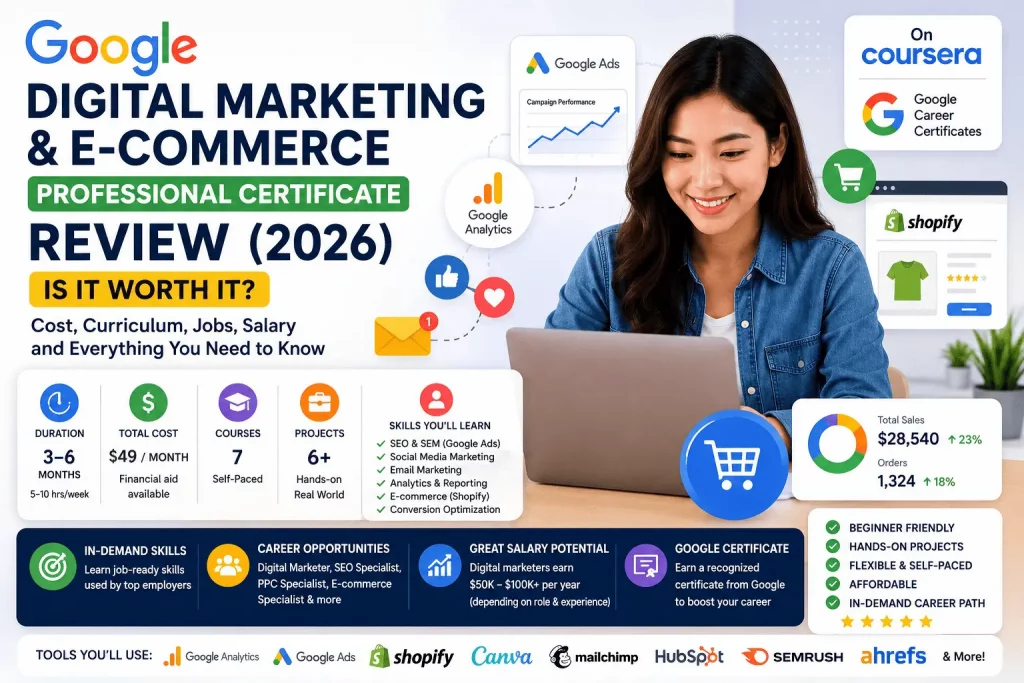
- Time to complete: roughly 3–6 months at 5–10 hours per week
- Cost: free with a 7-day Coursera trial, otherwise about $49/month (financial aid available)
- Where to take it: Coursera, under Google Career Certificates
- Standout feature: hands-on Shopify e-commerce projects alongside SEO and Google Ads training
Course Snapshot
| Detail | Information |
|---|---|
| Provider | Google, delivered through Coursera |
| Certificate type | Professional Certificate |
| Number of courses | 7 courses |
| Estimated completion time | 3–6 months (self-paced) |
| Skill level | Beginner to intermediate |
| Subtitles/language | Multiple languages available |
| Career support | Job search resources through the Google Career Certificates employer consortium |
| Credential recognized by | Employers in the Google Career Certificates hiring network, including select retail, agency, and e-commerce companies |
What Is the Google Digital Marketing & E-commerce Professional Certificate?
The Google Digital Marketing & E-commerce Professional Certificate is an online training program built by Google’s own marketing and e-commerce teams, designed to take someone with zero prior experience and prepare them for entry-level roles in digital marketing or e-commerce management. It’s part of the broader Google Career Certificates lineup, which also includes programs in data analytics, cybersecurity, IT support, UX design, and project management.
Unlike a general “intro to marketing” course, this certificate is split almost evenly between two disciplines that usually get taught separately: digital marketing (SEO, email, social, paid ads, analytics) and e-commerce (product listings, online storefronts, customer journeys, conversion optimization). That dual focus is deliberate — Google built the curriculum around the reality that most small and mid-sized businesses expect one hire to handle both the marketing and the online store.
The program is delivered entirely online through Coursera, is fully self-paced, and includes graded quizzes, discussion prompts, and several hands-on projects that simulate real marketing and e-commerce tasks, including building out a mock Shopify store.
Who Should Take It?
This certificate is designed with a specific audience in mind, and it delivers best when you fall into one of these groups:
Students who want a credential that complements a degree in business, communications, or a related field. It’s a low-cost way to add a practical, resume-ready skill set before graduating.
Career changers coming from unrelated industries — retail, hospitality, customer service, administration — who want a structured path into marketing without going back to school. The course assumes no prior marketing knowledge, which makes it genuinely beginner-friendly rather than beginner-friendly in name only.
Freelancers who already do bits of marketing work for clients but want to formalize their skills, fill knowledge gaps (especially around Google Ads and analytics), and have a credential to point to when pitching new clients.
Small business owners who run their own online store or local business and want to stop guessing at SEO, email marketing, and paid ads. The e-commerce modules in particular are built around real storefront scenarios, which makes this one of the more practically useful certificates for someone running their own shop.
Marketing professionals who are early in their careers and want to round out their skill set, particularly if their current role hasn’t exposed them to e-commerce platforms, Google Ads, or structured analytics work.
Who Should Skip It?
Not everyone benefits from this certificate, and being honest about who should skip it is part of giving a useful review.
Senior digital marketers with several years of hands-on campaign management experience will find almost nothing new here. The curriculum is built for people starting from zero, so the pacing and depth will feel slow.
SEO specialists who already understand technical SEO, keyword research tools, and search algorithms will outgrow the SEO modules within the first hour. This certificate covers SEO fundamentals, not advanced technical or enterprise-level strategy.
PPC managers who actively run Google Ads or Meta Ads campaigns professionally already have deeper platform knowledge than this course provides. The Google Ads coverage here is introductory, aimed at getting someone comfortable with the platform for the first time.
If any of those describe you, your time is better spent on platform-specific certifications (like the Google Ads certifications directly through Google Skillshop) or advanced courses through Semrush Academy or HubSpot Academy instead.
Skills You’ll Learn
The certificate is structured to build a broad, functional skill set rather than deep expertise in a single area. By the end, you should be comfortable with:
- SEO fundamentals — keyword research basics, on-page optimization, understanding how search engines rank content
- Google Ads — campaign structure, targeting, budgeting, and measuring ad performance
- Email marketing — building segmented campaigns, automation basics, and using tools like Mailchimp
- Social media marketing — platform strategy, content planning, and scheduling workflows
- Analytics — reading and interpreting data in Google Analytics to guide marketing decisions
- E-commerce — setting up and managing an online store, product listings, and the customer purchase journey
- AI for marketing — using AI tools to support content creation, campaign ideation, and workflow efficiency
- Customer journey mapping — understanding how customers move from awareness to purchase and beyond
- Conversion rate optimization (CRO) — identifying friction points in a funnel and testing improvements
This is a broad list, and that breadth is both the strength and the limitation of the program. You’ll finish with functional literacy across nine skill areas rather than mastery in one or two — which is exactly what most entry-level digital marketing coordinator roles are looking for.
Curriculum Breakdown
The certificate is organized into seven courses, each building on the last. Here’s what each one covers:
1. Foundations of Digital Marketing and E-commerce An overview course that introduces the marketing funnel, e-commerce business models, and the tools you’ll use throughout the program. You’ll learn the difference between B2B and B2C marketing, get a first look at how online stores generate revenue, and walk through the day-to-day responsibilities of digital marketing and e-commerce roles. This sets expectations and gives you a shared vocabulary before diving into specifics, and it’s also where the course starts weaving in AI for marketing as a supporting theme that resurfaces throughout the rest of the program.
2. Attract and Engage Customers with Digital Marketing Covers audience research, brand positioning, and the basics of building marketing campaigns that reach the right people. This course also introduces content marketing principles, customer personas, and the early stages of the customer journey — the groundwork that every later course builds on. You’ll practice translating a business’s target audience into an actual marketing plan, which is a skill that shows up repeatedly in real coordinator-level job descriptions.
3. From Likes to Leads: Interact with Customers Online Focused on social media marketing — organic content strategy, community engagement, and turning social interactions into leads. You’ll build a sample content calendar, practice writing platform-specific copy, and learn how to read basic social engagement metrics. This is where tools like Buffer and Hootsuite for scheduling and monitoring become relevant in the real world, even though the course itself uses Google-native tools and generic examples for demonstrations rather than any single third-party scheduler.
4. Think Outside the Inbox: Email Marketing A deep dive into email campaign structure, segmentation, automation, and deliverability. You’ll learn how to build a welcome sequence, segment a list by behavior, and avoid the common mistakes that get emails flagged as spam. Hands-on work here typically involves building sample campaigns similar to what you’d do inside Mailchimp or a comparable email service provider, and the segmentation logic taught in this course transfers directly to almost any email platform you’ll use on the job.
5. Assess for Success: Marketing Analytics and Measurement Introduces Google Analytics in depth — setting goals, tracking conversions, and using data to justify marketing decisions. You’ll practice building simple reports, interpreting traffic sources, and identifying which channels are actually driving results versus which ones just look busy. This course alone is worth the price of admission for beginners who’ve never touched an analytics dashboard before, since data literacy is one of the most consistently requested skills in entry-level marketing job postings.
6. Drive Direct-to-Consumer Sales Using Google Ads and Ecommerce Covers paid search advertising strategy and connects it directly to e-commerce conversion goals. You’ll build sample Google Ads campaigns, practice keyword bidding logic, set budgets, and learn how to connect Google Merchant Center product feeds to Shopping ads. The course frames everything around a direct-to-consumer e-commerce brand, which keeps the paid ads training grounded in a realistic business scenario rather than abstract theory.
7. Optimize Ecommerce Website Experience The most hands-on course in the program, centered on building and refining a mock Shopify store: product pages, checkout flow, site navigation, and conversion optimization tactics. You’ll audit a sample store for friction points, apply CRO principles from earlier in the certificate, and finish with a functioning storefront you can screenshot, demo, or reference directly in interviews.
Each course ends with a graded assessment, and several include peer-reviewed projects, meaning other learners review your work — a useful (if imperfect) way to get feedback before applying skills to a real client or employer.
Hands-on Projects
What separates this certificate from a lot of “watch and quiz” online courses is the number of applied projects baked into the curriculum. You’ll build:
- A sample social media content calendar and engagement strategy
- A segmented email marketing campaign with automation logic
- A Google Analytics reporting dashboard interpreting sample business data
- A Google Ads campaign structure for a fictional e-commerce brand
- A functioning mock Shopify storefront, including product pages and checkout optimization
That last project is the standout. Very few marketing certificates — including ones from Meta and HubSpot — give you direct, guided experience inside an actual e-commerce platform. If you finish this program and walk away with nothing else, you’ll still have a working example of a Shopify store to show in interviews or add to a portfolio.
Tools Covered
The certificate gives you structured exposure to the following tools:
- Google Analytics — for tracking site traffic, conversions, and campaign performance
- Google Ads — for paid search campaign creation and management
- Shopify — for building and managing an online store
- Canva — for designing marketing assets and social media graphics
- Mailchimp — for email campaign creation and automation
- HubSpot — introduced for CRM and inbound marketing concepts
- Google Merchant Center — for managing product listings that feed into Google Shopping ads
If you’re building out your own marketing stack after finishing this certificate, a few of these tools are worth paying for once you move past the free tiers. Canva Pro unlocks brand kits and premium templates that speed up content creation significantly. If you plan to run an actual online store rather than just the course’s mock version, Shopify’s paid plans (or WooCommerce if you’re already on WordPress) become necessary rather than optional. For email marketing beyond a small list, Mailchimp’s paid tiers add the automation depth the course only introduces at a surface level. And once you’re doing keyword research or competitor analysis for real clients, Semrush or Ahrefs will go far beyond what the course’s SEO module covers — those are natural next steps rather than something you need on day one.
Certificate Value: What It Actually Signals to Employers
A certificate’s value comes down to two things: does it teach real skills, and does it signal something meaningful to the people making hiring decisions? On the first count, this program does well — the curriculum maps closely to tasks entry-level marketing coordinators and e-commerce assistants actually perform. On the second, results are mixed but generally positive for entry-level roles specifically.
The Google name carries weight with hiring managers who are unfamiliar with the specifics of any given course but recognize the brand and know it involves a structured curriculum. That’s useful for getting past initial resume screens, especially at companies without a marketing team large enough to have strong opinions about which certificate is “better.” Where the certificate has less pull is at agencies and larger companies with dedicated senior marketers doing the hiring — those interviewers tend to weight a portfolio and demonstrated results over any single credential.
The practical takeaway: use this certificate to get your foot in the door for entry-level and coordinator-level roles, but plan to pair it with real project work (client work, freelance gigs, or a personal e-commerce store) to make your application competitive beyond the first screen.
Career Opportunities
Graduates commonly pursue these entry-level and early-career roles:
- Digital Marketing Specialist — managing multi-channel campaigns across social, email, and paid search
- SEO Specialist — entry-level SEO roles focused on on-page optimization and content support
- PPC Specialist — junior paid advertising roles managing Google Ads or social ad accounts
- E-commerce Specialist — managing online storefronts, product listings, and conversion optimization
- Marketing Coordinator — supporting a broader marketing team with content, scheduling, and reporting
- Growth Marketer — a generalist role focused on customer acquisition and funnel optimization
Because the certificate covers both marketing and e-commerce, graduates are often well-positioned for hybrid roles at small and mid-sized online retailers — a niche a lot of competing certificates don’t address directly.
Salary Outlook
Salary ranges for these roles vary significantly by location, company size, and industry, so treat any figure as a general benchmark rather than a guarantee. Entry-level digital marketing specialists and marketing coordinators in the United States typically start in the $40,000–$55,000 range annually, with e-commerce specialists often landing in a similar or slightly higher bracket depending on the size of the store they manage. PPC and SEO specialist roles tend to see faster salary growth with experience, since those skills scale directly with measurable results (traffic, conversions, ad ROI) that are easy to point to in a raise or promotion conversation.
Outside the U.S., particularly in markets like the Philippines and other parts of Southeast Asia, digital marketing and e-commerce roles are in high demand from both local businesses and remote-first companies hiring internationally, which has kept salaries for these skill sets competitive relative to other entry-level office roles in the region.
Cost
Google Career Certificates are hosted on Coursera and priced through Coursera’s subscription model rather than a flat one-time fee.
- Monthly subscription: approximately $49/month
- Free trial: 7 days free when you first sign up
- Estimated total cost: if you complete the certificate in 3 months at the average pace, expect to pay roughly $100–$150 total; slower learners taking 5–6 months should budget closer to $250–$300
Free Trial
New Coursera accounts get a 7-day free trial on Google Career Certificates. That’s enough time to complete the first course or two if you dedicate several focused hours to it, giving you a genuine feel for the teaching style and workload before committing financially.
Financial Aid
Coursera offers financial aid for Google Career Certificates, and approval is generally accessible for students, unemployed individuals, and low-income applicants. The application asks for a brief explanation of your financial situation and career goals — approval typically comes within about two weeks, and if granted, it can cover the subscription cost for a set number of months.
Time Commitment
Google estimates the certificate can be completed in about 3 months at roughly 10 hours per week. In practice, most learners fall somewhere between 3 and 6 months depending on how much time they can dedicate weekly and how much prior familiarity they already have with marketing concepts. Because the program is entirely self-paced with no live cohort deadlines, you can move faster through sections you find easy and slow down for the more hands-on projects, particularly the Shopify storefront build in the final course.
Pros
- Combines digital marketing fundamentals with genuine hands-on e-commerce training, which most competing certificates don’t offer together
- Affordable relative to bootcamps and traditional marketing courses, especially with financial aid
- No prior experience or degree required to enroll
- Backed by Google’s name recognition, which helps with initial resume screening
- Includes practical projects (Shopify store, Google Ads campaign, analytics dashboard) you can point to in interviews
- Access to Google’s Career Certificates employer consortium for job search support
- Self-paced structure fits around work, school, or freelance schedules
Cons
- Coverage of each individual skill (SEO, PPC, email) is introductory — not deep enough for specialist roles
- Monthly subscription cost adds up if you move through the material slowly
- Certificate alone may not be enough to land competitive roles at larger companies without a supporting portfolio
- Some tool coverage (like HubSpot and Google Merchant Center) is surface-level rather than hands-on
- Peer-reviewed assignments can be inconsistent in quality of feedback
Comparison: Google vs. Meta vs. HubSpot vs. Semrush Academy
| Feature | Google Digital Marketing & E-commerce | Meta Social Media Marketing | HubSpot Academy | Semrush Academy |
|---|---|---|---|---|
| Cost | ~$49/month (Coursera) | ~$49/month (Coursera) | Mostly free | Mostly free |
| E-commerce training | Yes, hands-on Shopify project | No | Limited | No |
| Paid ads coverage | Google Ads | Meta Ads | General overview | No |
| SEO depth | Introductory | Minimal | Introductory | Advanced/specialist |
| Best for | Beginners wanting marketing + e-commerce | Beginners focused on social ads | Inbound marketing and CRM basics | Learners who already know marketing basics and want SEO/PPC depth |
| Career support | Google employer consortium | Meta certification badge | HubSpot community and job board | None dedicated |
| Ideal next step after this course | — | — | — | Recommended follow-up after finishing Google’s certificate |
The practical way to think about these four options: Google’s certificate is the strongest starting point if you want breadth across marketing and e-commerce in one program. Meta’s certificate is a better fit if you specifically want to specialize in social advertising early. HubSpot Academy is worth layering on afterward for CRM and inbound marketing concepts, since it’s free and modular. Semrush Academy is best treated as a second step — most of its content assumes you already understand marketing fundamentals, which makes it a natural follow-up once you’ve completed Google’s program and want to go deeper into SEO and competitive research.
Decision Matrix
Use this quick framework to decide if the certificate fits your situation:
| Your situation | Recommendation |
|---|---|
| Complete beginner wanting a broad marketing foundation | Strong yes |
| Running or planning to run an online store | Strong yes — the e-commerce modules are the standout |
| Freelancer wanting a credential to show clients | Yes |
| Already work in SEO or PPC professionally | Skip — pursue specialist training instead |
| Want deep technical SEO skills specifically | Skip — go to Semrush Academy or a dedicated SEO course |
| Tight budget, want free options first | Try HubSpot Academy first, then this certificate if you want e-commerce depth |
| Want the fastest path to a marketing coordinator role | Strong yes |
Atlas Career Roadmap
For learners mapping out a full career path in digital marketing, this certificate typically fits into a progression like this:
Beginner → Google Digital Marketing & E-commerce Certificate → Digital Marketing Specialist role → SEO or PPC Specialist (specialization) → Growth Marketing Manager → Digital Marketing Director
This certificate is designed to be a launch point, not a finish line. The roles immediately after completion tend to be generalist and entry-level; the real career growth comes from specializing in either SEO, paid media, or e-commerce management within your first two to three years.
Atlas Learning Path
If you want to keep building on this certificate rather than stopping after one credential, a logical learning path looks like this:
Google Digital Marketing & E-commerce → Google Analytics Certification → Google Ads Certification → SEO Specialization (Semrush Academy or similar) → Growth Marketing coursework
This path deepens each skill area the base certificate only introduces, moving from broad literacy to job-ready specialization within 12–18 months of consistent study.
Atlas Skill Matrix
| Skill Area | Depth Covered | Suitable For Job-Ready Use? |
|---|---|---|
| SEO | Foundational | Entry-level content support only |
| Google Ads / PPC | Foundational to intermediate | Junior campaign management |
| Email Marketing | Intermediate | Yes, for small-to-mid list management |
| Social Media Marketing | Foundational to intermediate | Yes, for organic strategy and scheduling |
| Analytics | Intermediate | Yes, for reporting and basic decision-making |
| E-commerce | Intermediate | Yes, for small store management |
| AI for Marketing | Foundational | Supplementary skill, not standalone |
| CRO | Foundational | Supplementary skill, not standalone |
Atlas Difficulty Meter
On a scale of 1 (very easy) to 5 (very difficult), this certificate rates a 2 out of 5. The material is designed for absolute beginners, the pacing is gentle, and the assessments are largely multiple-choice quizzes plus guided projects rather than open-ended technical challenges. Learners with any prior exposure to marketing or e-commerce will likely find the first two or three courses move quickly.
Atlas Outcome Score
Based on curriculum depth, hands-on project quality, cost-to-value ratio, and employer recognition, this certificate earns an Outcome Score of 8.2 out of 10. It loses points primarily on specialist-level depth (which isn’t really its goal) and gains points for being one of the only beginner certificates that pairs marketing fundamentals with a genuine e-commerce platform project.
Frequently Asked Questions
Is the Google Digital Marketing & E-commerce Professional Certificate worth it in 2026? Yes, for beginners, career changers, freelancers, and small business owners. It’s less valuable for people who already work professionally in SEO, PPC, or senior marketing roles, since the content stays introductory throughout.
How long does it take to complete the certificate? Most learners finish in 3 to 6 months, depending on how many hours per week they can commit. Google’s official estimate is about 3 months at 10 hours per week.
How much does the Google Digital Marketing & E-commerce Certificate cost? It’s priced through Coursera’s subscription model at roughly $49/month, with a 7-day free trial and financial aid available for eligible applicants.
Do I need a degree to enroll? No. The certificate has no prerequisites and is designed for complete beginners.
Does this certificate include e-commerce training? Yes, and it’s one of the most hands-on parts of the program. The final course walks you through building a mock Shopify storefront, covering product pages, navigation, and checkout optimization.
Will this certificate teach me Google Ads? Yes, at an introductory-to-intermediate level. You’ll build sample campaigns and learn core concepts like targeting and budgeting, though it won’t replace a dedicated Google Ads specialist certification for advanced strategy.
Can I get a job with just this certificate and no experience? It’s possible, particularly for entry-level marketing coordinator or e-commerce assistant roles, but pairing the certificate with a portfolio, freelance projects, or an internship significantly improves your chances.
Is the Google certificate better than the Meta Social Media Marketing Certificate? It depends on your goal. Google’s certificate offers broader coverage including e-commerce and Google Ads, while Meta’s certificate goes deeper into paid social advertising specifically. If you want breadth, choose Google’s; if you want to specialize in social ads, choose Meta’s.
Does this certificate cover SEO in depth? No. SEO coverage is foundational — enough to understand keyword research and on-page basics, but not enough for a dedicated SEO specialist role. For deeper SEO training, Semrush Academy is a strong follow-up.
What tools will I learn to use? Google Analytics, Google Ads, Shopify, Canva, Mailchimp, HubSpot, and Google Merchant Center are all covered during the program.
Is financial aid actually available, and how do I apply? Yes. Coursera’s financial aid application asks about your financial situation and career goals, and approval typically takes about two weeks. If approved, it covers the subscription cost for a set period.
Can I complete this certificate part-time while working full-time? Yes. The self-paced structure with no live deadlines makes it well-suited for part-time study alongside a job.
Does completing this certificate qualify me for a Digital Marketing Specialist role? It can, particularly for entry-level and coordinator-level positions. More senior specialist roles typically require additional experience or specialization beyond the certificate alone.
How does this compare to a traditional marketing degree? It’s far more affordable and faster to complete, but it doesn’t carry the same academic weight or breadth as a full degree program. It’s best viewed as a practical skills credential rather than a degree replacement.
Is there a final exam or capstone project? There’s no single capstone exam. Instead, each course includes graded assessments and hands-on projects, with the Shopify storefront build in the final course serving as the closest thing to a capstone project.
Will I get access to job search support after completing the certificate? Yes. Google Career Certificates graduates get access to a job search platform and connections to the employer consortium that partners with the program.
What’s the difference between this and the Google Ads certification through Skillshop? Google Skillshop’s Ads certifications are free, narrowly focused on Google Ads specifically, and aimed at people who already understand marketing basics. This Professional Certificate is broader, paid, and designed to build marketing literacy from zero.
Is the AI for Marketing module useful? It’s a helpful introduction to using AI tools for content ideation and workflow support, but it’s supplementary rather than a deep AI marketing specialization.
Can freelancers benefit from this certificate? Yes, particularly freelancers who want to formalize existing skills, fill gaps in areas like analytics or Google Ads, and have a credential to reference when pitching clients.
Does the certificate include CRM training? It introduces HubSpot for CRM and inbound marketing concepts, but the coverage is surface-level rather than a full CRM specialization.
What’s the biggest weakness of this certificate? Depth. Every skill area is covered broadly rather than deeply, which means graduates are well-rounded generalists but not yet specialists in any single discipline.
What’s the biggest strength of this certificate? The combination of marketing fundamentals with a genuine, hands-on e-commerce project — a pairing that’s hard to find in competing beginner certificates.
Should I take this certificate before or after learning SEO tools like Semrush or Ahrefs? Take this certificate first. It builds the foundational context that makes tools like Semrush and Ahrefs far more useful once you start using them for real keyword research and competitive analysis.
Is this certificate accepted internationally, including in the Philippines and Southeast Asia? Yes. Because it’s fully online and self-paced, it’s accessible globally, and digital marketing and e-commerce skills are in strong demand across Southeast Asian markets, both for local businesses and international remote roles.
How does this fit into the full Google Career Certificates roadmap? It sits alongside certificates in AI Essentials, AI, Data Analytics, Cybersecurity, IT Support, and UX Design as part of Google’s broader career training ecosystem, with Business Intelligence, Advanced Data Analytics, and IT Automation with Python rounding out the lineup for learners who want to explore other career paths.
How to Get the Most Out of This Certificate
Finishing the certificate is only half the equation — how you approach it determines whether it actually moves your career forward. A few practices make a measurable difference:
Build a real project alongside the mock one. The Shopify storefront project inside the course is useful, but it’s still a simulation. If you have access to a real product, even a small side project or a friend’s business, rebuild what you learn on an actual live store. Employers respond far more strongly to a real, working example than a course exercise.
Don’t skip the discussion prompts. It’s tempting to click through peer-review assignments quickly, but the discussion and feedback components are where a lot of the practical nuance gets reinforced. Reading how other learners approached the same assignment often surfaces angles the video lessons didn’t cover.
Start a portfolio from day one, not after you finish. Screenshot your Google Ads mock campaigns, export your analytics reports, and save every project as you go. By the time you finish all seven courses, you should already have a portfolio folder ready to share rather than scrambling to recreate examples after the fact.
Layer on a specialization immediately after finishing. Because this certificate is intentionally broad, its value roughly doubles when it’s followed by focused practice in one area — whether that’s more advanced SEO training, a deeper Google Ads certification, or real freelance client work in e-commerce.
Common Mistakes to Avoid
A few patterns show up repeatedly among learners who don’t get the results they expected from this certificate:
Treating the certificate as a finish line instead of a starting point. The credential opens doors, but it doesn’t guarantee interviews by itself. Learners who pair it with applied project work consistently report better outcomes than those who rely on the certificate alone.
Rushing through the analytics and CRO modules. These two areas are the least flashy but arguably the most valuable for entry-level hiring, since they demonstrate that you can connect marketing activity to measurable business results — a skill hiring managers specifically screen for.
Ignoring the e-commerce half of the program. Some learners come in purely for the marketing content and skim through the Shopify-focused courses. That’s a mistake, since the e-commerce hands-on work is precisely what differentiates this certificate from competitors like Meta’s or HubSpot’s marketing-only programs.
Not customizing the resume language afterward. Simply listing “Google Digital Marketing & E-commerce Professional Certificate” on a resume is far less effective than translating specific skills and projects (Shopify storefront build, Google Ads campaign structure, analytics reporting) into resume bullet points that match the language used in job postings you’re applying to.
Final Thoughts
The Google Digital Marketing & E-commerce Professional Certificate earns its place as one of the better beginner-to-intermediate marketing credentials available in 2026, specifically because it doesn’t stop at marketing theory — it puts you inside an actual e-commerce platform and has you build something real. For students, career changers, freelancers, and small business owners, that combination of affordability, structure, and hands-on practice makes it a genuinely worthwhile investment. For working SEO specialists, PPC managers, and senior marketers, the value simply isn’t there, and your time is better spent on specialized training instead.
If you’re starting from zero and want one program that covers both sides of running a modern online business — marketing and e-commerce — this certificate is one of the strongest options on the market right now.
Related Guides
- Best Communication Skills Courses Online
- Best Excel Courses Online
- Best Microsoft Word Courses Online
- Best PowerPoint Courses Online
- Best Leadership Courses Online in 2026
- Best Project Management Courses Online in 2026
- Free Online Courses for Skill Upgrade in 2026: The Complete Global Guide
- Google AI Essentials Review (2026): Everything You Need to Know Before You Enroll
- Google AI Professional Certificate: The Complete 2026 Review
- Google Data Analytics Professional Certificate: The Complete Review
- Google Cybersecurity Professional Certificate Review (2026): Is It Worth It?
- Google IT Support Professional Certificate Review (2026): Is It Worth It?