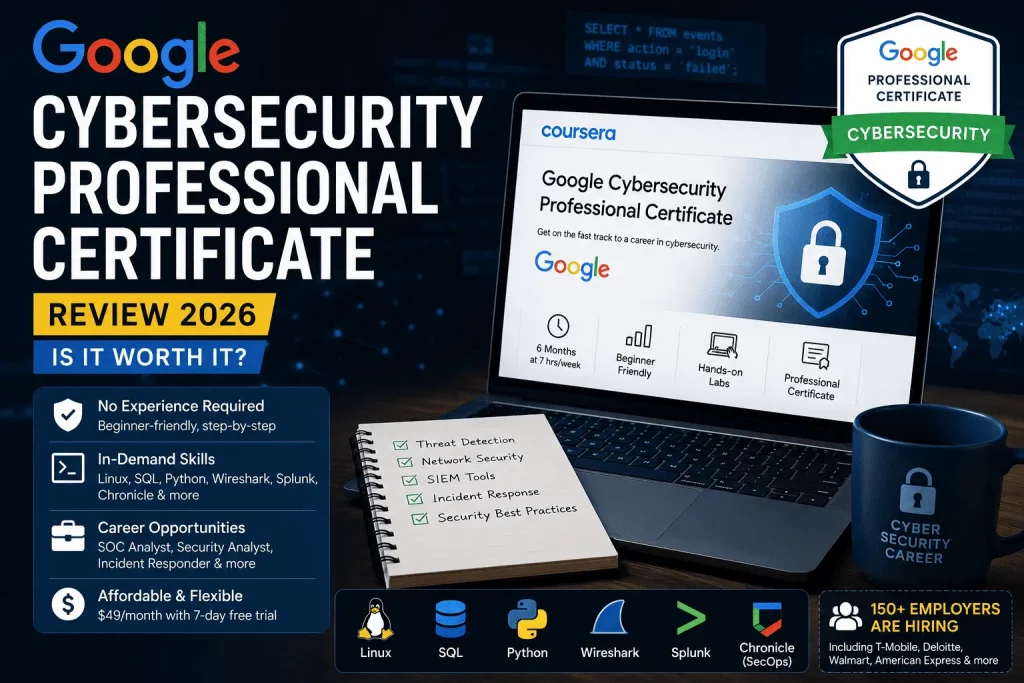
Cybersecurity has quietly become the safest bet in tech hiring. While software engineering roles have tightened and layoffs have rattled other corners of the industry, security teams keep hiring — because the threats aren’t slowing down and the talent pipeline can’t keep up. Ransomware attacks on hospitals and municipalities, AI-generated phishing campaigns, and a global shortage of trained analysts have pushed cybersecurity into the small list of careers where demand consistently outpaces supply.
That gap is exactly what the Google Cybersecurity Professional Certificate was built to close. Offered through Coursera as part of Google’s Career Certificates program, it promises to take a complete beginner — no degree, no IT background — and get them job-ready for entry-level security roles in about six months.
But “job-ready” is a big claim for a $49-a-month online course. In this review, we break down exactly what’s inside the program, what it actually teaches, how much it costs after every discount and free-trial trick, and whether it delivers enough to justify the time you’d put into it. This is a course-by-course, tool-by-tool audit — not a marketing recap.
Quick Verdict
Yes, the Google Cybersecurity Professional Certificate is worth it — but only for a specific type of learner.
If you’re a complete beginner, an IT support professional looking to move into security, or a career changer who needs a credible, structured on-ramp into cybersecurity without a four-year degree, this program delivers real value for the price. It teaches genuinely useful tools (Linux, SQL, Python, Splunk, Wireshark, Google’s own Chronicle/SecOps platform), it’s backed by Google’s name and a 150+ employer hiring consortium, and it preps you for the CompTIA Security+ exam at a discount.
If you already hold Security+, CISSP, or have hands-on SOC experience, this certificate will teach you very little you don’t already know. It’s an entry-level credential, not an advanced or specialized one — treat it as a foundation, not a ceiling.
Course Snapshot™
| Attribute | Details |
|---|---|
| Provider | Google, delivered via Coursera |
| Format | 8 self-paced online courses |
| Level | Beginner — no degree or experience required |
| Time commitment | ~6 months at 7 hours/week (roughly 170 hours total) |
| Cost | $49/month subscription (Coursera Plus), 7-day free trial |
| Typical total cost | ~$250–$300 if completed in 5–6 months |
| Certification exam | None — graded via quizzes and hands-on projects |
| Related credential | Prepares for CompTIA Security+ exam (discounted voucher included) |
| Academic credit | ACE-recommended for 9 lower-division college credit hours |
| Employer network | 150+ hiring partners including T-Mobile, Deloitte, American Express, Walmart |
| Rating | 4.8/5 average across tens of thousands of learner reviews |
What Is the Google Cybersecurity Professional Certificate?
The Google Cybersecurity Professional Certificate is an entry-level training program designed by Google’s own security practitioners and delivered through Coursera under the “Grow with Google” Career Certificates initiative — the same program family that produced Google’s popular Data Analytics, UX Design, and IT Support certificates.
It’s built for people with zero cybersecurity background. Across eight courses, it walks learners from foundational concepts (what a security analyst actually does, common attack types, the CIA triad) through to hands-on technical skills: Linux command-line basics, SQL queries, network protocols, SIEM tools, intrusion detection systems, and basic Python scripting for automating security tasks.
Unlike vendor certifications such as CompTIA Security+ or ISC2’s CISSP, there’s no proctored final exam. You earn the certificate by completing graded quizzes and project-based assignments inside each course. Think of it less like a licensing exam and more like a structured, employer-recognized bootcamp you can complete from your living room.
Who Should Take It?
Students. If you’re studying IT, computer science, or a related field and want a practical, resume-ready credential to pair with your degree, this certificate adds hands-on tool experience that most academic programs don’t cover in depth.
IT Support Professionals. This is arguably the strongest fit. If you already work in help desk, network administration, or general IT support, you likely have transferable skills (ticketing systems, basic networking, troubleshooting) that make the security concepts click faster — and the certificate gives you a clear lateral move into a SOC or security analyst role.
Career Changers. For people switching from unrelated fields — retail management, hospitality, teaching — this program is designed specifically for you. No coding background, no prior IT experience, and no degree are required to start.
Government Employees. Public-sector agencies are actively expanding cybersecurity staffing, and many government roles accept industry certificates like this one in lieu of a specific degree, especially for entry-level analyst or technician positions.
Business Owners. If you run a small business and want to understand security risk well enough to make informed decisions about vendors, policies, and incident response — without becoming a full-time analyst — the foundational courses alone are worth the first month’s subscription.
Who Should Skip It?
Experienced Security Engineers. If you’re already working mid-level or senior security roles, the content here will feel introductory. You’d be paying to relearn concepts you use daily.
Penetration Testers. This certificate is defensive-security focused (SOC operations, detection, incident response). It doesn’t cover offensive security, exploit development, or red-team methodology in any real depth — look toward OSCP or similar credentials instead.
CISSP Holders. CISSP already assumes and validates years of hands-on experience across eight security domains. This program won’t add meaningful depth to that credential, though some CISSP holders do complete it purely for continuing education (CPE) credits.
Skills You’ll Learn
The certificate is built around a defensible, employer-relevant skill stack:
- Network Security — how networks are structured, common attack surfaces, and how to defend them
- Linux — command-line navigation, file permissions, and system administration basics used daily in SOC environments
- SQL — querying databases to investigate security events and pull data during incident analysis
- Python — writing basic scripts to automate repetitive security tasks
- SIEM (Security Information and Event Management) — using tools like Splunk and Google’s Chronicle/SecOps to monitor and analyze security events
- IDS (Intrusion Detection Systems) — configuring and interpreting alerts from tools like Suricata
- Threat Detection — recognizing indicators of compromise and common attack patterns
- Incident Response — following structured processes (the NIST framework) to contain and remediate security incidents
- Risk Management — identifying, assessing, and prioritizing security risks using established frameworks
Curriculum Breakdown: Every Course, Reviewed
The certificate is split into eight courses, each building on the last. Here’s what each one actually covers.
1. Foundations of Cybersecurity. The on-ramp course. Covers what security analysts do day to day, core terminology (threats, risks, vulnerabilities), the CIA triad (confidentiality, integrity, availability), and an introduction to major security frameworks and controls. Light on technical work, heavy on vocabulary and mental models you’ll need for everything after.
2. Play It Safe: Manage Security Risks. Introduces risk management frameworks (including NIST), common attack types (social engineering, malware, network-based attacks), and the basics of security auditing. This is where “risk management” as a discipline actually starts to take shape rather than staying abstract.
3. Connect and Protect: Networks and Network Security. A dense networking course — TCP/IP, the OSI model, firewalls, VPNs, and network hardening practices. If you’ve never touched networking before, this is the course where the pace picks up noticeably.
4. Tools of the Trade: Linux and SQL. Fully hands-on. You’ll work directly in a Linux command-line environment (navigation, permissions, filters) and write SQL queries against sample databases. This is one of the most practically useful courses in the program for day-one SOC work.
5. Assets, Threats, and Vulnerabilities. Covers vulnerability assessment, common vulnerability scoring (CVSS-style thinking), asset classification, and how organizations prioritize what to protect first. Bridges risk theory from Course 2 into practical asset-level decision-making.
6. Sound the Alarm: Detection and Response. The SIEM-heavy course. You’ll get hands-on time in Splunk and Google’s Chronicle (now branded Google SecOps), learn to read and triage alerts, and work through incident detection and response workflows end to end. Many reviewers cite this as the most job-relevant course in the entire certificate.
7. Automate Cybersecurity Tasks with Python. No prior coding experience assumed. Covers Python fundamentals (variables, loops, functions) applied specifically to security automation tasks — parsing logs, automating repetitive checks, and basic scripting patterns analysts use to save time.
8. Put It to Work: Prepare for Cybersecurity Jobs. A capstone and career-prep course. Includes a portfolio project you can show employers, resume and LinkedIn guidance, interview preparation specific to security roles, and information on the CompTIA Security+ exam pathway.
Hands-on Labs
This certificate leans heavily on guided labs rather than passive video lectures — a meaningful differentiator from a lot of budget cybersecurity courses. Labs are embedded throughout, especially from Course 4 onward, and typically follow a “watch, then do” structure: a short instructional walkthrough followed by a graded lab where you perform the task yourself in a sandboxed environment.
Expect labs covering Linux file navigation and permissions, SQL querying against realistic datasets, packet analysis in Wireshark, SIEM log investigation in Splunk and Chronicle, and Python scripts for automating log parsing. Total guided instruction and lab time across the program runs to roughly 170 hours.
Tools Covered
One of the strongest selling points of this certificate is that it doesn’t just talk about tools — it puts you inside them. The toolset includes:
- Linux — command-line environment used throughout the SOC-focused courses
- SQL — for querying and investigating security data
- Python — for scripting and task automation
- Wireshark — for packet capture and network traffic analysis
- Splunk — industry-standard SIEM platform used widely across real SOC environments
- Chronicle (Google SecOps) — Google’s own cloud-native SIEM and threat detection platform
Familiarity with Splunk and Chronicle in particular carries real weight on a resume — both are tools hiring managers specifically screen for when filling SOC analyst roles.
Certificate Value
The certificate’s value comes from three overlapping sources: the Google brand, the employer consortium, and the CompTIA Security+ bridge.
Google’s name recognition does real work here — recruiters and hiring managers know the Career Certificates brand, and it signals a baseline of structured, vetted training rather than an unknown bootcamp. More concretely, Google maintains a hiring consortium of 150+ employers (including T-Mobile, Deloitte, American Express, and Walmart) who have committed to considering certificate holders for entry-level roles, which gives graduates an actual application pathway rather than just a line on a resume.
The certificate also carries an ACE (American Council on Education) recommendation of 9 lower-division college credit hours — though whether any specific college accepts those credits is entirely up to that institution, so don’t count on this before confirming with a target school.
Finally, completing the certificate prepares you for the CompTIA Security+ exam and includes discounted access to the exam and training materials — effectively giving you a second, more traditionally recognized credential within reach immediately after finishing.
Career Opportunities
Graduates typically target entry-level defensive security roles, including:
- Security Analyst
- SOC Analyst
- Junior Cybersecurity Analyst
- IT Security Specialist
- Threat Analyst
These roles share a common thread: they’re monitoring- and detection-focused rather than offensive-security roles, which lines up directly with what the curriculum actually teaches.
Salary Outlook
Entry-level cybersecurity analyst salaries vary significantly by region, employer size, and whether the role sits in a SOC, IT department, or dedicated security team. In the U.S., entry-level SOC and security analyst roles commonly start in the $55,000–$75,000 range, with salaries climbing quickly after 1–2 years of hands-on experience as analysts move into mid-level roles. The certificate alone won’t guarantee a specific number — actual offers depend heavily on local market conditions, prior experience (even adjacent IT experience counts), and whether you pair the certificate with Security+.
Cost
Coursera charges $49 per month for access to the Google Cybersecurity Professional Certificate in the U.S. and Canada (pricing may be lower in other countries). At the recommended pace of 7 hours per week, most learners finish in about 6 months, putting total cost at roughly $250–$300. Learners who dedicate more hours per week routinely finish in 3–4 months, cutting total cost to roughly $150–$200.
Free Trial
New Coursera users get a 7-day free trial before billing begins. It’s genuinely enough time to complete Course 1 and get a real feel for the teaching style, pacing, and lab format before committing financially — we’d recommend front-loading your first week specifically to test-drive the course before deciding to continue past the trial.
Financial Aid
Coursera offers financial aid for learners who qualify, which can reduce or eliminate the monthly subscription cost entirely for eligible applicants. The application is submitted directly through Coursera and reviewed on a case-by-case basis — worth applying before assuming the program is out of reach financially.
Time Commitment
Google’s official estimate is 6 months at roughly 7 hours per week — about 170 hours of guided instruction and labs in total. Because the program is fully self-paced, that timeline is flexible in both directions: learners who can dedicate 15–20 hours a week often finish in 6–8 weeks, while those studying around a full-time job may reasonably stretch it to 8–9 months.
Pros
- Zero prerequisites — genuinely accessible to complete beginners
- Hands-on labs in real tools (Splunk, Chronicle, Wireshark, Linux, SQL, Python) rather than theory-only lectures
- Backed by Google’s brand and a 150+ employer hiring consortium
- Affordable relative to bootcamps ($10,000–$20,000) or a degree ($40,000+)
- Direct pathway to a discounted CompTIA Security+ exam
- Strong, consistent learner reviews (4.8/5 average)
- Self-paced — fits around a job or other commitments
Cons
- No proctored exam, so it doesn’t carry the same industry weight as Security+ or CISSP on its own
- Entry-level only — offers little to no value for experienced security professionals
- Covers defensive security almost exclusively; no offensive security or penetration testing content
- Subscription pricing means slower learners pay more — procrastination has a real dollar cost
- College credit (ACE recommendation) isn’t guaranteed to transfer; depends entirely on the receiving institution
Comparison: Google vs. IBM Cybersecurity vs. CompTIA Security+ vs. Microsoft SC-900
| Feature | Google Cybersecurity | IBM Cybersecurity | CompTIA Security+ | Microsoft SC-900 |
|---|---|---|---|---|
| Format | 8-course Coursera program | 8-course Coursera program | Single proctored exam | Single proctored exam |
| Level | Beginner | Beginner | Foundational–Intermediate | Foundational |
| Proctored exam | No | No | Yes | Yes |
| Typical cost | ~$250–$300 | ~$250–$300 | ~$400 (exam fee) | ~$99 (exam fee) |
| Time commitment | ~6 months | ~8 months | Weeks of self-study | Weeks of self-study |
| Vendor neutrality | Vendor-neutral concepts | Vendor-neutral concepts | Fully vendor-neutral | Microsoft-specific |
| Hands-on labs | Extensive | Moderate | Minimal (exam-based) | Minimal (exam-based) |
| Industry recognition | Growing, Google-backed | Growing, IBM-backed | Established industry standard | Strong for Microsoft/Azure roles |
| Best for | True beginners | Beginners wanting IBM tool exposure | Anyone wanting a widely recognized standalone credential | Those targeting Microsoft security stack roles |
The practical takeaway: Google’s certificate and Security+ aren’t really competitors — they’re designed to be stacked. Complete the Google certificate first to build foundational skills and hands-on tool experience, then sit for Security+ (using the discount the Google program provides) to add a vendor-neutral, widely recognized credential employers specifically screen for in job postings.
Atlas Decision Matrix™
| Your Situation | Recommended Path |
|---|---|
| Complete beginner, no IT background | Start with Google Cybersecurity Certificate |
| Currently in IT support, want to move into security | Google Cybersecurity Certificate → Security+ |
| Have 1–2 years of IT/security-adjacent experience | Consider going straight to Security+ |
| Already working as a security analyst | Skip — pursue specialized or advanced certifications instead |
| Interested in offensive security / pentesting | Skip — look into OSCP or eJPT instead |
| Want the cheapest possible path with maximum hands-on practice | Google Cybersecurity Certificate |
| Need a credential that’s instantly recognized by every hiring manager | Prioritize CompTIA Security+ |
| Targeting Microsoft/Azure-heavy environments specifically | Add Microsoft SC-900 to your plan |
Atlas Career Roadmap™
IT Beginner
    ↓
Google Cybersecurity Professional Certificate
    ↓
SOC Analyst
    ↓
Cybersecurity Analyst
    ↓
Security Engineer
This roadmap reflects the most common progression reported by graduates: the certificate gets you in the door at the SOC Analyst level, where 1–2 years of hands-on monitoring and incident response experience typically qualifies you to move up to a broader Cybersecurity Analyst role, with Security Engineer as a realistic 3–5 year target once you’ve layered on additional certifications and specialized experience.
Atlas Skill Matrix™
| Skill | Coverage Depth | Beginner-Friendly? |
|---|---|---|
| Linux | Strong | Yes |
| Networking | Moderate–Strong | Yes |
| Security (fundamentals) | Strong | Yes |
| Python | Foundational | Yes |
| Threat Detection | Strong | Yes |
| Incident Response | Strong | Yes |
The pattern here is consistent across every skill area: this certificate builds strong foundations rather than deep specialization. That’s by design — it’s meant to make you employable at the entry level, not to make you an expert in any single domain.
Is It Worth It? A Breakdown by Learner Type
Students: Worth it. It’s an affordable way to add verified, hands-on skills to a resume that might otherwise be all theory and no tool experience.
Professionals (adjacent fields, e.g., general IT): Worth it, and arguably the best-fit audience. Your existing technical literacy accelerates the learning curve, and the lateral move into security is a well-worn, realistic career path.
Career Changers: Worth it, with a caveat — pair it with networking (industry meetups, LinkedIn outreach, informational interviews) since a certificate alone rarely overcomes a complete lack of professional experience in the field.
Business Owners: Worth it for the first 2–3 courses even if you never finish the full program — the risk management and network security fundamentals directly inform better vendor and policy decisions.
Government Employees: Worth it, particularly where agencies explicitly accept industry certificates for entry-level technical postings in lieu of a specific degree.
Frequently Asked Questions
Is the Google Cybersecurity Professional Certificate free?
No, but it starts with a 7-day free trial. After that, Coursera charges $49/month. Financial aid is available for learners who qualify.
How much does the Google Cybersecurity Professional Certificate cost in total?
Most learners finish in about 6 months at $49/month, for a total cost of roughly $250–$300. Faster learners who dedicate more hours per week can finish for less.
Is the Google Cybersecurity Professional Certificate worth it in 2026?
Yes, for beginners and career changers specifically. It’s less valuable for anyone who already has hands-on security experience or holds an advanced credential like CISSP.
Is the Google Cybersecurity Professional Certificate worth it in 2026?
Yes, for beginners and career changers specifically. It’s less valuable for anyone who already has hands-on security experience or holds an advanced credential like CISSP.
How long does it take to complete?
Google estimates about 6 months at 7 hours per week, though the program is self-paced and can be completed faster or slower depending on your schedule.
Do I need any prior experience to enroll?
No. The program is explicitly designed for complete beginners with no cybersecurity or IT background.
Is there a proctored exam?
No. You earn the certificate by completing graded quizzes and hands-on project assignments within each course — there’s no standalone exam at the end.
Does the certificate prepare you for CompTIA Security+?
Yes. Completing the program prepares you for the Security+ exam, and graduates get discounted access to the exam and training materials.
What tools will I learn to use?
Linux, SQL, Python, Wireshark, Splunk, and Google’s Chronicle (Google SecOps) platform.
Is the certificate available on Coursera only?
It’s primarily delivered through Coursera, though Google also makes it available via its own Grow with Google / Career Certificates platform.
Can I get a job with just this certificate and no degree?
Yes, it’s possible — Google’s employer consortium of 150+ companies has committed to considering certificate holders for entry-level roles specifically because a degree isn’t required.
What jobs can I get after completing this certificate?
Common entry points include Security Analyst, SOC Analyst, Junior Cybersecurity Analyst, IT Security Specialist, and Threat Analyst roles.
How much can I expect to earn after completing the certificate?
Entry-level SOC and security analyst salaries commonly fall in the $55,000–$75,000 range in the U.S., though this varies widely by region, employer, and prior experience.
Does the certificate offer college credit?
It carries an ACE recommendation of 9 lower-division college credit hours, but individual colleges decide independently whether to accept those credits.
Is the Google Cybersecurity Certificate the same as a Google Cloud security certification?
No. Google Cloud’s security certifications (like Professional Cloud Security Engineer) are separate, role-based, experience-oriented credentials with proctored exams — this certificate is entry-level and vendor-neutral by comparison.
How is this different from CompTIA Security+?
Security+ is a standalone proctored exam with no built-in instruction; the Google certificate is a full instructional course with labs, quizzes, and projects, but no proctored exam. They’re designed to complement each other, not replace one another.
Is Splunk experience from this course actually useful on the job?
Yes. Splunk is one of the most widely deployed SIEM platforms in real SOC environments, so hands-on familiarity carries genuine weight with hiring managers.
What is Google Chronicle / Google SecOps, and why does it matter?
It’s Google’s own cloud-native SIEM and threat detection platform. Learning it inside the certificate gives you direct exposure to a tool that’s increasingly used by organizations running on Google Cloud infrastructure.
Can I complete the certificate faster than 6 months?
Yes. Learners who dedicate 15–20 hours a week frequently finish in 6–8 weeks, which also reduces total subscription cost.
Is there a mobile app to study on the go?
Yes, Coursera’s mobile app supports video lessons and some coursework, though hands-on labs are generally better completed on a desktop or laptop.
Does the certificate cover cloud security?
Only at an introductory level. It’s not a substitute for cloud-specific security certifications if that’s your target specialization.
Is prior coding experience required for the Python course?
No. The Python course assumes zero prior coding experience and builds fundamentals from scratch, applied specifically to security automation tasks.
How does this compare to a cybersecurity bootcamp?
It’s significantly cheaper (roughly $250–$300 versus $10,000–$20,000 for most bootcamps) and self-paced, though bootcamps typically offer more intensive live instruction and career coaching.
Will this certificate alone get me a job with zero other experience?
It can, but pairing it with a portfolio project, networking effort, and ideally the Security+ exam significantly improves your odds versus relying on the certificate in isolation.
Is the certificate recognized outside the United States?
Yes, though the employer consortium and specific hiring partnerships are strongest in the U.S. Recognition and pricing may vary by country.
How often is the curriculum updated?
Google periodically refreshes course content to reflect current industry practices, including recent updates addressing how AI is used by both defenders and attackers.
Is CISSP or Security+ a better starting point instead?
Not for true beginners. Both CISSP and Security+ assume some baseline security or IT knowledge; the Google certificate is specifically built to provide that foundation first.
Conclusion: Is the Google Cybersecurity Professional Certificate Worth It?
For the exact audience it was built for — beginners, career changers, and IT professionals looking to move laterally into security — this certificate earns its price. You get real hands-on time in Splunk, Chronicle, Wireshark, Linux, SQL, and Python, a structured six-month path with no prerequisites, and a direct, discounted bridge to the more widely recognized CompTIA Security+ exam. Backed by Google’s name and a 150+ company hiring consortium, it’s one of the few sub-$300 credentials that can plausibly open the door to an entry-level SOC role.
It won’t replace hands-on experience, and it won’t impress anyone who already works in security. But as a first step into the field — one that teaches real tools instead of just theory — it’s hard to beat at this price point in 2026.
Bottom line: if you’re starting from zero, enroll. If you’re already in the field, skip it and put that time toward Security+ or a specialization instead.
Related Professional Development Guides
Leadership rarely develops in isolation — it usually pairs with a handful of other practical workplace skills. If you’re building out a broader professional development plan, these guides cover the skills that most often complement leadership training:
- Best Communication Skills Courses Online
- Best Excel Courses Online
- Best Microsoft Word Courses Online
- Best PowerPoint Courses Online
- Best Leadership Courses Online in 2026
- Best Project Management Courses Online in 2026
- Free Online Courses for Skill Upgrade in 2026: The Complete Global Guide
- Google AI Essentials Review (2026): Everything You Need to Know Before You Enroll
- Google AI Professional Certificate: The Complete 2026 Review
- Google Data Analytics Professional Certificate: The Complete Review
- Google IT Support Professional Certificate Review (2026): Is It Worth It?
- Google UX Design Professional Certificate Review (2026): Is It Worth It?
- Google Digital Marketing & E-commerce Professional Certificate Review: Is It Worth It?
- Microsoft Certifications Guide (2026): The Complete Certification Roadmap
- AI-900 Review (2026): Is Azure AI Fundamentals Worth It?
- AZ-104 Microsoft Azure Administrator Review (2026): Is It Worth It?
- Azure Certifications Guide (2026): The Complete Azure Certification Roadmap