Quick Answer
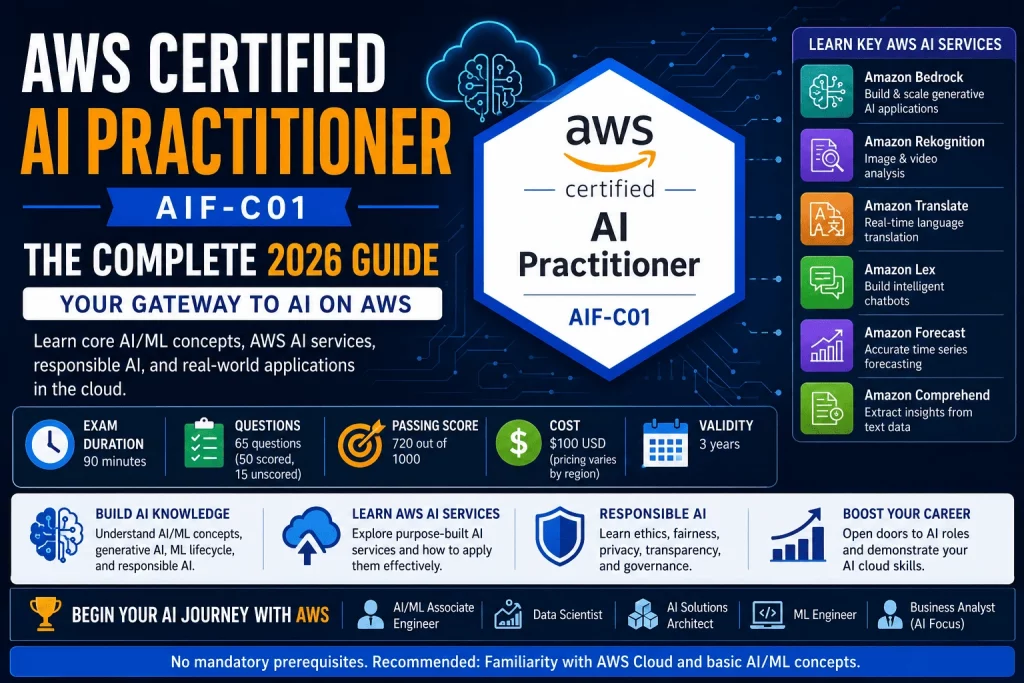
The AWS Certified AI Practitioner (exam code AIF-C01) is AWS’s foundational-level certification for artificial intelligence, machine learning, and generative AI. It costs $100 USD (regional pricing varies), runs 90 minutes, contains 65 questions (50 scored, 15 unscored), and requires a scaled score of 700 out of 1000 to pass. There are no mandatory prerequisites, though AWS recommends around six months of exposure to AI/ML concepts and familiarity with core AWS services. The exam is organized into five weighted domains: Fundamentals of AI and ML (20%), Fundamentals of Generative AI (24%), Applications of Foundation Models (28%), Guidelines for Responsible AI (14%), and Security, Compliance, and Governance for AI Solutions (14%). It’s designed for people who use AI on AWS — business analysts, developers, managers, students — not people who build ML models from scratch. The certification is valid for three years.
AI is no longer a specialist skill confined to data scientists. It’s a baseline expectation across marketing, product management, software engineering, customer support, and executive decision-making. Employers across nearly every industry now expect the people they hire — technical or not — to have a working understanding of what generative AI can and can’t do, how foundation models work at a conceptual level, and how to use these tools responsibly. That shift in expectations is exactly why AWS launched the Certified AI Practitioner certification: cloud vendors compete not just on infrastructure anymore, but on who can prove their workforce (and their customers’ workforce) is fluent in AI.
AWS launched the AI Practitioner certification as a foundational-tier credential — sitting alongside Cloud Practitioner as an entry point into the AWS certification ecosystem, but focused entirely on AI, ML, and generative AI rather than general cloud computing. It exists because AWS recognized a gap: plenty of professionals interact with AI-powered products, prompt large language models daily, or make business decisions about AI investments, without ever touching a Jupyter notebook or training a model. Cloud Practitioner didn’t test that knowledge in any depth. AI Practitioner does.
Who should consider taking it? Students exploring a tech career, software developers who want AI fluency without becoming ML engineers, IT professionals supporting AI-powered systems, business analysts and product managers evaluating AI tools, and managers overseeing AI initiatives are all reasonable candidates. If your job touches AI in any capacity — using it, buying it, managing people who build it, or explaining it to stakeholders — this certification is built for you.
What you’ll learn in this guide: everything from the exact exam format and domain weightings to a full 30-day study plan, a comparison against AWS Cloud Practitioner and Microsoft’s AI-900, salary data, and two original Atlas frameworks — a readiness checklist and a decision matrix — that most other AI certification guides simply don’t offer.
What Is the AWS Certified AI Practitioner (AIF-C01)?
The AWS Certified AI Practitioner is a foundational-level certification designed to validate a broad, practical understanding of artificial intelligence, machine learning, and generative AI concepts, along with the AWS services that implement them. It sits at the same tier as AWS Certified Cloud Practitioner — meaning it assumes no deep technical background — but its subject matter is narrowly focused on AI rather than cloud computing generally.
Certification overview. AIF-C01 tests whether a candidate can describe AI, ML, and generative AI concepts and strategies; identify appropriate use cases for these technologies in a business context; select the correct category of AI/ML technology for a given problem; and apply these technologies responsibly. It is explicitly not a hands-on, build-it-yourself exam.
Purpose. AWS designed this certification to fill a gap that existed between “knows nothing about AI” and “can build and train ML models” (the domain of the AWS Certified Machine Learning Engineer Associate and Machine Learning Specialty certifications). AI Practitioner sits squarely in the middle: it validates AI literacy and informed decision-making, not engineering capability.
AI fundamentals. The exam covers basic terminology and concepts — the differences between AI, machine learning, and deep learning; supervised, unsupervised, and reinforcement learning; training versus inference; and how to evaluate whether a business problem is even a good fit for an AI-based solution in the first place.
Cloud AI concepts. Beyond generic AI theory, the exam tests how these concepts map onto AWS specifically — which AWS services correspond to which AI capability, how pricing models for AI services work (including token-based pricing for generative AI), and how AWS’s shared responsibility model applies to AI workloads.
Responsible AI. A meaningful share of the exam addresses fairness, bias, explainability, transparency, and safety in AI systems — recognizing when a model might produce biased or harmful outputs and understanding the tools and practices (like guardrails) that mitigate that risk.
Generative AI basics. Because generative AI is the fastest-growing and most business-relevant area of AI right now, it gets outsized attention: foundation models, prompt engineering, retrieval-augmented generation (RAG), fine-tuning versus prompting, and the tradeoffs of different foundation model choices.
Who Should Take This Certification?
Suitable for:
- Students exploring careers in tech, cloud, or AI who want a credible, resume-ready credential without years of prior experience
- Developers who build applications that call AI services (chatbots, recommendation features, content generation) but don’t specialize in ML engineering
- IT professionals who support, procure, or administer systems that increasingly include AI-powered components
- Business analysts who need to evaluate AI vendor claims, ROI, and feasibility as part of their day-to-day work
- Managers overseeing teams or projects involving AI, who need enough fluency to ask good questions and make informed decisions without doing the technical work themselves
- AI beginners with no formal background who want a structured, respected starting point rather than piecing together fragmented free tutorials
- Cloud professionals who already hold other AWS certifications and want to round out their credential set with AI-specific knowledge
Who should NOT take it. If you’re already a working ML engineer, data scientist, or hold (or are working toward) the AWS Certified Machine Learning Engineer Associate or Machine Learning Specialty certification, AIF-C01 will likely feel too basic to be worth the time and money — those higher-tier certifications subsume this content and signal significantly more to employers. Similarly, if your goal is to actually build, train, and deploy machine learning models — writing training pipelines, tuning hyperparameters, doing feature engineering — this exam explicitly does not test any of that, and you should look at AWS’s ML-focused certifications instead. It’s also not the right choice if you need a deeply technical, hands-on credential for a specific engineering role; hiring managers for those roles will generally not treat AIF-C01 as sufficient evidence of engineering capability.
AWS Certified AI Practitioner Exam Overview
| Attribute | Detail |
|---|---|
| Exam code | AIF-C01 |
| Certification level | Foundational |
| Number of questions | 65 (50 scored, 15 unscored/experimental) |
| Time limit | 90 minutes |
| Question formats | Multiple choice, multiple response, ordering, matching |
| Passing score | 700 out of 1000 (scaled scoring, range 100–1000) |
| Cost | $100 USD (varies by country) |
| Delivery | Pearson VUE testing center or online proctored |
| Languages | English, Japanese, Korean, Simplified Chinese, French, German, Italian, Portuguese (Brazil), Spanish, Arabic, and others depending on current availability |
| Certification validity | 3 years |
| Retake wait period | 14 days after a failed attempt |
| Prerequisites | None formal; ~6 months of AI/ML exposure recommended |
A few structural details worth knowing before exam day: the 15 unscored questions are mixed in invisibly, so treat every question as if it counts. The exam uses a compensatory scoring model, meaning you don’t need to pass each domain individually — only the exam overall — though your score report will still break down performance by domain so you can see relative strengths and weaknesses. Unanswered questions are scored as incorrect, and there’s no penalty for guessing beyond that, so never leave a question blank.
Question formats go beyond simple multiple choice: ordering questions ask you to arrange 3–5 responses into the correct sequence to complete a task, and matching questions ask you to pair items from two lists correctly, with no partial credit for near-misses on either format. These formats are less common on older AWS foundational exams and catch some first-time candidates off guard, so it’s worth practicing them specifically rather than assuming every question will be a simple four-option multiple choice.
AWS AI Practitioner Exam Domains
Domain 1: Fundamentals of AI and Machine Learning — 20%
This domain covers the conceptual bedrock everything else builds on. Expect questions on the differences between AI, ML, and deep learning; the major learning paradigms (supervised, unsupervised, and reinforcement learning); common ML terminology (training data, labels, features, inference, overfitting); and general-purpose AWS ML services like Amazon SageMaker AI at a conceptual level — what it’s for, not how to code in it.
Example scenario: A question might describe a business that wants to predict customer churn based on historical account data and ask which category of ML approach (supervised learning, specifically classification) fits best, without expecting you to write any code to implement it.
Domain 2: Generative AI Concepts — 24%
The second-largest domain, reflecting how central generative AI has become to AWS’s AI Practitioner blueprint. Topics include foundation models and what distinguishes them from traditional ML models, tokens and token-based pricing, prompt engineering basics, embeddings, and the tradeoffs between using a model as-is via prompting versus fine-tuning it on custom data.
Example scenario: A question might present a company deciding between prompting an off-the-shelf foundation model with detailed instructions versus fine-tuning a model on proprietary data, and ask you to identify which approach better fits a stated constraint like limited budget and no ML engineering staff — the answer being prompt engineering with a capable foundation model, since fine-tuning requires more specialized skill and cost.
Domain 3: Applications of Foundation Models — 28%
This is the largest domain on the exam, and it’s where the exam gets the most practical: applying generative AI to real business problems using AWS services. Expect deep coverage of Amazon Bedrock, retrieval-augmented generation (RAG) architecture, agents, guardrails, and how to select an appropriate foundation model for a specific use case based on factors like cost, latency, context window size, and modality (text, image, multimodal).
Example scenario: A question might describe a customer support chatbot that needs to answer questions using a company’s internal knowledge base, which changes daily, without retraining a model every time content updates — the correct answer being a RAG architecture using Amazon Bedrock Knowledge Bases, since RAG retrieves current information at query time rather than requiring the underlying model to be retrained.
Domain 4: Responsible AI — 14%
This domain tests your understanding of fairness, bias, explainability, transparency, privacy, and safety in AI systems. Expect questions on identifying sources of bias in training data, the importance of explainable models in regulated industries, and AWS tools that support responsible AI practices, including guardrails that filter harmful or off-topic model outputs.
Example scenario: A question might describe a hiring-screening AI tool that appears to systematically disadvantage a protected group of applicants, and ask you to identify the most likely root cause (biased or unrepresentative training data) and the category of mitigation that addresses it (auditing training data and testing for disparate impact before deployment).
Domain 5: Security, Compliance, and Governance — 14%
The final domain covers how to secure AI systems and how organizations govern AI use responsibly at scale. Topics include the AWS shared responsibility model as it applies to AI services, IAM for controlling access to AI resources, data governance practices (lineage, residency, logging, monitoring), and compliance considerations relevant to AI deployments.
Example scenario: A question might ask which AWS capability helps an organization track where training or inference data originated and how it was used, in order to satisfy an internal audit requirement — testing your familiarity with data lineage and governance concepts rather than any specific compliance certification.
AWS AI Services You Should Know
The exam expects familiarity with what each of AWS’s core AI services does, when to use it, and roughly how it fits into the broader AI/ML service catalog — not how to code against its API in depth.
Amazon Bedrock. AWS’s fully managed service for accessing foundation models from multiple providers through a single API, without managing any underlying infrastructure. Central to Domain 3 — expect Bedrock to appear in the majority of “Applications of Foundation Models” questions, including its support for RAG via Knowledge Bases, agents, guardrails, and model customization.
Amazon SageMaker AI. AWS’s comprehensive platform for building, training, and deploying machine learning models. On this exam, you need to know what SageMaker is for at a conceptual level (the full ML lifecycle, from data prep through deployment) rather than how to use its notebooks or training APIs directly — that hands-on depth belongs to the ML Engineer Associate exam instead.
Amazon Q. AWS’s family of generative AI-powered assistants, including variants for business use, developer productivity, and AWS console/infrastructure questions. Know what problem each variant of Amazon Q solves at a high level.
Amazon Rekognition. A pre-built computer vision service for image and video analysis — object detection, facial analysis, content moderation — without needing to train a custom model.
Amazon Comprehend. A natural language processing service for extracting insights from text: sentiment analysis, entity recognition, key phrase extraction, and language detection.
Amazon Lex. A service for building conversational interfaces (chatbots and voice assistants) using natural language understanding, commonly used for customer service automation.
Amazon Polly. Converts text into lifelike speech — text-to-speech — used in applications like audiobooks, accessibility tools, and interactive voice response systems.
Amazon Textract. Automatically extracts text, handwriting, and structured data (like tables and forms) from scanned documents, going beyond basic optical character recognition.
Amazon Transcribe. Converts speech into text — automatic speech recognition — used for call transcription, subtitling, and voice-driven applications.
Amazon Translate. A neural machine translation service for converting text between languages, used in localization and multilingual customer-facing applications.
For exam purposes, the single highest-leverage thing you can do is build a simple mental map: “text in, insights out” → Comprehend; “image/video in, insights out” → Rekognition; “speech to text” → Transcribe; “text to speech” → Polly; “document to structured data” → Textract; “language to language” → Translate; “conversational interface” → Lex; “foundation models, generative AI” → Bedrock; “full custom ML lifecycle” → SageMaker AI; “AI-powered assistant” → Amazon Q. Confusing these pre-built, single-purpose AI services with each other is one of the most common sources of lost points on this exam.
AWS AI Practitioner Exam Cost
Exam fee. The AIF-C01 exam costs $100 USD in the United States, with regional pricing adjustments applied in other countries (paid in local currency, plus any applicable taxes). This makes it one of the more affordable AWS certifications — roughly a third less than the associate-level exams, consistent with its foundational tier.
Retake policy. If you don’t pass, you must wait 14 days before retaking the exam, with no annual limit on the number of attempts. Each retake requires paying the full exam fee again, unless you’re using a discount voucher.
Rescheduling. Exams booked through Pearson VUE can typically be rescheduled for free if done with sufficient advance notice (generally at least 24–48 hours before your scheduled time, though the exact policy can vary) — rescheduling closer to your appointment time may incur a fee.
Cancellation. Similar rules apply to cancellations: cancel with enough advance notice and you can generally receive a refund or credit; cancel too close to your appointment and you may forfeit the fee entirely. Always check the current Pearson VUE cancellation policy at the time of booking, since these terms are set by the testing vendor and can change.
Voucher information. AWS periodically offers 50%-off exam vouchers — often distributed at AWS events (like re:Invent), through AWS Educate for students, via partner promotions, or occasionally after a failed exam attempt. These vouchers aren’t guaranteed or permanent, so check your AWS Certification account and official AWS communications for current offers rather than assuming a discount will always be available.
AWS AI Practitioner Certification Path
AIF-C01 is designed as an entry point, not a destination. A typical long-term progression looks like this:
AWS Certified Cloud Practitioner (optional starting point for those with zero AWS background) ↓ AWS Certified AI Practitioner (AIF-C01) — foundational AI/ML literacy ↓ AWS Certified Machine Learning Engineer Associate — hands-on ML engineering skills, building on the conceptual foundation from AIF-C01 ↓ AI/ML Specialty-level certification (if available in AWS’s current catalog) — deeper technical specialization ↓ Professional-level AI and ML roles, potentially supported by professional-tier certifications like AWS Certified Solutions Architect Professional (for those moving toward AI systems architecture) or continued growth into senior ML engineering and applied AI leadership positions
Neither Cloud Practitioner nor AI Practitioner is a strict prerequisite for anything else in this path — you can jump straight to Machine Learning Engineer Associate if you already have the technical background. But for candidates without prior AWS or ML exposure, this sequence builds knowledge in a logical order: general cloud fluency, then AI/ML conceptual literacy, then hands-on ML engineering skill, then specialization.
How Difficult Is the AWS AI Practitioner Exam?
Difficulty level. AIF-C01 is widely regarded as one of the more approachable AWS certifications — several test-takers report it as easier than even the Cloud Practitioner exam, despite covering material that’s conceptually newer to most candidates. This is because it rewards breadth of understanding over technical depth: you need to know what things are and when to use them, not how to implement them.
Common challenges. The most common source of lost points isn’t difficulty of concepts but confusion between similarly-named AWS AI services (mixing up Rekognition and Textract, for instance, or Comprehend and Lex), underestimating the Responsible AI and Security/Governance domains because they feel less “technical,” and overconfidence from candidates who already use AI tools daily in their personal life but haven’t studied the specific AWS service mappings and terminology the exam tests.
Pass rate. AWS does not publish official pass rates for any of its certification exams, including AIF-C01, so any specific percentage you see cited online should be treated as an unverified estimate rather than an official figure.
Time commitment. Most candidates with some prior AWS or general tech background report passing after roughly 15–30 hours of focused study. Complete beginners to both AWS and AI concepts should budget closer to 30–40 hours, generally spread across three to four weeks of part-time study.
30-Day Study Plan
Week 1: Fundamentals. Start with the official AWS Exam Guide PDF to understand exactly what’s in and out of scope — this single document should shape everything else you study. Work through basic AI/ML terminology: supervised versus unsupervised versus reinforcement learning, training versus inference, and how to recognize when a business problem is (or isn’t) a good fit for an AI-based solution. Spend time on Amazon SageMaker AI at a conceptual level — what it does across the ML lifecycle — without needing to touch its console in depth.
Week 2: Generative AI. Shift focus to foundation models, tokens and token-based pricing, prompt engineering fundamentals, and the distinction between prompting an existing model versus fine-tuning one. This is also the right week to start exploring Amazon Bedrock directly in the AWS console (free-tier eligible in limited ways) — invoke a foundation model through the console playground to build real intuition for how prompting and model responses actually work, rather than only reading about it.
Week 3: AWS AI Services. Dedicate this week to memorizing and internalizing the purpose-built AI services: Rekognition, Comprehend, Lex, Polly, Textract, Transcribe, Translate, and Amazon Q. Build the “input → service → output” mental map described in Section 5, and if possible, try each service briefly in the console using sample data so the differences stick. This is also the week to cover Responsible AI and Security/Governance content in depth, since it pairs naturally with the service-level knowledge you’re building.
Week 4: Practice Exams. Take a full-length, timed practice exam under real conditions by day 22–23, then review every wrong answer with its explanation rather than just noting your score. Use the domain-level breakdown to identify your single weakest area and spend the next several days exclusively re-studying that domain rather than reviewing everything evenly. Take a second practice exam around day 27–28 to confirm improvement, do a light final review of your weakest domain only in the final two days, and schedule your exam for the end of the month while the material is freshest.
Best AWS AI Practitioner Courses
| Platform | Best For | Notes |
|---|---|---|
| AWS Skill Builder | Official, free foundational content | The single source of truth for exam scope; includes a free Exam Prep plan and a paid Enhanced Exam Prep plan with additional practice questions and labs |
| Coursera | Structured, university-style pacing | Often bundled with broader AI/ML specializations; useful if you want AIF-C01 prep alongside deeper conceptual grounding |
| Udemy | Budget-friendly video courses | Frequently discounted; quality varies significantly by instructor, so check recent review dates and confirm the course is updated for AIF-C01 specifically |
| Tutorials Dojo | Practice-exam-first learners | Known primarily for high-quality practice exams with detailed explanations rather than long-form video content |
| Pluralsight | Professionals with an existing subscription | Solid structured content if you already have organizational access; less commonly purchased standalone just for this one exam |
No single platform is objectively “best” for every learner — candidates who learn well from structured video benefit most from Coursera or Udemy, while candidates who learn best through repetition and testing benefit most from leaning heavily on Tutorials Dojo-style practice exams paired with the free official AWS Skill Builder content.
Best Books and Study Guides
Official Exam Guide. The AWS-published Exam Guide PDF for AIF-C01 is free, authoritative, and the only document that directly reflects the current domain weightings and in-scope/out-of-scope task statements. Read it before purchasing anything else.
AWS documentation. The official documentation pages for Bedrock, SageMaker AI, and each purpose-built AI service (Rekognition, Comprehend, Lex, etc.) are free and current, and reading the “getting started” and “how it works” pages for each service covers a large share of Domain 3 and Domain 5 content at no cost.
Practice books. Dedicated AIF-C01 study guides from established technical publishers (several exist as of 2026, generally running 200–300 pages) work well for candidates who prefer reading linearly over jumping between web pages and videos, and typically include end-of-chapter practice questions.
AI fundamentals resources. For candidates who are new to AI/ML concepts generally (not just AWS’s flavor of them), a general introductory AI/ML resource — separate from anything AWS-specific — can help solidify Domain 1 content before layering AWS service knowledge on top.
Best Practice Exams
| Provider | Strengths | Consider If |
|---|---|---|
| Official AWS Practice Exam | Closest to real question style and difficulty calibration | You want the single most reliable signal of readiness |
| Tutorials Dojo | Detailed explanations, reference links, domain-level scoring | You want to understand why an answer is right or wrong, not just get a score |
| Udemy | Large volume of questions at low cost | You want extensive repetition and don’t mind variable explanation quality |
| Whizlabs | Broad AWS certification catalog with mock exams | You’re studying multiple AWS certifications and want one platform across all of them |
Regardless of provider, look for practice exams explicitly updated for the current AIF-C01 domain weightings, with a timed simulation mode, an untimed review mode, and — critically — a domain-by-domain score breakdown so you know exactly where to focus your remaining study time.
Career Opportunities After Certification
AIF-C01 rarely opens a door on its own, but it strengthens a resume and supports a case for these roles when paired with relevant experience or additional certifications:
- AI Specialist — supporting AI-powered features or products within a broader engineering or product team
- Cloud Engineer — general cloud infrastructure roles where AI/ML workloads are an increasing part of the job
- AI Consultant — advising organizations on AI adoption, tool selection, and implementation strategy
- Solutions Architect — particularly for architects designing systems that incorporate AI/ML components, even if they aren’t building the models themselves
- Data Analyst — analysts who increasingly need to evaluate AI-generated insights and AI-powered analytics tooling
- Technical Sales — pre-sales and solutions engineering roles that require credible technical fluency in AI to support enterprise sales conversations
- AI Product Manager — product managers who need enough technical grounding in AI capabilities and limitations to make credible roadmap and prioritization decisions
Expected Salary
Compensation for roles associated with AI Practitioner certification varies enormously by experience level, employer, industry, and location — the certification itself is a signal and differentiator, not the primary driver of salary. That said, general market ranges reported across salary-tracking platforms and industry surveys in 2026 give a rough sense of scale:
- United States: Roles where this certification is relevant (cloud engineer, AI-adjacent product or analyst roles, technical sales) commonly report total compensation in a broad range depending heavily on seniority — the certification is more often cited as supporting a higher offer within a role’s existing band than as independently setting compensation.
- Europe: Generally reports somewhat lower nominal figures than the U.S. in local-currency terms, consistent with broader regional tech salary differences, though purchasing-power-adjusted value is often more comparable.
- Asia (including India): AI-related roles are among the fastest-growing salary categories in the region’s tech sector, with foundational AI credentials increasingly appearing as a preferred (though rarely mandatory) qualification in job postings for cloud and AI-adjacent roles.
Treat any specific salary figure you encounter — including on this page or others — as directional rather than a guarantee, since compensation surveys vary in methodology and sample size, and your own outcome depends far more on your actual experience, role, negotiation, and local market than on holding this one credential.
AWS AI Practitioner vs. AWS Cloud Practitioner
| AI Practitioner (AIF-C01) | Cloud Practitioner (CLF-C02) | |
|---|---|---|
| Difficulty | Similar or slightly easier by most reports | Similar or slightly harder by most reports |
| Cost | $100 | $100 |
| Audience | Anyone working with or around AI on AWS | Anyone needing general AWS cloud literacy |
| Topics | AI/ML concepts, generative AI, responsible AI, AI-specific AWS services | Core AWS services, billing, security basics, general cloud concepts |
| Career path | Leads toward ML Engineer Associate and AI-focused roles | Leads toward Solutions Architect, Developer, or SysOps Associate certifications |
The two certifications overlap only slightly — Cloud Practitioner’s content outline includes just a single task statement related to AI, while AI Practitioner’s entire content outline is AI-focused. They’re not competitors; many candidates pursue both, since Cloud Practitioner builds general AWS fluency (billing models, the shared responsibility model, core services like S3 and EC2) that makes AI Practitioner’s AWS-specific service questions easier to digest. If you have to choose just one and your interest is specifically AI, choose AI Practitioner; if you need broad AWS literacy first, start with Cloud Practitioner.
AWS AI Practitioner vs. Microsoft AI-900
| AWS AI Practitioner (AIF-C01) | Microsoft Azure AI Fundamentals (AI-900) | |
|---|---|---|
| Vendor | Amazon Web Services | Microsoft Azure |
| AI services covered | Amazon Bedrock, SageMaker AI, Rekognition, Comprehend, Lex, Polly, Textract, Transcribe, Translate, Amazon Q | Azure AI Foundry, Azure Machine Learning, Azure AI Vision, Azure AI Language, Azure AI Speech, Azure OpenAI Service |
| Exam format | 65 questions, 90 minutes, $100 | Similar format and pricing tier, generally in a comparable cost range for Microsoft fundamentals-level exams |
| Certification level | Foundational | Fundamentals |
| Career focus | AI literacy within the AWS ecosystem specifically | AI literacy within the Azure ecosystem specifically |
The honest answer to “which one should I get” is almost always: whichever cloud platform your employer or target employers actually use. The conceptual AI/ML content (supervised vs. unsupervised learning, what a foundation model is, responsible AI principles) overlaps heavily between the two exams, since it’s largely vendor-agnostic knowledge. What differs is the specific service names and platform terminology you need to map that knowledge onto. If your organization is AWS-first, AIF-C01 is the more directly useful credential; if it’s Azure-first, AI-900 serves the equivalent purpose. Candidates working in multi-cloud consulting or freelance environments sometimes pursue both, since the incremental cost of the second exam (given how much conceptual knowledge transfers) is relatively low.
Pros and Cons
Pros
- Beginner friendly — no coding required, no formal prerequisites, and content that assumes minimal prior AI/ML exposure
- Growing demand — AI literacy is one of the fastest-growing hiring priorities across industries, and this credential directly targets that
- AI-focused — unlike broader cloud certifications that touch AI only briefly, this exam goes genuinely deep on generative AI specifically
- AWS ecosystem — validates knowledge on the world’s largest cloud platform, which remains the default choice at a large share of employers
- Valuable foundational credential — a legitimate, respected starting point rather than an informal online badge
Cons
- Introductory level — it won’t, by itself, qualify you for hands-on ML engineering roles or signal deep technical capability
- Requires ongoing learning — AI services and best practices evolve quickly, and the exam guide itself is revised periodically to keep pace, meaning the certification reflects a snapshot rather than permanent mastery
- May not be sufficient alone for advanced AI roles — employers hiring for genuinely technical AI/ML positions will generally expect this certification paired with real project experience or a more advanced credential, not as a standalone qualification
Is AWS AI Practitioner Worth It in 2026?
For students: Yes, and arguably one of the best entry points available — it’s affordable, beginner-friendly, and gives a structured, credible way to demonstrate AI literacy before you have professional experience to point to.
For developers: Worth it if you build applications that touch AI services but don’t want to become a dedicated ML engineer. If you’re already comfortable with SageMaker, model training, and ML pipelines, this exam will feel too introductory to justify the time relative to a more advanced ML certification.
For career changers: Strongly worth considering, particularly as a first step in a broader plan that eventually includes more technical AI/ML certifications or hands-on project experience — it signals intentional, structured learning to a hiring manager evaluating a nontraditional background.
For managers and business professionals: Yes — this is close to an ideal fit, since the exam is explicitly designed for people who need to make informed decisions about AI without building it themselves.
Bottom line: AIF-C01 delivers the most value to people early in their AI journey — students, career changers, non-ML developers, and business-side professionals — who need credible, structured AI literacy. It makes the most sense to pursue more advanced certifications next once your role or ambitions shift toward actually building AI/ML systems rather than evaluating, buying, or applying them.
Atlas Certification Readiness Checklist™
Before you spend $100 booking the exam, run through this checklist honestly. If you can check off most of these, you’re likely ready to schedule; if you’re missing several, that’s your remaining study plan.
Prerequisites and background
- [ ] I can explain the difference between AI, machine learning, and deep learning in plain language
- [ ] I understand the AWS shared responsibility model at a conceptual level
- [ ] I’ve used the AWS console at least briefly (doesn’t need to be extensive)
AI fundamentals
- [ ] I can describe supervised, unsupervised, and reinforcement learning with an example of each
- [ ] I understand the difference between model training and inference
- [ ] I can explain what a foundation model is and how it differs from a traditional, narrowly-trained ML model
Cloud AI basics
- [ ] I know what Amazon Bedrock does and can name at least two things it’s used for
- [ ] I know what Amazon SageMaker AI is for, even without having used its console in depth
- [ ] I can match each purpose-built AI service (Rekognition, Comprehend, Lex, Polly, Textract, Transcribe, Translate) to its primary use case without hesitation
Study resources
- [ ] I’ve read the official AWS Exam Guide PDF at least once, in full
- [ ] I’ve completed at least one structured course or the free AWS Skill Builder content covering all five domains
- [ ] I’ve reviewed the AWS documentation “how it works” pages for Bedrock and at least three purpose-built AI services
Hands-on practice
- [ ] I’ve invoked a foundation model through the Bedrock console playground at least once
- [ ] I’ve tried at least one purpose-built AI service (Rekognition, Comprehend, etc.) with sample data in the console
- [ ] I can explain, from memory, one real or hypothetical business use case for RAG and why it fits better than fine-tuning in that scenario
Mock exams
- [ ] I’ve taken at least one full-length, timed practice exam under realistic conditions
- [ ] My most recent practice exam score was comfortably above the 700/1000 passing threshold equivalent (most practice platforms report a percentage; aim for 80%+ on a reputable set)
- [ ] I’ve reviewed every incorrect answer from my practice exam with its explanation, not just noted the score
If you can honestly check 12 or more of these 15 items, you’re in strong position to schedule your exam. If you’re below 10, spend one more focused week on your weakest section — most likely Domain 4 (Responsible AI) or Domain 5 (Security, Compliance, and Governance), since these are the two domains candidates most often under-study relative to their weight.
Atlas AI Certification Decision Matrix™
Choosing among the growing list of foundational AI certifications can be confusing, since several now compete for the same “AI literacy” positioning. This matrix compares the five most commonly considered options side by side.
| Certification | Intended Audience | Technical Depth | Estimated Study Time | Certification Type | Ideal Career Goal |
|---|---|---|---|---|---|
| AWS AI Practitioner (AIF-C01) | AWS-ecosystem professionals wanting AI literacy | Low-to-moderate; no coding required | 15–40 hours | Vendor exam, proctored, scored | Roles touching AI within an AWS-based organization |
| AWS Cloud Practitioner (CLF-C02) | Anyone new to AWS generally | Low; general cloud concepts only | 20–40 hours | Vendor exam, proctored, scored | Broad AWS literacy as a foundation for any AWS specialization |
| Microsoft AI-900 | Azure-ecosystem professionals wanting AI literacy | Low-to-moderate; no coding required | 15–30 hours | Vendor exam, proctored, scored | Roles touching AI within an Azure-based organization |
| Google AI Essentials | General professionals, non-technical audiences | Low; conceptual and tool-usage focused | 10–15 hours | Course certificate, not a proctored exam | Broad AI literacy for non-technical roles, quick entry point |
| Google AI Professional Certificate | Career changers seeking applied AI skills | Moderate; includes applied projects | 40–80+ hours (multi-course program) | Course certificate series, not a proctored exam | Practical, portfolio-building AI skills for career transition |
How to read this matrix. The two AWS/Microsoft vendor exams (AIF-C01 and AI-900) are the closest direct competitors to each other — same format (proctored, scored, pass/fail), similar depth, and the choice between them should be driven almost entirely by which cloud ecosystem you (or your target employer) actually use. Google’s offerings sit in a different category entirely: they’re course-completion certificates rather than proctored exams, which makes them faster and less formal to obtain, but generally carries less signaling weight with employers who specifically screen for vendor-certified, proctored credentials. If your goal is a credential that shows up cleanly as a verifiable AWS certification on LinkedIn and passes recruiter keyword filters, AIF-C01 or AI-900 (matched to your ecosystem) is the stronger choice. If your goal is fast, practical AI literacy without the pressure of a timed exam, Google AI Essentials is a reasonable lower-commitment starting point — though it’s worth pairing with a vendor exam later if you want a credential that carries more weight in formal hiring processes.
Sample Exam-Style Questions (With Reasoning)
Reading about domain weightings is different from experiencing the question style. Below are three original, exam-style questions written in the spirit of AIF-C01 — not reproductions of real exam content, since actual exam questions are confidential — with reasoning through each one.
Sample question 1 (Fundamentals of AI and ML). A retail company wants to predict which customers are likely to cancel their subscription in the next 30 days, using two years of historical account activity where the outcome (canceled or not) is already known for past customers. What category of machine learning best fits this problem?
Because the historical data already includes the labeled outcome (canceled vs. not canceled), this is a supervised learning problem, specifically a binary classification task. The presence of labeled historical outcomes is the key detail that rules out unsupervised learning (which works with unlabeled data to find patterns) and reinforcement learning (which learns through trial-and-error reward signals, not historical labeled records).
Sample question 2 (Applications of Foundation Models). A company wants a customer-facing chatbot to answer questions using product documentation that changes weekly, without the cost and delay of retraining a model every time the documentation updates. Which approach best fits this requirement?
Retrieval-augmented generation (RAG) is the correct fit, because RAG retrieves current information from a connected knowledge source at query time rather than requiring updated information to be baked into the model through retraining. Fine-tuning would require repeated, costly retraining every time the documentation changes, which directly conflicts with the stated constraint.
Sample question 3 (Responsible AI). An organization deploys a generative AI assistant and later discovers it occasionally produces confident-sounding but factually incorrect answers. What is this phenomenon called, and what AWS capability helps mitigate it?
This phenomenon is commonly referred to as “hallucination” — when a generative model produces plausible-sounding but incorrect or fabricated output. Grounding the model’s responses in verified data through a RAG architecture (rather than relying purely on the model’s internal training) and applying guardrails to filter or flag unreliable outputs are the standard mitigation approaches tested on this domain.
Across all three, notice that correct answers usually hinge on one specific constraint stated in the scenario — “documentation changes weekly,” “labeled historical outcomes,” “confident-sounding but incorrect.” Training yourself to isolate that one deciding detail, rather than reacting to the general topic of the question, is the single most transferable skill for this exam.
Quick-Reference Cheat Sheet
A condensed set of distinctions worth memorizing cold before exam day, since they show up repeatedly across multiple domains:
- AI vs. ML vs. deep learning: AI is the broad field of machines performing tasks that typically require human intelligence; ML is a subset of AI where systems learn patterns from data rather than being explicitly programmed; deep learning is a subset of ML using multi-layered neural networks
- Supervised vs. unsupervised vs. reinforcement learning: supervised learning uses labeled data to predict known outcomes; unsupervised learning finds patterns in unlabeled data (like clustering); reinforcement learning learns through trial, error, and reward signals
- Prompting vs. fine-tuning: prompting adapts a foundation model’s behavior through instructions at inference time with no model changes; fine-tuning further trains the model on custom data, which costs more and takes longer but can improve performance on narrow, specialized tasks
- RAG vs. fine-tuning: RAG retrieves current, external information at query time without changing the model; fine-tuning bakes new knowledge or behavior directly into the model’s weights — RAG is generally the better fit when the underlying information changes frequently
- Amazon Bedrock vs. Amazon SageMaker AI: Bedrock provides managed access to pre-built foundation models via API with minimal infrastructure management; SageMaker AI supports the full custom ML lifecycle, including building and training models from scratch
- Rekognition vs. Textract: Rekognition analyzes images and video for objects, faces, and content; Textract extracts text and structured data (like tables and forms) specifically from documents
- Comprehend vs. Lex: Comprehend extracts insights (sentiment, entities, key phrases) from existing text; Lex builds conversational interfaces like chatbots and voice assistants
- Polly vs. Transcribe: Polly converts text into speech; Transcribe converts speech into text — opposite directions of the same general capability
- Bias vs. hallucination: bias refers to systematically skewed or unfair model outputs traceable to unrepresentative training data; hallucination refers to a model confidently generating false or fabricated information, unrelated to fairness
Frequently Asked Questions
Is AWS AI Practitioner beginner-friendly? Yes. It’s a foundational-tier certification with no coding requirements and no formal prerequisites, designed explicitly for people with limited or no prior AI/ML background.
Is coding required? No. The exam explicitly excludes developing or coding AI/ML models, hyperparameter tuning, and building ML pipelines from its scope. You need conceptual understanding and the ability to select appropriate AWS services for given scenarios, not programming ability.
What is the exam code? AIF-C01.
How much does the exam cost? $100 USD in the United States, with regional pricing adjustments in other countries.
How long is the certification valid? Three years from your pass date, after which recertification is required.
Is the certification difficult? It’s generally considered one of the more approachable AWS certifications — comparable to or slightly easier than AWS Cloud Practitioner for most candidates, particularly those with some existing tech background.
Can I take it online? Yes. AWS offers both in-person testing at Pearson VUE testing centers and online proctored exams you can take remotely.
What AWS services are covered? Primarily Amazon Bedrock and Amazon SageMaker AI, along with purpose-built AI services including Amazon Rekognition, Amazon Comprehend, Amazon Lex, Amazon Polly, Amazon Textract, Amazon Transcribe, Amazon Translate, and Amazon Q.
What score do I need to pass? A scaled score of 700 out of a possible 1000.
Is it worth getting in 2026? For students, career changers, business professionals, and developers who aren’t dedicated ML engineers, yes — it’s an affordable, credible way to demonstrate AI literacy in a job market where that literacy is increasingly expected. For working ML engineers or data scientists, a more advanced, technically deep certification will generally serve you better.
Final Takeaway
The AWS Certified AI Practitioner certification fills a real gap in the market: a credible, structured, vendor-backed way to prove AI literacy without requiring years of machine learning engineering experience. It’s affordable, approachable, and directly aligned with what a growing share of employers actually need — people who can make informed decisions about AI, not necessarily people who can build it from scratch. If you work through the study plan in this guide, build real (if brief) hands-on familiarity with Bedrock and the purpose-built AI services rather than studying purely from theory, and give the Responsible AI and Governance domains the attention their combined 28% weighting deserves, you’ll be well positioned to pass on your first attempt — and to walk away from the process with AI knowledge that’s actually useful in your day-to-day work, not just on your resume.
Related Guides
- Microsoft Certifications Guide (2026): The Complete Certification Roadmap
- AI-900 Review (2026): Is Azure AI Fundamentals Worth It?
- AZ-104 Microsoft Azure Administrator Review (2026): Is It Worth It?
- Azure Certifications Guide (2026): The Complete Azure Certification Roadmap
- Free Online Courses for Skill Upgrade in 2026: The Complete Global Guide
- Best Time Management Courses in 2026 (For Government Employees & Professionals)
- Google AI Essentials Review (2026): Everything You Need to Know Before You Enroll
- Google AI Professional Certificate: The Complete 2026 Review
- Google Data Analytics Professional Certificate: The Complete Review
- Google Cybersecurity Professional Certificate Review (2026): Is It Worth It?
- Google IT Support Professional Certificate Review (2026): Is It Worth It?
- Google UX Design Professional Certificate Review (2026): Is It Worth It?
- Google Digital Marketing & E-commerce Professional Certificate Review: Is It Worth It
- AWS Certified Developer Associate (DVA-C02): The Complete 2026 Guide
- AWS Certified Cloud Practitioner (2026): Complete Certification Guide
- AWS Certifications Guide (2026): The Complete AWS Certification Roadmap