Artificial intelligence has moved from an emerging skill to a baseline expectation across almost every job category. Employers are willing to pay measurably more for staff who can use AI tools competently, and that wage gap shows up across sales, marketing, finance, operations, and IT roles alike. At the same time, hiring managers have no easy way to verify who actually knows how to use AI responsibly and who is simply putting “AI-savvy” on a resume. That’s the gap certifications are built to close.
A certification does three things a resume bullet point can’t: it comes from a recognized issuer (Google, Microsoft, Amazon), it’s tied to a structured curriculum you can point to, and it gives a recruiter a fast, comparable signal across candidates. That doesn’t mean every certification is worth your time and money — some are genuinely career-changing, others are a weekend well spent, and a few are overkill unless you’re aiming for a specific engineering role.
This guide is for anyone deciding where to start: students building a foundation before graduation, career changers trying to break into AI-adjacent roles, working professionals who want to stay relevant, government employees looking to modernize how they work, and IT professionals deciding which cloud AI credential to add next. By the end, you’ll know exactly which certification fits your starting point, what each one actually costs and covers, and how to sequence them so each credential builds on the last instead of duplicating it.
What Are the Best AI Certifications in 2026?
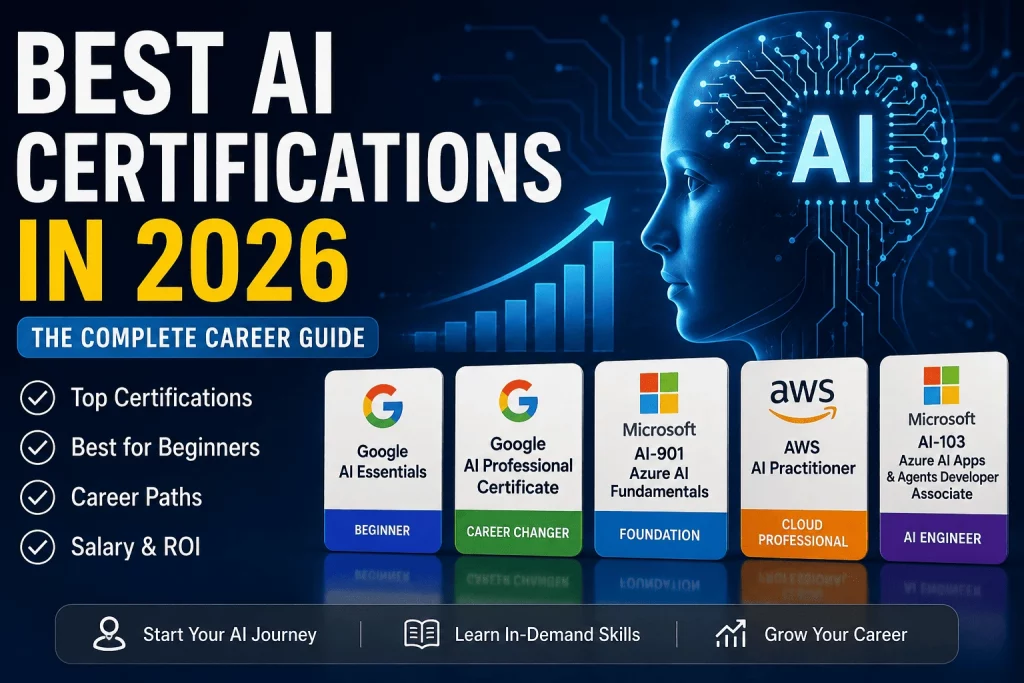
Quick answer: The best AI certifications in 2026 depend on your starting point and goal. For absolute beginners, Google AI Essentials ($49, under 10 hours) is the fastest path to a recognized credential. For career changers who want a deeper, portfolio-building program, the Google AI Professional Certificate is the strongest option. Non-technical professionals who want a vendor-neutral-feeling foundation should look at AI-901 (Azure AI Fundamentals) or the AWS Certified AI Practitioner, both priced around $99–$150. Aspiring AI engineers and developers should target AI-103 (Azure AI Apps and Agents Developer Associate), the current Microsoft credential for building generative AI and agentic solutions on Azure.
Top Recommendations
| Certification | Best For |
|---|---|
| Google AI Professional Certificate | Career Changers |
| Google AI Essentials | Beginners |
| AI-901 (Azure AI Fundamentals) | Non-Technical Professionals |
| AWS Certified AI Practitioner | Cloud Professionals |
| AI-103 (Azure AI Apps and Agents Developer Associate) | AI Engineers |
A quick note on naming, since it trips people up: two of the certifications above recently changed exam codes. Microsoft retired the long-standing AI-900 (Azure AI Fundamentals) exam on June 30, 2026, replacing it with AI-901 — same certification name, same roughly $99 price, same beginner-friendly format, but refreshed content that leans harder into generative AI and Microsoft Foundry. Microsoft also retired AI-102 (Azure AI Engineer Associate) on the same date, replacing it with AI-103, which leads to a newly named credential: Microsoft Certified: Azure AI Apps and Agents Developer Associate. If you see older articles referencing AI-900 or AI-102 as something to sign up for today, treat that as outdated — this guide reflects the current exam codes.
Atlas AI Certification Framework™
Not everyone needs the same certification at the same time. This framework groups the leading AI credentials into three tiers based on technical depth, so you can find your starting tier and see exactly what comes next.
Tier 1: AI Foundations
Best for:
- Students
- Beginners
- Non-technical professionals
Certifications:
- Google AI Essentials
- AI-901 (Azure AI Fundamentals)
- AWS Certified AI Practitioner
Tier 1 certifications assume zero coding background. They test whether you understand what AI can and can’t do, how to use generative AI tools responsibly, and how to recognize the right AI service for a given business problem. None of them require you to write a single line of code.
Tier 2: AI Career Transition
Best for:
- Career changers
- Analysts
- Professionals moving into AI-adjacent roles
Certifications:
- Google AI Professional Certificate
- AI-103 (Azure AI Apps and Agents Developer Associate)
Tier 2 is where things get hands-on. You’re no longer just describing AI concepts — you’re building things: custom AI tools, prompt workflows, and (on the Azure side) actual applications that call AI services and orchestrate agents. This tier is the realistic bridge between “I use AI at work” and “I have a job that’s about AI.”
Tier 3: AI Specialization
Best for:
- AI engineers
- Data scientists
- Machine learning specialists
Certifications:
- Advanced Azure AI certifications (including machine learning operations-focused paths)
- Advanced AWS AI certifications (including AWS Certified Machine Learning Engineer – Associate)
- Specialized machine learning certifications from providers like DeepLearning.AI and IBM
Tier 3 is deliberately out of scope for a beginner-to-intermediate guide like this one, but it’s worth knowing it exists: once you’ve built a foundation and picked a lane (cloud AI development, data science, ML engineering), the specialized certifications in this tier are where you go to prove deep technical competence.
Quick Comparison Table
| Certification | Difficulty | Cost | Career Impact |
|---|---|---|---|
| Google AI Essentials | Beginner | Low (~$49) | High |
| AI-901 (Azure AI Fundamentals) | Beginner | Medium (~$99) | High |
| AWS Certified AI Practitioner | Beginner | Medium (~$150) | High |
| Google AI Professional Certificate | Beginner–Mid | Medium (~$49/month) | Very High |
| AI-103 (Azure AI Apps and Agents Developer) | Mid | High (~$165) | Very High |
Top AI Certifications in 2026
Google AI Essentials
Why It Matters
Google AI Essentials is the lowest-friction way to earn a recognizable AI credential. It’s built by Google’s own AI practitioners, distributed through Coursera (and mirrored on Google Skills), and designed for people with zero technical background. If your goal is simply to prove you can use generative AI tools competently and responsibly at work, this is the fastest path there.
Skills Covered
The program is organized into five short courses covering practical, everyday applications: using generative AI tools to brainstorm and problem-solve, drafting and organizing written content, writing more effective prompts, evaluating AI output critically, and applying AI responsibly — including awareness of bias, privacy, and the importance of human oversight.
Pros
- Costs about $49 (Coursera’s standard monthly subscription price), with a 7-day free trial
- Most learners finish in well under 10 hours, often in a single weekend
- No coding, no prerequisites, no technical background required
- Backed by the Google brand, which carries real recognition with hiring managers
- Content is refreshed regularly to keep pace with fast-moving AI tools
Cons
- Covers generic workplace use cases rather than industry-specific applications
- Doesn’t touch code, APIs, or how AI systems work “under the hood”
- Too basic for anyone who already uses ChatGPT, Gemini, or Copilot daily as part of their job
- Carries less weight than the Professional Certificate for candidates trying to change careers into AI-focused roles
Best For
Absolute beginners, students, and any working professional who wants a quick, credible AI credential without a major time investment.
Career Outcomes
On its own, Google AI Essentials rarely changes a job title or salary band. Its real value is as a fast, visible signal — something to add to LinkedIn, a resume, or a performance review that shows initiative and baseline AI fluency. It’s most effective when paired with existing domain expertise: a marketer or analyst with this certificate is more credible than either a generic marketer or a generic “AI certified” candidate with no other skills.
Google AI Professional Certificate
Why It Matters
Where Google AI Essentials teaches you to use AI tools, the Google AI Professional Certificate teaches you to build with them. It’s Google’s flagship credential for people who want AI fluency to translate into real job outcomes — the kind of certificate designed to sit at the center of a career-change resume rather than as a supplementary line item.
Skills Covered
Learners practice using Gemini (including Canvas and Deep Research), Gemini Notebook, and Gemini inside Google Workspace apps (Docs, Slides, Sheets) to accelerate daily tasks, and go on to build a custom AI tool using Google AI Studio. The program is built around creating more than 20 practical AI-powered solutions rather than passively watching lecture content. Enrollees also receive several months of no-cost access to Google’s more advanced AI models, giving hands-on exposure to frontier-level tooling as part of the certificate.
Pros
- Directly hands-on: you leave with built projects, not just completed modules
- Includes complimentary access to Google’s premium AI tier during the program
- Strong brand recognition, globally available in English
- Bridges naturally from Google AI Essentials for a structured two-step path
Cons
- Requires a genuine time commitment beyond Essentials — this is not a weekend certificate
- Monthly subscription pricing means slower learners pay more in total
- Still non-technical in the coding sense — not a substitute for a machine learning or software engineering credential
Best For
Career changers actively trying to move into AI-adjacent roles: AI enablement, AI-focused operations, prompt engineering-adjacent positions, and business roles where AI fluency is now a core job requirement.
Career Outcomes
This is the certificate most likely to appear directly in job requirements or resume screens for “AI-fluent” roles that don’t require a computer science background. It signals that a candidate can not only use AI tools but actually design workflows and lightweight tools around them — a meaningfully different (and more hireable) skill set than tool familiarity alone.
AI-901 (Azure AI Fundamentals)
Why It Matters
AI-901 is Microsoft’s current entry-level AI credential, and as of mid-2026 it has fully replaced the long-running AI-900 exam. It leads to the same certification title — Microsoft Certified: Azure AI Fundamentals — so anyone who already holds the credential earned via AI-900 keeps it without needing to retest. For new candidates, AI-901 is now the only way to earn it, and it’s noticeably more current than its predecessor: where AI-900 asked candidates to describe classic AI workloads, AI-901 shifts toward generative AI, retrieval-augmented generation (RAG), grounding, and Microsoft Foundry.
Skills Covered
The exam is organized into two broad areas: identifying AI concepts and workload responsibilities (roughly 40–45% of the exam) and implementing AI solutions using Microsoft Foundry (roughly 55–60%). Topics include responsible AI principles, core machine learning concepts like classification and regression, computer vision basics, natural language processing, and generative AI fundamentals including large language models and Azure OpenAI-based services.
Pros
- Costs about $99 USD, with periodic free-voucher opportunities through Microsoft Virtual Training Days
- No coding required and no formal prerequisites
- Fundamentals-level Microsoft certifications don’t expire
- Directly relevant to anyone working in or around the Microsoft/Azure ecosystem
- Refreshed 2026 content covers generative AI and agents, not just legacy AI services
Cons
- Vendor-specific: focused on Azure, so less useful if your organization runs on AWS or Google Cloud
- Conceptual rather than hands-on — it won’t teach you to build anything
- On its own, rarely moves salary; it’s a foundation-layer credential, not a career-changer
Best For
Business professionals, IT staff, and anyone in a Microsoft-centric organization who wants a low-cost, respected way to demonstrate AI literacy.
Career Outcomes
AI-901 works best as a stepping stone. It’s frequently the first exam candidates take before pursuing an associate-level Azure credential, and some employers specifically request it (or its predecessor) as a baseline requirement for roles that touch Azure AI services even lightly.
AWS Certified AI Practitioner
Why It Matters
The AWS Certified AI Practitioner (exam code AIF-C01) is Amazon’s answer to the same beginner-level need Microsoft addresses with AI-901: a foundational, non-technical way to validate AI and generative AI literacy, this time inside the AWS ecosystem. It’s one of the newer credentials in the AWS certification catalog, built specifically around the surge in generative AI adoption on AWS infrastructure.
Skills Covered
The exam tests understanding of AI, machine learning, and generative AI concepts, along with the ability to identify appropriate AWS AI/ML services and tools for common use cases — including Amazon Bedrock for generative AI — and how to apply these technologies responsibly. Candidates are expected to have up to roughly six months of informal exposure to AI/ML concepts on AWS, though this isn’t a hard prerequisite.
Pros
- Recognition and application focus rather than deep engineering — approachable for non-developers
- Strong return relative to cost: roughly $150 for the exam and about 30–40 hours of prep time
- Valid for three years, renewable by retaking the current exam or earning the AWS Certified Machine Learning Engineer – Associate credential
- AWS research shows employers pay meaningfully more for AI-skilled staff across sales, marketing, finance, operations, and IT — evidence the market is actively rewarding this skill set
Cons
- Doesn’t teach you to build or deploy anything — it’s a knowledge-validation exam, not a project-based program
- AWS-specific, so it’s most valuable if your organization already runs on AWS
- By itself, rarely changes a salary band — it amplifies an existing role more than it creates a new one
Best For
Cloud professionals, business analysts, and career changers who want a credible, low-cost entry point into the AI conversation inside an AWS-centric organization.
Career Outcomes
Candidates who pair this certification with an existing domain skill set (sales, marketing, project management, cloud administration) tend to see the clearest benefit — it functions as a credibility signal and conversation-starter in performance reviews and interviews rather than a standalone salary lever.
AI-103 (Azure AI Apps and Agents Developer Associate)
Why It Matters
This is the certification aspiring AI engineers should be targeting in 2026. Microsoft retired the previous AI-102 exam and its associated Azure AI Engineer Associate certification on June 30, 2026, replacing both with AI-103, which leads to a newly created credential: Microsoft Certified: Azure AI Apps and Agents Developer Associate. If you already hold the older certification, it remains on your record, but there’s no longer a renewal path through AI-102 — AI-103 is now the only route to a current Azure AI development credential, and it’s a meaningfully different exam, not a rebrand.
Skills Covered
AI-103 shifts the center of gravity hard toward generative AI and agentic systems, which now make up the largest single domain on the exam (roughly 30–35%). Candidates work with Microsoft Foundry, Azure OpenAI, Azure AI Search, Azure AI Vision, Azure AI Language, and Azure AI Document Intelligence, typically using Python or C# SDKs. Core skills include designing and deploying generative AI solutions, building retrieval-augmented generation (RAG) pipelines, implementing AI agents, and applying responsible AI controls across all of it. Much of the foundational content — vision, language, and knowledge-mining skills — carries over from AI-102, but the exam reweights heavily toward building modern, agent-based applications rather than wiring together individual cognitive services.
Pros
- Reflects what employers are actually hiring for in 2026: generative AI and agent-building skills, not just API integration
- Strong salary association — Azure AI engineering roles have historically clustered in the six-figure range in the U.S.
- Renewed annually through a free online assessment, keeping the credential current without a full retest
- A clear differentiator versus candidates still holding the retired AI-102 credential
Cons
- Requires real development experience — this is not a weekend certificate, and Microsoft recommends a genuine coding background
- Costs about $165, the highest of the certifications in this guide
- Preparation typically takes 8–12 weeks for candidates without existing Azure development experience
- Azure-specific: doesn’t transfer directly to AWS or Google Cloud environments
Best For
AI engineers, cloud application developers, and machine learning engineers who build production AI solutions on Azure and want their credential to reflect current, generative-AI-first hiring expectations.
Career Outcomes
AI-103 is positioned as the credential recruiters and technical leads will keep looking for going forward. Roles it supports include AI Engineer, Cloud AI Developer, and Machine Learning Engineer positions, with the credential also strengthening candidacy for broader cloud engineering and automation roles as AI capabilities get embedded across more of the stack.
Atlas AI Career Path Matrix™
| Career Goal | Recommended Certification |
|---|---|
| AI Beginner | Google AI Essentials |
| AI Career Changer | Google AI Professional Certificate |
| Business Professional | AI-901 (Azure AI Fundamentals) |
| Cloud Professional | AWS Certified AI Practitioner |
| AI Engineer | AI-103 (Azure AI Apps and Agents Developer Associate) |
Atlas AI Certification ROI Matrix™
| Certification | Cost | Study Time | Difficulty | ROI |
|---|---|---|---|---|
| Google AI Essentials | Low | Low | Easy | High |
| AI-901 (Azure AI Fundamentals) | Medium | Low | Easy | High |
| Google AI Professional Certificate | Medium | Medium | Moderate | Very High |
| AI-103 (Azure AI Apps and Agents Developer Associate) | High | High | Advanced | Very High |
Highest ROI AI Certifications
Best for Salary Growth
- AI-103 (Azure AI Apps and Agents Developer Associate)
- AWS Certified AI Practitioner
- Google AI Professional Certificate
Best for Beginners
- Google AI Essentials
- AI-901 (Azure AI Fundamentals)
Best for Career Changers
- Google AI Professional Certificate
Certifications by Career Stage
Students
Start with Google AI Essentials to build baseline AI literacy quickly and cheaply, then layer in AI-901 or the AWS Certified AI Practitioner if you’re leaning toward a cloud-adjacent major or internship track. Both fundamentals-level Microsoft credentials don’t expire, so there’s no downside to earning one early.
Fresh Graduates
The Google AI Professional Certificate is a strong differentiator on an entry-level resume because it demonstrates built projects, not just completed coursework. Pairing it with AI-901 or AWS Certified AI Practitioner signals both practical AI fluency and cloud-platform awareness — two things new-grad hiring managers increasingly screen for.
Career Changers
This is where sequencing matters most. Start with Google AI Essentials if you have zero AI exposure, move to the Google AI Professional Certificate to build a portfolio of AI-built solutions, and add AI-901 or AWS Certified AI Practitioner depending on which cloud ecosystem your target employers use. If the end goal is a technical AI development role, AI-103 is the eventual destination — but it assumes real coding ability, so don’t skip the foundational layer to get there faster.
Working Professionals
If you’re already employed and simply want to stay current, Google AI Essentials or AI-901 deliver the best return for the time invested — both are achievable in a matter of days around a full-time job. Professionals whose roles touch AI strategy, procurement, or vendor evaluation benefit most from the Google AI Professional Certificate, since it goes beyond tool use into actually assessing and building AI workflows.
Government Employees
AI adoption inside government agencies is accelerating, particularly around productivity, reporting, and document creation — tasks that don’t require a technical background to improve dramatically with the right AI skills. For government staff (including readers coming from an ApplySmartPH background exploring career growth beyond civil service pay grades), the practical entry points are:
- AI for productivity: using generative AI to draft correspondence, summarize policy documents, and speed up routine administrative tasks
- AI for office work: applying AI inside familiar tools (spreadsheets, word processors, presentation software) rather than learning entirely new platforms
- AI for reports: using AI to organize data, draft first versions of reports, and check writing for clarity and consistency
- AI for document creation: generating templates, memos, and structured documents faster while keeping human review and approval in the loop
Google AI Essentials is the most accessible starting point for this audience — no technical background needed, low cost, and directly focused on everyday productivity tasks. Employees in agencies that use Microsoft tools may also find AI-901 valuable, since it builds a foundation that aligns with the Microsoft 365 and Azure tools many government offices already run on.
Atlas AI Certification Readiness Assessment™
Answer Yes or No to the following:
- Do you use AI tools regularly?
- Do you want to transition into tech?
- Are you comfortable with cloud platforms?
- Do you want an AI-related role?
- Are you willing to study 5–10 hours weekly?
Results
- 0–2 Yes answers → Start with Google AI Essentials
- 3–4 Yes answers → Google AI Professional Certificate
- 5 Yes answers → AI-103 (Azure AI Apps and Agents Developer) path
Common AI Certification Mistakes
Mistake #1: Collecting certificates without projects
A stack of certificates with nothing built to show for them is a weaker signal than one certificate paired with a real project — a workflow you automated, a report you streamlined, a tool you built in Google AI Studio. Certifications open the door; projects prove you walked through it.
Mistake #2: Choosing based only on salary
The highest-paying-sounding certification isn’t automatically the right one if it doesn’t match your actual background. An AI-103 badge on a resume with no development experience behind it raises more questions than it answers in an interview.
Mistake #3: Ignoring employer demand
A certification is only as valuable as the number of employers who recognize and ask for it. Before committing time and money, check actual job postings in your target field and see which credentials show up repeatedly — that’s a better guide than a generic “best certifications” ranking.
Mistake #4: Skipping AI fundamentals
Jumping straight to a technical, associate-level exam like AI-103 without first understanding core AI concepts usually backfires. Fundamentals-level certifications exist because the vocabulary and reasoning they teach — what a model actually does, where generative AI can go wrong, what “grounding” and “responsible AI” mean in practice — underpin everything at the next tier.
How to Choose the Right AI Certification
Use these four factors, in order, to narrow your decision:
- Career goal. Are you trying to add a credible skill to an existing role, or actively changing careers into an AI-focused position? The former favors Tier 1 certifications; the latter favors Tier 2 and eventually Tier 3.
- Technical background. If you’ve never written code and don’t plan to, rule out AI-103 for now and focus on Google AI Essentials, AI-901, or AWS Certified AI Practitioner — all genuinely built for non-technical learners.
- Budget. Costs range from about $49 (Google AI Essentials) to roughly $165 (AI-103). If budget is tight, start at the low end; each of these credentials stacks logically onto the next rather than becoming redundant.
- Time commitment. Under 10 hours (Google AI Essentials) versus several weeks (Google AI Professional Certificate) versus 8–12 weeks (AI-103) is a real difference. Be honest about how much study time you can protect each week before committing to a program.
Bringing It All Together
- Best overall: Google AI Professional Certificate — the strongest balance of accessibility, hands-on skill-building, and employer recognition
- Best beginner: Google AI Essentials — the fastest, cheapest way to a credible AI credential
- Best career changer: Google AI Professional Certificate — purpose-built to move someone from AI user to AI-capable professional
- Best technical path: AI-103 (Azure AI Apps and Agents Developer Associate) — the current, generative-AI-first credential for anyone building real AI applications on Azure
There’s no single “best” AI certification in 2026 — there’s a best certification for where you’re starting and where you’re trying to go. Start at the tier that matches your technical background, stack credentials in a logical order, and pair every certificate with at least one real project so the credential proves something an employer can actually see.
Frequently Asked Questions
What is the best AI certification in 2026?
There isn’t one universal answer — it depends on your background and goal. For most beginners, Google AI Essentials is the best starting certification because it’s inexpensive, fast, and requires no technical background. For career changers who want a deeper, project-based credential, the Google AI Professional Certificate is generally the stronger pick.
Is Google AI Professional Certificate worth it?
Yes, for the right audience. It’s worth it for career changers and professionals who want hands-on experience building AI-powered solutions, not just using AI tools. It includes complimentary access to Google’s more advanced AI models and results in more than 20 practical projects, making it one of the more substantive non-technical AI credentials available.
Is AI-901 (formerly AI-900) worth it?
Yes, particularly for business and IT professionals in Microsoft-centric environments. At roughly $99 with no coding required, it’s a low-cost way to build a recognized, non-expiring foundation in AI concepts — and since it replaced AI-900 in mid-2026, it’s the current, up-to-date version of that credential.
Which AI certification is best for beginners?
Google AI Essentials is generally the best starting point for complete beginners due to its low cost, short time commitment, and zero technical prerequisites. AI-901 and the AWS Certified AI Practitioner are close alternatives if you specifically want exposure to a cloud platform’s AI ecosystem.
Do AI certifications help get jobs?
They help, but mostly as a supporting signal rather than a guarantee. Certifications work best when paired with demonstrated projects and existing domain expertise — a hiring manager is more likely to be persuaded by a certified marketer who’s actually built AI-assisted workflows than by a certificate alone.
Can I get an AI job without a degree?
Yes, particularly for AI-adjacent roles that emphasize tool fluency, prompt design, and workflow design rather than deep technical engineering. Credentials like the Google AI Professional Certificate are specifically built for non-technical learners, and many AI-enablement and AI-operations roles prioritize demonstrated skill over formal degrees. Deeply technical AI engineering roles, by contrast, still generally expect either a relevant degree or substantial hands-on development experience.
Are AI certifications worth it in 2026?
Generally yes, given the documented wage premium employers pay for AI-skilled workers across sales, marketing, finance, operations, and IT. The key is matching the certification to your actual goal and background rather than collecting credentials indiscriminately — a well-chosen certificate paired with real project experience delivers meaningfully more career value than an unfocused stack of certificates.
What is the highest paying AI certification?
Among the certifications covered here, AI-103 (Azure AI Apps and Agents Developer Associate) is most closely associated with higher-paying, technical AI engineering roles, since it requires genuine development skill and validates the ability to build production generative AI and agentic solutions. That said, no certification guarantees a salary outcome on its own — actual pay depends heavily on role, experience, region, and how the certification is applied on the job.
Related Guides
- Microsoft Certifications Guide (2026): The Complete Certification Roadmap
- AI-900 Review (2026): Is Azure AI Fundamentals Worth It?
- AZ-104 Microsoft Azure Administrator Review (2026): Is It Worth It?
- Azure Certifications Guide (2026): The Complete Azure Certification Roadmap
- Free Online Courses for Skill Upgrade in 2026: The Complete Global Guide
- Best Time Management Courses in 2026 (For Government Employees & Professionals)
- Google AI Essentials Review (2026): Everything You Need to Know Before You Enroll
- Google AI Professional Certificate: The Complete 2026 Review
- Google Data Analytics Professional Certificate: The Complete Review
- Google Cybersecurity Professional Certificate Review (2026): Is It Worth It?
- Google IT Support Professional Certificate Review (2026): Is It Worth It?
- Google UX Design Professional Certificate Review (2026): Is It Worth It?
- Google Digital Marketing & E-commerce Professional Certificate Review: Is It Worth It
- AWS Certified Developer Associate (DVA-C02): The Complete 2026 Guide
- AWS Certified Cloud Practitioner (2026): Complete Certification Guide
- AWS Certifications Guide (2026): The Complete AWS Certification Roadmap
- Google AI Professional Certificate vs Google Data Analytics Professional Certificate