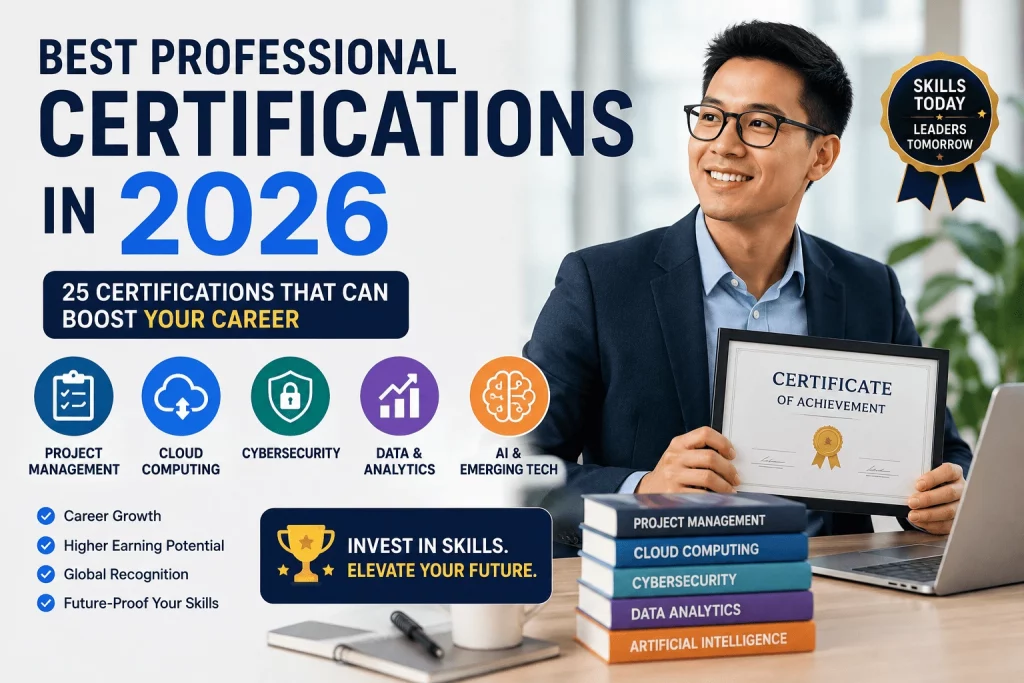
The job market is becoming increasingly skills-based. Employers are looking for candidates who can demonstrate practical expertise, and professional certifications have become one of the fastest ways to validate those skills without going back to school for another degree. Whether you’re switching careers entirely, trying to break into tech for the first time, or looking to move up into a management or specialist role, the right certification can meaningfully shorten the distance between where you are now and where you want to be.
The most valuable certifications in 2026 are concentrated in project management, cloud computing, cybersecurity, data analytics, AI, and business operations — fields where demand continues to outpace the supply of qualified, certifiably-skilled professionals. This guide breaks down 25 of the most relevant certifications across these categories, organizes them by career stage and career goal, and walks through common mistakes people make when choosing a certification path.
This is not a ranked “best to worst” list. Instead, it’s organized around a simple idea: the best certification for you depends on where you are in your career and where you’re trying to go. A fresh graduate exploring tech for the first time needs a very different starting point than a mid-career professional angling for a management role, and this guide is structured to help both — and everyone in between — find the right fit.
Why Certifications Matter More in 2026
Several converging trends have made certifications more relevant to hiring decisions than they were even a few years ago. Remote and hybrid work have widened the pool of applicants for many roles, making it harder for hiring managers to rely purely on where someone went to school or which companies appear on their resume. At the same time, many fields — particularly cloud computing, cybersecurity, and AI — are evolving fast enough that a degree earned five or ten years ago may not reflect current, in-demand skills.
Certifications help close that gap in two ways. First, they give employers a standardized, third-party-verified signal of competency, which is especially valuable when comparing candidates from very different educational and professional backgrounds. Second, because most certification bodies periodically update their exams and content to reflect current tools and best practices, a recent certification can actually be a stronger signal of up-to-date skills than a degree completed years earlier.
None of this means certifications have replaced degrees or experience — they haven’t. But for career changers, self-taught professionals, and anyone trying to formally validate skills they’ve picked up outside a traditional classroom, certifications have become one of the most efficient tools available for getting noticed.
What Are the Best Professional Certifications in 2026?
If you only have time to skim, here’s the short version:
- For project management: PMP is the global gold standard, with CAPM as a beginner-friendly entry point.
- For cloud computing: AWS Solutions Architect Associate and Microsoft Azure Administrator (AZ-104) are consistently among the most in-demand.
- For cybersecurity: CISSP for experienced professionals, CompTIA Security+ for those starting out.
- For data and analytics: Google Data Analytics Professional Certificate is one of the strongest career-changer credentials available.
- For AI: Google AI Professional Certificate and Microsoft AI certifications are growing quickly alongside enterprise AI adoption.
- For agile teams: Professional Scrum Master (PSM) remains highly valuable across both software and business teams.
The sections below go deeper into each of these, plus a full comparison table, tiered framework, and career-stage breakdown to help you choose confidently.
Quick Comparison Table
| Certification | Industry | Difficulty | Career Impact | Global Recognition |
|---|---|---|---|---|
| PMP | Project Management | High | Very High | Excellent |
| AWS Solutions Architect | Cloud | Medium | Very High | Excellent |
| Google Data Analytics | Data | Beginner | High | Good |
| CISSP | Cybersecurity | High | Very High | Excellent |
| Scrum Master | Agile | Medium | High | Excellent |
| CAPM | Project Management | Beginner | High | Excellent |
| Azure Certifications | Cloud | Medium | High | Excellent |
| CompTIA Security+ | Cybersecurity | Medium | High | Excellent |
Use this table as a quick filter: if you already know which industry you’re targeting, start there, then cross-reference difficulty level against how much time and prior background you’re realistically able to commit.
Atlas Career Certification Framework™
Rather than treating all 25 certifications as equally relevant to everyone, it helps to think in terms of career stage. The Atlas Career Certification Framework™ organizes certifications into three tiers based on who they’re best suited for.
Tier 1: Career Launch Certifications
Best for: Students, fresh graduates, career changers
These certifications are designed to be accessible without extensive prior experience, making them ideal starting points for anyone trying to break into a new field.
- Google Data Analytics
- Google IT Support
- AWS Cloud Practitioner
- AI-900 Azure AI Fundamentals
- CAPM
Tier 2: Career Growth Certifications
Best for: Professionals with 2–5 years of experience
Once you have some foundational work experience, these certifications help formalize and deepen your expertise, often unlocking mid-level roles with more responsibility.
- PMP
- AWS Solutions Architect Associate
- Azure Administrator (AZ-104)
- Scrum Master
- CompTIA Security+
Tier 3: Career Acceleration Certifications
Best for: Senior professionals, managers, specialists
These are typically harder to earn, require significant prior experience, and are aimed at professionals looking to move into senior technical or leadership roles.
- CISSP
- AWS Professional Certifications
- Advanced Azure Certifications
- Advanced Cybersecurity Certifications
Knowing which tier you fall into is often more useful than trying to chase the “best” certification in the abstract — a Tier 3 certification pursued too early, without the underlying experience to back it up, tends to be a much harder and less rewarding path than starting at the appropriate tier and working your way up.
Top 25 Professional Certifications in 2026
Category 1: Project Management
PMP (Project Management Professional)
Why it matters:
- Global gold standard for project management
- Recognized across industries, from construction to software
- Strong salary impact for professionals who hold it
Best for: Project Managers, Operations Managers, Program Managers
PMP is administered by the Project Management Institute (PMI) and requires candidates to meet minimum experience thresholds before sitting for the exam, which is part of why it carries so much weight with employers — it’s not simply a knowledge test, but a credential that confirms you’ve actually managed real projects. The exam itself covers a broad range of methodologies, including both traditional waterfall approaches and agile frameworks, reflecting how most modern organizations now blend the two rather than relying exclusively on one.
CAPM (Certified Associate in Project Management)
Why it matters:
- Beginner-friendly pathway into project management
- Doesn’t require the extensive professional experience that PMP does
Best for: Career starters looking to break into project management roles
Unlike PMP, CAPM doesn’t require extensive documented project management experience, making it a realistic goal for recent graduates or professionals coordinating projects informally within a broader role — such as an operations coordinator or team lead — who want a credential that formally signals project management competency.
Professional Scrum Master (PSM)
Why it matters:
- Agile methodology is now mainstream across both software and non-software teams
- Valuable for professionals working in cross-functional, iterative environments
Best for: Team leads, product owners, and anyone coordinating agile workflows
PSM certification validates your understanding of the Scrum framework specifically, one of the most widely adopted agile methodologies. Because agile principles have expanded well beyond software development into marketing, product design, and even HR teams in many organizations, this certification has become relevant to a much broader audience than its original software-engineering roots would suggest.
Category 2: Cloud Computing
AWS Solutions Architect Associate
Consistently among the most in-demand cloud certifications on the market, this credential validates your ability to design and deploy scalable systems on Amazon Web Services — one of the dominant cloud platforms used by enterprises worldwide. It typically requires some hands-on experience with AWS services and a working understanding of core architectural principles like fault tolerance, cost optimization, and security best practices, which is part of why it’s positioned as a Tier 2 rather than beginner credential.
AWS Cloud Practitioner
Widely considered the best beginner cloud certification available, this credential introduces foundational cloud concepts without requiring deep technical background, making it a natural entry point for career changers. It’s often used as a stepping stone toward the more technical Solutions Architect certification once a learner has built enough foundational comfort with cloud terminology and services.
Azure Administrator (AZ-104)
The best option for professionals working within the Microsoft ecosystem, particularly in organizations already relying heavily on Azure infrastructure and services. This certification focuses heavily on the practical, day-to-day work of managing Azure resources — identity, storage, networking, and compute — making it especially relevant for IT professionals moving from on-premises infrastructure roles into cloud administration.
Azure AI Fundamentals (AI-900)
Demand for this certification is growing quickly as enterprises continue adopting AI tools built on Microsoft’s platform, making it a relevant credential even for non-technical professionals who need to understand AI concepts at a foundational level. Because it doesn’t require a programming background, it’s often recommended for business analysts, project managers, and other non-engineering roles who increasingly need to collaborate with AI-focused teams.
Category 3: Cybersecurity
CISSP (Certified Information Systems Security Professional)
Best suited for experienced cybersecurity professionals, CISSP is widely regarded as one of the most respected credentials in the field, often required or strongly preferred for senior security roles. Administered by (ISC)², it requires several years of verified security work experience across multiple domains before a candidate is eligible to earn full certification, which is a major reason it carries such weight in hiring decisions for leadership-level security positions like security architect or Chief Information Security Officer (CISO).
CompTIA Security+
One of the strongest entry-level cybersecurity certifications available, Security+ is frequently used as a baseline requirement for cybersecurity positions, including many government and defense-related roles. It covers foundational concepts across network security, threats, cryptography, and risk management, and is vendor-neutral — meaning the knowledge it validates applies broadly rather than being tied to one specific company’s products or platform.
Google Cybersecurity Professional Certificate
A good entry point into cybersecurity careers, particularly for career changers who want a structured, guided introduction to the field without needing extensive prior IT experience. The program typically combines foundational security concepts with hands-on practice using industry tools, giving learners practical experience they can point to in interviews even before landing their first cybersecurity role.
Category 4: Data & Analytics
Google Data Analytics Professional Certificate
An excellent certification for career changers, this program is designed to take learners with little to no prior background and build them toward job-ready data analytics skills, including tools like SQL, spreadsheets, and data visualization. The curriculum is built around a case-study-driven format, meaning learners complete a portfolio-style capstone project along the way — a genuine advantage for anyone entering the job market without prior professional data work to showcase.
Microsoft Power BI Certification
Demand for business intelligence skills continues to grow as more organizations rely on data dashboards and visualization tools to guide decision-making, making Power BI certification increasingly valuable across industries — not just for dedicated data analysts, but also for finance, marketing, and operations professionals who regularly build or interpret reports for stakeholders.
Databricks Certifications
Particularly high demand in modern data engineering roles, Databricks certifications validate skills in large-scale data processing and analytics — an increasingly critical function as organizations manage growing volumes of data. These certifications tend to assume a stronger technical background than the other data credentials on this list, making them more appropriate for professionals already comfortable with programming and distributed data systems.
Category 5: AI Certifications
Google AI Professional Certificate
A structured credential designed to build foundational and applied AI skills, positioned well for professionals looking to move into AI-adjacent roles or add AI literacy to an existing technical background. The program typically balances conceptual understanding — how large language models and machine learning systems actually work — with practical application, such as prompt engineering and integrating AI tools into existing workflows.
AWS AI Practitioner
Growing rapidly alongside enterprise AI adoption, this certification validates foundational knowledge of AI and machine learning concepts within the AWS ecosystem. It’s designed to be accessible to a broad audience, including business and technical professionals who need a working understanding of AI capabilities without necessarily building models themselves.
Microsoft AI Certifications
Particularly relevant for organizations using Microsoft Copilot and other AI tools built into the Microsoft 365 ecosystem, these certifications are well-suited to professionals working in Microsoft-centric enterprise environments. As more companies roll out AI-assisted tools across everyday productivity software, certifications like this help professionals demonstrate they can use these tools effectively rather than merely being aware they exist.
Highest ROI Certifications in 2026
If you’re choosing a certification primarily based on career return on investment, it helps to work backward from your specific goal rather than picking the certification with the most name recognition. The decision matrix below maps common career goals to the certification most directly aligned with that outcome.
| Goal | Recommended Certification |
|---|---|
| First Tech Job | Google IT Support |
| Data Career | Google Data Analytics |
| Cloud Career | AWS Solutions Architect |
| Cybersecurity | Security+ |
| Management | PMP |
| AI Career | Google AI Professional Certificate |
| Business Analyst | CAPM |
| Leadership | PMP |
Notice that PMP appears twice — once for management and once for leadership more broadly. This reflects how widely recognized and cross-applicable the certification is, extending well beyond formal project management job titles into general leadership credibility.
Certifications by Career Stage
Beyond the tiered framework above, it can help to see certifications grouped explicitly by where you currently are in your career.
Students
- Google IT Support
- Google Data Analytics
- AWS Cloud Practitioner
- AI-900
These certifications are specifically designed to be approachable without a professional work history, making them ideal for building a resume before graduation.
Career Changers
- Google Career Certificates (broadly)
- CAPM
- AWS Cloud Practitioner
Career changers benefit from certifications that don’t assume prior industry-specific experience, while still signaling genuine, job-ready competency to a new set of employers.
Mid-Career Professionals
- PMP
- Scrum Master
- Security+
- AZ-104
At this stage, certifications tend to formalize skills you may already be using informally on the job, helping you compete for promotions or lateral moves into more specialized roles.
Senior Professionals
- CISSP
- AWS Professional Certifications
These credentials typically require substantial hands-on experience to earn, and are most valuable for professionals already operating at a senior technical or leadership level looking to further validate and formalize their expertise.
How to Choose the Right Certification for You
With so many options across categories, choosing where to start can feel overwhelming. A few practical questions can help narrow the field considerably:
- What industry am I trying to enter or advance within? This alone typically eliminates most of the list.
- How much relevant experience do I already have? Be honest about whether you’re realistically a Tier 1, Tier 2, or Tier 3 candidate.
- How much time can I commit to studying? Beginner-friendly certifications like Google Career Certificates are designed for flexible, self-paced learning, while credentials like CISSP or PMP often require months of dedicated preparation.
- Does my target employer or industry specifically value this certification? Some fields have strong, well-established certification expectations (cybersecurity and Security+, for example), while others weigh certifications more loosely alongside portfolio work and interviews.
- Am I choosing this certification because it’s genuinely relevant, or just because it looks impressive? This distinction matters more than most people expect, and is explored further in the mistakes section below.
Answering these questions honestly will typically point you toward one or two certifications worth prioritizing, rather than leaving you trying to evaluate all 25 at once.
Stacking Certifications Strategically
For professionals already a few years into their career, a common and effective strategy is stacking certifications that build on each other rather than jumping between unrelated fields. A cloud professional, for example, might start with AWS Cloud Practitioner, move to AWS Solutions Architect Associate once they have hands-on project experience, and eventually pursue an AWS Professional-level certification once they’re operating in a senior architecture role. Each credential in that sequence builds a coherent, increasingly specialized story that’s easy for a hiring manager to follow.
The same logic applies across categories, not just within them. A project manager who earns PMP might later add a Scrum Master certification to strengthen their credibility in organizations that blend traditional and agile project methodologies. A data analyst who starts with Google Data Analytics might later add a Power BI certification to specialize further in business intelligence and reporting. The key is ensuring each additional certification adds a genuinely new, complementary capability rather than simply duplicating what a previous credential already demonstrated.
This is also where the earlier point about avoiding certification-collecting for its own sake becomes especially relevant — a strategically stacked set of two or three certifications, each paired with real project work, is almost always more persuasive to employers than five or six credentials that don’t clearly build toward a coherent specialization.
How to Prepare and Study Effectively
Once you’ve chosen a certification, how you prepare matters almost as much as which credential you pick. Most of the certifications on this list offer official study materials directly from the certifying body — Google, AWS, Microsoft, PMI, or (ISC)² — and starting there is generally more reliable than relying solely on third-party study guides, which can sometimes lag behind exam updates.
For technical certifications in particular, hands-on practice environments make a significant difference. Cloud providers like AWS and Microsoft typically offer free-tier accounts that let you practice directly with real services rather than studying concepts in the abstract. Cybersecurity learners often benefit from setting up home lab environments or using dedicated practice platforms designed to simulate real-world security scenarios. For project management and agile certifications, working through realistic case studies and practice exams tends to matter more than memorizing terminology, since these exams frequently test applied judgment rather than simple recall.
Practice exams deserve particular attention regardless of which certification you’re pursuing. Most certifying bodies or reputable third-party providers offer practice tests that mirror the format and difficulty of the real exam, and consistently scoring well on these before attempting the actual certification is one of the more reliable predictors of success. Rushing into an exam without this step is one of the most common reasons capable, well-prepared candidates fail on their first attempt.
Finally, pacing matters. Beginner-friendly certifications are often designed for flexible, self-paced study over a few months, while advanced certifications like PMP or CISSP frequently require a more structured, sustained study plan — sometimes spanning three to six months of consistent, dedicated preparation. Setting a realistic timeline from the outset, rather than assuming you’ll simply “find time” as you go, significantly improves the odds of actually finishing what you start.
Common Certification Mistakes
Even strong, motivated professionals sometimes undermine their own certification strategy through a handful of avoidable mistakes.
Mistake #1: Collecting Certificates Without Practical Projects
A stack of certifications with no practical work to back them up can actually raise questions rather than answer them in an interview. Certifications work best as a complement to hands-on projects, not a substitute for them — employers increasingly want to see evidence that you can apply what a certification claims you’ve learned. A candidate who can walk an interviewer through a real project, even a small self-directed one, will typically leave a stronger impression than one who can only describe what a certification covered in the abstract.
A practical way to avoid this mistake is to treat every certification as half of a two-part commitment: complete the coursework, then immediately apply what you’ve learned to a small, concrete project — even something as simple as analyzing a public dataset, setting up a personal cloud environment, or running a mock security audit on your own home network. These projects don’t need to be elaborate to be valuable; what matters is that they exist and that you can speak to them specifically.
Mistake #2: Choosing Certifications Based Solely on Salary
Chasing whichever certification has the highest reported salary attached to it, without considering whether the underlying work genuinely interests you or fits your existing skill set, often leads to a mismatched career path and a credential that doesn’t translate into real opportunities. Salary potential matters, but it shouldn’t be the only factor driving your decision.
This mistake tends to show up most often when professionals see a certification cited alongside an impressive salary figure in an online article or forum post, without accounting for how much of that figure depends on years of prior experience, geographic location, or a specific niche specialization that the certification alone doesn’t guarantee. A more reliable approach is to research the actual day-to-day work associated with a certification — job descriptions, typical responsibilities, required tools — and honestly assess whether that work is something you’d want to be doing five days a week, regardless of the number attached to it.
Mistake #3: Ignoring Employer Demand
Some certifications are technically well-regarded within a niche community but carry little weight with the specific employers or industries you’re targeting. Before committing time and money to a certification, it’s worth researching whether the specific companies or sectors you want to work in actually value and recognize it.
One practical way to check this is to search job postings in your target field and see how frequently a specific certification is listed as required or preferred. If a certification rarely or never appears in postings for the roles you actually want, it may still have value for personal learning, but it likely shouldn’t be your top priority if your primary goal is improving your job prospects in the near term.
Reddit discussions consistently note that certifications help get interviews, but practical experience and projects remain critical for hiring success — a pattern echoed across most professional communities discussing this topic. In other words, a certification is often best understood as a door-opener rather than the entire case for your candidacy.
Atlas Certification Selection Matrix™
If you already know the specific role you’re aiming for, this quick-reference matrix maps common target roles to the certification most commonly recommended as a starting point.
| If You Want To Become… | Get This Certification First |
|---|---|
| Data Analyst | Google Data Analytics |
| Project Manager | CAPM |
| Cloud Engineer | AWS Cloud Practitioner |
| Cybersecurity Analyst | Security+ |
| AI Professional | Google AI Professional Certificate |
| Scrum Master | PSM |
This matrix intentionally recommends the most accessible entry-point certification for each path rather than the most advanced one — the idea being that it’s generally easier and more strategic to build toward CISSP or PMP after establishing foundational credibility, rather than attempting to start there directly.
Maintaining and Renewing Your Certifications
Earning a certification is often treated as the finish line, but many of the credentials covered in this guide require ongoing maintenance to remain valid — a detail that’s easy to overlook when you’re focused on passing the initial exam. PMP, for example, requires accumulating continuing education units over a multi-year cycle to keep the certification active. CISSP has a similar continuing professional education requirement, reflecting how quickly best practices evolve in cybersecurity. Cloud certifications from AWS and Microsoft typically expire after a set period as well, requiring recertification exams to confirm your knowledge has kept pace with platform updates.
This ongoing requirement isn’t necessarily a downside — in many ways, it’s part of what keeps these certifications credible with employers in the first place. A credential that never expires, in a field that changes as quickly as cloud computing or AI, would eventually stop meaning very much. But it does mean that choosing a certification is a longer-term commitment than just the initial study period, and it’s worth factoring ongoing renewal requirements into your decision, particularly if you’re weighing multiple certifications with similar career value.
Practically, this means keeping a simple record of when each certification needs to be renewed and what specific requirements — continuing education credits, a recertification exam, or proof of ongoing professional activity — apply to it. Many professionals build this renewal cycle into their broader professional development routine, treating it as a periodic checkpoint to refresh their skills rather than a bureaucratic afterthought.
Bringing It All Together
With 25 certifications spread across five major categories, it’s worth restating the core idea this guide is built around: there’s no single “best” certification in 2026, only the certification that’s best matched to your current experience level, your target industry, and the specific role you’re trying to move into.
If you’re just starting out, resist the temptation to jump straight to an advanced, Tier 3 credential like CISSP or a professional-level AWS certification — not because you couldn’t eventually pass the exam, but because these certifications are designed to validate experience you likely haven’t accumulated yet, and the study process works best when it’s reinforcing knowledge you’re already applying in some capacity. Start with a Tier 1 certification that matches your target field, pair it with a small practical project, and let your certification path grow alongside your actual work experience.
If you’re further along in your career, the highest-value move is usually strategic stacking rather than starting over in a new field — building on your existing expertise with a certification that formalizes and extends what you already do, rather than chasing whichever credential currently has the most buzz around it.
Whichever certifications you ultimately choose, treat them as one part of a broader professional development strategy rather than the entire strategy itself. The most competitive candidates in any of these fields typically combine a well-chosen certification with genuine hands-on projects, ongoing learning, and a clear, honest sense of the type of work they actually want to be doing — and that combination, more than any single credential, is what tends to open doors.
Frequently Asked Questions
What is the best professional certification in 2026?
There isn’t a single universal answer, since the “best” certification depends heavily on your target industry and career stage. That said, PMP remains one of the most recognized certifications globally for management professionals, while AWS Solutions Architect and CISSP lead their respective technical fields in terms of recognition and career impact.
Are certifications worth it?
Certifications can improve resume visibility and demonstrate skills, particularly for career changers or those without a traditional degree in their target field. However, they are most effective when paired with practical experience and projects — a certification alone rarely guarantees a job offer, but it can meaningfully improve your chances of getting an interview.
Which certification has the highest ROI?
PMP, AWS Solutions Architect, CISSP, and leading cloud and cybersecurity certifications consistently rank among the highest-ROI credentials, largely because they’re tied to fields with strong, sustained employer demand and relatively limited supply of certified professionals.
Do I need a certification to break into tech?
Not necessarily, but for many career changers without a computer science degree or prior technical work history, a well-chosen entry-level certification like Google IT Support or Google Data Analytics can provide a structured, credible way to demonstrate foundational skills to employers who might otherwise be hesitant to consider your application.
How long does it typically take to earn these certifications?
This varies significantly by certification. Beginner-friendly credentials like Google Career Certificates or AWS Cloud Practitioner are often designed to be completed in a few months of part-time study, while more advanced certifications like PMP or CISSP frequently require months of dedicated preparation and, in some cases, a minimum amount of verified professional experience before you’re even eligible to sit for the exam.
Should I get multiple certifications, or focus on just one?
For most people, it’s more effective to focus on one certification that’s directly relevant to your target role, complete it thoroughly, and pair it with practical projects, before moving on to a second credential. Spreading effort across multiple certifications simultaneously often results in a shallower grasp of any single one, which can undermine the very credibility the certification is meant to provide. Once you’ve established a solid foundation, stacking a second, complementary certification — as discussed earlier in this guide — tends to be far more effective than pursuing several unrelated credentials at once.
Are free certifications as valuable as paid ones?
It depends on the issuing organization and industry recognition rather than the price tag itself. Some free or low-cost certifications from well-recognized providers carry substantial weight, while some expensive certifications from lesser-known providers may not be widely recognized by employers. Researching how a specific certification is regarded within your target industry — including how frequently it appears in job postings and professional discussions — is more useful than assuming cost directly correlates with value.
Can certifications alone get me a job with no experience at all?
It’s uncommon, though not impossible, particularly for entry-level roles specifically designed for career changers. In most cases, certifications work best as one part of a broader application that also includes some form of practical demonstration — a portfolio, a personal project, volunteer work, or an internship. Employers hiring for entry-level roles generally understand that candidates won’t have extensive professional experience, but they still want some evidence, beyond the certificate itself, that you can apply what you’ve learned in a realistic setting.
Related Guides
- Microsoft Certifications Guide (2026): The Complete Certification Roadmap
- AI-900 Review (2026): Is Azure AI Fundamentals Worth It?
- AZ-104 Microsoft Azure Administrator Review (2026): Is It Worth It?
- Azure Certifications Guide (2026): The Complete Azure Certification Roadmap
- Free Online Courses for Skill Upgrade in 2026: The Complete Global Guide
- Best Time Management Courses in 2026 (For Government Employees & Professionals)
- Google AI Essentials Review (2026): Everything You Need to Know Before You Enroll
- Google AI Professional Certificate: The Complete 2026 Review
- Google Data Analytics Professional Certificate: The Complete Review
- Google Cybersecurity Professional Certificate Review (2026): Is It Worth It?
- Google IT Support Professional Certificate Review (2026): Is It Worth It?
- Google UX Design Professional Certificate Review (2026): Is It Worth It?
- Google Digital Marketing & E-commerce Professional Certificate Review: Is It Worth It
- AWS Certified Developer Associate (DVA-C02): The Complete 2026 Guide
- AWS Certified Cloud Practitioner (2026): Complete Certification Guide
- AWS Certifications Guide (2026): The Complete AWS Certification Roadmap
- Google AI Professional Certificate vs Google Data Analytics Professional Certificate