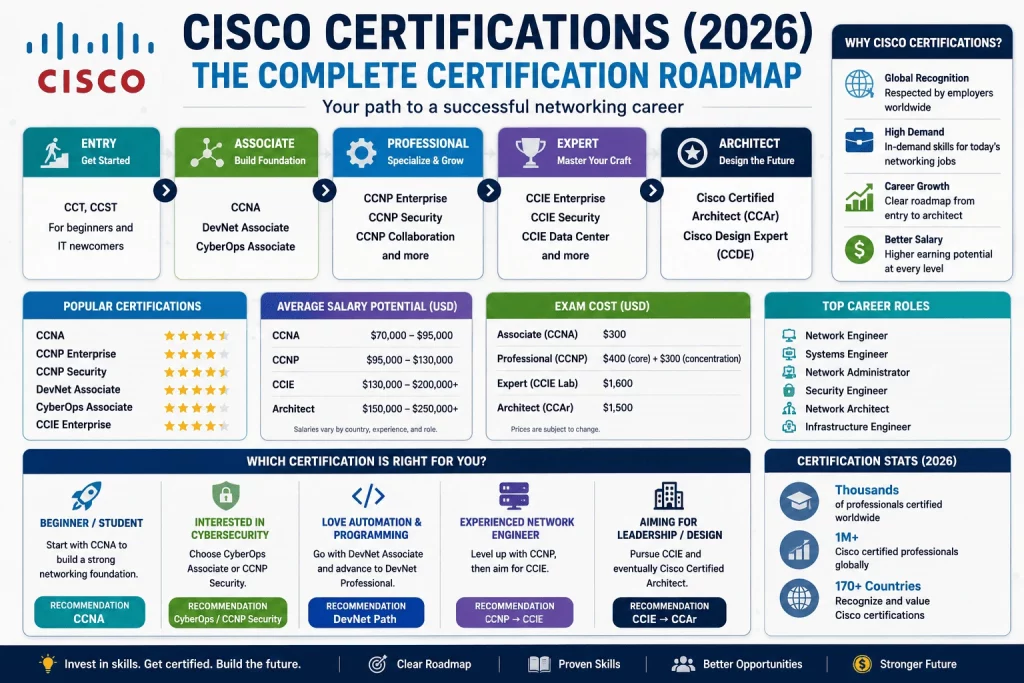
If you’re trying to figure out which Cisco certification to pursue, how much it will cost you, how long it will take, and whether it will actually move the needle on your salary, you’re in the right place. This guide walks through the entire Cisco certification system — from entry-level credentials to the CCIE and Cisco Certified Architect — with real 2026 pricing, realistic timelines, and a decision framework you can use today.
Most people should start with the CCNA (200-301), which costs $300 for the exam, takes 3–6 months of study for a typical beginner, and is the single most recognized networking credential in IT. From there, the path splits based on your goals: CCNP for deeper specialization and a real salary jump, CyberOps or CCNP Security if you want cybersecurity, DevNet if you want automation and programmability, and CCIE if you want to reach the top of the technical ladder.
Everything below expands on that answer in detail.
What Are Cisco Certifications?
Cisco certifications are vendor-specific IT credentials issued by Cisco Systems that validate a person’s ability to design, install, configure, operate, and troubleshoot Cisco networking equipment and software. They are administered through the Cisco Learning Network and delivered primarily via Pearson VUE testing centers (with the exception of CCIE and CCDE lab exams, which run through Cisco’s own lab infrastructure).
Cisco certifications matter because Cisco hardware and software still underpin a huge share of enterprise networking, service provider infrastructure, and data center environments worldwide. Even as cloud-native networking, SD-WAN, and infrastructure-as-code have reshaped the field, the fundamentals Cisco certifications teach — routing, switching, IP addressing, network security, and increasingly automation and APIs — remain the backbone of how organizations actually move data.
A few reasons Cisco certifications continue to carry weight:
- Global recognition. A CCNA or CCNP means roughly the same thing whether you’re being interviewed in Manila, Toronto, London, or Dubai. Few IT credentials travel this well.
- Networking careers still require them. Job postings for network engineer, network administrator, NOC technician, and infrastructure engineer roles frequently list a Cisco certification as required or strongly preferred.
- Employer demand hasn’t disappeared. Even as multi-vendor and cloud-first environments grow, most enterprises run hybrid infrastructure that still includes significant Cisco hardware, meaning Cisco-certified staff remain in demand.
- The ladder is well-defined. Unlike some certification ecosystems that feel scattered, Cisco’s five-level structure (Entry → Associate → Professional → Expert → Architect) gives you a clear, linear path to follow.
Why Cisco Still Matters in 2026
The networking world has diversified — AWS, Azure, and Google Cloud all have their own certification tracks, and vendor-neutral options like CompTIA Network+ exist too. But Cisco hasn’t been displaced so much as it has adapted. Cisco has folded automation, APIs, and software-defined networking into its associate and professional tracks (most visibly through DevNet), which means a modern Cisco certification isn’t just about CLI commands anymore — it also signals that you understand how networks are automated and integrated with cloud platforms. For most networking career paths, Cisco certifications remain either the primary credential or a strong complement to cloud certifications, not a replacement need.
Quick Verdict: The Atlas Scorecard™
| Category | Rating | Notes |
|---|---|---|
| Beginner Friendly | 4/5 | CCNA is achievable with 3–6 months of focused study, even without prior IT experience |
| Salary Potential | 4.5/5 | Meaningful pay jumps at every tier, with CCIE-level professionals commanding six-figure premiums |
| Global Recognition | 5/5 | Recognized in virtually every country with an IT sector |
| Employer Demand | 4/5 | Still a common requirement or preferred qualification in networking, security, and infrastructure roles |
| Career Growth | 4.5/5 | Clear vertical path from help desk to principal network architect |
| Technical Difficulty | Scales from 2/5 (Entry) to 5/5 (Expert/Architect) | Difficulty is a function of which level you’re targeting |
| Overall Recommendation | Strongly worth pursuing | Best suited to anyone building a career in networking, infrastructure, or network security |
Complete Cisco Certification Roadmap (2026)
Cisco’s certification system is organized as a five-level pyramid. Each level builds on the one before it, though — importantly — Cisco no longer requires you to hold every lower-level certification before attempting the next one (with limited exceptions at the CCIE and CCAr level, discussed below).
The visual roadmap:
Entry (CCT, CCST)
        ↓
Associate (CCNA, DevNet Associate, CyberOps Associate)
        ↓
Professional (CCNP Enterprise, Security, Collaboration, Data Center, Service Provider, DevNet Professional)
        ↓
Expert (CCIE Enterprise, CCIE Security, CCIE Collaboration, CCIE Data Center, CCIE Service Provider, CCIE Enterprise Wireless, DevNet Expert, CCDE)
        ↓
Architect (Cisco Certified Architect — CCAr)
The Atlas Certification Navigator™: A Simple Decision Tree
If you’re not sure where to start, walk through this:
Want your first IT job, with no prior networking background? → Start with CCNA. It’s the credential employers recognize most, and it doesn’t assume prior certifications.
Already working as a network engineer with a few years of experience? → Go for CCNP in the track that matches your job (Enterprise, Security, Collaboration, Data Center, or Service Provider).
Want to become a recognized enterprise-level expert? → Target CCIE in your specialty. This is a career-defining credential, not a resume line item.
Want to move into network design and high-level architecture, and you’re already an expert-level professional? → Pursue Cisco Certified Architect (CCAr), the top of the pyramid.
This decision tree is intentionally simple because most people overthink the starting point. Unless you already have deep hands-on Cisco experience, CCNA is almost always the right first move.
Cisco Certification Levels Explained
Entry Level
The entry tier includes the Cisco Certified Support Technician (CCST) credentials (Networking, Cybersecurity, and IT Support tracks) and the older Cisco Certified Technician (CCT). These are designed for people with little or no IT background — often students, career changers, or people testing whether networking is a fit before committing to CCNA-level study. They’re inexpensive, short, and focused on fundamentals: basic networking concepts, simple troubleshooting, and foundational terminology.
Associate Level
This is where most career-focused candidates begin in earnest. The associate tier includes:
- CCNA (200-301) — the flagship, vendor-recognized networking associate certification
- DevNet Associate — network automation, APIs, and software development fundamentals for network professionals
- CyberOps Associate — security operations center (SOC) fundamentals, threat detection, and incident response
Associate-level certifications assume some foundational knowledge but don’t require any prior Cisco certification. They typically take 3–6 months of dedicated study for someone with limited experience, or 6–8 weeks for someone already working in IT.
Professional Level
The professional tier is where Cisco certifications start to specialize. CCNP certifications require passing a core exam (shared foundation for that track) plus a concentration exam (your specialization within the track). Available CCNP tracks include:
- CCNP Enterprise
- CCNP Security
- CCNP Collaboration
- CCNP Data Center
- CCNP Service Provider
- DevNet Professional
Professional-level certifications are aimed at people with real production experience — Cisco doesn’t formally require it, but the exams assume it. Most candidates have 2–5 years of hands-on networking work before attempting CCNP.
Expert Level
This is where Cisco certification becomes genuinely elite. CCIE certifications require passing the same core written exam as the corresponding CCNP track, followed by an 8-hour hands-on lab exam — one of the most demanding exams in the entire IT industry. Cisco also offers CCDE (Cisco Certified Design Expert) and DevNet Expert at this level. Roughly a quarter to a third of candidates pass the CCIE lab on their first attempt, and many candidates require multiple sittings.
Architect Level
Cisco Certified Architect (CCAr) sits at the very top. It’s not a written or lab exam in the traditional sense — it’s a board review process, where you present and defend enterprise network architecture designs to a panel of experts. Very few people hold this certification globally, and it’s reserved for professionals operating at a principal architect or CTO-adjacent level.
Complete Cisco Certification List
| Certification | Level | Difficulty | Best For |
|---|---|---|---|
| CCST (Networking/Cybersecurity/IT Support) | Entry | ★☆☆☆☆ | Students, absolute beginners |
| CCNA | Associate | ★★☆☆☆ | Anyone starting a networking career |
| DevNet Associate | Associate | ★★★☆☆ | Network engineers moving into automation |
| CyberOps Associate | Associate | ★★☆☆☆ | Aspiring SOC analysts |
| CCNP Enterprise | Professional | ★★★★☆ | Working network engineers |
| CCNP Security | Professional | ★★★★☆ | Network security professionals |
| CCNP Collaboration | Professional | ★★★★☆ | Unified communications / voice engineers |
| CCNP Data Center | Professional | ★★★★☆ | Data center infrastructure engineers |
| CCNP Service Provider | Professional | ★★★★☆ | ISP and telecom network engineers |
| DevNet Professional | Professional | ★★★★☆ | Automation-focused network engineers/developers |
| CCIE Enterprise Infrastructure | Expert | ★★★★★ | Senior network engineers, architects-in-training |
| CCIE Security | Expert | ★★★★★ | Senior security engineers |
| CCIE Collaboration | Expert | ★★★★★ | Senior voice/UC engineers |
| CCIE Data Center | Expert | ★★★★★ | Senior data center engineers |
| CCIE Service Provider | Expert | ★★★★★ | Senior telecom/ISP engineers |
| CCIE Enterprise Wireless | Expert | ★★★★★ | Senior wireless network engineers |
| Cisco Certified Architect (CCAr) | Architect | ★★★★★+ | Principal architects, CTO-track professionals |
The Atlas Difficulty Meter™
To put actual numbers behind “difficulty,” here’s how the major certifications compare across the factors that matter most:
| Certification | Difficulty | Typical Study Time | Lab Requirement | Coding Required | Networking Knowledge Needed |
|---|---|---|---|---|---|
| CCNA | Moderate | 150–300 hours | Simulated (exam-based) | No | Foundational |
| DevNet Associate | Moderate–High | 200–350 hours | Simulated | Yes (Python basics) | Foundational–Intermediate |
| CyberOps Associate | Moderate | 150–300 hours | Simulated | No | Foundational |
| CCNP (any track) | High | 250–600 hours | Simulated + real-world config | Varies by track | Intermediate–Advanced |
| CCIE (any track) | Very High | 600–1,200+ hours | Full 8-hour practical lab | Sometimes | Expert |
| CCAr | Extreme | Years of experience + board prep | Design defense, not hands-on lab | No | Master-level |
Which Cisco Certification Should You Choose?
The “best” Cisco certification depends entirely on where you’re starting from and what you want out of it. Here’s how the recommendation changes by situation.
Students
If you’re still in school or a recent graduate with no professional IT experience, start with CCNA. Many academic institutions partner with Cisco Networking Academy, which offers discounted or free access to CCNA-aligned coursework — sometimes cutting the eventual exam cost by up to half through student vouchers. Don’t jump straight to CCNP; build the fundamentals first.
Career Changers
If you’re coming from a different field entirely (retail, hospitality, a non-technical office job), CCNA is still the right entry point, but budget more study time — realistically 4–6 months of consistent effort — since you’re building networking fundamentals from scratch rather than reinforcing existing knowledge.
IT Support / Help Desk
If you’re already in a help desk or IT support role, CCNA is a natural next step and often directly unlocks promotion into network administrator or junior network engineer roles. Many help desk professionals see CCNA as the single highest-ROI certification available to them.
Network Engineer
If you’re already working as a network engineer with 2+ years of experience, CCNP is where the real value is. Choose the track that matches your actual job: Enterprise for general routing/switching environments, Security if you’re security-adjacent, Data Center if you work with Nexus switching and UCS, Collaboration if you manage voice/video infrastructure.
Cybersecurity
If your goal is a security career specifically, CyberOps Associate followed by CCNP Security is the strongest Cisco-specific path. Pairing this with a vendor-neutral credential like CompTIA Security+ or a SOC-analyst-focused certification can broaden your options further.
Cloud Engineer
Cisco certifications are not cloud certifications, but DevNet Associate/Professional bridges the gap well, since it focuses on APIs, automation, and infrastructure-as-code principles that translate directly to cloud and hybrid environments. Most cloud-leaning professionals pair DevNet with an AWS or Azure certification rather than relying on Cisco alone.
The Atlas Career Match™
| Goal | Best Certification |
|---|---|
| First IT job | CCNA |
| Maximum salary | CCIE (Security or Enterprise) |
| Remote work flexibility | DevNet Associate/Professional |
| Security career | CyberOps Associate → CCNP Security |
| Cloud/hybrid infrastructure | DevNet + AWS/Azure certification |
| Automation focus | DevNet Associate → DevNet Professional |
| Leadership / architecture track | CCNP → CCIE → CCAr |
Cisco Certification Cost
This is one of the most searched questions about Cisco certifications, and the honest answer is: it depends heavily on which level you’re targeting and how much of the preparation you pay for versus do yourself.
Exam Fees by Level (2026 Pricing)
| Certification | Exam Fee (USD) |
|---|---|
| CCST (Entry) | $125 |
| CCNA (200-301) | $300 |
| DevNet Associate | $300 |
| CyberOps Associate | $300 |
| CCNP core exam | $400 |
| CCNP concentration exam | $300 |
| CCNP total (core + concentration) | ~$700 |
| CCIE written/core exam | $400–$450 |
| CCIE lab exam | $1,600+ |
| CCAr board qualification review | $3,750 |
| CCAr board review | $11,250 |
| CCAr total | ~$15,000 |
Full Cost Breakdown
Exam fee. As shown above, this ranges from $125 at entry level to well over $2,000 for the CCIE written-plus-lab combination, and roughly $15,000 for the CCAr board process.
Study materials. Official Cisco Press cert guides typically run $50–$100 per book. Bundled “library” editions with practice exams can run closer to $150–$200.
Cisco U. Cisco’s own learning platform (Cisco U.) offers free and paid content, including some official practice exams and continuing education material — a cost-effective option, especially for renewal credits.
Books. Beyond official Cisco Press material, many candidates supplement with third-party guides, video courses (often $15–$50/month on subscription platforms), and flashcard apps.
Practice labs. Hands-on practice is essential, especially past CCNA level. Cisco Modeling Labs (CML) personal licenses run roughly $199 for a 20-node license or $349 for 40 nodes, though a free limited-node edition exists. GNS3 and Packet Tracer remain free alternatives for CCNA-level practice.
Retakes. Every retake costs the full exam fee again — there’s no discount for a second attempt, and Cisco enforces a mandatory waiting period (commonly five days) between attempts at the same exam.
Realistic Total Cost by Level
| Path | Self-Study Total | With Instructor-Led Training |
|---|---|---|
| CCNA | $380–$800 | $1,500–$4,000+ |
| CCNP | $800–$2,500 | $3,000–$6,000+ |
| CCIE | $12,000–$19,000+ (including retakes, travel to lab centers, and extended prep) | Often $15,000–$25,000+ |
| CCAr | ~$15,000 exam/board fees alone, before years of preparation | N/A — this is an experience-driven credential |
The Atlas ROI Calculator™: Certification vs. Cost vs. Salary Lift
| Certification | Approx. Total Cost | Typical Prep Time | Average Associated Salary | Rough ROI Read |
|---|---|---|---|---|
| CCNA | ~$400–$800 | 150–300 hrs | ~$85,000–$112,000 | Extremely strong — often pays for itself within weeks of a raise or new role |
| CCNP | ~$800–$2,500 | 250–600 hrs | ~$110,000–$145,000 | Strong — clear 15–25% premium over CCNA-only professionals |
| CCIE | ~$12,000–$19,000 | 600–1,200+ hrs | ~$135,000–$200,000+ (security/data center tracks trending highest) | Very strong long-term, but the steepest time investment relative to incremental pay |
| CCAr | ~$15,000+ | Years of senior-level experience | Principal/architect-level compensation, often $200,000+ | Only relevant once you’re already operating at that seniority |
Certification Difficulty Comparison
| Cert | Beginner Friendly | Labs Required | Coding Involved | Typical Time to Complete |
|---|---|---|---|---|
| CCST | Yes | No | No | 4–8 weeks |
| CCNA | Yes | Simulated only | No | 3–6 months |
| CyberOps Associate | Yes | Simulated only | Minimal | 3–5 months |
| DevNet Associate | Somewhat | Simulated | Yes (Python) | 4–7 months |
| CCNP (any track) | No — assumes CCNA-level knowledge | Real-world configuration scenarios | Track-dependent | 6–12 months |
| CCIE (any track) | No — expert only | Full 8-hour hands-on lab | Sometimes | 12–24+ months |
| CCAr | No — architect only | Design board defense | No | Multi-year career milestone |
Skills You’ll Learn
Cisco certifications build a layered skill set. Here’s roughly what maps to each stage:
Foundational networking (CCNA level):
- Routing and switching fundamentals
- TCP/IP protocol suite
- IPv4 and IPv6 addressing and subnetting
- VLANs and trunking
- Basic network security concepts
- WLAN fundamentals
- Introductory automation and programmability concepts
Intermediate/advanced networking (CCNP level):
- OSPF and BGP routing protocols at depth
- Advanced switching and redundancy protocols
- Network security architecture (firewalls, VPNs, access control)
- Quality of Service (QoS)
- SD-WAN and SD-Access
- Network automation using APIs and Python
Security-specific skills (CyberOps / CCNP Security):
- Threat detection and security monitoring
- Incident response processes
- Firewall and intrusion prevention configuration
- Security information and event management (SIEM) fundamentals
Automation-specific skills (DevNet track):
- REST APIs and API-based network management
- Python scripting for network automation
- Infrastructure as code (Ansible, Terraform basics as applied to networking)
- CI/CD concepts applied to network operations
The Atlas Skills Matrix™
| Skill Area | CCNA | CCNP | CCIE | DevNet | CyberOps |
|---|---|---|---|---|---|
| Networking Fundamentals | ●●●○○ | ●●●●● | ●●●●● | ●●●○○ | ●●○○○ |
| Security | ●●○○○ | ●●●●○ | ●●●●○ | ●●○○○ | ●●●●● |
| Automation | ●○○○○ | ●●●○○ | ●●●○○ | ●●●●● | ●○○○○ |
| Programming | ○○○○○ | ●○○○○ | ●○○○○ | ●●●●○ | ●○○○○ |
| Cloud Integration | ●○○○○ | ●●○○○ | ●●○○○ | ●●●○○ | ●●○○○ |
| Troubleshooting | ●●●○○ | ●●●●○ | ●●●●● | ●●●○○ | ●●●●○ |
| Infrastructure Design | ●○○○○ | ●●●○○ | ●●●●○ | ●●○○○ | ●●○○○ |
Cisco Certification Career Paths
Traditional Networking Path
Help Desk / NOC Technician
        ↓
CCNA
        ↓
Network Engineer / Network Administrator
        ↓
CCNP
        ↓
Senior Network Engineer / Network Architect
        ↓
CCIE
        ↓
Principal Network Engineer / Distinguished Engineer
Security Path
IT Support / SOC Tier 1 Analyst
        ↓
CyberOps Associate
        ↓
SOC Analyst / Security Engineer
        ↓
CCNP Security
        ↓
Senior Security Engineer
        ↓
CCIE Security
        ↓
Security Architect
Automation Path
Network Engineer (CCNA-level)
        ↓
DevNet Associate
        ↓
Network Automation Engineer
        ↓
DevNet Professional
        ↓
Senior Automation Engineer / NetDevOps Lead
The Atlas Career Growth Planner™ (5-Year View)
| Year | Milestone | Typical Title | Cisco Cert Held |
|---|---|---|---|
| Year 1 | Entry into IT/networking | Help Desk / NOC Technician | None or CCST |
| Year 1–2 | First associate certification | Junior Network Engineer | CCNA |
| Year 2–4 | Build production experience | Network Engineer / Security Analyst | CCNA (renewed) |
| Year 3–5 | Professional certification | Senior Network Engineer | CCNP |
| Year 5–7 | Expert certification (optional but high-value) | Principal Engineer / Network Architect | CCIE |
| Year 8+ | Architecture leadership (rare, senior-only) | Enterprise Architect / CTO-track | CCAr |
Cisco Certification Salary
Cisco certification salaries vary significantly by certification level, specialization track, geography, and years of experience. Below is a realistic 2026 snapshot based on current labor market data.
United States
| Certification Level | Approximate Average Salary |
|---|---|
| CCNA | $85,000–$112,000 |
| CCNP (Enterprise) | $110,000–$145,000 |
| CCNP Security | ~$150,000+ |
| CCIE (average across tracks) | $135,000–$175,000+ |
| CCIE Security | $175,000+ (top earners exceeding $250,000) |
| CCAr / Principal Architect | $200,000+ |
For context, general “CCNA/CCNP” combined salary data across major platforms in 2026 clusters in the $109,000–$161,000 range depending on the source and how titles are self-reported, with the highest-paying US metro areas showing roughly 10–25% premiums over the national average.
Other Regions (Approximate, Entry-to-Mid CCNA/CCNP Range)
| Country | Approximate Annual Salary Range (Entry–Mid, USD equivalent) |
|---|---|
| Canada | $55,000–$90,000 |
| United Kingdom | $40,000–$75,000 |
| Australia | $65,000–$110,000 |
| Singapore | $45,000–$85,000 |
| Philippines | $8,000–$20,000 |
Note: international figures vary widely by employer type (multinational vs. local), city, and specific role. Treat these as directional ranges, not guarantees.
The Atlas Global Salary Comparison™ by Career Stage
| Career Stage | Typical Certification | US | UK | Australia | Philippines |
|---|---|---|---|---|---|
| Entry | CCNA | $70K–$95K | £28K–£40K | AU$70K–$95K | ₱300K–₱600K |
| Mid | CCNP | $105K–$140K | £45K–£65K | AU$100K–$130K | ₱700K–₱1.2M |
| Senior | CCIE | $150K–$220K+ | £70K–£100K+ | AU$140K–$190K+ | ₱1.5M–₱3M+ |
Job Opportunities
Cisco-certified professionals are hired across a wide range of industries. Some of the most consistent employers of Cisco-certified talent include:
- Telecommunications — ISPs, telecom carriers, and network service providers rely heavily on CCNP Service Provider and CCIE-level talent.
- Banking and financial services — highly regulated environments where network security certifications (CyberOps, CCNP Security, CCIE Security) are especially valued.
- Healthcare — hospital networks and healthcare IT systems require secure, highly available infrastructure, making CCNP and security-focused Cisco certifications relevant.
- Cloud providers and managed service providers (MSPs) — MSPs in particular value broad Cisco certification coverage since they support many different client environments.
- Government — public sector IT departments, especially in defense-adjacent or critical infrastructure roles, frequently require Cisco certifications as part of compliance frameworks.
- Education — universities and school districts maintaining their own networks often hire CCNA/CCNP-certified staff.
The Atlas Industry Demand™ Snapshot
| Category | Industries |
|---|---|
| Best Industries for Cisco-Certified Talent | Telecommunications, Financial Services, MSPs |
| Fastest-Growing Demand | Cloud/hybrid infrastructure providers, cybersecurity-focused firms |
| Highest-Paying Industries | Financial services, large-scale cloud/MSP providers, defense contractors |
Cisco Certifications vs. AWS Certifications
Cisco and AWS certifications aren’t direct competitors — they validate different skill domains. Cisco certifications focus on the physical and logical network layer: routing, switching, security appliances, and increasingly automation. AWS certifications focus on cloud infrastructure, services, and architecture within Amazon’s ecosystem.
In practice, many infrastructure professionals hold both. A network engineer with CCNA/CCNP plus an AWS Solutions Architect Associate certification is well-positioned for hybrid cloud roles, since modern enterprise networks routinely span on-premises Cisco hardware and cloud-hosted resources. If you’re choosing one first, base it on your target role: pure networking or security roles favor Cisco first; cloud infrastructure or DevOps roles favor AWS first.
Cisco Certifications vs. Microsoft Certifications
Microsoft certifications (Azure Administrator, Azure Solutions Architect, etc.) overlap with Cisco less than AWS does in terms of subject matter, but they compete for the same career runway in many hybrid IT roles. Cisco certifications remain stronger for pure networking and network security roles; Microsoft certifications are stronger for cloud administration, identity management, and Microsoft-centric enterprise environments (Active Directory, Azure, Microsoft 365 infrastructure). Many enterprise IT professionals hold a Cisco associate-level cert alongside a Microsoft Azure credential.
Cisco Certifications vs. CompTIA Certifications
CompTIA certifications (Network+, Security+, A+) are vendor-neutral and generally considered easier and more foundational than Cisco’s associate-level exams. CompTIA Network+ is often recommended as a stepping stone before CCNA for complete beginners, though it isn’t required. The key difference: CompTIA proves you understand networking concepts in general; Cisco certifications prove you can implement those concepts specifically on Cisco equipment, which is what most networking employers actually run.
Cisco Certifications vs. College Degree
A four-year degree in computer science or IT and a Cisco certification aren’t mutually exclusive, but they answer different employer questions. A degree signals broad theoretical grounding and is often a hard requirement for corporate or government roles with formal education minimums. A Cisco certification signals specific, current, hands-on competence with the equipment an employer actually uses. For many networking roles — especially at small and mid-sized companies — a strong CCNA or CCNP can outweigh the absence of a degree. For large enterprises, government contractors, and roles requiring security clearances, a degree is often still necessary alongside certification.
The Atlas Best Certification Ranking™: Top 10
| Rank | Certification | Best For | Difficulty | Salary Impact | ROI |
|---|---|---|---|---|---|
| 1 | CCNA | Career starters | ★★☆☆☆ | High relative to cost | Exceptional |
| 2 | CCNP Enterprise | Working network engineers | ★★★★☆ | High | Excellent |
| 3 | CCNP Security | Security-focused engineers | ★★★★☆ | Very High | Excellent |
| 4 | CyberOps Associate | Aspiring SOC analysts | ★★☆☆☆ | Moderate–High | Very Good |
| 5 | DevNet Associate | Automation-focused engineers | ★★★☆☆ | High | Very Good |
| 6 | CCIE Security | Senior security experts | ★★★★★ | Very High | Strong (long-term) |
| 7 | CCIE Enterprise Infrastructure | Senior network architects | ★★★★★ | Very High | Strong (long-term) |
| 8 | DevNet Professional | Automation leads | ★★★★☆ | High | Strong |
| 9 | CCNP Data Center | Data center engineers | ★★★★☆ | High | Good |
| 10 | Cisco Certified Architect | Principal architects | ★★★★★+ | Highest | Situational (career-capstone only) |
The Atlas Beginner Ranking™ (Easiest Entry Points)
- CCST (Networking or IT Support)
- CCNA
- CyberOps Associate
The Atlas Salary Ranking™ (Highest Average Pay)
- CCIE Security
- Cisco Certified Architect
- CCIE Enterprise Infrastructure
- CCNP Security
- CCNP Enterprise
The Atlas Fastest Certification Ranking™ (Quickest to Complete)
- CCST (4–8 weeks)
- CCNA (3–6 months)
- CyberOps Associate (3–5 months)
- DevNet Associate (4–7 months)
The Atlas Government Employee Guide™
Cisco certifications are commonly recognized (and sometimes explicitly required) across public-sector IT roles. Here’s how they typically apply:
- DICT (Department of Information and Communications Technology) roles — CCNA and CCNP are frequently listed as preferred qualifications for network infrastructure positions.
- LGU (Local Government Unit) ICT departments — CCNA is often sufficient for network administrator roles at the municipal or provincial level.
- National government IT departments — CCNP or higher is more common for positions overseeing larger, multi-site government networks.
- Public schools and school divisions — CCNA is typically adequate for managing school or district-level network infrastructure.
- State universities and colleges — CCNA or CCNP depending on the scale of the university’s network and data center operations.
- State agencies with security mandates — CyberOps Associate or CCNP Security is increasingly requested where cybersecurity compliance is part of the role.
If you’re pursuing a government IT career, CCNA is a safe, broadly applicable starting point; CCNP Security becomes valuable as agencies increasingly formalize cybersecurity requirements into hiring criteria.
The Atlas Career Decision Quiz™
Answer these five questions to get a directional recommendation:
Question 1: Do you have hands-on networking experience (2+ years)?
- Yes → Consider CCNP directly (CCNA is not a hard prerequisite, though the knowledge is expected)
- No → Start with CCNA
Question 2: Are you interested in cybersecurity specifically?
- Yes → CyberOps Associate, then CCNP Security
- No → Continue down the general networking track
Question 3: Are you interested in automation, scripting, or DevOps-style workflows?
- Yes → DevNet Associate
- No → Continue down the traditional CCNA/CCNP track
Question 4: Is maximizing salary your top priority, and are you willing to invest 1–2 years of deep study?
- Yes → Target CCIE (Security or Enterprise track tend to offer the strongest premiums)
- No → CCNP is likely your ceiling of diminishing returns for now, and that’s a perfectly good place to stop
Question 5: Do you need your first IT job as quickly as possible?
- Yes → CCNA — it’s the fastest path to a credential that actually gets you interviews
- No → You have room to plan a longer-term track toward CCNP or beyond
Are Cisco Certifications Worth It?
The short answer: for most people building a networking, infrastructure, or network security career, yes — Cisco certifications are worth it. But “worth it” depends on who’s asking.
For Students
Yes, and CCNA specifically is an efficient way to differentiate yourself before graduation. Combined with Cisco Networking Academy discounts, the cost barrier is low relative to the career opening it provides.
For Career Changers
Yes, with a caveat: budget realistic time (4–6 months minimum) and don’t expect CCNA alone to guarantee a six-figure job immediately. It’s a strong entry credential, not an instant salary multiplier — the multiplier comes from stacking experience and eventually CCNP on top of it.
For IT Professionals Already in Networking Roles
Yes, especially CCNP and beyond. This is where the ROI is clearest: the jump from CCNA-only to CCNP-certified professionals shows a consistent, well-documented salary premium in current market data, generally in the 15–25% range.
For Government Employees
Yes, particularly where certifications map directly to hiring criteria or compliance mandates (especially for CyberOps and CCNP Security in agencies with cybersecurity obligations).
For Freelancers and Consultants
Yes, with a different value proposition — certifications here function less as an employer requirement and more as a trust signal for clients evaluating an unfamiliar contractor’s competence. CCNP or CCIE-level credentials can meaningfully influence freelance rate negotiations.
Frequently Asked Questions
Which Cisco certification should I get first? For almost everyone, CCNA (200-301) is the right starting point. It doesn’t require any prior Cisco certification and is the most broadly recognized credential in the entire Cisco ecosystem.
Is CCNA enough to get a job? CCNA alone can get you interviews for entry-level network administrator, NOC technician, or junior network engineer roles, especially when paired with any hands-on lab experience or a relevant internship. It’s rarely sufficient on its own for senior roles.
How much do Cisco exams cost? CCNA costs $300. CCNP totals around $700 (a $400 core exam plus a $300 concentration exam). CCIE runs from roughly $2,000 to $19,000+ depending on how many lab attempts are needed and whether training is included. CCAr totals around $15,000 in board fees alone.
How long are Cisco certifications valid? Most Cisco certifications, including CCNA and CCNP, are valid for three years from the date you pass.
Are Cisco certifications recognized worldwide? Yes. Cisco certifications are among the most globally portable IT credentials, recognized consistently across North America, Europe, Asia-Pacific, and the Middle East.
Which Cisco certification pays the most? CCIE Security currently shows the highest average salaries among Cisco’s technical certifications, commonly cited in the $175,000+ range in the US, with top earners exceeding $250,000. Cisco Certified Architect sits above this in absolute compensation but is reserved for a very small number of senior-most professionals.
Can beginners pass CCNA? Yes. CCNA is specifically designed to be achievable without prior professional networking experience, though it does require genuine study — typically 150–300 hours for someone starting from scratch.
Is CCNA harder than AWS Cloud Practitioner? Generally, yes. AWS Cloud Practitioner is an introductory, largely conceptual certification, while CCNA tests deeper technical configuration knowledge and is considered a meaningfully more rigorous exam.
Do Cisco certifications expire? Yes. Most expire after three years unless renewed, either by retaking a current exam, passing a higher-level exam (which also renews lower-level certifications), or earning Continuing Education (CE) credits through Cisco U. and other approved training.
Can I study Cisco online? Yes. Cisco Networking Academy, Cisco U., and numerous third-party platforms (video courses, practice exam providers, and lab simulators like Packet Tracer and Cisco Modeling Labs) support fully remote, self-paced study for every certification level up through CCNP. CCIE lab exams, by contrast, must be taken in person at designated Cisco lab locations.
Is CCNP worth it if I already have CCNA? Yes, for most working network engineers. CCNP typically adds a documented salary premium over CCNA alone and unlocks job postings that explicitly require professional-level certification.
Do I need CCNA before CCNP? No, Cisco doesn’t formally require it — you can attempt CCNP exams without holding CCNA. That said, the CCNP core exam assumes CCNA-level knowledge, so most successful candidates either hold CCNA already or have equivalent real-world experience.
How many attempts does it typically take to pass the CCIE lab? Most candidates don’t pass on the first attempt; industry estimates commonly cite a first-attempt pass rate around 25–30%. Multiple attempts are the norm, not the exception, which is part of why total CCIE costs can climb well above the base exam fees.
What’s the difference between CCNP and CCIE? CCNP is a written-exam-only professional certification proving strong working knowledge of a specialization. CCIE requires that same core knowledge plus an 8-hour hands-on practical lab exam, making it a substantially higher bar reserved for expert-level practitioners.
Is DevNet a good alternative to traditional Cisco tracks? It’s less an alternative and more a complement. DevNet certifications validate automation, API, and software skills applied to networking, which is increasingly valuable alongside — not instead of — core CCNA/CCNP knowledge.
Should I pursue Cisco certifications or cloud certifications first? If your target role is traditional networking, network security, or infrastructure engineering, start with Cisco. If your target role is cloud architecture or DevOps, start with a cloud provider certification and treat Cisco (particularly DevNet) as a complementary credential.
Final Takeaway
Cisco’s certification pyramid gives you a clear, well-lit path from your first IT job to the very top of network engineering — but you don’t need to climb the whole thing to get real value. For most people, CCNA is the highest-leverage move available: it’s affordable, achievable in a few months, and recognized everywhere. From there, let your actual job and interests decide the next step — CCNP for depth, CyberOps or CCNP Security for cybersecurity, DevNet for automation, and CCIE only once you’re ready to commit to becoming a genuine subject-matter expert.
Related Guides
- Microsoft Certifications Guide (2026): The Complete Certification Roadmap
- AI-900 Review (2026): Is Azure AI Fundamentals Worth It?
- AZ-104 Microsoft Azure Administrator Review (2026): Is It Worth It?
- Azure Certifications Guide (2026): The Complete Azure Certification Roadmap
- Free Online Courses for Skill Upgrade in 2026: The Complete Global Guide
- Best Time Management Courses in 2026 (For Government Employees & Professionals)
- Google AI Essentials Review (2026): Everything You Need to Know Before You Enroll
- Google AI Professional Certificate: The Complete 2026 Review
- Google Data Analytics Professional Certificate: The Complete Review
- Google Cybersecurity Professional Certificate Review (2026): Is It Worth It?
- Google IT Support Professional Certificate Review (2026): Is It Worth It?
- Google UX Design Professional Certificate Review (2026): Is It Worth It?
- Google Digital Marketing & E-commerce Professional Certificate Review: Is It Worth It
- AWS Certified Developer Associate (DVA-C02): The Complete 2026 Guide
- AWS Certified Cloud Practitioner (2026): Complete Certification Guide
- AWS Certifications Guide (2026): The Complete AWS Certification Roadmap
- Google AI Professional Certificate vs Google Data Analytics Professional Certificate