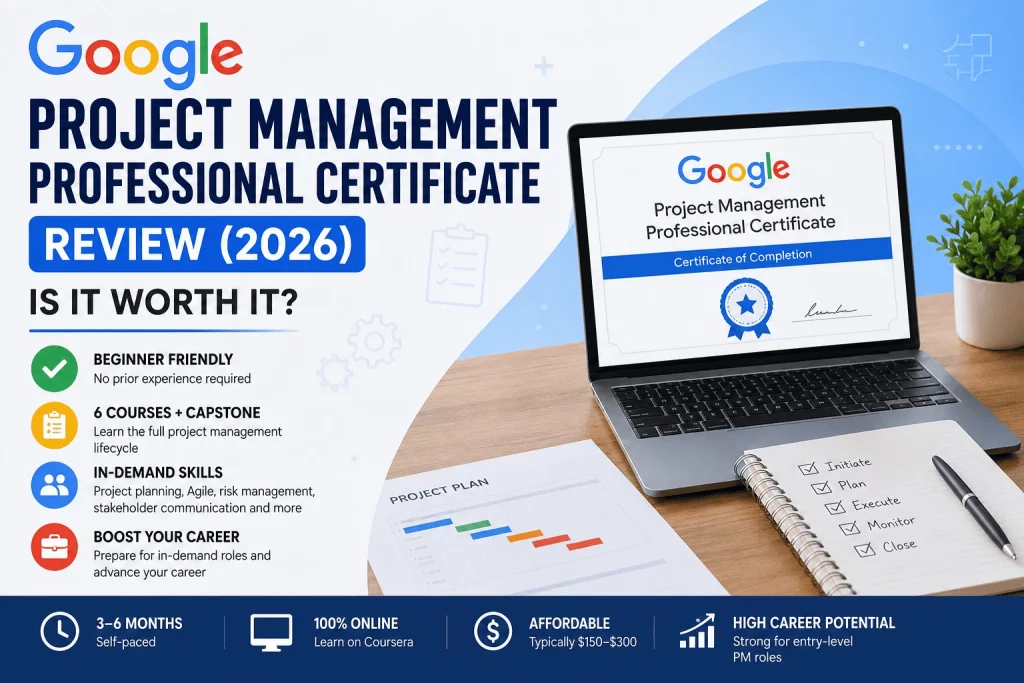
The Google Project Management Professional Certificate is a beginner-level, self-paced training program hosted on Coursera that walks learners through the entire project management lifecycle — from writing a charter to closing out a capstone project. Google built the program as part of its wider Career Certificates initiative, an effort to create low-cost, skills-first pathways into high-demand office careers that don’t require a four-year degree. The logic behind the program is simple: employers increasingly care about demonstrated competence, not just credentials, and project management happens to be one of the most transferable skill sets in the modern workplace.
Project management has stayed in demand because virtually every industry now runs on projects — software releases, marketing campaigns, construction builds, government initiatives, product launches. The Project Management Institute has repeatedly projected that millions of new project-oriented roles will need to be filled through the end of the decade, and organizations of every size are formalizing project coordination functions that used to be handled informally by whoever was available.
This certificate is aimed squarely at people with little or no formal project management background: career changers, recent graduates, administrative staff looking to move up, and government or corporate employees who already coordinate work informally and want the vocabulary and credibility to make it official. It is not designed for experienced project managers chasing a senior-level credential — that audience is better served by the PMP.
So, is it worth it in 2026? For the right audience — beginners who want a structured, affordable, and practical introduction to the discipline — yes, with realistic expectations. It won’t hand you a six-figure job on its own, but it is one of the most efficient on-ramps into the field that currently exists. The rest of this review breaks down exactly why, and for whom.
Quick Verdict
| Category | Verdict |
|---|---|
| Best For | Beginners, career changers, and administrative or coordination-adjacent professionals |
| Difficulty | Beginner-friendly; no prior experience or degree required |
| Duration | Roughly 3–6 months at 5–10 hours per week, self-paced |
| Cost | Typically $150–$300 total, depending on completion speed |
| Career Potential | Strong for entry-level and coordinator roles; limited for senior PM positions without additional experience |
| Beginner Friendly? | Yes — explicitly designed for people with zero project management background |
| Overall Rating | 4.4 / 5 for its intended audience |
What Is the Google Project Management Professional Certificate?
At its core, this is a six-course training program delivered through Coursera under Google’s Career Certificates umbrella. It was first launched in 2021 and has been periodically refreshed since, most notably with the addition of AI-assisted job search tools and updated Agile content to keep pace with how modern teams actually operate.
Program overview. The certificate walks learners through the full project lifecycle: initiating a project, planning it, executing it, monitoring it, and closing it out — followed by a dedicated Agile and Scrum course and a final capstone that ties everything together into a portfolio-ready case study.
Coursera partnership. Google doesn’t host the courses itself; it partners with Coursera to deliver the video lessons, readings, quizzes, and peer-reviewed assignments. This means access requires either a per-course subscription or a Coursera Plus subscription, though individual courses can often be audited for free if you only want to review the material without earning the credential.
Professional Certificate distinction. Unlike a single short course, this is a “Professional Certificate” — a structured, multi-course credential intended to represent job-readiness in a specific field, similar in spirit to Google’s other Career Certificates in data analytics, UX design, and IT support.
Self-paced learning. There are no live lectures or fixed deadlines. Learners move through video modules, readings, and assessments on their own schedule, which makes the program friendly to people working full-time jobs or juggling other responsibilities.
No experience required. Google designed the curriculum assuming zero prior exposure to project management. Terminology, frameworks, and tools are introduced from first principles, which is part of why it’s such a popular entry point for total beginners.
Who Should Take This Certificate?
Beginners. If you’ve never managed a project formally, this is built for you. Every concept is introduced from scratch, with plenty of real-world examples to anchor abstract ideas like scope creep or stakeholder mapping.
Government Employees. Public-sector workers who coordinate programs, budgets, or interagency initiatives often lack a formal PM credential even though they’re already doing the work. This certificate gives that experience a name and a paper trail, and the CAPM-eligible training hours can matter for future promotions or lateral moves.
Career Changers. For people leaving retail, hospitality, teaching, or the military, project management is one of the more accessible white-collar pivots because it rewards organizational and communication skills you likely already have.
Office Professionals. Anyone currently working in an operations, admin, or coordinator role can use this certificate to formalize skills they’re already using informally and make a case for a title change or raise.
Team Leaders. If you already lead a small team but never had formal PM training, the certificate fills in the structural gaps — risk registers, RACI charts, sprint planning — that experience alone doesn’t always teach.
Supervisors. Frontline supervisors managing schedules, budgets, and people will find the planning and stakeholder communication modules directly transferable to their day-to-day work.
Administrative Staff. Executive assistants and administrative coordinators frequently manage timelines and vendor relationships without the title of “project manager.” This certificate is a natural next step toward that title.
College Students. Students who want a practical, resume-ready credential alongside their degree — especially in business, communications, or IT programs — can complete this in a semester without much disruption to coursework.
Business Professionals. Analysts, marketers, and product-adjacent professionals who need to run cross-functional initiatives benefit from a shared vocabulary and framework for planning and reporting on that work.
Program Overview
| Category | Details |
|---|---|
| Provider | Google (Google Career Certificates) |
| Platform | Coursera |
| Level | Beginner |
| Duration | Roughly 3–6 months at 5–10 hours per week (self-paced) |
| Modules | 6 core courses, plus an optional AI-powered job search module |
| Certificate | Yes — shareable certificate and LinkedIn badge upon completion |
| Financial Aid | Yes — need-based aid available through Coursera on eligible courses |
Skills You’ll Learn
Project Planning. Breaking large objectives into scoped, sequenced tasks with clear deliverables and owners.
Scheduling. Building timelines, identifying dependencies, and using tools like Gantt charts to keep work on track.
Budgeting. Estimating costs, tracking spend against a baseline, and communicating variances to stakeholders.
Agile. Understanding iterative, flexible delivery models and when they outperform traditional planning approaches.
Scrum. Running sprints, standups, and retrospectives, and understanding the distinct roles of Scrum Master, Product Owner, and the development team.
Stakeholder Communication. Identifying who needs to be informed, consulted, or approved at each stage, and tailoring updates to their level of interest and influence.
Risk Management. Spotting potential problems early, scoring them by likelihood and impact, and building mitigation plans before they materialize.
Team Leadership. Motivating a team without formal authority over them — a core reality of most project manager roles.
Documentation. Producing the artifacts stakeholders and auditors expect: charters, status reports, retrospectives, and lessons-learned logs.
Change Management. Handling scope changes, shifting requirements, and organizational resistance without derailing a project’s timeline or budget.
Course Curriculum
The program is structured as six sequential courses, each building on the last.
Course 1 — Foundations of Project Management. This opening course introduces what project managers actually do across industries, the difference between “project” work and ongoing “operations,” and core terminology like scope, milestone, and deliverable. It also covers organizational culture and where project management fits inside it. Students finish this course understanding the PM role well enough to explain it to someone outside the field.
Course 2 — Project Initiation: Starting a Successful Project. Here, learners build the documents that kick off a real project: a project charter, a stakeholder analysis, and a RACI chart clarifying who is Responsible, Accountable, Consulted, and Informed. This is where abstract planning turns into a concrete, documented starting point.
Course 3 — Project Planning: Putting It All Together. The planning course covers building a full project plan — timelines, budgets, resource allocation, and quality standards — and introduces tools like work breakdown structures to organize complex work into manageable pieces.
Course 4 — Project Execution: Running the Project. This course focuses on keeping a project moving once it’s underway: tracking progress, managing changes to scope, resolving conflicts, and reporting status to stakeholders without losing momentum.
Course 5 — Agile Project Management. A deep dive into Agile philosophy and the Scrum framework specifically, including sprint planning, Scrum ceremonies, and Kanban as a visual alternative. The course also covers hybrid approaches that blend Agile with traditional, plan-driven methods — which is how most real organizations actually operate.
Course 6 — Capstone: Applying Project Management in the Real World. Rather than introducing new material, the capstone asks learners to apply everything they’ve learned to a sustained, realistic case study — following a fictional project from initiation through closeout. The final deliverable becomes a genuine portfolio piece you can show employers.
An optional seventh module, Accelerate Your Job Search with AI, was added later and focuses on using AI tools for resume writing, interview prep, and job searching specifically within project management.
What learners actually walk away with, course by course. By the end of Course 1, most learners can explain the difference between a project manager and a functional manager, describe the typical project lifecycle without notes, and identify which industries hire for PM roles. Course 2 leaves learners with an actual, usable project charter template and the confidence to run a first stakeholder meeting. Course 3 is often described as the most demanding of the six, since it requires synthesizing scope, schedule, budget, and quality planning into one coherent document — but it’s also the course that produces the most resume-ready artifact. Course 4 shifts the mindset from planning to execution, and this is where learners typically start to feel like they understand what a PM does on a daily basis: running standups, updating trackers, and having difficult conversations about scope changes. Course 5 tends to be the most conceptually dense, since Agile requires unlearning some of the linear thinking reinforced in Courses 1–3, but it’s also the course most directly tied to modern tech-industry hiring. Course 6, the capstone, is less about new content and more about proving you can hold the entire lifecycle in your head at once — which is exactly the skill employers are testing for in interviews.
Time investment by course. Based on learner reporting across several independent reviews, Course 1 typically takes 10–15 hours, Courses 2 and 3 run closer to 15–20 hours each given the volume of graded assignments, Course 4 is comparable to Course 1 at around 12–15 hours, Course 5 runs 15–18 hours due to the density of Agile and Scrum material, and the capstone in Course 6 can take anywhere from 15–25 hours depending on how much care you put into the final deliverable. Learners who treat the capstone as a résumé-defining artifact — rather than a box to check — consistently report better interview outcomes.
Project Management Methodologies
Agile. An iterative approach that breaks work into small increments, gathers feedback continuously, and adjusts direction as it goes. Best suited to projects where requirements are likely to change.
Scrum. A specific Agile framework built around fixed-length sprints, daily standups, and defined roles. It’s the most widely used Agile framework in software and product teams.
Waterfall. A linear, sequential approach where each phase — initiation, planning, execution, closing — finishes before the next begins. It works well when requirements are stable and predictability matters more than flexibility.
Kanban. A visual workflow system built around a board of columns (like “To Do,” “In Progress,” “Done”) and limits on how much work can be in progress at once. It’s popular for ongoing, continuous-flow work rather than fixed-length projects.
Lean. A methodology focused on maximizing value while minimizing waste — of time, resources, or effort. It originated in manufacturing but has since spread into software and service industries.
Choosing between them in practice. New project managers often assume they need to pick a single methodology and stick with it forever, but the certificate is careful to push back on that idea. In reality, most organizations run hybrid models: a construction firm might use Waterfall for permitting and physical sequencing while using Kanban to manage the internal punch-list of finishing tasks near project close. A software company might use Scrum for feature development while using a Waterfall-style plan for a major infrastructure migration with hard external deadlines. The certificate’s emphasis on hybrid approaches in Course 5 reflects this — it’s less about method loyalty and more about matching the framework to the constraints of a specific project: how firm are the requirements, how much does the client or sponsor need predictability, and how quickly does the team need to be able to change direction.
A note on certification bodies. Waterfall and general PM literacy map most closely to PMI’s CAPM and PMP credentials. Scrum specifically has its own certification ecosystem — Scrum.org’s PSM I and Scrum Alliance’s CSM — which go considerably deeper into facilitation mechanics than this certificate does. Learners who finish Course 5 and find Agile particularly compelling often use that as a signal to pursue one of those dedicated Scrum credentials next.
Tools Covered
Google Sheets for budgets, trackers, and basic data analysis. Google Docs for charters, meeting notes, and status reports. Google Slides for stakeholder presentations. Google Workspace broadly, since the program is built around tools most learners already have free access to. Beyond Google’s own suite, the curriculum also introduces industry-standard platforms: Jira for Agile and Scrum tracking, Asana and Trello for task and workflow management, and Smartsheet for spreadsheet-style project tracking at scale. Learners get hands-on practice with several of these so the certificate isn’t purely theoretical — it reflects the actual software stack many PM teams use day to day.
Why tool exposure matters for hiring. Job postings for coordinator and junior PM roles frequently list specific software by name — “experience with Jira or Asana preferred” is one of the most common lines in entry-level PM job descriptions. Having hands-on exposure to at least two or three of these tools, even at a beginner level, means you’re not walking into a new job needing to learn the interface from scratch. It also gives you something concrete to discuss in an interview when asked “what tools have you used to track a project?” — a question that trips up candidates who only have theoretical PM knowledge.
Where the certificate’s tool coverage is shallow. It’s worth being honest that a few hours inside Jira or Asana during a course module isn’t the same as months of daily use. Learners targeting software or product-heavy PM roles specifically often supplement this certificate with a short, focused Jira or Asana course to build real fluency, since technical hiring managers may probe deeper on tool-specific workflows than this program covers.
Real-World Projects
Across the six courses, learners work through several project scenarios designed to mirror actual workplace situations:
- Marketing Campaign — planning a product launch campaign with a fixed budget and deadline
- IT Project — coordinating a systems rollout with technical stakeholders
- Government Program — managing a public-sector initiative with compliance and multiple layers of approval
- Construction Project — sequencing physical work with hard dependencies and safety considerations
- Software Project — running an Agile sprint cycle for a product feature
- Product Launch — coordinating cross-functional teams (marketing, engineering, sales) toward a single release date
These scenarios matter because they force learners to apply frameworks to messy, realistic constraints rather than clean textbook examples.
Learning Roadmap
A typical progression for someone starting from zero looks like this:
Beginner → Google Project Management Certificate → Junior Project Coordinator → Project Manager → Senior Project Manager → Program Manager
Each step usually requires additional on-the-job experience, and many professionals layer on a PMI credential like CAPM or PMP as they move from “coordinator” toward “senior” titles.
Study Plan
7-Day Overview. Best suited to someone with significant free time or an existing PM background who wants a fast refresher — expect 3–4 hours a day focused almost entirely on Courses 1–2, with the rest of the program to follow.
14-Day Plan. A sprint-style pace of roughly 4–5 hours a day, moving through two courses every 2–3 days. Realistic only for learners who can treat this like a temporary full-time commitment.
30-Day Plan. A more sustainable full-time pace: about 2 hours a day, finishing one course roughly every five days, leaving time to actually absorb the material rather than rush the quizzes.
60-Day Plan. A comfortable part-time pace of around an hour a day, which lines up well with the “10 hours a week” estimate Google itself uses and gives ample time for the capstone project.
Most learners with a job and other obligations land somewhere between the 30-day and Google’s own 3–6 month estimate — the program rewards consistency far more than intensity.
Best Learning Resources
| Resource | Best For |
|---|---|
| Coursera | The official home of the certificate; best for structured, graded progress |
| Google Resources | Supplementary guides and career resources tied to the Career Certificates program |
| PMI | Best for learners planning to pursue CAPM or PMP after finishing this certificate |
| Udemy | Useful for cheap, narrow deep-dives on specific tools like Jira or Asana |
| LinkedIn Learning | Good for short refreshers on soft skills like negotiation and stakeholder management |
| YouTube | Free supplementary explanations, especially for visual learners struggling with a specific concept |
| Books | Best for learners who want theoretical depth beyond what a beginner course can offer |
Google Career Certificates Ecosystem
The Project Management certificate doesn’t exist in isolation — it’s one piece of a broader family of Google Career Certificates, and many learners pair it with a second credential to widen their job prospects. Data Analytics pairs well for PMs who want to speak the language of metrics and reporting. UX Design suits PMs working closely with product teams. Cybersecurity and IT Support are natural additions for PMs targeting technology-heavy industries. AI essentials have become increasingly popular as a companion certificate, since AI literacy is now expected in most coordination roles. Digital Marketing rounds things out for PMs interested in marketing or agency environments. Because all of these live on the same Coursera infrastructure, stacking two certificates back-to-back is a common and efficient strategy.
Atlas Project Management Framework™
A simple way to internalize the project lifecycle taught throughout the certificate:
Initiate → Plan → Execute → Monitor → Close
- Initiate — Define the problem, get stakeholder buy-in, and write the charter.
- Plan — Build the schedule, budget, resource plan, and risk register.
- Execute — Do the work, coordinate the team, and manage day-to-day changes.
- Monitor — Track progress against the plan and course-correct as issues emerge.
- Close — Confirm deliverables, document lessons learned, and formally hand off or archive the project.
This five-phase structure mirrors the traditional PMI lifecycle and underlies nearly every course in the certificate, even the Agile-focused ones.
Atlas PM Method Selection Guide™
A quick decision guide for choosing a methodology:
| If you need… | Choose |
|---|---|
| Flexibility to adapt as requirements change | Agile |
| A predictable, fixed schedule with stable requirements | Waterfall |
| Continuous delivery in fixed iterations | Scrum |
| A visual, flow-based workflow with WIP limits | Kanban |
In practice, most real organizations blend these — using Waterfall for high-level planning and Agile or Scrum for execution within individual teams.
Atlas Project Lifecycle™
Expanding on the five-phase framework:
Phase 1 — Initiation. Stakeholders align on the “why.” A charter defines scope, objectives, and success criteria. Poor initiation is the single most common root cause of failed projects, because it means the rest of the lifecycle is built on an unclear foundation.
Phase 2 — Planning. The project is broken into a work breakdown structure, sequenced into a timeline, and budgeted. Risks are identified and scored before work begins, not after something goes wrong.
Phase 3 — Execution. The plan meets reality. Tasks get assigned, work gets done, and the project manager spends most of their time here coordinating people rather than doing the technical work themselves.
Phase 4 — Monitoring & Controlling. Running in parallel with execution, this phase tracks actual progress against the baseline plan, flags variances early, and manages formal change requests.
Phase 5 — Closing. Deliverables are confirmed against the original scope, contracts and vendor relationships are closed out, and a retrospective captures what worked and what didn’t for the next project.
Atlas Stakeholder Matrix™
A simplified version of the stakeholder mapping tool taught in Course 2:
| Stakeholder | Influence | Interest |
|---|---|---|
| Executive Sponsor | High | High |
| Department Head | High | Medium |
| End Users | Low | High |
| External Vendor | Medium | Medium |
| Compliance/Legal | Medium | Low |
| General Staff | Low | Low |
Stakeholders in the high-influence, high-interest quadrant get the most frequent, detailed communication; low-influence, low-interest stakeholders get brief, infrequent updates so they’re informed without being overwhelmed.
Atlas Risk Assessment Matrix™
Probability × Impact = Priority
A basic risk sits on a scale from low to high on both axes:
| Low Impact | Medium Impact | High Impact | |
|---|---|---|---|
| High Probability | Medium priority | High priority | Critical priority |
| Medium Probability | Low priority | Medium priority | High priority |
| Low Probability | Low priority | Low priority | Medium priority |
Practical example: A key vendor missing a delivery deadline might be scored as medium probability, high impact — landing it in the “high priority” band, meaning it needs a documented mitigation plan (like a backup vendor) before the project even starts, not just a note to “keep an eye on it.”
Atlas Project Dashboard™
A sample dashboard layout mirroring what learners are asked to build during the capstone:
- Timeline — Gantt-style view of major milestones and current position against plan
- Budget — planned vs. actual spend, with variance highlighted
- Risks — top open risks, scored and color-coded by priority
- Tasks — current sprint or phase tasks with owners and due dates
- Status — a simple red/yellow/green health indicator with a one-line summary
- Team Progress — completion rate by team member or workstream
A dashboard like this is one of the most useful artifacts to bring into a job interview, since it demonstrates you can communicate project health at a glance.
Atlas Career Map™
Project Coordinator → Project Administrator → PM Assistant → Project Manager → Senior PM → Program Manager → Portfolio Manager
Most graduates of this certificate enter at the coordinator or administrator level, since those roles typically don’t require prior PM experience — just the vocabulary and frameworks the certificate provides. Progression from there depends heavily on accumulating real project experience, not additional certificates alone.
Typical timelines between stages. Moving from Project Coordinator to full Project Manager commonly takes one to three years of demonstrated delivery, often alongside a CAPM or PMP credential once you’re eligible. The jump from Project Manager to Senior PM typically requires leading progressively larger or higher-risk projects and often coincides with earning a PMP. Program Manager and Portfolio Manager roles — which involve overseeing multiple related projects or an entire portfolio of initiatives — usually require five-plus years of PM experience and a track record of managing budgets and teams at scale. None of this happens automatically from certificates alone; the credential opens the door, but the promotions come from delivered work.
Atlas Salary Growth™
Beginner → Intermediate → Senior → Director
Broadly, entry-level project coordinators in the U.S. earn in the $50,000–$65,000 range, mid-level project managers move into the $70,000–$100,000 range, senior project managers often land between $100,000 and $130,000, and directors of program or portfolio management can exceed $150,000. The U.S. Bureau of Labor Statistics has reported a median wage for project management specialists around the $100,000 mark, with meaningful variation by industry — finance and insurance tends to pay above that median, while some construction and manufacturing roles sit closer to it.
Atlas ROI Meter™
| Factor | Rating |
|---|---|
| Salary Growth | Strong — clear path from coordinator to senior PM salaries |
| Difficulty | Low — genuinely beginner-friendly |
| Cost | Low — typically $150–$300 total |
| Time Investment | Moderate — 3–6 months part-time |
| Job Demand | High — project management roles exist across nearly every industry |
| Overall ROI | High, especially relative to cost, for entry-level career changers |
Atlas Hiring Demand™
Project management roles show consistent demand across a wide range of industries: Government agencies coordinating public programs and infrastructure; Healthcare systems managing facility and technology projects; Banking and financial services running compliance and systems initiatives; IT departments delivering software and infrastructure projects; Construction firms sequencing physical builds; Manufacturing operations managing process improvements; and Consulting firms staffing client engagements. This breadth is one of the certificate’s biggest selling points — the skills transfer across sectors far more easily than most technical credentials.
Atlas Decision Matrix™
| Certificate | Best For |
|---|---|
| Google Project Management | Beginners wanting broad, cross-industry coordination skills |
| Google Data Analytics | Learners who want to work with data and reporting |
| Google Cybersecurity | Learners targeting security-specific technical roles |
| Google UX Design | Learners interested in product and design careers |
| Google AI | Learners who want foundational AI literacy alongside a practical skill |
For many career changers, Project Management pairs especially well with Data Analytics, since PMs are increasingly expected to interpret and report on project metrics.
Atlas Certification Roadmap™
Google AI Essentials → Google Project Management → Google Data Analytics → Google Business Intelligence → Google Cloud
This roadmap represents one common stacking strategy: start with broad AI literacy, add project management as a practical coordination skill, then layer on data and cloud credentials as your role becomes more technical over time.
Program Cost
Coursera subscription. Access to the certificate requires either a standalone monthly subscription (commonly around $49/month in the U.S. and Canada) or a Coursera Plus subscription that unlocks a much wider course catalog for a flat monthly or annual fee.
Free trial. New subscribers typically get a seven-day free trial, which is enough time to complete the first course or two if you move quickly.
Financial aid. Coursera offers need-based financial aid on eligible courses, which can reduce or eliminate the subscription cost for learners who qualify — it’s worth applying for before assuming the program is out of reach financially.
Time to complete. Google’s own estimate is under six months at roughly 10 hours per week, though motivated learners who study more intensively often finish in 8–12 weeks.
Total estimated cost. Most learners who complete the program within three to six months land in the $150–$300 range. Stretching completion out longer increases the total cost since it’s billed monthly, so finishing efficiently is the single biggest lever learners have over the final price.
Salary by Country
| Country | Average Annual Salary |
|---|---|
| USA | $65,000–$100,000 |
| Canada | CA$60,000–CA$85,000 |
| UK | £30,000–£45,000 |
| Australia | AU$75,000–AU$100,000 |
| Singapore | S$50,000–S$75,000 |
| Philippines | ₱400,000–₱700,000 |
These figures are broad, entry-to-mid-level ranges intended as a general guide — actual pay varies significantly by industry, company size, and local cost of living, so treat them as a starting point rather than a guarantee.
Job Opportunities
Graduates typically target entry-level and associate roles such as: Project Coordinator, Junior Project Manager, Operations Coordinator, PMO Analyst, Program Coordinator, and Business Operations Associate. These titles share a common thread — they involve scheduling, tracking, and communication responsibilities without requiring years of prior PM experience to get hired.
Hiring Companies
Google has built partnerships with a large employer consortium that considers Career Certificate graduates for open roles, and the certificate is broadly recognized well beyond that list. Companies commonly associated with hiring project coordination talent — either through the Google employer consortium or simply as large employers of PM talent generally — include Google, Accenture, IBM, Deloitte, Amazon, Microsoft, Oracle, and Capgemini. Being on an employer’s radar doesn’t guarantee an interview, but it does mean the credential is recognized rather than ignored during resume screening at these organizations.
How to actually use the employer consortium. Simply finishing the certificate doesn’t automatically route your resume to these companies — you generally still need to apply directly through each employer’s own careers page. The value of the consortium is more about signal than pipeline: recruiters at these companies have seen the certificate before, know what it represents, and are less likely to screen it out as an unfamiliar credential. Treat it as a door that’s easier to knock on, not one that opens automatically.
Beyond the named consortium. Small and mid-sized businesses, nonprofits, and government agencies are often more receptive to this certificate than large enterprises, simply because they’re less likely to require years of formal PM experience for coordinator-level hires. Many successful graduates land their first role at a company far smaller than the household names above, then use that experience to move toward larger employers later.
Pros
- Genuinely beginner-friendly with no prerequisites — you can start with zero background and follow along
- Low cost relative to university certificates or bootcamps, especially if you complete it efficiently
- Self-paced, fitting around full-time work, caregiving, or other study
- Covers both traditional (Waterfall) and Agile/Scrum methodologies, so you’re not one-dimensional in interviews
- Produces real portfolio artifacts (charter, risk register, dashboard, capstone case study) you can actually show employers
- Counts toward PMI’s CAPM eligibility requirements, giving you a natural next step
- Backed by a large employer consortium, which means recruiters at those companies are more likely to recognize the credential
- Strong ecosystem of complementary Google certificates, making it easy to stack additional skills later
- High volume of learner reviews and enrollment, which means troubleshooting content, study groups, and outside guides are easy to find
Cons
- Peer-graded assignments can be inconsistent in feedback quality and turnaround time, since you’re relying on other learners rather than instructors
- Entry-level focus means it won’t substitute for real PM experience in a competitive job search
- Ongoing Coursera subscription cost means procrastination directly increases the total price you pay
- Doesn’t carry the same prestige or recognition as PMP for senior or highly competitive roles
- Some content, especially in the early courses, can feel slow for learners who already have adjacent coordination or admin experience
- Tool coverage is introductory, not deep — you’ll need extra practice to be truly fluent in something like Jira
- Market saturation is a real consideration: because enrollment numbers are in the millions, the certificate alone won’t differentiate you the way it might have shortly after launch — pairing it with a strong capstone and real experience matters more each year
Is It Worth It?
For beginners with zero project management background, this is one of the most efficient, affordable ways to build a real foundation and walk away with tangible portfolio artifacts.
For career changers, the certificate is a credible signal to employers that you’ve made a deliberate, structured investment in the transition — especially paired with a portfolio project from your capstone.
For government employees, it formalizes skills many are already using informally and can support internal promotion cases or CAPM eligibility down the line.
For professionals already working adjacent to project coordination, it’s a relatively low-cost way to add a recognized credential to a resume that may currently lack one.
For students, it’s a practical complement to a degree, particularly for business, IT, or communications majors who want something concrete to show alongside academic coursework.
Where it’s not the right tool: if you’re already an experienced project manager, this certificate will feel redundant, and your time and money are better spent on PMP or an industry-specific credential.
Comparisons
Google Project Management vs PMP. PMP is the industry-standard credential for experienced PMs, but it requires several years of documented project experience and a several-hundred-dollar exam fee. The Google certificate is the on-ramp, not a substitute — many professionals complete Google’s program first, then work toward PMP once they have qualifying experience.
Google Project Management vs CAPM. These are more directly comparable, since both target early-career professionals. Completing the Google certificate contributes toward the training-hours requirement for CAPM eligibility, making the two a natural sequence rather than competitors.
Google Project Management vs PRINCE2. PRINCE2 is a more rigid, process-heavy methodology popular in the UK and parts of Europe, often required by specific employers or government contracts. Google’s certificate is broader and more U.S.-centric in its framing, with more emphasis on Agile.
Google Project Management vs Scrum Master. A dedicated Scrum Master certification (like PSM I or CSM) goes far deeper into Agile facilitation specifically. Google’s Course 5 gives a solid introduction to Scrum but isn’t a substitute for a standalone Scrum credential if you’re targeting Agile-heavy software teams.
Google Project Management vs Google Data Analytics. These serve different goals entirely — Project Management builds coordination and planning skills, while Data Analytics builds technical, tool-based data skills. They pair well together rather than competing for the same career outcome.
Side-by-side snapshot:
| Credential | Experience Required | Typical Cost | Best For |
|---|---|---|---|
| Google Project Management | None | $150–$300 | Absolute beginners |
| CAPM (PMI) | None (but benefits from training hours) | Exam fee plus prep materials | Early-career candidates wanting a PMI-branded credential |
| PMP (PMI) | Several years of documented PM experience | Several hundred dollars for the exam, plus PMI membership | Experienced PMs seeking the industry-standard senior credential |
| PRINCE2 | None, though often employer-mandated | Varies by training provider | Roles in the UK/Europe or government contracts requiring PRINCE2 specifically |
| PSM I / CSM (Scrum) | None | Varies by provider | PMs specializing in Agile software or product teams |
The practical takeaway: none of these credentials are strictly “better” in isolation — they’re built for different career stages. Google’s certificate is almost always the cheapest and fastest starting point, with PMI or Scrum-specific credentials layered on as your experience and specialization grow.
Common Mistakes
- Rushing modules just to hit a completion date, without absorbing the frameworks well enough to explain them in an interview
- Skipping hands-on projects and only watching videos, which leaves you without the portfolio artifacts that make the certificate valuable
- Ignoring Agile concepts because Waterfall feels more intuitive at first — Agile fluency is increasingly expected even in traditional industries
- Not completing the capstone properly, since it’s the single most valuable artifact for job applications
- Focusing only on videos instead of engaging with peer-reviewed assignments and discussion prompts, which is where the deeper learning actually happens
- Treating the certificate as the finish line rather than the starting point — the credential opens conversations, but it’s the artifacts and follow-up experience that actually get you hired
- Neglecting the discussion forums, which is where many learners find study partners, get unstuck on confusing concepts, and pick up tips on how graders evaluate assignments
- Letting the subscription lapse mid-program, which not only pauses progress but often means paying for another free-trial-adjacent month to restart momentum
- Never applying for financial aid despite qualifying, simply because the option isn’t prominently advertised during signup
Real-World Pacing Advice
A pattern worth naming explicitly: learners who set a hard deadline — a specific date they’ve told a friend, mentor, or accountability partner about — finish at dramatically higher rates than those who leave the timeline open-ended. Because the program has no external deadlines of its own, procrastination is the single biggest risk to completion, not the difficulty of the material. If you’re serious about finishing, pick one of the study plans in Section 12, put it on a calendar, and treat missed sessions the same way you’d treat missing a paid class — as something to make up, not skip.
One-Day-Before-Finishing Checklist
- ✓ Finish all remaining quizzes
- ✓ Complete and submit the capstone project
- ✓ Update your LinkedIn profile with the new skills and certificate
- ✓ Update your resume to reflect the credential and key artifacts produced
- ✓ Download and save your certificate file for future applications
30-Day Career Action Plan
Week 1 — Resume. Rewrite your resume around project management language: scope, stakeholders, timelines, risk mitigation — even if your prior job titles weren’t “project manager.”
Week 2 — LinkedIn. Update your headline and About section, add the certificate, and start engaging with project management content to build visibility in the space.
Week 3 — Portfolio. Package your capstone project and any supporting artifacts (charter, risk register, dashboard) into a simple portfolio you can share with a link or PDF.
Week 4 — Apply for jobs. Begin applying to coordinator and junior PM roles, using your capstone artifacts as talking points in cover letters and interviews.
Atlas Resume Booster™
On your resume: List it under a “Certifications” section as “Google Project Management Professional Certificate, Google/Coursera (2026),” and pull specific skills (Agile, stakeholder management, risk assessment) into your bullet points under relevant past roles, even if those roles didn’t formally carry a PM title.
On LinkedIn: Add it under the “Licenses & Certifications” section, attach the shareable certificate link, and mention it in your headline if project management is the direction you’re pursuing.
On government applications: Reference the specific number of training hours it qualifies toward PMI credentials, since many public-sector applications value quantifiable training hours over brand-name recognition alone.
On an online portfolio: Create a dedicated case-study page for your capstone project, walking through the charter, plan, execution challenges, and final outcome — this does more to convince a hiring manager than the certificate title alone.
Atlas Interview Preparation™
Common interview questions you should be ready for include: “Walk me through how you’d initiate a new project,” “How do you handle a stakeholder who keeps changing requirements?”, and “What’s your approach to identifying and managing risk?”
Behavioral questions often follow the format “Tell me about a time you managed competing priorities” or “Describe a project that didn’t go as planned and what you did about it” — draw directly from your capstone or any real coordination work you’ve done, even informally.
Project management scenarios may include being handed a mini case study on the spot and asked to outline a plan, identify risks, or explain how you’d communicate a delay to a stakeholder. Practicing the Atlas Project Management Framework (Initiate → Plan → Execute → Monitor → Close) as a mental checklist helps structure answers quickly under interview pressure.
Atlas Portfolio Builder™
A strong beginner portfolio built from certificate coursework should include:
- Project Charter — a one-page document defining scope, objectives, and success criteria for a sample project
- Risk Register — a scored list of potential risks with mitigation plans
- Timeline — a Gantt-style schedule showing major milestones and dependencies
- Budget Plan — a simple planned-vs-actual budget tracker
- Stakeholder Matrix — an influence/interest map like the one in Section 18
- Lessons Learned — a short retrospective summarizing what worked, what didn’t, and what you’d do differently
Packaging these into a single shareable document or simple webpage turns coursework into tangible proof of capability — far more persuasive to a hiring manager than the certificate title alone.
Frequently Asked Questions
Is Google Project Management worth it? For beginners and career changers, yes — it’s an affordable, structured, and practical introduction to the field, though it works best combined with real project experience.
Is it beginner friendly? Yes, it’s explicitly designed for learners with no prior project management background.
How much does it cost? Typically $150–$300 total, depending on how quickly you complete it and which subscription option you choose.
Can I finish in one month? Yes, at an intensive pace of roughly 2 hours a day, though a more sustainable pace over 3–6 months is what Google itself recommends.
Is Coursera required? Yes, the certificate is delivered exclusively through Coursera.
Does Google hire graduates? Google is part of the employer consortium that considers Career Certificate graduates, alongside many other participating companies, though completion doesn’t guarantee an interview or offer.
Is it recognized? Yes, it’s broadly recognized by employers as evidence of structured PM training, particularly for entry-level roles, though it doesn’t carry the same weight as PMP for senior positions.
Can government employees benefit? Yes — many use it to formalize existing informal coordination experience and to work toward PMI training-hour requirements.
Can I get financial aid? Yes, Coursera offers need-based financial aid on eligible courses within the program.
Is it better than PMP? They serve different purposes — PMP is for experienced PMs seeking a senior-level credential, while Google’s certificate is an entry-level on-ramp for beginners.
Do I need a degree to enroll? No. The program is explicitly built to require no prior degree or experience — anyone can enroll directly through Coursera.
Does the certificate expire? No, the certificate itself doesn’t expire once earned, though the skills and tools referenced (like specific software versions) will naturally evolve over time.
How is the coursework graded? Through a mix of auto-graded quizzes and peer-reviewed assignments, where fellow learners assess your submitted artifacts against a rubric.
Is peer review reliable? It’s generally serviceable for a beginner program, though feedback quality and turnaround time vary since it depends on other learners’ engagement, not professional instructors.
How does it compare to a bootcamp? Bootcamps are typically more intensive, more expensive, and often include live cohorts or job placement support; this certificate is slower-paced, self-directed, and considerably cheaper.
Can I use it for freelance project management work? Yes — many freelancers use the certificate to formalize their skill set when pitching clients, though freelance work also depends heavily on referrals and a visible portfolio.
Will it help me get promoted internally? It can, particularly at organizations that value demonstrated training, but internal promotion still typically depends on performance and manager advocacy alongside the credential.
Does it teach specific software certifications, like a Jira credential? No — it introduces tools like Jira, Asana, and Trello at a working-familiarity level, not to the depth of a vendor-specific certification.
Can I complete it entirely on mobile? Yes, Coursera’s mobile app supports video lessons and many assignment types, though longer written assignments are easier to complete on a desktop.
Is there a proctored final exam? No. There’s no single high-stakes exam; assessment happens continuously through course-level quizzes and the capstone project.
How long does the certificate stay relevant on a resume? Indefinitely as a training credential, though hiring managers increasingly weigh it alongside actual project experience the longer you’re in the workforce.
Can I skip courses if I already have experience? The courses build sequentially and Google recommends completing them in order, but experienced learners often move through the early, more foundational courses more quickly.
Is the capstone project graded by Google employees? No — like other assignments, it’s assessed through structured peer review against a detailed rubric, not by Google staff directly.
Does completing the certificate guarantee a job interview? No. It signals training and initiative, but it doesn’t guarantee interviews or offers from any specific employer, including those in Google’s partner network.
Is it available in languages other than English? Yes, Coursera offers the program with subtitles and translated materials in several languages, though availability can vary by course.
What happens if I stop paying my Coursera subscription mid-program? Your progress is generally saved, and you can resume once you resubscribe, though you won’t have active access to new lessons while unsubscribed.
Is this the same as a PMI certification? No — it’s a Google-branded, Coursera-hosted certificate. It is recognized by PMI as contributing toward CAPM training-hour requirements, but it is not itself a PMI credential.
Can this certificate help outside the U.S.? Yes, though recognition and hiring impact vary by country and local labor market norms — it tends to carry more direct weight in the U.S. and Canada, where the employer consortium is concentrated.
Is there a mobile-only version of the certificate at a lower price? No, pricing is tied to the Coursera subscription model regardless of device, though promotional discounts occasionally appear.
Atlas Project Management Toolkit™
One thing most reviews of this certificate skip: a simple, reusable reference of the actual templates the program trains you to build. Bookmark this table — it doubles as a checklist for your own portfolio (see Section 40) and as a quick refresher any time you start a new project after finishing the certificate.
| Template | Purpose |
|---|---|
| Project Charter | Define project scope, objectives, and success criteria before any work begins |
| Risk Register | Track identified risks, their probability, impact, and mitigation plans |
| Stakeholder Register | Identify every stakeholder and their level of influence and interest |
| Communication Plan | Decide who gets updates, how often, and through which channel |
| Gantt Chart | Visualize the project schedule, milestones, and task dependencies |
| Meeting Minutes | Document decisions, action items, and owners from every key meeting |
| Lessons Learned | Capture what worked and what didn’t at project close, for the next project |
How to use this toolkit in practice. Each of these templates maps directly to a specific course in the certificate — the Charter and Stakeholder Register come out of Course 2, the Gantt Chart and Communication Plan out of Course 3, Meeting Minutes out of Course 4, and the Lessons Learned document out of Course 6’s capstone. Keeping blank, reusable versions of all seven on hand means that the next time you’re handed a project — in class, at work, or as a volunteer coordinator — you’re not starting from a blank page. Employers and interviewers respond well to candidates who can produce a real example of each of these on request, since it signals the certificate translated into an actual working habit rather than just a line on a resume.
A simple way to sequence them on a new project. Start with the Stakeholder Register and Project Charter together, since you can’t finalize scope without knowing who needs to weigh in on it. Once scope is locked, build the Gantt Chart and Communication Plan in parallel — the schedule tells you what’s happening and when, and the plan tells you who needs to hear about it. The Risk Register should be drafted alongside the schedule, not after, since risks are easiest to catch before a timeline is finalized. Meeting Minutes then run continuously throughout execution, and the Lessons Learned document closes things out once the project wraps.
Conclusion
The Google Project Management Professional Certificate earns its reputation as one of the most practical, low-risk ways to break into project management. It’s best suited to beginners, career changers, administrative professionals, and government employees who want structured training without the time or cost of a traditional degree program. It won’t replace real-world experience or compete with PMP for senior roles, but as an entry point, it consistently delivers relevant skills, portfolio-ready artifacts, and a credential employers recognize.
Career opportunities skew toward coordinator and junior PM roles initially, with a clear path toward senior project management and program management as real project experience accumulates. Salary potential starts modestly at the entry level but scales meaningfully with experience and additional credentials like CAPM or PMP.
The best study strategy is consistency over intensity — a steady 5–10 hours a week over three to six months, with real attention paid to the hands-on assignments and capstone rather than just the videos. Do that, and the final recommendation is straightforward: for the audience it was built for, the Google Project Management Professional Certificate is a smart, affordable investment in 2026.
Related Guides
- Microsoft Certifications Guide (2026): The Complete Certification Roadmap
- AI-900 Review (2026): Is Azure AI Fundamentals Worth It?
- AZ-104 Microsoft Azure Administrator Review (2026): Is It Worth It?
- Azure Certifications Guide (2026): The Complete Azure Certification Roadmap
- Free Online Courses for Skill Upgrade in 2026: The Complete Global Guide
- Best Time Management Courses in 2026 (For Government Employees & Professionals)
- Google AI Essentials Review (2026): Everything You Need to Know Before You Enroll
- Google AI Professional Certificate: The Complete 2026 Review
- Google Data Analytics Professional Certificate: The Complete Review
- Google Cybersecurity Professional Certificate Review (2026): Is It Worth It?
- Google IT Support Professional Certificate Review (2026): Is It Worth It?
- Google UX Design Professional Certificate Review (2026): Is It Worth It?
- Google Digital Marketing & E-commerce Professional Certificate Review: Is It Worth It
- AWS Certified Developer Associate (DVA-C02): The Complete 2026 Guide
- AWS Certified Cloud Practitioner (2026): Complete Certification Guide
- AWS Certifications Guide (2026): The Complete AWS Certification Roadmap